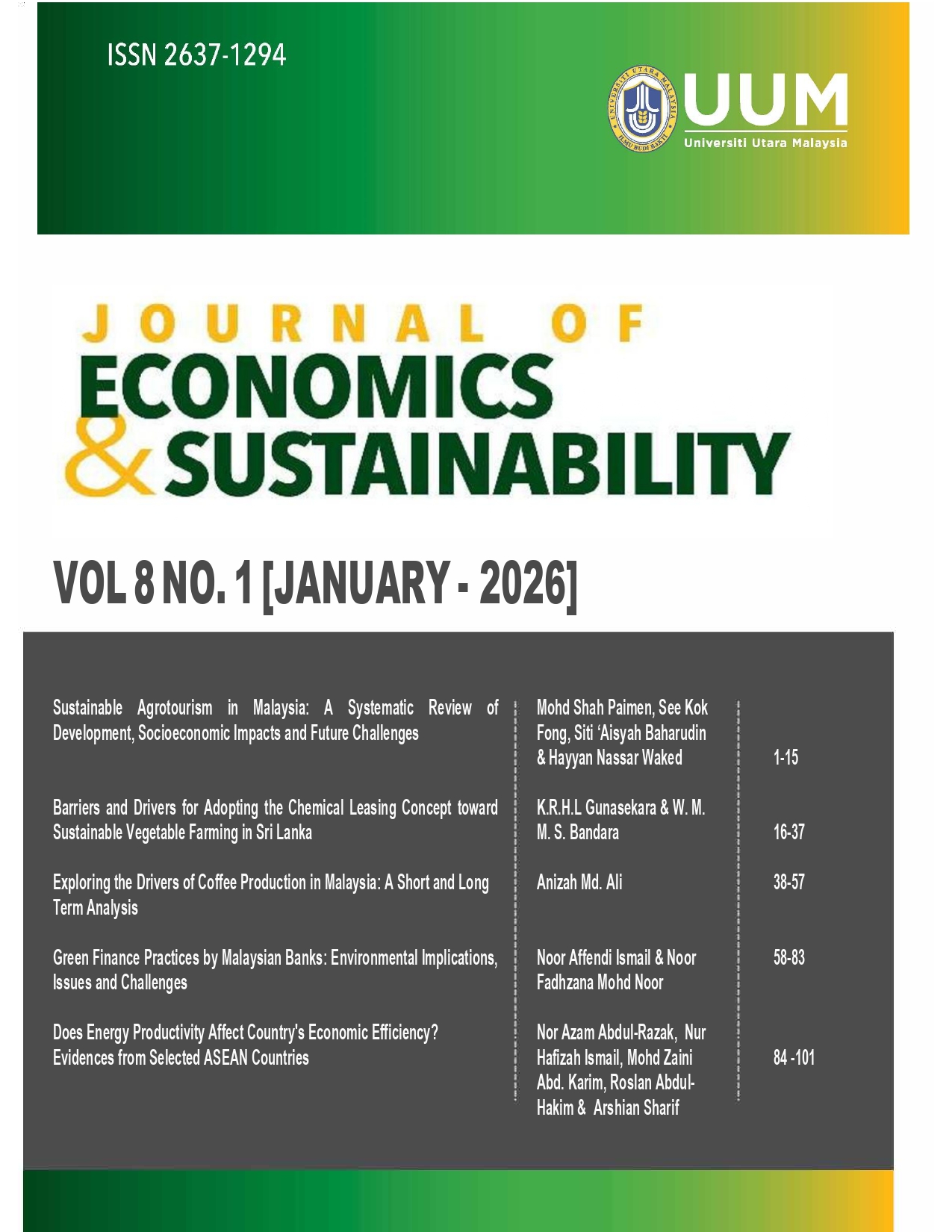
Exploring the Drivers of Coffee Production in Malaysia: A Short- and Long-Term Analysis

Pengarang

  • Anizah Md Ali Universiti Utara Malaysia, Malaysia

DOI:

https://doi.org/10.32890/jes2026.8.1.3

Kata kunci:

ARDL, coffee, long run, production response, short run

Abstrak

Coffee demand in Malaysia has shown an increasing trend; however, domestic production remains relatively low and unstable. This study examines the short-term and long-term effects of selected macroeconomic variables on coffee production in Malaysia using secondary data from 1982 to 2023 and the Autoregressive Distributed Lag (ARDL) approach. The results indicate that, in the long run, climate conditions (proxied by rainfall) and population growth are the main positive drivers of coffee production, reflecting the importance of favourable weather and growing domestic demand. In contrast, cultivated land area and cocoa prices are negatively associated with coffee production, suggesting land-use constraints and crop substitution effects. In the short run, government expenditure and rainfall exert positive influences on output, highlighting the role of policy support and climatic conditions during early adjustment periods. Lagged effects of past production, land use, cocoa prices, and government expenditure also contribute positively, indicating that historical decisions and investments continue to shape current production outcomes. However, adverse weather conditions in previous periods negatively affect yields, underscoring the vulnerability of coffee production to climatic extremes. Overall, the findings suggest that while targeted policy support can facilitate short-term production responses, the long-term sustainability and growth of Malaysia’s coffee sector depend primarily on climate resilience, efficient land use, and demand-driven factors. Strengthening adaptive capacity, improving productivity, and enhancing value-chain efficiency are therefore essential to improve competitiveness and support sustainable development of the coffee industry.
Rujukan

Aipi, B. (2012). Supply response of coffee in Papua New Guinea. Bank of Papua New Guinea. https://www.researchgate.net/publication/265554341.

Akintunde, Y. W., Adesope, A. A. A., & Okoruwa, V. O. (2013). An analysis of federal government expenditure and monetary policy on agricultural output in Nigeria. International Journal of Economics, Finance and Management Sciences, 1(6), 310–317. https://doi.org/10.11648/j.ijefm.20130106.17

Anigbogu, T. U., Agbasi, O. E., & Okoli, I. M. (2015). Socioeconomic factors influencing agricultural production among cooperative farmers in Anambra State, Nigeria. International Journal of Academic Research in Economics & Management Sciences, 4(3). http://dx.doi.org/10.6007/IJAREMS/v4-i3/1876. Abu Hassan Asari, F. F., Abd Rahman, N. H., Abdul Razak, E. A., Shabir Ahmad, B. A., Harun, N. F.

A., & Jusoff, K. (2011). A time series analysis of the relationship between total area planted, palm oil price and production of Malaysian palm oil. World Applied Sciences Journal, 12(Special Issue on Bolstering Economic Sustainability), 34–40. https://www.researchgate.net/publication/295460953_A_time_series_analysis_of_the_relations hip_between_total_area_planted_palm_oil_price_and_production_of_Malaysian_palm_oil.

Askari, H., & Cummings, J. T. (1977). Estimating agricultural supply response with the Nerlove model: A survey. International Economic Review, 18(2), 257–291.

Astro Awani. (2023, Oktober 1). Malaysia antara peminum kopi terbanyak di Asia Pasifik. Astro Awani. https://www.astroawani.com/gaya-hidup/malaysia-antara-peminum-kopi-terbanyak-diasia-pasifik-439763.

Barlow, T. (2023, May 22). Arabica vs Robusta Coffee: In-depth guide to taste & quality. Majesty Coffee. https://majestycoffee.com/blogs/posts/arabica-vs-robusta-coffee.

Bashir, M. S., & Yuliana, E. (2019). The influence of wetland area and urban population on rice production in Indonesia. Journal of Agricultural Economics, 7(1), 101–110.

Bernama. (2025, Januari 5). Harga biji kopi meningkat, penggemar ubah selera pilih alternatif. Berita Harian. https://www.bharian.com.my/bisnes/lain-lain/2025/01/1345270/harga-biji-kopimeningkat-penggemar-ubah-selera-pilih-alternatif.

Bernama. (2025, Januari 20). Budaya ‘cafe hunting’ - Darul Kopi. Tinta Minda. https://www.bernama.com/bm/tintaminda/news.php?id=2381055.

Brown, R. L., Durbin, J., & Evans, J. M. (1975). Techniques for testing the constancy of regression relationships over time. Journal of the Royal Statistical Society: Series B (Methodological), 37(2), 149–192.

Cleaver, K. M. (1985). The impact of price and exchange rate policies on agriculture in Sub-Saharan Africa. World Bank Staff Working Papers, No. 728.

Dawuda Rasheed, & Appiah, S. K. (2023). Vector autoregressive model of maize production in Northern Region of Ghana. Asian Journal of Agricultural Extension, Economics & Sociology, 41(11), 299–311. https://doi.org/10.9734/AJAEES/2023/v41i112287

Department of Agriculture (DOA). (2016). Industrial crops statistics Malaysia 2016. Jabatan Pertanian, Putrajaya, Malaysia.

Department of Agriculture (DOA). (2019). Industrial crops statistics Malaysia 2019. Jabatan Pertanian, Putrajaya, Malaysia.

Department of Agriculture (DOA). (2020). Industrial crops statistics Malaysia 2020. Jabatan Pertanian, Putrajaya, Malaysia.

Department of Agriculture (DOA). (2021). Industrial crops statistics Malaysia 2021. Jabatan Pertanian, Putrajaya, Malaysia.

Department of Agriculture (DOA). (2022). Industrial crops statistics Malaysia 2022. Jabatan Pertanian, Putrajaya, Malaysia.

Department of Agriculture (DOA). (2023). Industrial crops statistics Malaysia 2023. Jabatan Pertanian, Putrajaya, Malaysia.

Department of Statistics (DOSM). (2021). Planted Area and Production of Selected Industrial Crops, Malaysia (2001-2019) [Data set]. Data.gov.my. Retrieved from https://archive.data.gov.my/data/dataset/planted-area-and-production-of-selected-industrialcrops-malaysia.

Diakosavvas, D. (1990). Government expenditure and agricultural performance in developing countries: A cross-country analysis. Journal of Agricultural Economics, 41(1), 43–52.

Egwuma, H., Mad Nasir, S., Zainalabidin M., Nitty Hirawaty K., & Wong, K.K.S. (2016). A model for the palm oil market in Negeria: An Econometrics approach. International Journal of Food and Agricultural Economics Vol.4 No.2, 2016, pp.69-85.

Engle, R.F., & Granger, C.W.J. (1987). Co-Integration and Error Correction: representation, estimation and testing. Econometrica. 55, 251-276.

Granger, C.W.J. (1983). Cointegrated variables and error correcting models. Unpublished University of California, San Diego. Discussion paper pp.83-113.

Gujarati, D. N., & Porter, D. C. (2009). Basic econometrics (5th ed.). McGraw-Hill.

Hakorimana, F., & Akcaoz, H. (2019). The relationship between coffee and climate factors: Case of Rwanda. Turkish Journal of Agriculture - Food Science and Technology, 7(9), 1367–1376. https://doi.org/10.24925/turjaf.v7i9.1367-1376.2639

Hegena, A., & Teshome, A. (2022). Land allocation and its effect on vegetable marketing in Ethiopia. African Journal of Agricultural Economics and Rural Development, 10(2), 42–49.

Iganiga, B. O., & Unemhilin, D. O. (2011). The impact of federal government agricultural expenditure on agricultural output in Nigeria. Journal of Economics, 2(2), 81–88.

Infopertanian. (2025, Februari 16). Bagaimana dengan usahawan kopi di Malaysia? Adakah bantuan kewangan turut ditawarkan oleh kerajaan? Infopertanian. https://www.infopertanian.com/2025/02/16/bagaimana-dengan-usahawan-kopi-di-malaysiaadakah-bantuan-kewangan-turut-ditawarkan-oleh-kerajaan/.

Jabatan Pertanian. (2021). Laporan tahunan 2020 (Edisi Pertama). Kementerian Pertanian dan Industri Makanan. https://www.doa.gov.my/doa/resources/aktiviti_sumber/sumber_awam/penerbitan/laporan_tahu nan/laporan_tahunan_DOA_2020.pdf

Josephson, A. L., Ricker-Gilbert, J., & Florax, R. J. G. M. (2014). How does population density influence agricultural intensification and productivity? Food Policy, 48, 142–152.

Kakar, Z., Khilji, B. A., & Khan, M. K. (2016). Impact of cultivated area on agriculture production in Pakistan. International Journal of Economics and Empirical Research, 4(5), 253–259.

Karanja, A. M., Nyoro, J. K., & Mugambi, D. (2002). Coffee prices and farmers’ response in Kenya. African Economic Research Consortium (AERC).

Khatibu, S. M., Kazungu, C. M. M., & Ondieki, C. M. M. (2016, September). Supply response and production trends of the Arabica coffee: A case study of the small holdings of Kiambu County between 2004 and 2014. Researchjournali’s Journal of Economics. https://researchjournali.com/view.php?id=3144.

Kierczyńska, S. (2019). Factors influencing the price and yield of red currants in Poland. Acta Scientiarum Polonorum Hortorum Cultus, 18(1), 109–118. https://ageconsearch.umn.edu/record/330070/files/KIERCZYNSKA.pdf.

MacKay, A. D., Morrissey, O., & Vaillant, C. (1998). Aggregate export and food crop supply response in Tanzania (CREDIT Research Paper No. 98/4). Centre for Research in Economic Development and International Trade (CREDIT), University of Nottingham. https://www.econstor.eu/bitstream/10419/81813/1/98-04.pdf.

Mahanum Abdul Aziz. (2024, Julai 29). Budaya ‘kafe’ hidupkan semula industri kedai kopi di Malaysia. Berita Harian. https://www.bharian.com.my/bisnes/lainlain/2024/07/1277837/budaya-kafe-hidupkan-semula-industri-kedai-kopi-di-malaysia.

Mohd Nawi, H. (2025, Februari 12). Kenali sejarah kopi tempatan. Harian Metro. https://www.hmetro.com.my/kenali-sejarah-kopi-tempatan.

Msuya, A. M. (2013). Impact of climate variability on coffee production and farmers’ coping and adaptation strategies in highlands of Kigoma District, Tanzania [Master’s dissertation, Sokoine University of Agriculture] https://www.suaire.sua.ac.tz/handle/123456789/XXXXX.

Mundlak, Y. (2001). Production and supply. In B. L. Gardner & G. C. Rausser (Eds.), Handbook of Agricultural Economics (Vol. 1A). Elsevier.

Nchare, A. (2007). Analysis of factors affecting the technical efficiency of Arabica coffee producers in Cameroon. African Economic Research Consortium. https://aercafrica.org.

Nerlove, M. (1958). The dynamics of supply: Estimation of farmers’ response to price. The Johns Hopkins University Press.

Niazi, M. A., & Farooq, U. (2018). Supply response of Basmati rice in Pakistan. Sarhad Journal of Agriculture. PARC Institute of Advanced Studies in Agriculture. https://www.researchgate.net/publication/337490979_Supply_Response_of_Basmati_Rice_in_ Pakistan.

Ojiya, E. A., Okoh, A. S., Mamman, A. B., & Chukwuemeka, N. J. (2017). An Empirical Analysis of the Effect of Agricultural Input on Agricultural Productivity in Nigeria. International Journal of Agricultural Science and Food Technology, 3(4), 77–85. https://doi.org/10.17352/2455815X.000026.

Onwusiribe, N. C., Mbanasor, J. A., & Oteh, O. U. (2022). Dynamics of coffee output in Nigeria. Gestão & Produção, 29, e7621. https://doi.org/10.1590/1806-9649-2022v29e7621.

Osuagwu, E. S. (2020). Agricultural productivity and government expenditure in Nigeria: An empirical analysis (1982–2017). Journal of Development and Agricultural Economics, 12(3), 95–102.

Pesaran, M. H., Shin, Y., & Smith, R. (1996). Testing for the existence of a long run relationship (No. 9622). Faculty of Economics, University of Cambridge.

Pesaran, M. H., Shin, Y., & Smith, R. J. (2001). Bounds testing approaches to the analysis of level relationships. Journal of Applied Econometrics, 16(3), 289–326. https://doi.org/10.1002/jae.616.

Phiri, H. (2018). Public expenditure and agricultural productivity in Uganda. African Journal of Economic Review, 6(1), 34–48.

Pitt, M. M., & Rosenzweig, M. R. (1986). Agricultural prices, food consumption, and the health and productivity of Indonesian farmers. World Bank Economic Review, 1(1), 1–27.

Rozlaily Zainol. (2023). Hala tuju penyelidikan dan pembangunan tanaman kopi di Malaysia. Buletin Teknologi MARDI, 37, 147–158.

Salifou, I., Dedehouanou, H., & Affognon, H. (2019). Cocoa and coffee price volatility and its impact on yield in West Africa. International Journal of Agricultural Research, 14(1), 23–31.

Salim, M. A., Hossain, M. T., & Chowdhury, M. A. (2020). Rainfall, flood, and agricultural productivity in Bangladesh. Environmental Research and Public Health, 17(22), 1–15.

Tambi, M. D. (2023). Determinants of coffee production in Melong Coffee Zone, Cameroon. Journal of Economic and Social Development – Resilient Society, 10(1), 1–13. https://www.jesdonline.com/articles/determinants-of-coffee-production-in-melong-coffee-zone-cameroon.pdf.

Tenaye, A. (2020). New evidence using a dynamic panel data approach: Cereal supply response in smallholder agriculture in Ethiopia. Economies, 8(3), 85. https://doi.org/10.3390/economies8030085.

The Editors of Encyclopaedia Britannica. (2025, June 11). Coffee: Origin, types, uses, history, & facts. In Encyclopædia Britannica. Retrieved June 18, 2025, from https://www.britannica.com/topic/coffee.

Tradeimex. (2025, February 12). Top 10 coffee producing countries in the world: Global coffee producers. https://www.tradeimex.in/blogs/top-10-coffee-producing-countries-global-.

U.S. Department of Agriculture, Foreign Agricultural Service. (2025). Production – Coffee. https://fas.usda.gov/data/production/commodity/coffee.

Utusan Malaysia. (2021, Oktober 1). Kerajaan peruntuk RM4.5 juta bangunkan industri tanaman kopi. https://www.utusan.com.my/berita/2021/10/kerajaan-peruntuk-rm4-5-juta-bangunkan-industritanaman-kopi/.

Wagner, S., Jassogne, L., Price, E., Jones, M., & Preziosi, R. (2021). Impact of climate change on the production of Coffea arabica at Mt. Kilimanjaro, Tanzania. Agriculture, 11(1), 53. https://doi.org/10.3390/agriculture11010053.

Wahab, M. A. M. A., & Nor, N. A. M. M. (2016, January 12). Exploring the potentials of coffee industry in Malaysia. Malaysian Agricultural Research and Development Institute (MARDI). https://ap.fftc.org.tw/article/1005.

Wickramaarachchi, N. C., & Weerahewa, J. (2018). Relationship between land size and productivity: Empirical evidence from paddy farms in irrigation settlements of Sri Lanka. Sri Lanka Journal of Economic Research, 5(2), 125–142. https://sljer.sljol.info/articles/52/files/submission/proof/52-1-110-1-10-20200713.pdf.

Widyawati, R. F., Suliswanto, M. S. W., Febriana, H., & Abbas, M. H. I. (2024). The effect of land area and labor on production of coffee in Indonesia. KnE Social Sciences, 2024, 1114–1126. https://www.researchgate.net/publication/382762775_The_Effect_of_Land_Area_and_Labor_o n_Production_of_Coffee_in_Indonesia.

Wong, K.K.S., & Mohammad Yusof, A. (2017). Factor influencing Malaysian palm oil export demand in long run and short run. International Journal of Business and Management. 1 (2): 204–210.

World Bank. (2025). World Bank commodities price data (The Pink Sheet). https://thedocs.worldbank.org/en/doc/2e049bb3e347494a9a3b7b0c449cbb770350012023/original/CMO-Pink-Sheet.xlsx.

World Bank. (2025). Climate Change Knowledge Portal. Malaysia - Climatology (CRU) | Climate Change Knowledge Portal.

Xaba, B. G., Masuku, M. B., & Vilane, B. R. T. (2013). Factors affecting the productivity and profitability of vegetables production in Swaziland. Journal of Agricultural Studies, 1(2), 37–52. https://scispace.com/pdf/factors-affecting-the-productivity-and-profitability-of-581qfug4la.pdf.

Xie, Y., Zhou, Y., & Deng, Z. (2020). Land consolidation and agricultural productivity in China: A temporal analysis. Land Use Policy, 92, 104470. https://www.sciencedirect.com/science/article/abs/pii/S0264837720300119

Yan, J., Chen, C., & Hu, B. (2019). Farm size and production efficiency in Chinese agriculture: Output and profit. China Agricultural Economic Review, 11(1), 20–38. https://doi.org/10.1108/CAER-05-2018-0082.

Ye, F., Yang, Z., Yu, M., Watson, S., & Lovell, A. (2023). Can Market-Oriented Reform of Agricultural Subsidies Promote the Growth of Agricultural Green Total Factor Productivity? Empirical Evidence from Maize in China. Agriculture, 13(2), 251. https://doi.org/10.3390/agriculture13020251.

Zhi, Q., & Wong, L. H. (2020). The impact of government expenditure on Malaysian agricultural productivity: A threshold regression analysis. Malaysian Journal of Economic Studies, 57(2), 101–118.

Diterbitkan

2026-01-31

Cara Memetik

Md Ali, A. (2026). Exploring the Drivers of Coffee Production in Malaysia: A Short- and Long-Term Analysis. Journal of Economics and Sustainability, 8(1), 38-57. https://doi.org/10.32890/jes2026.8.1.3

Artikel yang paling banyak dibaca oleh pengarang yang sama




