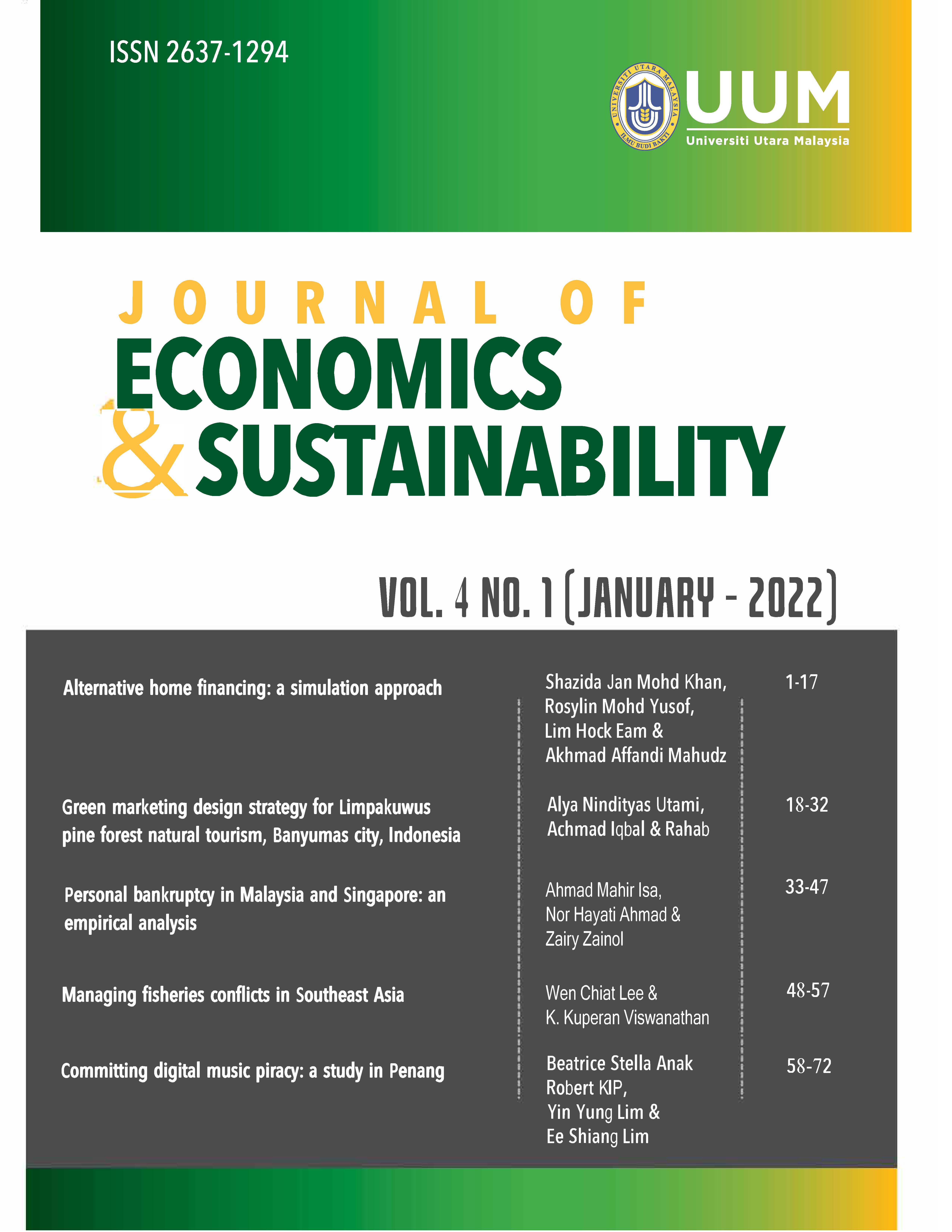
Alternative Home Financing: A Simulation Approach

Pengarang

  • Shazida Jan Mohd Khan Economic & Financial Policy Institute (ECoFI), School of Economics, Finance and Banking, Universiti Utara Malaysia, Malaysia
  • Rosylin Mohd Yusof Othman Yeop Graduate School, Universiti Utara Malaysia, Malaysia
  • Hock Eam Lim Economic & Financial Policy Institute (ECoFI), School of Economics, Finance and Banking, Universiti Utara Malaysia, Malaysia
  • Akhmad Affandi Mahudz ZICO Shariah Indonesia, Indonesia

DOI:

https://doi.org/10.32890/jes2022.4.1.1

Kata kunci:

Musharakah mutanaqisah, affordable homeownership, simulation approach, housing loan default

Abstrak

This paper looks at alternative financing for first-time buyers to accommodate an unprecedented occasion that may have a greater impact on homebuyers’ credibility and default risk. The existing financing under the common conventional mortgages may need to be studied to move towards Musharakah Mutanaqisah (MM) provided under Islamic financing. The simulation indicates that MM could deliver a much stable and affordable platform for buyers as the financing is on a sharing basis because the risk will be shared between the financier and the buyer. The finding also demonstrates the possibility of changing to MM as both parties could benefit even if the buyer faces total default. This simulation highlights the possibilities of alternative home financing and promoting affordable homeownership.
Rujukan

Abdullah, M. F. (2016). Application of Wa’d (promise) in Islamic Banking Products: A Study in Malaysia and Bangladesh (Doctoral dissertation, Jabatan Syariah dan Ekonomi, Akademi Pengajian Islam, Universiti Malaya).

Abdullah, N. I. (2010). Status and implications of promise (wa’d) in contemporary Islamic banking. Humanomics.

Al-Masri, R. Y. (2002). The Binding Unilateral Promise (Wa’d) in Islamic Banking Operations: Is It Permissible for a Unilateral Promise (Wa’d) to Be Binding As an Alternative to a Proscribed Contract.

Amin, H., Abdul-Rahman, A. R., & Abdul-Razak, D. (2013). An integrative approach for understanding Islamic home financing adoption in Malaysia. International Journal of Bank Marketing.

Lim, H.E., Yusof, R. M. & Khan, S. J. M. (2019). Musharakah mutanaqisah (mm) home financing for the affordability of homeownership: a simulation case study approach. Planning Malaysia, 17(9), 23-24.

Meera, A. K. M. & Razak, D. A. (2005). Islamic Home Financing through Musharakah Mutanaqisah and al-Bay Bithaman Ajil Contracts: A Comparative Analysis. Review of Islamic Economics, 9(2), 5.

Meera, A. K. M. & Razak, D. A. (2009). Home financing through the musharakah mutanaqisah contracts: Some practical issues. Journal of King Abdulaziz University: Islamic Economics, 22(1).

Mohammed, M. O., & Taib, F. M. (2016). The performance measurement of Islamic banking based on the maqasid framework. In Islamic Financial Economy and Islamic Banking (pp. 108-127). Routledge.

Razak, D. A. (2011). Consumers’ perception on Islamic home financing: Empirical evidences on Bai Bithaman Ajil (BBA) and diminishing partnership (DP) modes of financing in Malaysia. Journal of Islamic Marketing.

Sawari, M. F. M., Abdullah, N. A. N., Jubri, M. M., & Aziz, A. A. (2018). The Enforceability of Wa ‘d Mulzim (Binding Promise) from a Fiqh Perspective: A Critical Analysis of Wa ‘d Application in Sukūk Contracts. Arabixiv. August, 19.

Smolo, E. & Hasan, M, K. (2011). The potentials of musha ̄rakah mutana ̄qisah for Islamic housing finance. International Journal of Islamic and Middle Eastern Finance and Management, 4 (3), 237-258

Subky, K. H. M., Liu, J. Y., Abdullah, M. M., Mokhtar, Z. F., & Faizrakhman, A. (2017). The implication of Musharakah Mutanaqisah in Malaysian Islamic banking arena: a perspective on legal documentation. International journal of management and applied research, 4(1), 17-30.

Wa’d. (2017). Retrieved from https://www.bnm.gov.my/documents/20124/761688/20170202+- +PD+on+Wa%60d.pdf/6db13262-5299-4c9b-a4ac-96895ca02537?t=1580887370995

Yahia, K. A-R. & Abdullah, S. T. (1999). LARIBA (Islamic) mortgage financing in the United States. Second Harvard University Forum on Islamic Finance: Islamic Finance into the 21st century. Retrieved from http://ifpprogram.com/login/view_pdf/?file= LARIBA%20 Mortgage%20 Financing.PDF&type=Project_Publication

Yusof, R.M., Kassim, S.H., Majid, M.S.A. & Hamid, Z. (2011). Determining the viability of rental price to benchmark Islamic home financing products: evidence from Malaysia, Benchmarking: An International Journal, 18(1), 69-85.

Yustiardhi, A. F., Aulia, M., & Permatasari, R. O. (2019). Islamic Contracts for Home Financing: A Comparative Analysis. International Journal of Management and Applied Research, 6(4), 19-030.

Zaini, S. M. (2011). The Application of Wa’d in Islamic Banking Contract. Management & Accounting Review (MAR), 10(2), 27-45.

Diterbitkan

2022-01-31

Cara Memetik

Mohd Khan, S. J., Mohd Yusof, R., Lim , H. E., & Mahudz, A. A. (2022). Alternative Home Financing: A Simulation Approach. Journal of Economics and Sustainability, 4(1), 1-17. https://doi.org/10.32890/jes2022.4.1.1

Artikel yang paling banyak dibaca oleh pengarang yang sama




