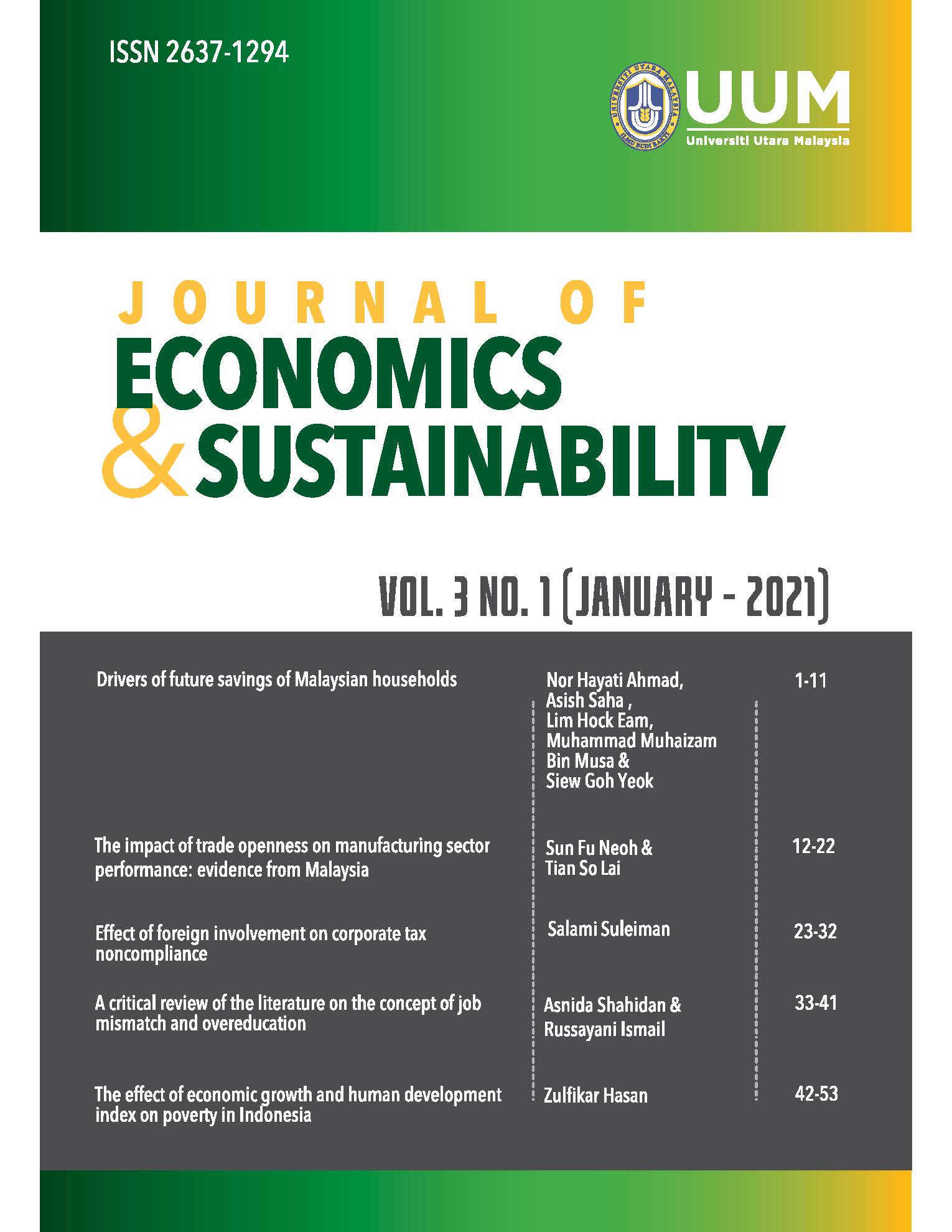
Drivers of Future Savings of Malaysian Households
DOI:
https://doi.org/10.32890/jes2021.3.1.1Keywords:
Future saving, seemingly unrelated regressions, bank customersAbstract
The households’ savings in Malaysia have shown a deteriorating trend that negatively impacts their financial security. The Financial Inclusion and Capability Study of BNM (2016) indicates that merely 6 percent of Malaysians could survive for more than six months and 18 percent up to three months if they lose their main source of income. Thus, it is imperative to examine the drivers of future savings of Malaysian households. A sample of 1,106 bank customers in three cities of peninsular Malaysia was recruited, and the descriptive statistics, correlation analysis, and Seemingly Unrelated Regressions (SUR) were employed. The results reveal that about 25 percent of households are not likely to make any changes in their savings profile in various financial and physical assets. The drivers of future saving are found to be socio-demographic parameters, such as age, education level, the number of working members in the household, and income, and other parameters, such as the percentage of income saved, and the period of the saving plan, which have a significant relationship with the change in future savings of the households. The policy implications of the findings are also presented.
Received 20 July 20. Revised 9 August 20. Accepted 11 August 20.
References
Ang, J. B. (2007). Are saving and investment cointegrated? The case of Malaysia (1965-2003). Applied Economics, 39(17), 2167-2174.
Athukorala, P. C., & Sen, K. (2004). The determinants of private saving in India. World Development, 32(3), 491–503.
Bebczuk, R. (2015). Understanding the Determinants of Household Saving : Micro Evidence for Latin America Understanding the Determinants of Household Saving : Micro Evidence for Latin America, TECHNICAL (October).
Beckmann, E., Hake, M., & Urvova, J. (2013). Determinants of Households’ Savings in Central, Eastern and Southeastern Europe. Focus on European Economic Integration, Q13(2009), 8–29.
Berry, S. & Williams,R.(2009). Household Savings, Bank of England Quarterly Bulletin Q3,191-201
BNM( 2016). “The Profile of Malaysian Financial Consumers”. Presentation at the Bolton, R.N. (1998), A dynamic model of the duration of the customer’s relationship with a continuous service provider: the role of satisfaction, Marketing Science, 17( 1), 45-65.
Delafrooz, N., & Paim, L. (2011). Personal Saving Behavior among Malaysian Employees: Socio Demographic Comparison. International Conference on Social and Humanity, 5, 361–363.
Harris, M. N., Loundes, J., & Webster, E. (2002). Determinants of Household Saving in Australia. Economic Record, 78(241), 207–223.
Horioka, C. Y. and Wan, J. (2007). The Determinants of Household Saving in China : A Dynamic Panel Analysis of Provincial Data. Journal of Money, Credit and Banking, 39(8), 2077–2096.
Kraay, A. (2000). Household Saving in China. The World Bank Economic Review, 14(3), 545–57.
Samantaraya, A., & Patra, S. K. (2014). Determinants of Household Savings in India: An Empirical Analysis Using ARDL Approach. Economics Research International, 2014, 1–8.
Selamah, A.Y.,Rohaiza A.R. and Wan J.W.J.(2015). Financial Fragility of Urban Households in Malaysia. Jurnal Ekonomi Malaysia, 49(1), 15-24.
Suppakitjarak, N., & Krishnamra, P. (2015). Household Saving Behavior and Determinants of the Forms of Saving and Investment in Thailand. Journal of Economics, Business and Management, 3(3), 326–330.
Tang, C. F. (2008). An empirical modelling on savings behavior in Malaysia. Labuan Bulletin of International Business and Finance, 6, 57–76.
Tang, C. F., & Chua, S. Y. (2012). The savings-growth nexus for the Malaysian economy: a view through rolling sub-samples. Applied Economics, 44(32), 4173–4185.
Published
Issue
Section
License
Copyright (c) 2021 Journal of Economics and Sustainability

This work is licensed under a Creative Commons Attribution 4.0 International License.

