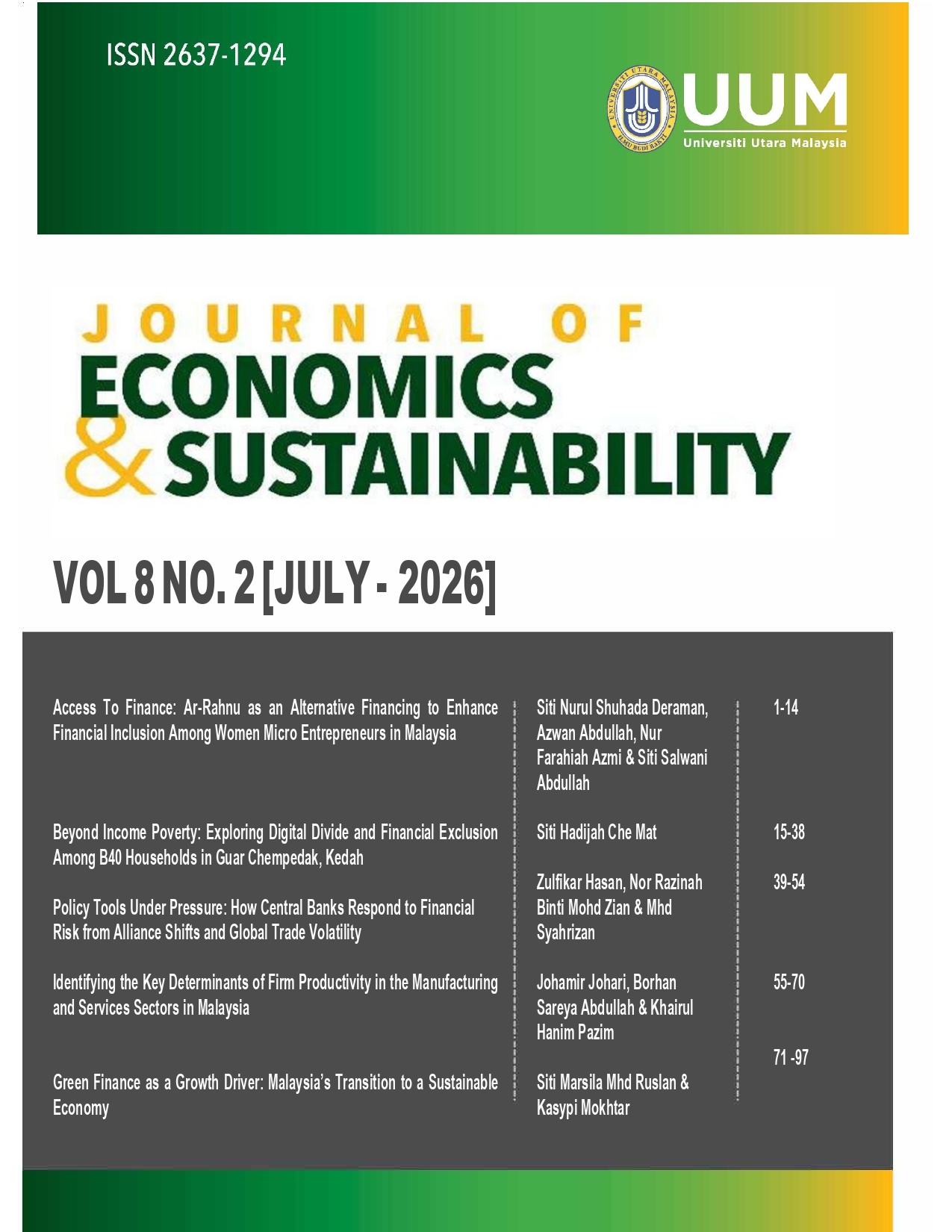
Policy Tools Under Pressure: How Central Banks Respond to Financial Risk from Alliance Shifts and Global Trade Volatility
DOI:
https://doi.org/10.32890/Kata kunci:
Central banks, emerging markets, geopolitical risk, global trade uncertainty, monetary policyAbstrak
This study investigates how central banks across 35 advanced and emerging economies adjust their monetary policy instruments in response to evolving financial risks arising from shifting geopolitical alliances and global trade volatility between 2010 and 2023. Employing advanced panel econometric techniques, including System Generalised Method of Moments (System GMM), this paper quantifies the dynamic effects of geopolitical risk (GPR) and global trade uncertainty (GTUI) indices on policy interest rates. The findings reveal that both GPR and GTUI exert significant tightening pressure on monetary policy, with emerging markets displaying heightened sensitivity compared to advanced economies. Robustness checks confirm the stability of these results across alternative model specifications and subsamples. Further analysis using impulse-response functions demonstrates the temporal dynamics of policy rate adjustments following shocks to geopolitical risk. The study contributes to the literature by integrating multidimensional global risk measures into the evaluation of central bank behaviour, providing critical insights for policymakers navigating complex international financial environments characterised by alliance shifts and trade disruptions.
Muat turun
Diterbitkan
Terbitan
Bahagian
Lesen
Hak Cipta (c) 2026 Journal of Economics and Sustainability

Kerja ini dilesenkan di bawah Creative Commons Attribution 4.0 International License.





