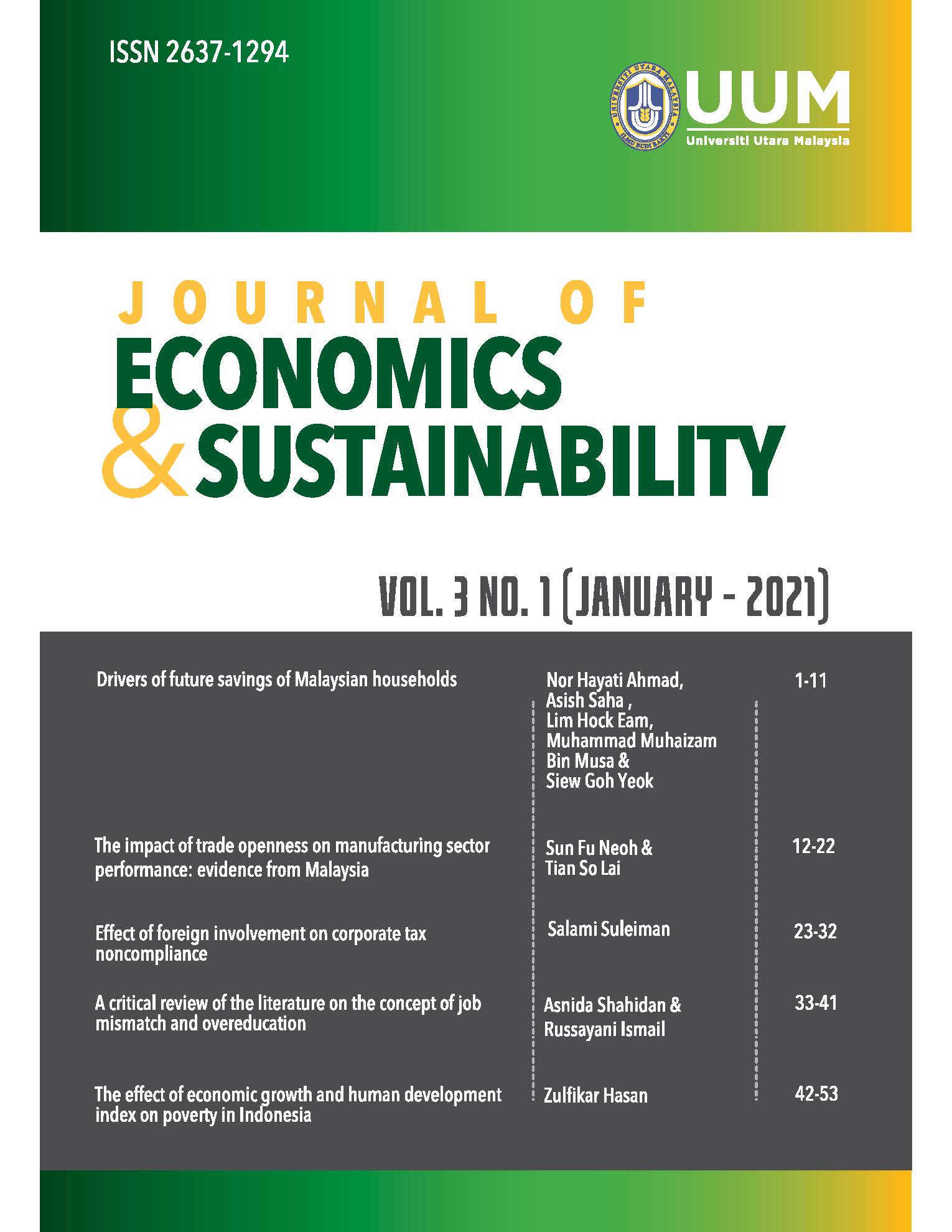
The Effect of Economic Growth and Human Development Index on Poverty in Indonesia
DOI:
https://doi.org/10.32890/jes2021.3.1.5Keywords:
Economic growth, Human development index, PovertyAbstract
Indonesia’s economic growth, which ranges from 5% - 6% per year, apparently has not been able to reduce the number of poor people. There has even been an increase in the total of poor people, which is currently around 37 million people. A World Bank study shows that almost 50% of Indonesia’s population is categorised as “poor†and “on the verge of povertyâ€. The problem of poverty deserves significant attention from all parties. Economic growth accompanied by an increase in the number of poor people is certainly inviting several questions, such as who is enjoying the economic growth and whether the economic growth is caused by increased productivity or the use of factors of production, etc. In Indonesia, economic growth seems to be concentrated in specific sectors, while some other areas have relatively slow growth that poverty reduction is difficult. Hence, research on economic growth, human development, and poverty levels in Indonesia is warranted. The results are expected to explain the phenomenon of increasing poverty in Indonesia.
Received 8 Jun 20. Revised 16 July 20. Accepted 27 July 20.
References
Ahluwalia. (2013). Pertumbuhan Ekonomi dan Pemerataan. In Ahluwalia, Pertumbuhan Ekonomi dan Pemerataan (pp. 42-52). Jakarta: Universitas Pamulang.
Berardi, N. & Marzo, F. (2015). The Elasticity of Poverty with Respect to Sectoral Growth in Africa. Banque de France Working Paper No. 538, Available at SSRN: http://dx.doi.org/10.2139/ssrn.2564105
Bigsten, A. & Levin, J. (2004). Growth, Income Distribution, and Poverty: A Review in Growth, Inequality, and Poverty: Prospects for Pro-poor Economic Development Anthony Shorrocks and Rolph van der Hoeven. Oxford: Oxford University Press.
Chaudhuri, S., Jalan, J. & Suryahadi, A. (2002). Assessing Household Vulnerability to Poverty from Cross-Sectional Data: A Methodology and Estimates from Indonesia. Department of Economics Discussion Papers 0102-52, Columbia University.
Datt, G. & Ravallion, M. (2002). Is India’s economic growth leaving the poor behind? Journal of Economic Perspectives, 16(3), 89-108.
Friedman, J. (2002). How Responsive is Poverty to Growth ? A Regional Analysis of Poverty, Inequality, and Growth in Indonesia. RAND, 1984-1999.
Hasan, R. & Quibria, M.G. (2002). Poverty and Patterns of Growth. ERD Working Paper No. 18, Asian Development Bank, Philippines.
Haq, M. U. (1996). Reflections on Human Development. New York: Oxford University Press.
Hoeven, R. (2004). Poverty and Structural Adjustment: Some Remarks on Trade off Between Equity and Growth. ILO Employment Paper 4. International Labor Organization.
Huppi, M. & Ravallion, M. (1990). The sectoral structure of poverty during an adjustment period: evidence from Indonesia in the Mid-1980s. World Bank Working Paper 529, Washington.
Kakwani, N. & Son, H.H. (2003). Pro-poor Growth: Concepts and Measurement with Country Case Studies. The Pakistan Development Review, 42(4), 417-444.
Lewis, W. (1954). Economic Development with Unlimited Supplies of Labour. The Manchester School of Economic and Social Studies, 22(2), 139-191.
Morris, M. D. (1979). Measuring the Condition of the World’s Poor: The Physical Quality of Life Index. London: Frank Crass.
National Human Development Report (2014). The Economics of Democracy: Financing Human Development in Indonesia. National Human Development Report 2014, BPS-Statistics Indonesia, Bappenas and UNDP Indonesia.
Ranis, G. & Fei, J. (1961). A Theory of Economic Development. American Economic Review, 51, 533-565.
Ravallion, M. & Datt, G. (1999). When is growth pro-poor? Evidence from the diverse experiences of India’s states. Policy Research Working Paper Series No 2263, The World Bank. https://EconPapers.repec.org/RePEc:wbk:wbrwps:2263.
Rose, S., Abbas, S., Ali, M.F., & Azeem, M.M. (2013). Growth-poverty linkages: does sectoral composition matter for Pakistan? World Applied Science Journal, 21(6), 915-919.
Saad, W. (2009). The nature of government expenditure and its impact on sustainable economic growth. Middle Eastern Finance and Economics, 1-12.
Siregar, H. & Wahyuniarti, D. (2008). Dampak Pertumbuhan Ekonomi Terhadap Penurunan Jumlah Pendduk Miskin. Online paper http://deptan.go.id Journal of Economics and Sustainability
Tambunan, T. (2001). Perekonomia Indonesia: Teori dan Temuan Empiris. Jakarta: Ghalia Indonesia.
Published
Issue
Section
License
Copyright (c) 2021 Journal of Economics and Sustainability

This work is licensed under a Creative Commons Attribution 4.0 International License.

