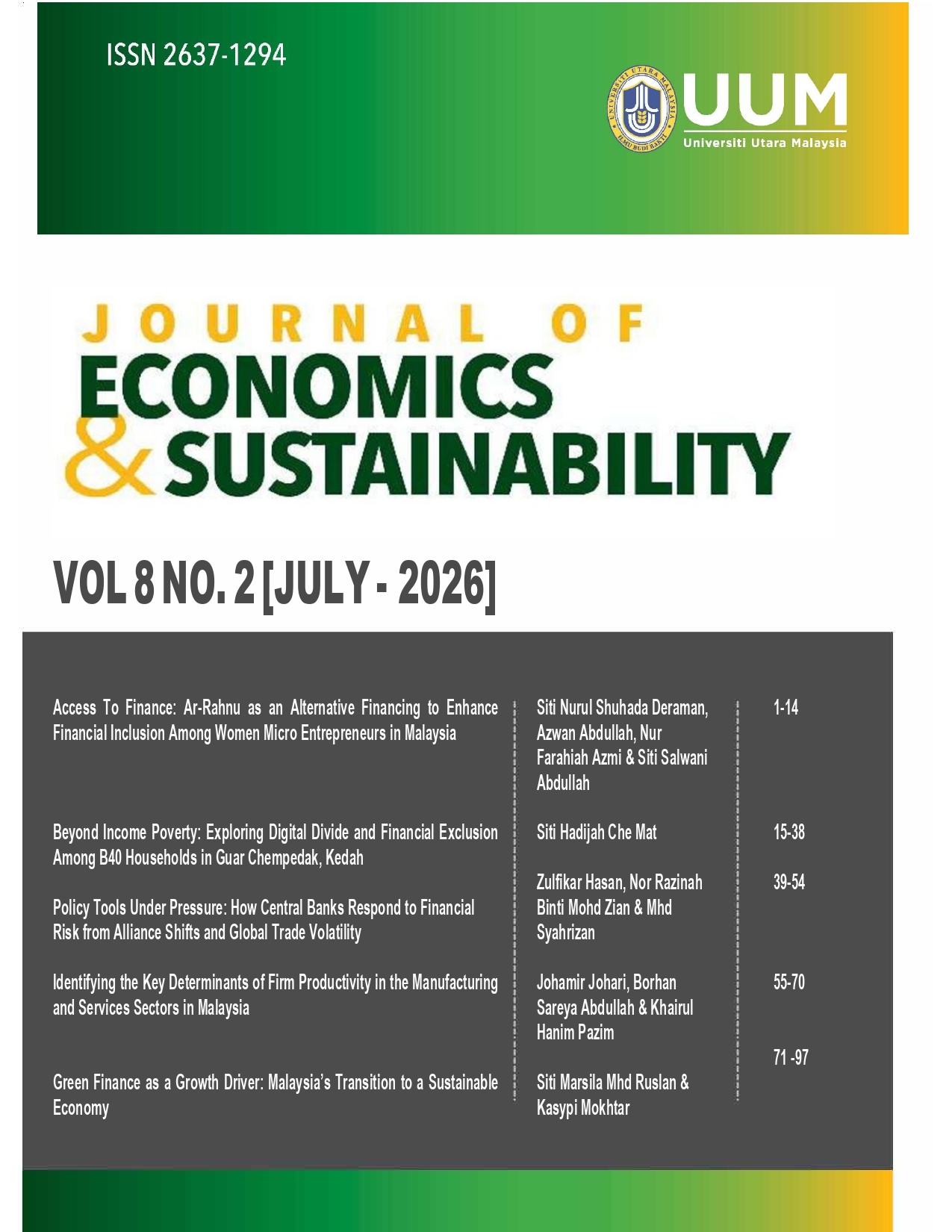
Policy Tools Under Pressure: How Central Banks Respond to Financial Risk from Alliance Shifts and Global Trade Volatility
DOI:
https://doi.org/10.32890/jes2026.8.2.3Keywords:
Central banks, emerging markets, geopolitical risk, global trade uncertainty, monetary policyAbstract
This study investigates how central banks across 35 advanced and emerging economies adjust their monetary policy instruments in response to evolving financial risks arising from shifting geopolitical alliances and global trade volatility between 2010 and 2023. Employing advanced panel econometric techniques, including System Generalised Method of Moments (System GMM), this paper quantifies the dynamic effects of geopolitical risk (GPR) and global trade uncertainty (GTUI) indices on policy interest rates. The findings reveal that both GPR and GTUI exert significant tightening pressure on monetary policy, with emerging markets displaying heightened sensitivity compared to advanced economies. Robustness checks confirm the stability of these results across alternative model specifications and subsamples. Further analysis using impulse-response functions demonstrates the temporal dynamics of policy rate adjustments following shocks to geopolitical risk. The study contributes to the literature by integrating multidimensional global risk measures into the evaluation of central bank behaviour, providing critical insights for policymakers navigating complex international financial environments characterised by alliance shifts and trade disruptions.
References
Ahir, H., Bloom, N., & Furceri, D. (2019). The World Uncertainty Index. International Monetary Fund, 19, 2019.
Aiyar, S., Ilyina, A., & Jobst, A. (2023). Geoeconomic Fragmentation and the Future of Multilateralism. IMF Staff Discussion Note No. 2023/001.
Arellano, M., & Bond, S. (1991). Some tests of specification for panel data: Monte Carlo evidence and an application to employment equations. The Review of Economic Studies, 8(5), 55.
Arellano, M., & Bover, O. (1995). Another look at the instrumental variable estimation of error-components models. Journal of Econometrics, 120(11), 259.
Baldwin, R., & Evenett, S. J. (2020). COVID-19 and Trade Policy: Why Turning Inward Won’t Work. CEPR Press.
Bank., W. (2023). Global Economic Prospects: Understanding Fragility in an Uncertain World.
Bernanke, B. S. (2020). 21st Century Monetary Policy: The Federal Reserve from the Great Inflation to COVID-19. W.W. Norton & Company, 2020.
Blundell, R., & Bond, S. (1998). Initial conditions and moment restrictions in dynamic panel data models. Journal of Econometrics, 43(March), 1–9.
Borio, C. (2022). Monetary policy in the grip of a pincer movement. In BIS Working Papers No. 1079. Bank for International Settlements (Issue 1079).
Brambor, T., Clark, W. R., & Golder, M. (2006). Understanding interaction models: Improving empirical analyses. Political Analysis, 13(Ii), 166–173.
Caldara, D., & Iacoviello, M. (2022b). Measuring Geopolitical Risk. American Economic Review, 112(8.5.2017), 2003–2005. https://doi.org/10.1257/aer.12102781
Galí, J., & Monacelli, T. (2016). Understanding the gains from wage flexibility: The exchange rate connection. American Economic Review, 4(June), 2016.
IMF. (2023). World Economic Outlook: Navigating Global Divergences. In International Monetary Fund.
International Money Fund. (2023). Global Financial Stability Report: Safeguarding Financial Stability Amid High Inflation and Geopolitical Risks. https://www.imf.org/en/Publications/GFSR/Issues/2023/04/11/global-financial-stability-report-april-2023
Reinhart, C. M. (2022). Central banking in a shifting global landscape. Brookings Papers on Economic Activity, 2022.
Published
Issue
Section
License
Copyright (c) 2026 Journal of Economics and Sustainability

This work is licensed under a Creative Commons Attribution 4.0 International License.

