
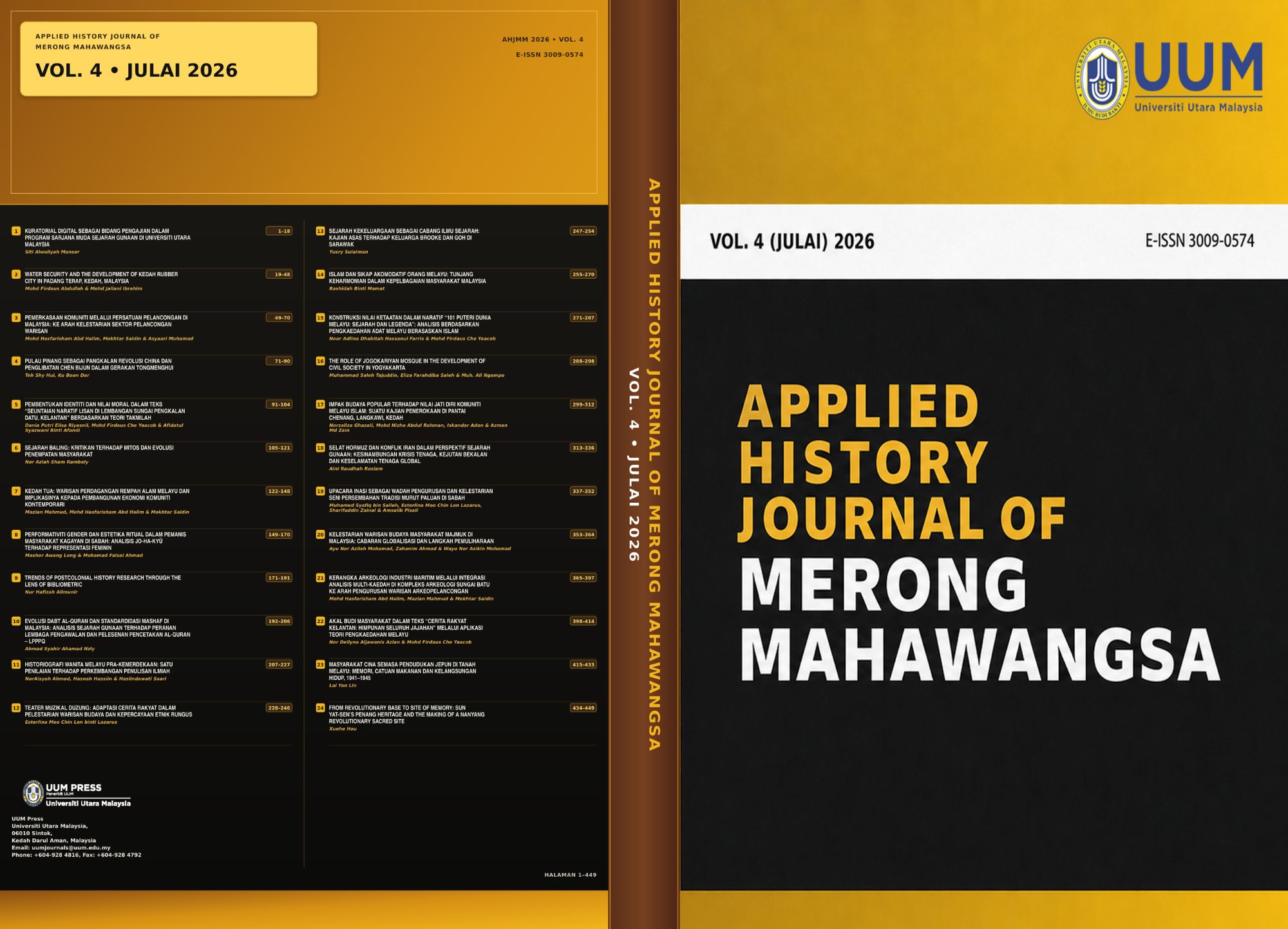
Kedah Tua: Warisan Perdagangan Rempah Alam Melayu dan Implikasinya kepada Pembangunan Ekonomi Komuniti Kontemporari
(Ancient Kedah: The Heritage of the Malay Spice Trade and Its Implications for Contemporary Community Economic Development)
DOI:
https://doi.org/10.32890/ahjmm2026.4.7Keywords:
Kedah Tua, perdagangan rempah, alam melayu Nusantara, warisan budaya, ekonomi komunitiAbstract
ABSTRAK
Kajian ini bertujuan untuk menganalisis dan menilai peranan kerajaan Kedah Tua dalam perdagangan rempah ratus di Alam Melayu Nusantara dan merekodkan potensi warisan maritim ini dalam proses pembangunan ekonomi komuniti kontemporari. Kedah Tua sebagai sebuah kerajaan maritime entreport yang terletak di laluan perdagangan Selat Melaka-Laut China Selatan telah terlibat dalam perdagangan antarabangsa sejak sebelum Masihi menjadikan ada kemungkinan kerajaan ini memainkan peranan terhadap perdagangan rempah di Alam Melayu. Bagi memperlengkapkan kajian, metodologi kajian seperti meneliti literatur akademik, dokumen sejarah dan laporan arkeologi telah dilakukan. Hasil kajian mendedahkan walaupun bukti arkeologi langsung untuk komoditi rempah Kedah Tua adalah terhad, namun berdasarkan kedudukan geografi Kedah Tua dan konteks perdagangan serantau menunjukkan kemungkinan ada penglibatan kritikal Kedah Tua dalam perdagangan rempah, di samping terdapat bukti ketara pengeluaran besi, struktur pelabuhan dan artifak lain di Lembah Bujang dan Sungai Batu yang menunjukkan kawasan ini sebagai lokasi perdagangan utama. Oleh yang demikian, kajian ini menyatakan bahawa Kedah Tua merupakan nod penting dalam rangkaian perdagangan maritim Nusantara, yang memperdagangkan pelbagai komoditi termasuk rempah ratus, besi dan sumber hutannya. Warisan maritimnya berpotensi untuk meningkatkan pelancongan warisan, identiti negara dan ekonomi kreatif di Malaysia. Oleh itu, kajian ini menawarkan pemahaman bersepadu tentang sejarah maritim Kedah Tua dan mengetengahkan peluang dan cabaran untuk memanfaatkan warisan ini dalam Malaysia kontemporari. Kajian ini menyumbang kepada pemahaman historiografi maritim Kedah Tua dengan menghubungkan warisan perdagangan rempah kepada pembangunan identiti nasional, pelancongan warisan dan pemerkasaan ekonomi komuniti kontemporari.
ABSTRACT
This study aims to analyze and evaluate the role of the Kedah Tua government in the spice trade within the Nusantara Malay Realm, and to record the potential of this maritime heritage in the economic development process of the contemporary community. Ancient Kedah, as a maritime entrepôt kingdom located on the Straits of Malacca-South China Sea trade route, has been involved in international trade since before Christ, making it possible for this kingdom to play a study aims to analyze and evaluate the role of the ancient role in the spice trade in the Malay Archipelago. To complete the study, research methodologies such as reviewing academic literature, historical documents, and archaeological reports The study employed research methodologies such as reviewing academic literature, historical documents, and archaeological reports. The results of the study revealed that although direct archaeological evidence for the spice commodity of ancient Kedah is limited, based on the geographical position of ancient Kedah and the regional trade context, ancient Kedah may have been critically involved in the spice trade, in addition to there being significant evidence of iron production, port structures, and other artifacts in the Bujang Valley that indicate this area as a major trading location. Therefore, this study states that ancient Kedah is an important node in the maritime trade network of the Nusantara, which trades various commodities, including spices, iron, and its forest resources. Its maritime heritage has the potential to enhance heritage tourism, national identity, and the creative economy in Malaysia. Therefore, this study offers an integrated understanding of the maritime history of ancient Kedah and highlights the opportunities and challenges for harnessing this heritage in contemporary Malaysia. This study contributes to the understanding of the maritime historiography of ancient Kedah by linking the legacy of the spice trade to the development of national identity, heritage tourism, and the economic empowerment of contemporary communities.
References
Abbas, I. (2022). The Spices Trade Route in Mollucas in the XVI and XVII Centuries. International Journal of Education and Social Science Research (IJESSR), 5(5): 105-116. Abd Rahman, R., Siti Zubaidah S., Ariff Fahmi A.B., Nik Zanariah N.M., Lim Hin Fui, Mansor M., Roda
J.M., Mohd Shahidan M.A., Koter R., Kar Yong Pin, & Azah, M.A.N. (2017). Socio-Economic Background of Herbal Industry in Peninsular Malaysia. Kepong: FRIM, 217 p. ISBN 978-9670622-91-0.
Abdul Rahman Ismail (2015). The Northern Region of Peninsular Malaysia: Historical Heritage and National Identity. Kajian Malaysia, 33(sup. 2): 1-25.
Abdul Razzaq, Sari Lestari Zainal Ridho & Asmuni (2017). The Kingdom of Srivijaya in the Development of Islamic Civilization and the Economy in Nusantara Before 1500 AD. Journal of Malay Islamic Studies, 1(1): 39-52. https://doi.org/10.19109/jmis.v1i1.3790
Adnan Jusoh (2016). Zaman Pra-Islam di Kedah Berdasarkan Bukti Arkeologi. Perspektif Jurnal Sains Sosial dan Kemanusiaan, 8(1): 106-117.
Ahmad Jelani Halimi (2020). Penguasaan Maritim dan Aktiviti Perdagangan Antarabangsa KerajaanKerajaan Melayu. International Journal of Interdisciplinary and Strategic Studies, 1(1): 17-29. https://doi.org/10.47548/ijistra.2020.23.
Ahmad, S. & Othman, N. (2013). Strategic Planning, Issues, Prospects and the Future of the Malaysian Herbal Industry. International Journal of Academic Research in Accounting Finance and Management Sciences. 3(4): 119-132.
Aisyah Syafiera (2016). Perdagangan di Nusantara Abad Ke-16. Avatara: Jurnal Pendidikan Sejarah, 4(3): 721-735.
Alfiyyatus Sadiida, Ulfah Hamidah & Laila Nur Kusuma (2025). Perdagangan Rempah dan Penyebaran Islam: Analisis Peran Pedagang Muslim di Nusantara Abad Ke-16. Jurnal Bima Pusat Publikasi Ilmu Pendidikan bahasa dan Sastra, 3(4): 48-61. https://doi.org/10.61132/bima.v3i4.2535
Anonymous (2011). Enam Jawatankuasa Ditubuh untuk Selaras Pembangunan Herba. mStar, July 14, 2011.
Anwar, G., Bustamam, H., Kasrina, K., Oktoyoki, H. & Senoaji, G. (2024). Empowering Women in Lunjuk Village through the Creation of MSMEs Ginger Products. Abdimas: Jurnal Pengabdian Masyarakat Universitas Merdeka Malang, 9(1): 103-113. https://doi.org/10.26905/abdimas.v9i1.12229.
Aprilia, M. (2024). Dunia Melayu di Bawah Kekuasaan Kolonial. Hadharah Jurnal Keislaman dan Peradaban, 18(1):15-25. https://doi.org/10.15548/h.v18i1.9499.
Averbuch, B. (2022). The Spice Trade in Southeast Asia. In David, L. (ed.), Oxford Research Encyclopedia of Asian History (New York, NY, Oxford Academic. https://doi.org/10.1093/acrefore/9780190277727.013.547.
Berkat, I.S. & Seniwati (2024). Diplomasi Maritim ‘Rempah’ di Nusantara: Perjalanan dari Maluku Sampai ke Pelabuhan Malaka. Journal of Creative Student Research, 2(6): 71–84. https://doi.org/10.55606/jcsr-politama.v2i6.4571.
Cattaneo, C. (2023). Value Chain Management. In: Idowu, S.O., Schmidpeter, R., Capaldi, N., Zu, L., Del Baldo, M. & Abreu, R. (eds). Encyclopedia of Sustainable Management. Springer, Cham, 39013912. https://doi.org/10.1007/978-3-031-25984-5_851.
Dasanayake, R. (2016). Cinnamon: A Spice of an Indigenous Origin-Historical Study. Narrations, 1(2): 46-58. ISBN 2478-0642.
Denissa, L. (2022). Pala dan Cengkeh di antara Jejak Sejarah, Batik dan Identitas. Humanitas (Jurnal Psikologi), 6(1): 63-80. https://doi.org/10.28932/humanitas.v6i1.4561.
Ducène, J.C. (2024). Medieval Spice Trade in the Arabic World. In: Goldstein, D. (ed). Oxford Research Encyclopedia of Food Studies, Oxrord Academic, 17. https://doi.org/10.1093/acrefore/9780197762530.013.38.
Dunpangol, D.C.U. (2024). Cultivating Sustainable Futures: Community-Led Farming Initiatives in Malaysia by APPGM-SDG. Journal of the Malaysian Parliament, 4: 325-343. https://doi.org/10.54313/journalmp.v4i.131.
Entebang, H., Wong, S.K. & Jarroop Zehnder, A.M. (2020). Development and Performance of the Pepper Industry in Malaysia: A Critical Review. International Journal of Business and Society, 20(3):1402-1423. https://doi.org/10.33736/ijbs.3361.2020. Fauziah Fathil, Wan Norizzati Wan Fazli, Mohamad Firdaus Mansor Majdin, Rahmah Ahmad Osman, Md
Salleh Yaapar & Saleh Alzeheimi (2022). The Trans-Indianica Maritime Networks and its Impacts on Malay Civilization: Revisiting the History of Kedah Kingdom. International Journal of Early Childhood Special Education, 14(3): 2336-2343. https://doi.org/10.9756/int-jecse/v14i3.277
Foo, J., Latiff, A., Omar, M. & Amir, A.A. (2016). Women's Perception on Medicinal Plants in Traditional Tamu, West Coast, Sabah, Malaysia. Malayan Nature Journal, 68(3): 95-104.
Gin, O.K. (2022). ‘Bridge’ to ‘Fence’ a Maritime History of the Straits of Malacca. Journal of Maritime Studies and National Integration, 6(1): 1-19. https://doi.org/10.14710/jmsni.v5i2.9443
Hall, K.R. (1985). The Opening of the Malay World to European Trade in the Sixtenth Century. Journal of the Malaysian Branch of the Royal Asiatic Society, 58(2): 85-106.
Hall, K.R. (2017). Maritime Trade and Societal Transitions in the Western Indonesian Archipelago: Samudra-Pasai at the Dawn of the European Age (c. 1200-1500). Asian Review of World Histories, 5(1): 31-68. http://dx.doi.org/10.12773/arwh.2017.5.1.031
Hamid, A.R. (2022). Jalur Rampah dan Islamisasi Nusantara: Jaringan Samudera Pasai abad XIII – XVI. Jurnal Masyarakat dan Budaya, 23(3): 269-282. https://doi.org/10.14203/jmb.v23i3.1065
Haslindawati Saari, Azmah Abdul Manaf & Norizan Kadir (2020). Pentadbiran Negeri Kedah Berdasarkan Surat Raja-Raja, 1882-1911. Sejarah: Journal of History Department, 29(1): 18-40. ISSN: 19850611.
Hazman Hassan, Mohd Kasturi Nor Abd Aziz, Juliana Ahmad & Mohd Nazim Mohd Noor (2024). Mencari Jati Diri Makanan Melayu Perlis: Suatu Catatan Awal. Asian Journal of Environment, History and Heritage, 8(1): 1-10. ISSN: 2590-4310.
Hoogervorst, T. (2021). Commercial Networks Connecting Southeast Asia with the Indian Ocean. In David, L. (ed.), Oxford Research Encyclopedia of Asian History, New York, Oxford Academic, 15p.https://doi.org/10.1093/acrefore/9780190277727.013.541
Hsieh, E. & Sakai, T. (2023). A Thousand Years of Connections between the Indian Ocean Region and Southeast Asia. In: Haines, J.J. & Hauser, M.W. eds). The Archaeology of Modern Worlds in the Indian Ocean. Gainesville: University Press of Florida. https://muse.jhu.edu/book/111423.
Ibrahim Bakar (2020). Peringatan Raja-Raja Kedah. Persatuan Sejarah Malaysia Cawangan Kedah, 1154. ISBN: 978-983-43275-9-0.
Jacq-Hergoualc'h, M. (1992). Un Exemple de Civilisation de Ports-Entrepôts des Mers du Sud: le Sud Kedah (Malaysia) Ve-XIVe siècles. Arts Asiatiques, 47, 40-48. https://doi.org/10.3406/ARASI.1992.1320 Josefin Manalu, Nada Azhari, Rika Hayani, Rina Sari Batubara & Meiman Pratama Harefa (2025). Analisis Faktor Pendorong Penjelajahan Samudra Bangsa Eropa Abad Ke-15–17 serta Dampaknya Terhadap Perdagangan di Nusantara. JERUMI: Journal of Education Religion Humanities and Multidiciplinary, 3(2): 1325-1333. https://doi.org/10.57235/jerumi.v3i2.7671
Keay, J. (2006). The Spice Route: A History. John Murray, 286p. ISBN: 071956199X.
Lapian, A.B. (2023). Wilayah Maluku dalam Konteks Perdagangan Internasional. Kalpataru Majalah Arkeologi, 22(1): 7-16. https://doi.org/10.24832/KPT.V22I1.106
Manguin, P.Y. (2021). Srivijaya: Trade and Connectivity in the Pre-modern Malay World. Journal of Urban Archaeology, 3: 87-100. https://doi.org/10.1484/J.JUA.5.123677 Mohd Amin Ali, Mohd Hasfarisham Abd Halim, Shyeh Sahibul Karamah Masnan, Mokhtar Saidin &
Suresh Narayanen (2023). Geoarchaeosites for Heritage Tourism Product of Kuala Muda District, Kedah, Malaysia. Geojournal of Tourism and Geosites, 1(46): 63-70. http://doi.org/10.30892/gtg.46107-1001
Md. Salleh Yaapar. (2019). Malay Navigation and Maritime Trade: A Journey through Anthropology and History. IIUM Journal of Religion and Civilisational Studies, 2(1), 73-81. https://doi.org/10.31436/ijrcs.v2i1.61
Mohd Hasfarisham Abd Halim & Mokhtar Saidin (2025a). Architecture of the Ancient Port Management SB2G Site at Sungai Batu Archaeological Complex (SBAC), Bujang Valley, Kedah, Malaysia. Journal of Maritime Archaeology, 1-19. https://doi.org/10.1007/s11457-025-09468-0
Mohd Hasfarisham Abd Halim & Mokhtar Saidin (2025b). Ancient Kedah Kingdom: Interpretations Based on Archaeological Studies. Herança – History, Heritage and Culture Journal, 8(1): 1-19. https://doi.org/10.52152/heranca.v8i1.984
Mohd Hasfarisham Abd Halim & Mokhtar Saidin (2026). Ancient Kedah as an Early Maritime Kingdom in Southeast Asia: A Case Study at the SB1H River Jetty Site, Sungai Batu Archaeological Complex, Bujang Valley, Kedah, Malaysia. Journal of Maritime Archaeology, 21: 1-30. https://doi.org/10.1007/s11457-026-09517-2 Mohd Hasfarisham Abd Halim, Iklil Izzati Zakaria, Shyeh Sahibul Karamah Masnan, Shaiful Shahidan &
Mokhtar Saidin (2025a). Revisiting the 2,600-Year-Old Ancient Kedah River Jetty Site of Sungai Batu Archaeological Complex, Bujang Valley, Kedah, Malaysia. International Journal of Nautical Archaeology, 1-29. https://doi.org/10.1080/10572414.2025.2450784 Mohd Hasfarisham Abd Halim, Naizatul Akma Mohd Mokhtar, Shyeh Sahibul Karamah Masnan &
Mokhtar Saidin (2025b). New Evidence of Ancient Kedah Iron Smelting Sites at Sungai Batu Archaeological Complex (SBAC), Bujang Valley, Kedah, Malaysia. L’Anthropologies (France), 129(1): 103342. https://doi.org/10.1016/j.anthro.2024.103342
Mohd Hasfarisham Abd Halim, Shyeh Sahibul Karamah Masnan & Mokhtar Saidin (2025c). Sungai Batu Archaeological Complex (SBAC), Kedah, Malaysia as a Sustainable Heritage Tourism Product. Built Heritage, 9(4): 1-20. https://doi.org/10.1186/s43238-024-00171-y
Mohd Hasfarisham Abd Halim & Mokhtar Saidin (2026). The Process of Developing Sungai Batu Archaeological Complex (SBAC) Sites as Heritage Tourism Products in Kedah, Malaysia. Built Heritage, 10(2). https://doi.org/10.1186/s43238-025-00239-3
Morgan, S.L. (2024). Southeast Asia, China, and the ‘maritime Silk Roads’, c.900–1650. In: Henderson, J., Morgan, S.L. & Salonia, M. (eds). Reimagining the Silk Roads, Routledge, 265-278. https://doi.org/10.4324/9781003348702-23
Murphy, S.A. (2017). Revisiting the Bujang Valley: A Southeast Asian Entrepôt Complex on the Maritime Trade Route. Journal of the Royal Asiatic Society, 28(2): 1-35. https://doi.org/10.1017/S1356186317000505 Naizatul Akma, M.M., Nordiana, M.M., Mokhtar, S., Rosli, S., Shyeh Sahibul Karamah, M., Nur Azwin, I., Andy Anderson, B., Teoh Ying, J., Sarmiza, S., Muhamad Taqiuddin, Z., Norshidah, Y.,
Norhidayahti, M.M. & Noer el Hidayah, I. (2022). Geophysical Approach to Identifying ncient Iron at Sungai Batu, Bujang Valley, Kedah, Malaysia. Acta Geodynamica et Geomaterialia, 19(3): 201-217. https://doi.org/10.13168/AGG.2022.0008
Nasha Rodziadi Khaw, Nazarudin Zainun & Mokhtar Saidin (2017). Kedah Tua: Satu Cerakinan Sumber India. Jurnal Arkeologi Malaysia, 30(2): 11-19. ISSN: 0128-0732.
Nasha Rodziadi Khaw, Shaiful Shahidan, Nazarudin Zainun & Mokhtar Saidin (2019). (2019). The Post14th Century Ancient Kedah: A Port In Decline?. In N. S. Mat Akhir, J. Sulong, M. A. Wan Harun, S. Muhammad, A. L. Wei Lin, N. F. Low Abdullah, & M.
Pourya Asl (Eds.), Role(s) and Relevance of Humanities for Sustainable Development, 68. European Proceedings of Social and Behavioural Sciences, (pp. 25-34). Future Academy. https://doi.org/10.15405/epsbs.2019.09.3 Noor Syahidah Mohamad Akhir, Syaimak Ismail, Aemy Aziz & Muhammad Saiful Islam Ismail, (2022). Kedah Tua sebagai Pelabuhan Kuno Perdagangan Antarabangsa Antara Abad ke-2M sehingga 13M: Lambang Ketamadunan Bangsa Melayu. Jurnal Melayu, 21(2): 115-132. ISSN 1675-7513.
Nordin Hussin (2008). Geografi dan Perdagangan: Kepentingan Selat Melaka kepada Perdagangan Dunia, Asia dan Dunia Melayu 1700-1800. Akademika, 73: 3-26.
Ooi Keat, G. (2022). ‘Bridge’ to ‘Fence’ a Maritime History of the Straits of Malacca. Journal of Maritime Studies and National Integration, 6(1): 1-19. https://doi.org/10.14710/jmsni.v5i2.9443
Park, J.E., Yi, J. & Kwon, O. (2022). Twenty Years of Traditional and Complementary Medicine Regulation and its Impact in Malaysia: Achievements and Policy Lessons. BMC Health Services Research, 22: 102. https://doi.org/10.1186/s12913-022-07497-2.
Paul, K.C., Azimi, H., Abu Samah, B., Ismail, I.A. & Dsilva, J. (2013). Rural Malay Involvement in Malaysian Herbal Entrepreneurship. Asian Social Science, 10(2): 202-202. https://doi.org/10.5539/ass.v10n2p202.
Paul, K.C., Hamzah, A., Abu Samah, B., Ismail, I.A. & D’Silva, J.L. (2014). Value of Social Network for Development of Rural Malay Herbal Entrepreneurship in Malaysia. Procedia-Social and Behavioral Sciences, 130: 59-64. https://doi.org/10.1016/j.sbspro.2014.04.008.
Paul, K.C., Hamzah, A., Samah, B.A., Ismail, I.A. & D’Silva, J.L. (2015a). Family Leadership for Development of Rural Malay Herbal Entrepreneurship in Malaysia. In: Erçetin, Ş. & Banerjee, S. (eds). Chaos, Complexity and Leadership. Springer Proceedings in Complexity. Springer, Cham, 367-377. https://doi.org/10.1007/978-3-319-09710-7_33.
Paul, K.C., Hamzah, A., Samah, B.A., Ismail, I.A. & D’Silva, J.L. (2015b). Rural Malay Youth Leadership and Malaysian Herbal Entrepreneurship Development. In: Erçetin, Ş., Banerjee, S. (eds) Chaos, Complexity and Leadership. Springer Proceedings in Complexity. Springer, Cham, 479-482. https://doi.org/10.1007/978-3-319-09710-7_42.
Pearson, M.N. (1996). Spices in the Indian Ocean World (An Expanding World: The European Impact on World History, 1450 to 1800. Routledge, 400p. ISBN-13: 978-08607785101.
Perttola, W. (2022). Digital Navigator on the Seas of the Selden Map of China: Sequential Least-Cost Path Analysis Using Dynamic Wind Data. Journal of Archaeological Method and Theory, 29(2): 688721. https://doi.org/10.1007/s10816-021-09534-6 Pristi Suhendro Lukitoyo, Ratih Baiduri, Pidia Amelia, Shaiful Shahidan & Rosmaida Sinaga (2025).The Role of the Bujang Valley Site and the Chinese City Site in the Dynamics of the Malacca Strait Trade Network in the 12th–14th Centuries AD. Proceedings of the International Conference on
Social Sciences and Interdisciplinary Studies (ICSSIS 2025), 971: 131-146. https://doi.org/10.2991/978-2-38476-499-0_12.
Ptak, R. (1992). The Northern Trade Route to the Spice Islands: South China Sea-Sulu Zone-North Moluccas, (14th to early 16th century). Arcipel, 43: 27-56.
Ravi, D.T. (2026). Growing a Future for Local Medicinal and Aromatic Plants. The Star, 01 Mac 2026.
Rinardo, A.P. & Suparman, A. & Syaiful, M. (2023). Pepper Diplomacy: Lampung International Network in the Bargaining Position of the Banten Sultanate. Proceedings of the 3rd Universitas Lampung International Conference on Social Sciences (ULICoSS 2022), 731-744. https://doi.org/10.2991/978-2-38476-046-6_71
Ririmasse, M.N.R. (2017). Sebelum Jalur Rempah: Awal Interaksi Niaga Lintas Batas di Maluku dalam Perspektif Arkeologi. Kapata Arkeologi, 13(1), 47-54. https://doi.org/10.24832/kapata.v13i1.388
Sarjiyanto & Nurul Adliyah Purnamasari (2023). Existence and Cultural Influence of Malay Peoples in the Banda Islands of the Central Moluccas from the 16th to the 19th Century. Proceedings of the 3rd International Conference on Linguistics and Cultural (ICLC 2022), 756: 533-546. https://doi.org/10.2991/978-2-38476-070-1_48
Senadjki, A., Nee, A.Y.N., Vija Kumaran, V. & Nathan, T.M. (2025). From Field to Market: Assessing the Adoption and Impact of Climate-Smart Farming Practices in Malaysian Bentong Ginger Cultivation. In: Appolloni, A, Caracciolo, F., Ding, Z., Gogas, P., Huang, G., Nartea, G., Strielkowski, W., Joshi, S. & Hanafi, M.M. (eds). Advances in Economics, Business and Management Research, Springer Nature. https://doi.org/10.2991/978-94-6463-666-6_20
Sibi, S. (2024). From Spice Trade to Modern Diplomacy with the Southeast through the Lens of Sangam Literature. Indian Study Review, 5(S-1): 94-112. ISSN: 2583-004X.
Simmons, J.A. (2024). Indian Ocean Trade. Oxford Research Encyclopedia of Food Studies. (New York, NY, online edn, Oxford Academic, 17 Apr. 2024), accessed 3 July 2026. https://doi.org/10.1093/acrefore/9780197762530.013.46
Subhiksha, R.S. & Jothimani, S. (2025). Consequences of the Chola Invasion on the Srivijayan Kingdom. Journal of the South Indian History Congress, 1-6. ISSN No.:2229-3671.
Sulistiyono, S.T., Noor Naelil Masruroh & Yet Rochwulaningsih (2018). Contest For Seascape: Local Thalassocracies and Sino-Indian Trade Expansion in the Maritime Southeast Asia During the Early Premodern Period. Journal of Marine and Island Cultures, 74-93. https://doi.org/10.21463/jmic.2018.07.2.05
Ujon Sujana (2019). Rekonstruksi Jalur Pelayaran Kapal-Kapal Eropa Abad ke-16 Hingga Abad Ke-17 di Kepulauan Maluku. Papua Journal of Anthropology, 11(1), 29-46. https://doi.org/10.24832/papua.v11i1.264
Zuliskandar Ramli (2020). Sejarah, perkembangan ekonomi dan hubungan antarabangsa Kedah Tua dari kurun ke-2 hingga ke-14 Masihi. International Journal of Interdiciplinary and Strategic Studies, 1(1): 58-87. https://doi.org/10.47548/ijistra.2020.26
Published
Issue
Section
License
Copyright (c) 2026 Mazlan Mahmud, Mohd Hasfarisham Abd Halim, Mokhtar Saidin

This work is licensed under a Creative Commons Attribution 4.0 International License.
How to Cite
Research impact
Harvested 2026-10-03Counts differ between services because each indexes a different body of literature. None of them is the whole picture.