
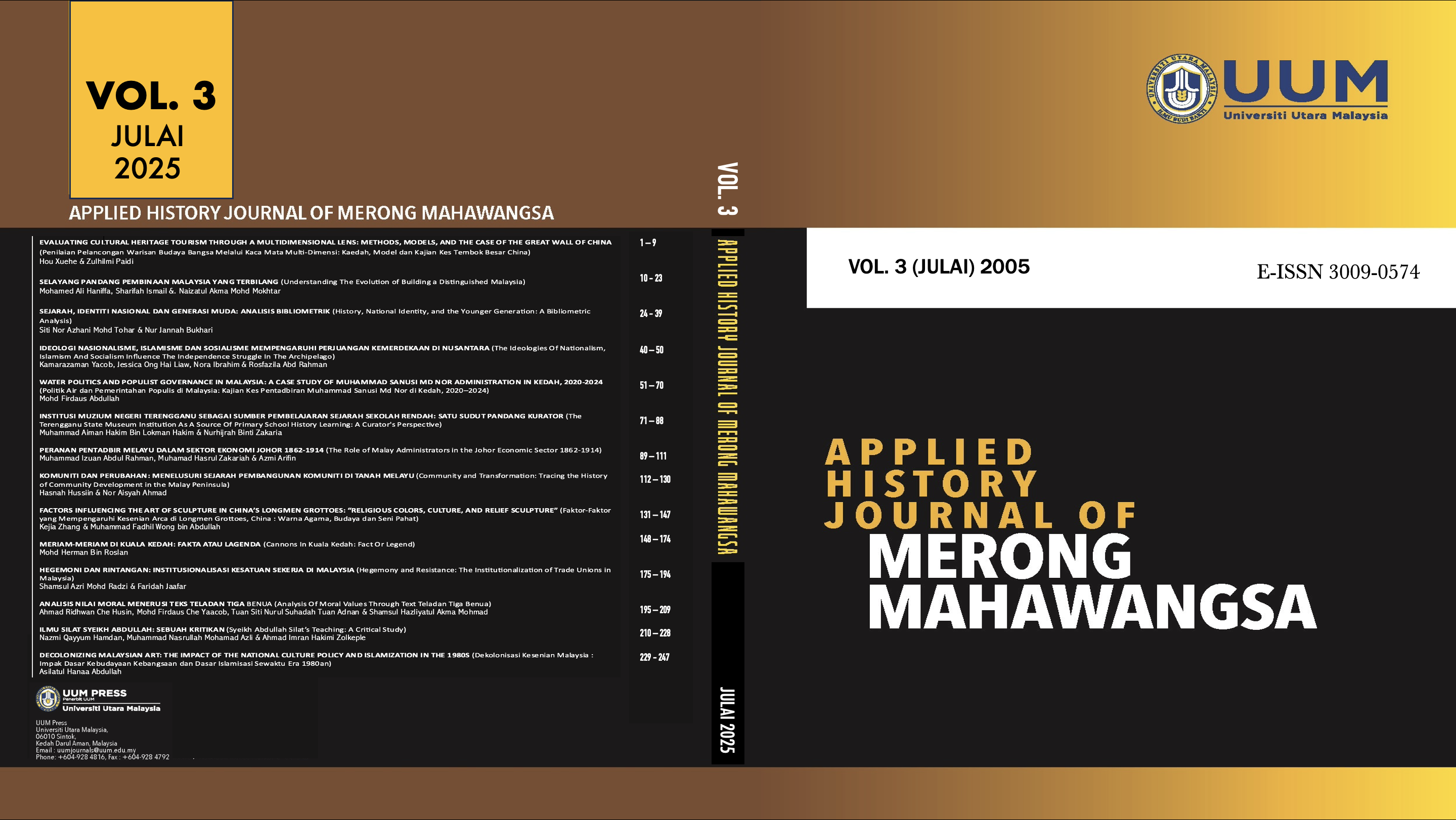
Decolonizing Malaysian Art: The Impact of the National Culture Policy and Islamization in the 1980S
(Dekolonisasi Kesenian Malaysia : Impak Dasar Kebudayaan Kebangsaan Dan Dasar Islamisasi Sewaktu Era 1980an)
DOI:
https://doi.org/10.32890/ahjmm2025.3.14Keywords:
National Culture Policy (NCP), Islamization Policies, Art of Malaysia, Decolonization, National IdentityAbstract
This paper presents a critical analysis of Malaysia’s arts and culture under the National Culture Policy (NCP) and the Islamization policies of the 1980s. While these sought to create a unifying national culture on Malay and Islamic values, these have, in return, sparked a big debate on arts freedom, inclusion, and creative freedom. This study, based on a qualitative study, sought to examine in which ways arts practitioners negotiated, resisted, or made accommodations in these regulations. The paper captures, in addition, a struggle between imposed narratives of culture and arts freedom, adding a contribution toward a wider debate on decolonization and postcolonial identity in Malaysia. Comparative studies of Nigeria and South Africa, and debates on globalization and digital arts, place Malaysia on a different trajectory
References
Abdullah, S. (2011). Thematic approaches in Malaysian art since the 1990s. JATI: Journal of Southeast Asian Studies, 16, 1–15.
Abdullah, S. (2020). The 1980s as (an attempt in) the decolonialization of Malaysian art. Southeast of Now: Directions in Contemporary and Modern Art in Asia, 4(1), 1–20.
Alatas, S. H. (1977). The myth of the lazy native: A study of the image of the Malays, Filipinos and Javanese from the 16th to the 20th century and its function in the ideology of colonial capitalism. London: Frank Cass.
Al-Attas, S. M. N. (1978). Islam and secularism. Kuala Lumpur: Muslim Youth Movement of Malaysia (ABIM).
Al-Attas, S. M. N. (1980). The concept of education in Islam: A framework for an Islamic philosophy of education. Kuala Lumpur: International Institute of Islamic Thought and Civilization (ISTAC).
Altabaa, H., & Altabaa, H. (2022). Villainous East versus the heroic West: A postcolonial analysis of The Kite Runner and its portrayal of Muslim Afghanistan. Journal of Islam in Asia, 19(1), 347–379.
Andriana, W. S. (2013). Study on the Malaysian Islamic visual art: The contemporary view. International Journal of Education and Research, 1(12), 15–30.
Bhabha, H. K. (1994). The location of culture. London: Routledge.
Esa, S. (1984). Ke arah Tauhid [Exhibition catalogue]. Kuala Lumpur: National Art Gallery.
Fanon, F. (1963). The wretched of the earth (R. Philcox, Trans.). New York: Grove Press. (Original work published 1961)
Ismail, Z. (1995). Ismail Zain retrospective exhibition. Kuala Lumpur: National Art Gallery.
Kember, P. (2022, July 23). Yee I-Lann. AWARE: Archive of Women Artists, Research and Exhibitions. Retrieved August 6, 2022, from https://awarewomenartists.com/en/artiste/yee-i-lann/
Kwok, K. C. (1994). Channels and confluences: Art in Singapore. Singapore: Singapore Art Museum.
Mignolo, W. D. (2011). Epistemic disobedience and the decolonial option: A manifesto. Transmodernity: Journal of Peripheral Cultural Production of the Luso-Hispanic World, 1(2), 44–66. https://escholarship.org/uc/item/62j3w283
Muslim, N. Y. (2021). The concept of decolonization in Malaysia: A philosophy perspective. International Journal of Academic Research in Business and Social Sciences, 11(8), 13–25. https://doi.org/10.6007/IJARBSS/v11-i8/10301
National Art Gallery Malaysia. (1984). Rupa dan Jiwa [Exhibition catalogue]. Kuala Lumpur: Balai Seni Lukis Negara.
National Art Gallery Malaysia. (1989). Ke Arah Tawhid [Exhibition catalogue]. Kuala Lumpur: Balai Seni Lukis Negara.
Ngũgĩ wa Thiong’o. (1986). Decolonising the mind: The politics of language in African literature. London: Heinemann.
Omar, F. (1990s). Untitled installations using decaying materials [Mixed media].
Piyadasa, R. (1994). On origins and beginnings. In T. K. Sabapathy (Ed.), Vision and idea: Relooking modern Malaysian art (pp. n.p.). Kuala Lumpur: National Art Gallery.
Piyadasa, R. (2002). Rupa Malaysia: Meninjau senilukis moden Malaysia. Kuala Lumpur: National Art Gallery.
Radjikin, B. U. (1993). Wajah [Sculpture].
Rajah, N. (1998). Transcending the post-colonial reflex. In Commonwealth of art: Traditions, imaginations and independent nations (pp. n.p.). Kuala Lumpur: National Art Gallery.
Raslan, K. (2002). Wong Hoy Cheong [Exhibition catalogue]. Kuala Lumpur: Valentine Willie Fine Arts.
Sabapathy, T. K. (1994). Pago-Pago to Gelombang: 40 years of Latiff Mohidin. Singapore: Singapore Art Museum.
Sabapathy, T. K. (1998). E-Art SEAsia. Kuching: Universiti Malaysia Sarawak.
Sabapathy, T. K., & Piyadasa, R. (1983). Modern artists of Malaysia. Kuala Lumpur: Dewan Bahasa dan Pustaka, Ministry of Education Malaysia.
Said, E. W. (1978). Orientalism. New York: Pantheon Books.
Zainol, S. (1994). Towards an alter-native vision: The idea of art since 1980. In T. K. Sabapathy (Ed.), Vision and idea: Relooking modern Malaysian art (pp. n.p.). Kuala Lumpur: National Art Gallery.
Published
Issue
Section
License
Copyright (c) 2025 Asilatul Hanaa Abdullah

This work is licensed under a Creative Commons Attribution 4.0 International License.
How to Cite
Research impact
Harvested 2026-10-03Counts differ between services because each indexes a different body of literature. None of them is the whole picture.