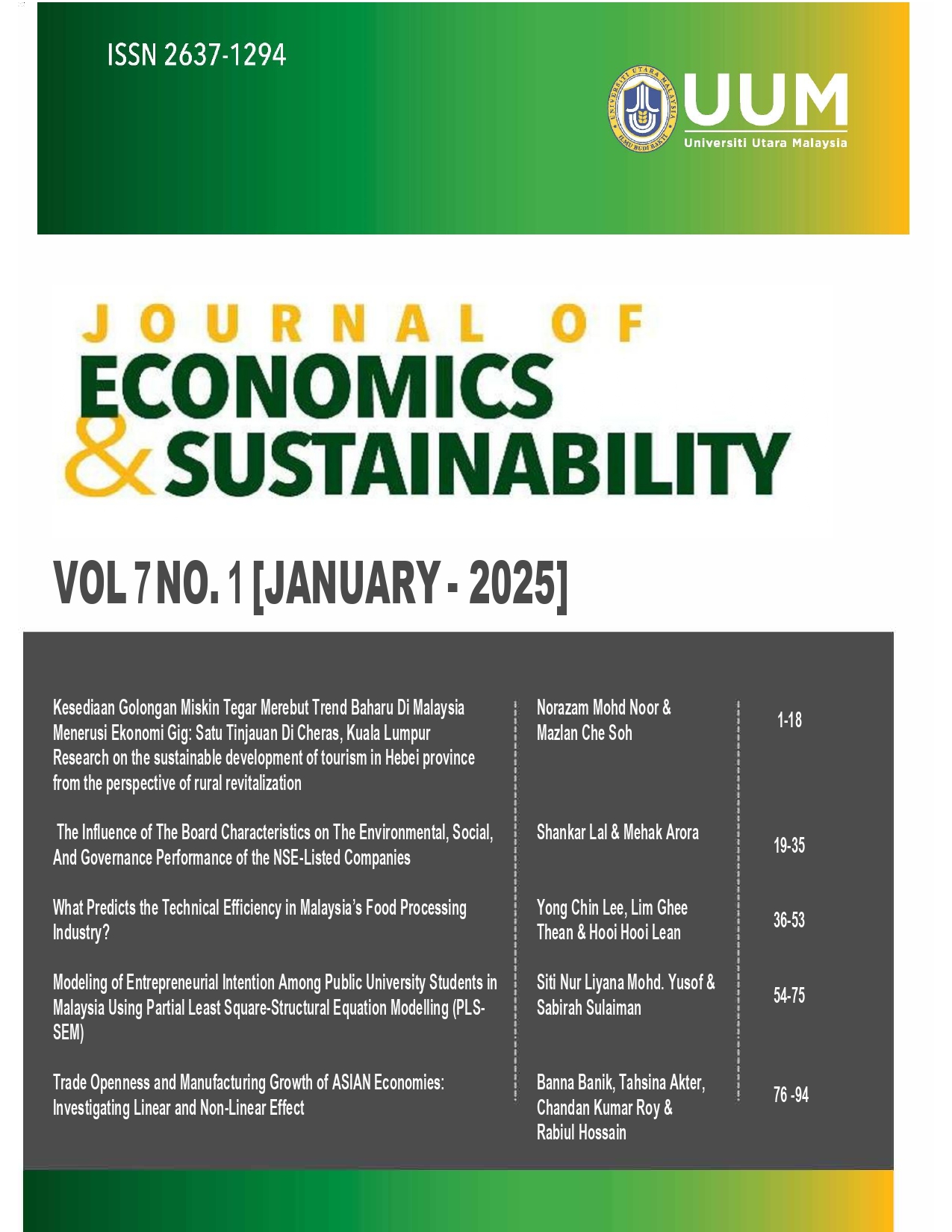
The Influence of the Board Characteristics on the Environmental, Social, and Governance Performance of the NSE-Listed Companies
DOI:
https://doi.org/10.32890/jes2025.7.1.2Kata kunci:
Social and governance, environmental, ESG performance, critical mass, board sizeAbstrak
This article examines how the size of the board, the presence of women on the board, and the critical mass of women on the board affect the environmental, social, and governance (ESG) performance of companies listed on the NSE. This study is a cross-sectional analysis that relies on secondary data from the CRISIL database and examines a sample of 973 companies listed on the NSE. The Credit Rating Information Services of India Limited (CRISIL) assigns an ESG score to assess Indian firms' ESG performance. We collected data on female representation and board size from the yearly reports of the firms and their respective websites. Our investigation findings indicate that Indian corporations prioritize social and governance issues more significantly than environmental concerns. The results indicate that the board characteristics have a varied impact on the ESG performance of the companies listed on the NSE.
Rujukan
Abeysekera, I. (2010). The influence of board size on intellectual capital disclosure by Kenyan listed firms. Journal of Intellectual Capital, 11(4), 504-518.
Adams, R. B., & Ferreira, D. (2009). Women in the boardroom and their impact on governance and performance. Journal of financial economics, 94(2), 291-309.
Adams, R. B., & Funk, P. (2012). Beyond the glass ceiling: Does gender matter? Management Science, 58(2), 219-235.
Adams, R. B., Licht, A. N., & Sagiv, L. (2011). Shareholders and stakeholders: How do directors decide? Strategic Management Journal, 32(12), 1331-1355.
Agnihotri, S., Kumar, P., & Attree, A. K. (2022). An Empirical Study of Business Responsibility Reporting as ESG Perspective in Select Indian Banks. The Management Accountant Journal, 57(3), 75-79.
Ahmed Haji, A., & Mohd Ghazali, N. A. (2013). A longitudinal examination of intellectual capital disclosures and corporate governance attributes in Malaysia. Asian Review of Accounting, 21(1), 27-52.
Aldowaish, A., Kokuryo, J., Almazyad, O., & Goi, H. C. (2022). Environmental, social, and governance integration into the business model: Literature review and research agenda. Sustainability, 14(5), 2959.
Allemand, I., Bédard, J., Brullebaut, B., & Deschênes, J. (2022). Role of old boys’ networks and regulatory approaches in selection processes for female directors. British Journal of Management, 33(2), 784-805.
Al-Shaer, H., Zaman, M., & Albitar, K. (2024). CEO gender, critical mass of board gender diversity and ESG performance: UK evidence. Journal of Accounting Literature.
Ashraf, D., Rizwan, M. S., & L’Huillier, B. (2022). Environmental, social, and governance integration: the case of microfinance institutions. Accounting & Finance, 62(1), 837-891.
Ben-Amar, W., Chang, M., & McIlkenny, P. (2017). Board gender diversity and corporate response to sustainability initiatives: Evidence from the carbon disclosure project. Journal of Business Ethics, 142(2), 369-383. Ben‐Amar, W., Francoeur, C., Hafsi, T., & Labelle, R. (2013). What makes better boards? A closer look at diversity and ownership. British Journal of Management, 24(1), 85-101.
Bhatia, A., & Dhawan, A. (2023). Legitimizing CSR through the institutional backup–gauging compliance of the Indian corporate sector in the mandatory regime. International Journal of Law and Management, 65(6), 614-634.
Birindelli, G., Iannuzzi, A. P., & Savioli, M. (2019). The impact of women leaders on environmental performance: Evidence on gender diversity in banks. Corporate Social Responsibility and Environmental Management, 26(6), 1485-1499.
Braun, P. (2010). Going green: women entrepreneurs and the environment. International Journal of Gender and Entrepreneurship, 2(3), 245-259. Cabeza‐García, L., Fernández‐Gago, R., & Nieto, M. (2018). Do board gender diversity and director typology impact CSR reporting? European Management Review, 15(4), 559-575.
Cambrea, D. R., Paolone, F., & Cucari, N. (2023). Advisory or monitoring role in ESG scenario: Which women directors are more influential in the Italian context? Business Strategy and the Environment, 32(7), 4299-4314.
Campbell, K., & Mínguez-Vera, A. (2008). Gender diversity in the boardroom and firm financial performance. Journal of business ethics, 83, 435-451.
Cappucci, M. (2018). The ESG integration paradox. Journal of Applied Corporate Finance, 30(2), 22-28.
Carter, D. A., D’Souza, F., Simkins, B. J., & Simpson, W. G. (2010). The gender and ethnic diversity of US boards and board committees and firm financial performance. Corporate Governance: An International Review, 18(5), 396-414.
Chamnankij, O., & Suttipun, M. (2016). The relationship between corporate governance and triple bottom line disclosures on websites: a case study of listed companies in the Stock Exchange of Thailand. Journal of Business Administration, 38(149), 23-43.
Chams, N., & García-Blandón, J. (2019). Sustainable or not sustainable? The role of the board of directors. Journal of Cleaner Production, 226, 1067–1081.
Chopra, C. (2016). Standards compliance in environmental, social and governance practices in Indian companies and the inflow of foreign capital in India. The Business & Management Review, 7(4), 74.
Coles, J. L., Daniel, N. D., & Naveen, L. (2008). Boards: Does one size fit all? Journal of financial economics, 87(2), 329-356.
Cook, A., & Glass, C. (2018). Women on corporate boards: Do they advance corporate social responsibility? Human relations, 71(7), 897-924.
Cosma, S., Leopizzi, R., Pizzi, S., & Turco, M. (2021). The stakeholder engagement in the European banks: Regulation versus governance. What changes after the NF directive? Corporate Social Responsibility and Environmental Management, 28(3), 1091-1103.
Daily, C. M., & Dalton, D. R. (2003). Women in the boardroom: A business imperative. Journal of Business strategy, 24(5).
Dalton, D. R., Daily, C. M., Johnson, J. L., & Ellstrand, A. E. (1999). Number of directors and financial performance: A meta-analysis. Academy of Management journal, 42(6), 674-686.
Dawson, L. M. (1997). Ethical differences between men and women in the sales profession. Journal of Business Ethics, 16, 1143-1152.
De Masi, S., Słomka‐Gołębiowska, A., Becagli, C., & Paci, A. (2021). Toward sustainable corporate behavior: The effect of the critical mass of female directors on environmental, social, and governance disclosure. Business Strategy and the Environment, 30(4), 1865-1878.
Dobija, D., Hryckiewicz, A., Zaman, M., & Puławska, K. (2022). Critical mass and voice: Board gender diversity and financial reporting quality. European Management Journal, 40(1), 29-44.
Eagly, A. H., & Johannesen‐Schmidt, M. C. (2001). The leadership styles of women and men. Journal of social issues, 57(4), 781-797.
Eagly, A. H., & Johnson, B. T. (1990). Gender and leadership style: A meta-analysis. Psychological bulletin, 108(2), 233.
Eisenberg, T., Sundgren, S., & Wells, M. T. (1998). Larger board size and decreasing firm value in small firms. Journal of financial economics, 48(1), 35-54.
Elmagrhi, M. H., Ntim, C. G., Elamer, A. A., & Zhang, Q. (2019). A study of environmental policies and regulations, governance structures, and environmental performance: The role of female directors. Business strategy and the environment, 28(1), 206-220.
Erokhina, A. V. (2022). Implementing an ESG strategy using the Sustainability Balanced Scorecard. Ekonomika: vchera, segodnya, zavtra, 12, 404-413.
Esa, E., & Anum Mohd Ghazali, N. (2012). Corporate social responsibility and corporate governance in Malaysian government‐linked companies. Corporate Governance, 12(3), 292–305.
Friede, G., Busch, T., & Bassen, A. (2015). ESG and financial performance: aggregated evidence from more than 2000 empirical studies. Journal of sustainable finance & investment, 5(4), 210-233.
Galbreath, J. (2018). Is board gender diversity linked to financial performance? The mediating mechanism of CSR. Business & Society, 57(5), 863-889.
García-Sánchez, I. M., Rodríguez-Domínguez, L., & Frías-Aceituno, J. V. (2015). Board of directors and ethics codes in different corporate governance systems. Journal of Business Ethics, 131, 681-698.
Giannarakis, G. (2014). The determinants influencing the extent of CSR disclosure. International Journal of Law and Management, 56(5), 393-416.
Gilligan, C. (1993). In a different voice: Psychological theory and women’s development. Harvard university press.
Glass, C., Cook, A., & Ingersoll, A. R. (2016). Do women leaders promote sustainability? Analyzing the effect of corporate governance composition on environmental performance. Business Strategy and the Environment, 25(7), 495-511.
Gregory, R. P. (2022). ESG activities and firm cash flow. Global Finance Journal, 52, 100698.
Gunningham, N. A., Thornton, D., & Kagan, R. A. (2005). Motivating management: Corporate compliance in environmental protection. Law & Policy, 27(2), 289-316.
Gupta, N., & Chanchal, A. (2022). Mainstreaming ESG and Role of the Board. J. on Governance, 5, 1.
Gupta, R., & Motwani, A. (2022). ESG Reporting in India: Current Scenario. Corporate Governance Insight, 88-104.
Hasan, A., Aly, D., & Hussainey, K. (2022). Corporate governance and financial reporting quality: a comparative study. Corporate Governance: The International Journal of Business in Society, 22(6), 1308-1326.
Huang, Y. S., & Wang, C. J. (2015). Corporate governance and risk-taking of Chinese firms: The role of board size. International Review of Economics & Finance, 37, 96-113.
Joecks, J., Pull, K., & Vetter, K. (2013). Gender diversity in the boardroom and firm performance: What exactly constitutes a “critical mass?”. Journal of business ethics, 118, 61-72.
Kanter, R. M. (1977). Men and women of the corporation. New York: Basic Books.
Kara, A., Nanteza, A., Ozkan, A., & Yildiz, Y. (2022). Board gender diversity and responsible banking during the COVID-19 pandemic. Journal of Corporate Finance, 74, 102213.
Kizys, R., Mamatzakis, E. C., & Tzouvanas, P. (2023). Does genetic diversity on corporate boards lead to improved environmental performance? Journal of International Financial Markets, Institutions and Money, 84, 101756.
Konrad, A. M., Kramer, V., & Erkut, S. (2008). Critical mass: The impact of three or more women on corporate boards. Organizational dynamics, 37(2), 145-164.
Lagasio, V., & Cucari, N. (2019). Corporate governance and environmental social governance disclosure: A meta‐analytical review. Corporate social responsibility and environmental management, 26(4), 701-711.
Levi, M., Li, K., & Zhang, F. (2014). Director gender and mergers and acquisitions. Journal of Corporate Finance, 28, 185-200.
Liao, Z., Zhang, M., & Wang, X. (2019). Do female directors influence firms’ environmental innovation? The moderating role of ownership type. Corporate Social Responsibility and Environmental Management, 26(1), 257-263.
Lin, T. L., Liu, H. Y., Huang, C. J., & Chen, Y. C. (2018). Ownership structure, board gender diversity, and charitable donation. Corporate Governance: The international journal of business in society, 18(4), 655-670.
Liu, C. (2018). Are women greener? Corporate gender diversity and environmental violations. Journal of Corporate Finance, 52, 118-142.
Liu, S., Wang, K. T., & Walpola, S. (2023). Female board representation and the adoption of corporate social responsibility criteria in executive compensation contracts: International evidence. Journal of International Financial Markets, Institutions and Money, 82, 101685.
Loo, R. (2003). Are women more ethical than men? Findings from three independent studies. Women in Management Review, 18(4), 169-181.
Lu, J., & Herremans, I. M. (2019). Board gender diversity and environmental performance: An industries perspective. Business Strategy and the Environment, 28(7), 1449-1464.
Lund, D. B. (2008). Gender differences in ethics judgment of marketing professionals in the United States. Journal of Business Ethics, 77, 501-515.
Main, B. G., & Gregory‐Smith, I. (2018). Symbolic management and the glass cliff: Evidence from the boardroom careers of female and male directors. British journal of management, 29(1), 136-155.
Maji, S. G., & Lohia, P. (2023). Environmental, social and governance (ESG) performance and firm performance in India. Society and Business Review, 18(1), 175-194.
Majumder, R., & Hussain, A. (2023). Legal Framework for Corporate Sustainability Reporting in India. International Journal of Engineering Technology and Management Sciences, 7(1), 28-33. Martínez‐García, I., Terjesen, S., & Gómez‐Ansón, S. (2022). Board gender diversity codes, quotas and threats of supranational legislation: impact on director characteristics and corporate outcomes. British Journal of Management, 33(2), 753-783.
Mason, E. S., & Mudrack, P. E. (1996). Gender and ethical orientation: A test of gender and occupational socialization theories. Journal of Business Ethics, 15, 599-604.
Menicucci, E., & Paolucci, G. (2022). Board diversity and ESG performance: Evidence from the Italian banking sector. Sustainability, 14(20), 13447. Mensi‐Klarbach, H., & Seierstad, C. (2020). Gender quotas on corporate boards: Similarities and differences in quota scenarios. European Management Review, 17(3), 615-631. Mishra, A., & Yadav, M. P. S. A Descriptive Study of ESG Investing: A Way Towards Sustainability. The Indian Renaissance: Aatm-Nirbhar Bharat Transforming India’s Management Landscape, 185.
Mitra, R. (2012). “My country’s future”: A culture-centered interrogation of corporate social responsibility in India. Journal of Business Ethics, 106, 131-147.
Naklerd, S., & Suttipun, M. (2016). An influence of corporate governance on environmental disclosures of listed companies in the Stock Exchange of Thailand. Chulalongkon Business Review, 38(149), 23-44.
Nielsen, S., & Huse, M. (2010). The contribution of women on boards of directors: Going beyond the surface. Corporate governance: An international review, 18(2), 136-148.
Nuber, C., & Velte, P. (2021). Board gender diversity and carbon emissions: European evidence on curvilinear relationships and critical mass. Business Strategy and the Environment, 30(4), 19581992.
Post, C., Rahman, N., & McQuillen, C. (2015). From board composition to corporate environmental performance through sustainability-themed alliances. Journal of Business Ethics, 130, 423-435.
Post, C., Rahman, N., & Rubow, E. (2011). Green governance: Boards of directors’ composition and environmental corporate social responsibility. Business & society, 50(1), 189-223.
Pramanik, A. K., Shil, N. C., & Das, B. (2008). Corporate environmental reporting: An emerging issue in the corporate world. International Journal of Business and management, 3(12), 146-154.
Rao, K., & Tilt, C. (2016). Board composition and corporate social responsibility: The role of diversity, gender, strategy and decision making. Journal of business ethics, 138, 327-347.
Rosette, A. S., & Tost, L. P. (2010). Agentic women and communal leadership: How role prescriptions confer advantage to top women leaders. Journal of applied psychology, 95(2), 221.
Samaha, K., Khlif, H., & Hussainey, K. (2015). The impact of board and audit committee characteristics on voluntary disclosure: A meta-analysis. Journal of International Accounting, Auditing and Taxation, 24, 13-28.
Sekar, A., & Krishnan, R. (2022). ESG-Marching Towards Sustainable Development Goals. The Management Accountant Journal, 57(3), 17-21. Setó‐Pamies, D. (2015). The relationship between women directors and corporate social responsibility. Corporate social responsibility and environmental management, 22(6), 334-345.
Shaukat, A., Qiu, Y., & Trojanowski, G. (2016). Board attributes, corporate social responsibility strategy, and corporate environmental and social performance. Journal of Business Ethics, 135, 569-585.
Shohaieb, D., Elmarzouky, M., & Albitar, K. (2022). Corporate governance and diversity management: evidence from a disclosure perspective. International Journal of Accounting & Information Management, 30(4), 502-525.
Siciliano, J. I. (1996). The relationship of board member diversity to organizational performance. Journal of business ethics, 15, 1313-1320.
Suttipun, M. (2021). The influence of board composition on environmental, social and governance (ESG) disclosure of Thai listed companies. International Journal of Disclosure and Governance, 18(4), 391-402.
Terjesen, S., Sealy, R., & Singh, V. (2009). Women directors on corporate boards: A review and research agenda. Corporate governance: an international review, 17(3), 320-337.
Torchia, M., Calabrò, A., & Huse, M. (2011). Women directors on corporate boards: From tokenism to critical mass. Journal of business ethics, 102, 299-317.
Uchida, K. (2011). Does corporate board downsizing increase shareholder value? Evidence from Japan. International Review of Economics & Finance, 20(4), 562-573.
Yarram, S. R., & Adapa, S. (2021). Board gender diversity and corporate social responsibility: Is there a case for critical mass? Journal of cleaner production, 278, 123319.
Yu, E. P. Y., Van Luu, B., & Chen, C. H. (2020). Greenwashing in environmental, social and governance disclosures. Research in International Business and Finance, 52, 101192.
Zalata, A. M., Tauringana, V., & Tingbani, I. (2018). Audit committee financial expertise, gender, and earnings management: does gender of the financial expert matter? International review of financial analysis, 55, 170-183.
Zhang, J. Q., Zhu, H., & Ding, H. B. (2013). Board composition and corporate social responsibility: An empirical investigation in the post Sarbanes-Oxley era. Journal of business ethics, 114, 381-392.
Muat turun
Diterbitkan
Terbitan
Bahagian
Lesen
Hak Cipta (c) 2025 Journal of Economics and Sustainability

Kerja ini dilesenkan di bawah Creative Commons Attribution 4.0 International License.




