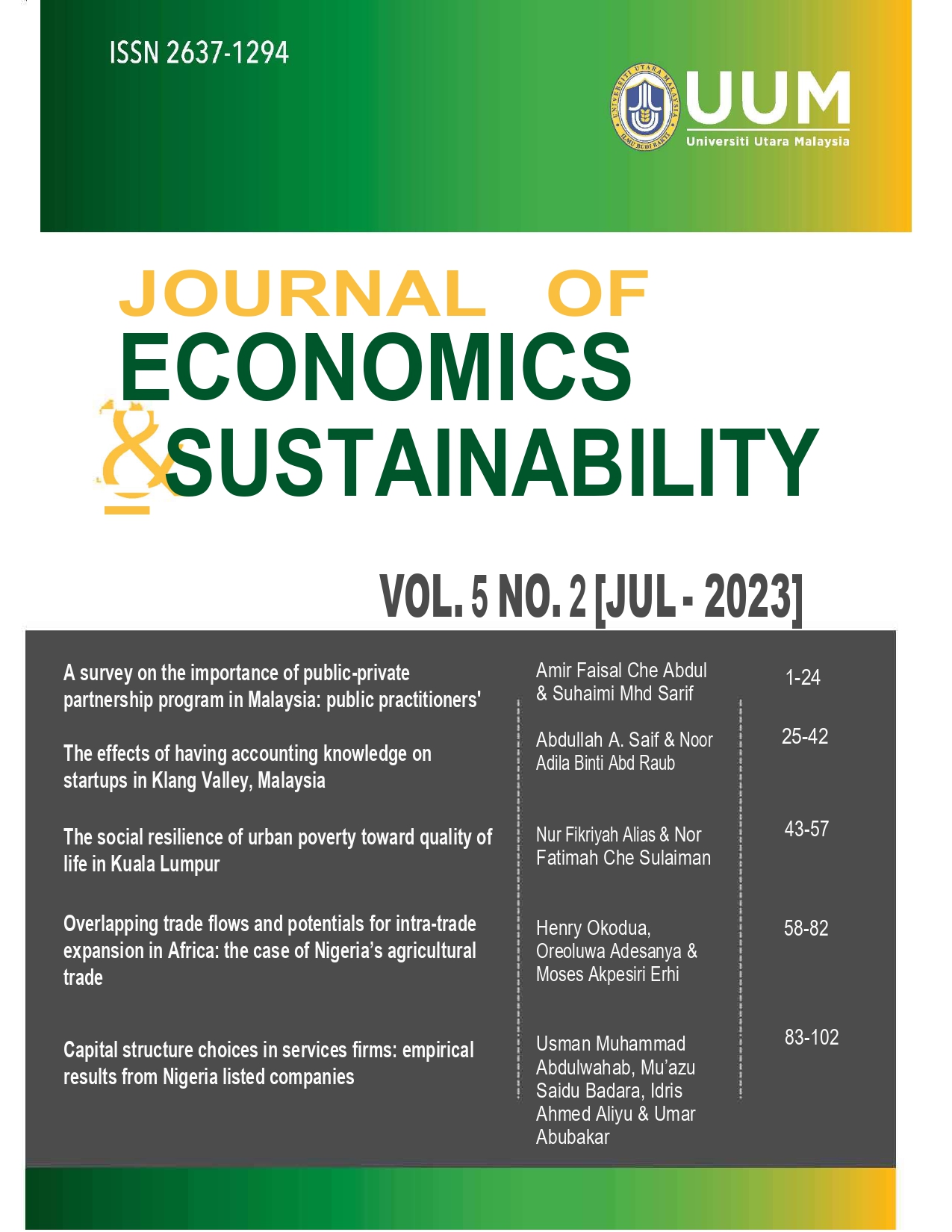
THE Social Resilience of Urban Poverty Toward Quality of Life in Kuala Lumpur
DOI:
https://doi.org/10.32890/jes2023.5.2.3Kata kunci:
urban poor, social resilience, low-income householdsAbstrak
Urban poverty in Malaysia has become a more prominent problem that is increasingly risking the quality of life. Meanwhile, resilience plays a very vital role in poor urban communities. Poverty will hinder sustainable development and a better quality of life. Improving the quality of life has always been the focus of the Malaysian government. Recent years have seen attempts to address this need for more community resilience research that investigates the impacts of poverty. Thus, examining a community’s resilience to poverty will produce communities that are resilient to urban pressures and challenges to improve their quality of life. This study aims to evaluate the social resilience of urban poverty toward quality of life in Kuala Lumpur. This study showed that higher resilience in poor communities can be justified by determining social resilience, such as participation in the community, decision-making and community trust. This study used quantitative methods for data collection. The questionnaire was administered using a sample of 400 respondents from urban poor households in Kuala Lumpur. Descriptive and correlation regression analysis was in this study. The findings of this study showed that the relationship between social resilience, participation in the community of the urban poor in Kuala Lumpur, and quality of life is significant.
Rujukan
Chong, N. O., Kamarudin, K. H., & Abd Wahid, S. N. (2018). Framework considerations for community resilience to disaster in Malaysia. Procedia Engineering, 212, 165-172.
Department of Statistics Malaysia. (2019). Population and Housing Census of Malaysia 2010. Putrajaya: Malaysia Department of Statistics.
Department of Statistics Malaysia (2020). Launching of Report on the Key Findings of the
Population and Housing Census of Malaysia 2020. Putrajaya: Malaysia Department of Statistics.
Department of Statistics Malaysia (2020). Poverty. https://www.dosm.gov.my/v1/index.php?r=column/cthemeByCat&cat=120&bul_id=TU0 0TmRhQ1N5TUxHVWN0T2VjbXJYZz09&menu_id=amVoWU54UTl0a21NWmdhMj FMMWcyZz09
Diehl, J. A. (2020). Growing for Sydney: Exploring the urban food system through farmers’ social networks. Sustainability, 12(8), 3346.
Economic Planning Unit. (2011). Malaysia Quality of Life Index (MQLI) 2011.
Hassan, N. Z. M., Kassim, E. S., Mohd Tobi, S. N., & Munir, R. S. (2017). Measuring Protective Factors to Resilience: A Study on Malaysian Young Adults. Advanced Science Letters, 23(1), 592-595.
Jayasooria, D. (2016). Inclusive development for urban poor and the Bottom 40% of communities in Malaysia. University Kebangsaan Malaysia: Bangi Selangor, Malaysia.
Maybery, D., Pope, R., Hodgins, G., Hitchenor, Y., & Shepherd, A. (2009). Resilience and wellbeing of small inland communities: Community assets as key determinants. Rural Society, 19(4), 326-339.
McCrea, R., Walton, A., & Leonard, R. (2016). Developing a model of community well-being and resilience in response to change. Social Indicators Research, 129(1), 195-214.
Mohamad, N., Jusoh, H., & Kassim, Z. (2019). Localizing of community resilience indicators for assessing urban community resilience in Putrajaya, Malaysia. International Journal of Engineering and Advanced Technology, 8(5), 359-365. Muhamad, S., Nawawi, M. N., Kulub Abd Rashid, N., Kusairi, S., Nik Mohd Kamil, N. F., &
Samsudin, H. (2019). Livelihood Resilience: The Case of Sungai Terengganu Communities. In Greater Kenyir Landscapes (pp. 271-286). Springer, Cham.
United Nations Development Programme. (1998). Human Development Report 1998. Oxford University Press, Inc. https://hdr.undp.org/system/files/documents//hdr1998encompletenostatspdf.pdf
Papadaki, M., & Kalogeraki, S. (2017). Social support actions as forms of building community resilience at the onset of the crisis in urban Greece: The case of Chania. Partecipazione e Conflitto, 10(1), 193-220.
Peters, D. J. (2019). Community resiliency in declining small towns: Impact of population loss on quality of life over 20 years. Rural Sociology, 84(4), 635-668.
Rosli, N. F., Rabe, N. S., Osman, M. M., & Abdullah, M. F. (2018). Perception of quality of life among the community in Selangor. Planning Malaysia, 16.
Siwar, C., Ahmed, F., Bashawir, A., & Mia, M. S. (2016). Urbanization and urban poverty in Malaysia: consequences and vulnerability. Journal of Applied Sciences, 16(4), 154-160.
Te Lintelo, D., Gupte, J., McGregor, J. A., Lakshman, R., & Jahan, F. (2017). Wellbeing and urban governance: Who fails, survives, or thrives in informal settlements in Bangladeshi cities? Cities, 72(B), 391-402.
Walton, A., McCrea, R., & Leonard, R. (2014). CSIRO survey of community wellbeing and responding to change: Western Downs region in Queensland. Australia: CSIRO Land and Water. http://gisera.org.au/publications/tech_reports_papers/socioeco-proj-3-communitywellbeing-report.pdf
World Bank. (1990). The World Bank Annual Report 1990. World Bank Publication.
World Bank. (2015). The World Bank Annual Report 2015. World Bank Publications.
Youssef, M., & El Baba, N. (2017). Guidelines for upgrading the quality of life in low-income areas: a case study–Sabra-Tarik Jdideh, Beirut, Lebanon. WIT Transactions on Ecology and the Environment, 226, 391-403.
Zainal, N. R., Kaur, G., Ahmad, N. A., & Khalili, J. M. (2012). Housing conditions and quality of life of the urban poor in Malaysia. Procedia-Social and Behavioural Sciences, 50, 827838.
Muat turun
Diterbitkan
Terbitan
Bahagian
Lesen
Hak Cipta (c) 2023 Journal of Economics and Sustainability

Kerja ini dilesenkan di bawah Creative Commons Attribution 4.0 International License.




