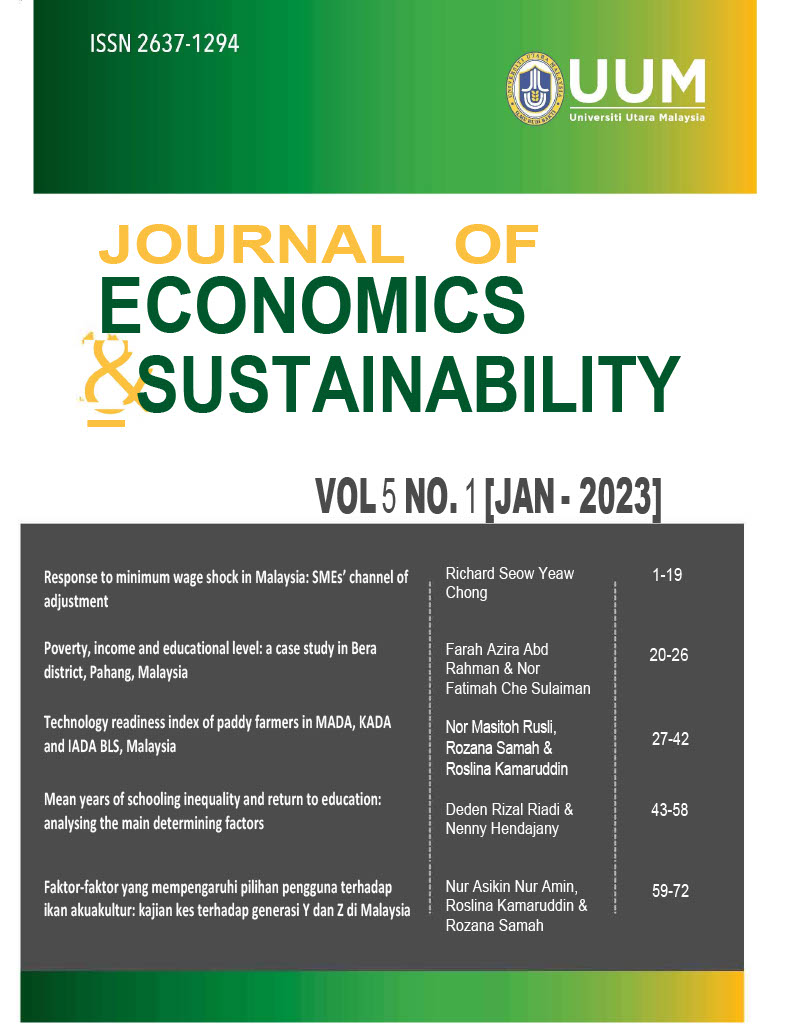
Poverty, Income, and Educational Level: A Case Study in Bera District, Pahang, Malaysia
DOI:
https://doi.org/10.32890/jes2023.5.1.2Kata kunci:
Family poverty, rural communities, primary education, income, employment opportunitiesAbstrak
Low levels of education and low income are often associated with communities located in rural areas. This is because rural communities have many constraints in obtaining education, employment opportunities, and earning a high income. This study aims to examine the factors that cause poverty in rural communities and investigate the socio-economic position and level of educational achievement of parents and children in rural communities in Bera District, Pahang, Malaysia. This study used a quantitative method for data collection. Questionnaires were administered to 100 respondents from the community living in the Bera district. Data obtained from respondents were analysed using Microsoft Excel and SPSS software through the Chi-square method. The study found that almost 51 percent of respondents agreed that the factors that drive poverty in rural families are the low education of household heads and the income earned by household heads based on their education level. In addition, a total of 59 respondents agreed with the issue of low education standards affecting the low level of income; 74 respondents agreed with the lack of employment opportunities in rural areas; and 59 respondents agreed that the education of the household heads makes it difficult for the children to get a good and higher education. As a result, the emphasis and opportunities on education, income, and employment opportunities, particularly in rural areas, must be increased more precisely.
Rujukan
Aini Samani & Suriati Ghazali (2018). Culture of poverty among the poor Malay in Seri Medan subdistrict of Batu Pahat, Johor. Perspective Journal of Social Science and Humanities, 10 (2) 58-65.
Asan Ali G. H., Mahani Mohd, Noor Al-Huda A. K., & Hassan A. (1999). Kemiskinan & Agihan Pendapatan di Tanah Rancangan FELDA. UUM Press, ISBN: 983-9559-54-0
DOSM (2020). The Key Findings: Income, Poverty, Inequality, Expenditure, Basic Amenities. Department of Statistics Malaysia.
DOSM (2021). Household Income Estimates and Incidence Poverty 2020. Department of Statistic Malaysia..
Jayasooria, D. (2016). Inclusive Development for Urban Poor & Bottom 40% Communities in Malaysia. UKM Ethnic Studies Paper Series, Institut Kajian Etnik (KITA), Bangi UKM, UKM Publisher.
Marwan, A., Sumintono, B., & Mislan, N. (2012). Revitalising rural schools: A challenge for Malaysia. Educational Issues, Research and Policies, 1(1), 172-188.
Narimah Samat, Siti Masayu Rosliah Abdul Rashid & Yasin Abdalla Elhadary (2018), Analysing Spatial Distribution of Poverty Incidence in Northern Region of Peninsular Malaysia. Asian Social Science, 14 (12), 86-96.
Nor Diana Mohd Idris (2013). Socio-economic Determination of Rural Income and Poverty: Case Study of Integrated Agricultural Development Project in Samarahan, Sarawak, Malaysia. Institute of Environment and Development (LESTARI), UKM Publisher.
Nor Fairani Ahmad, Mariani Mansor & Laily Paim. (2016). Income Poverty and Well-Being among Vulnerable Households: A Study in Malaysia. Asian Social Science; 12(2), 195-204.
Siti Hadijah Che Mat (2012). Multi-dimensional Poverty Index As an Alternative to Poverty Measurement: A Case Study in Baling District, Kedah. UUM Press.
Siti Masayu Rosliah Abdul Rashid. (2009). Educational Opportunities and Challenges among Rural Communities: A Case Study of Poor Malay Households in Bachok District, Kelantan. Unpublished Master’s Thesis, Universiti Sains Malaysia.
Zalika Adam, Faridah Kassim, Mohamad Johdi Salleh (2009) Empowering Rural Education. Proceedings of the National Conference on Rural Education 2009. 3-5 Feb 2009 Hotel Baverly Kota Kinabalu Sabah. School of Social Development and Education, Universiti Malaysia Sabah, UMS Publisher.
Zurina Ahmad Saidi, Hukil Sino & Norinsan Kamil Othman. (2018). Characteristic of Education and Socio-Economic Population at Sungai Budor Village, Kelantan Darul Naim, Journal of Social Sciences and Humanities, 13 (3), 222-233.
Muat turun
Diterbitkan
Terbitan
Bahagian
Lesen
Hak Cipta (c) 2023 Journal of Economics and Sustainability

Kerja ini dilesenkan di bawah Creative Commons Attribution 4.0 International License.




