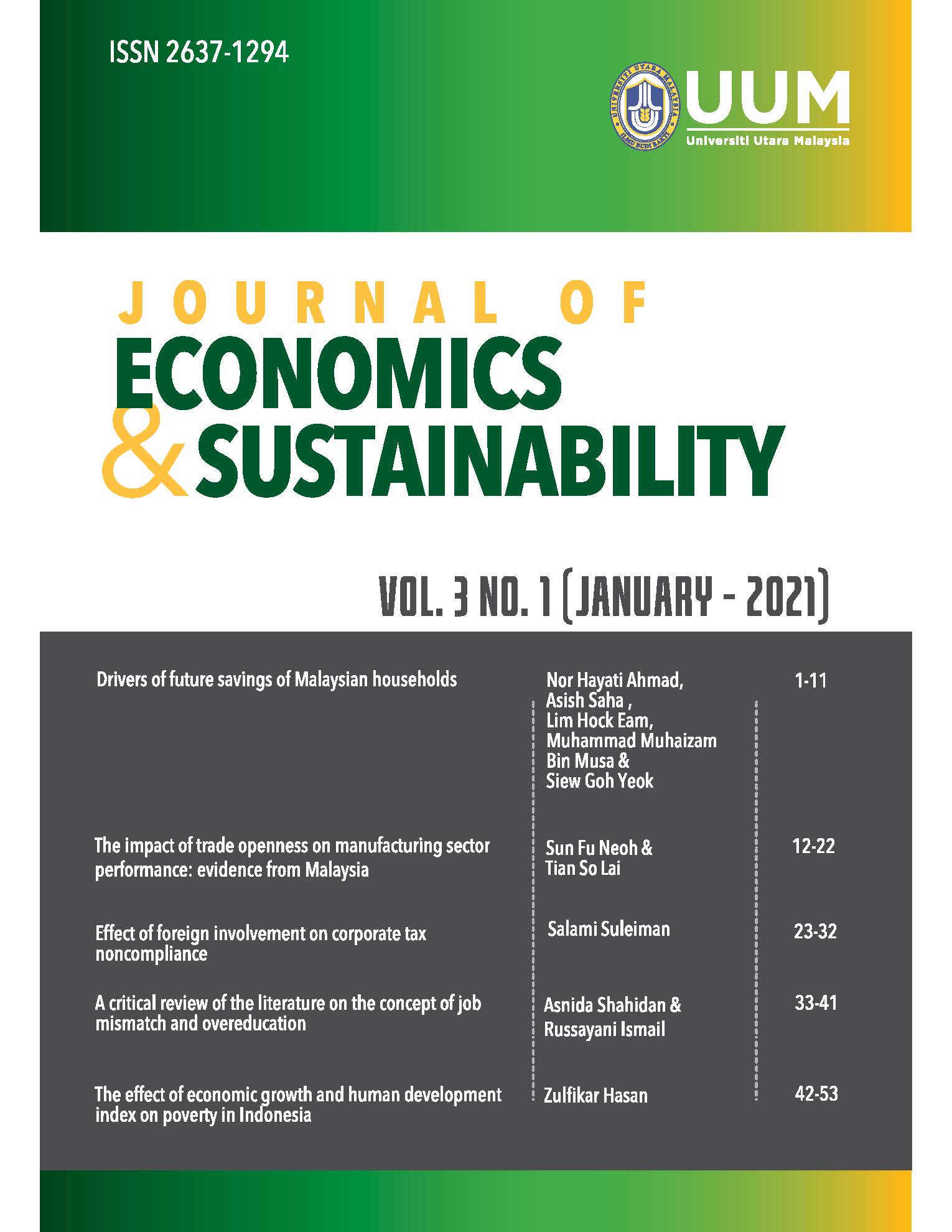
A Critical Review of the Literature on the Concept of Job Mismatch and Overeducation

Pengarang

  • Asnida Shahidan Universiti Utara Malaysia, Malaysia
  • Russayani Ismail Universiti Utara Malaysia, Malaysia

DOI:

https://doi.org/10.32890/jes2021.3.1.4

Kata kunci:

Mismatch, overeducation, qualification, graduate, job

Abstrak

Job-education mismatch and overeducation issues among graduates have been discussed extensively, specifically related to the incidents, determinants, methods of measurement, and the effects of the mismatch. Despite this, the concept of job-education mismatch itself is not clearly explained. Since understanding this concept has theoretical and practical implications, this paper provides a critical review of the job mismatch concept and relates it to overeducation, which is a type of job-education imbalance under a vertical mismatch. This study relies solely on the literature review and does not provide any empirical evidence related to these concepts. A few issues have been highlighted and worth considering for further deliberation. Firstly, even though job-education mismatch, overeducation, overqualification, and underemployment are interchangeably used, these concepts have quite a distinct meaning. Secondly, when individuals’ skills are considered in discussing vertical and horizontal mismatch, the scope of mismatch tends to be broader than that of overeducation. Thirdly, the discussion on overeducation tends to concentrate on the level of study imbalance and not on both the level and type of study. Fourthly, job-education imbalance by the field of study (horizontal mismatch) is not easily defined, and the discussion tends to be related to overeducation.   

Received 16 May 20. Revised 27 Jul 20. Accepted 2 August 20.
Rujukan

Agut, S., Peiro, J. M., & Grau, R. (2009). The Effect of Overeducation on Job Content Innovation and Career-Enhancing Strategies Among Young Spanish Employees. Journal of Career Development, 36(2), 159–182.

Asnida Shahidan, Russayani Ismail & Siti Norliza Jumali. (2019). Job Mismatch and Overeducation among Graduates in Malaysia. Indian-Pacific Journal of Accounting and Finance, 3(4), 14-24.

Allen, J., & De Weert, E. (2007). What do educational mismatches tell us about mismatches? A cross country analysis. European Journal of Education, 42(1), 59-73.

Barcena-Martin, E., Budria, S., & Egido, A. (2011). Skill mismatches and wages among European university graduates. MRPA Paper No. 33673, 2011. Retrieved from http://mpra.ub.uni-muenchen.de/33673/

Battu, H., Belfield, C., & Sloane, P. (2000). How well can we measure graduate overeducation and its effects? National Institute Economic Review, 171, 82–93.

Betti, G., D’Agostino, A. & Neri, L. (2011). Educational Mismatch of Graduates: a Multidimensional and Fuzzy Approach. Working Paper. Retrieved from https://pdfs.semanticscholar.org/5a4b/40525024fea31cced0067a1e15f0f364a950.pdf

Beukes, R., Fransman, T., Murozvi, S. & Yu, D. (2017). Underemployment in South Africa. Journal Development Southern Africa, 34(1), 33-55.

Bol, T., Eller, C. C., Van de Werfhorst, H. G. & DiPrete, T. A. (2019). School-to-Work Linkages, Educational Mismatches, and Labor Market Outcomes. American Sociological Association, 84(2), 275-307.

Boudarbat, B. (2008). Field of study choice by community college students in Canada. Economics of Education Review, 27, 79–93.

Boudarbat, B., & Chernoff, V. (2012). Education–job match among recent Canadian university graduates. Applied Economics Letters, 19(18), 1923–1926. Bla´zquez, M., & Budrı´a, S. (2012). Overeducation dynamics and personality. Education Economics, 20(3), 260–283.

Caroleo, F. E. & Pastore, F. (2012). Overeducation at a glance. The wage penalty of the educational mismatch in the Italian graduate labour market, looking at the AlmaLaurea data, XXVII AIEL Conference, Caserta.

Chevalier, A. (2003). Measuring Over-education. Economica, 70(279), 509–531.

Croce, G. & Ghignoni, E. (2015). Educational mismatch and spatial flexibility in Italian local labour markets. Education Economics, 23(1), 25–46.

Department of Labour Peninsular Malaysia. (2013). Malaysia Standard Classification of Occupations (MASCO) 2013. Ministry of Human Resources. Retrieved from jtksm.mohr.gov.my/en/sumber-sumber/penerbitan/garis-panduan/814-malaysia-standard-classification-of-occupations-masco-2013.

Desjardins, R. & Rubenson, K. (2011). An Analysis of Skill Mismatch Using Direct Measures of Skills. Education Working Papers No. 63. Retrieve from https://www.researchgate.net/publication/254439630_An_Analysis_of_Skill_Mismatch_Us ing_Direct_Measures_of_Skills

Domadenik, P., Farcnik, D., & Pastore, F. (2013). Horizontal Mismatch in the Labour Market of Graduates: The Role of Signalling. IZA Discussion Paper No. 7527, Institute of Labor Economics. Journal of Economics and Sustainability

Farooq, S. (2011). Mismatch between education and occupation : A case study of Pakistani graduates. The Pakistan Development Review, 50(4), 531-552.

Frenette, M. (2004). The overqualified Canadian graduate: the role of the academic program in the incidence, persistence, and economic returns to overqualification. Economics of Education Review, 23(1), 29–45.

Gajderowicz, T., Grotkowska, G., & Wincenciak, L. (2014). Graduates’ job satisfaction across domains of study. International Journal of Manpower, 35(4), 470-499.

Garcia-Espejo, I., & Ibanez, M. (2006). Educational-skill mismatches and labor market achievements among graduates in Spain. European Sociological Review, 22(2), 141-156.

Groot, W., & Maassen van den Brink, H. (2000). Skill mismatches in the Dutch labor market. Internatinal Journal of Manpower, 21(8), 584-596.

Halaby, C. (1994). Overeducation and skill mismatch. Sociology of Education, 67(1), 47-59.

International Labor Organization. (2013). Global Employment Trends for Youth 2013 | A generation at risk. Retrieved from http://www.ilo.org/global/research/global-reports/global-employment-trends/ youth/2013/lang-en/index.htm

Ishak Yussof, Rahmah Ismail & Robiah Sidin. (2008). Graduan dan alam pekerjaan: Kes siswazah UKM. Akademika, 72, 3-24. Kebolehpasaran Graduan Tahun 2018. Accessed on 21 July 2019 from http://www.moe.gov.my/images/KPM/UKK/2019/04_Apr/infographicGE_2018.pdf

Kucel, A. (2011). Ensayo bibliográfico: Literature Survey of the Incidence of Over-education: A Sociological Approach, Reis, 134, 125–142. Retrieved from http://reis.cis.es/REIS/PDF/Reis_134_061302519925436.pdf

Li, F., & Wang, L. (2020). An empirical study on distance education and job match. Sustainability (Switzerland), 12(2). https://doi.org/10.3390/su12020619

Lim, H. E. (2013). Overeducation and happiness in the Malaysian graduate labour market. International Journal of Business and Society, 14(1), 93-110.

Linsley, I. (2005). Causes of overeducation in the Australian labor market. Australian Journal of Labour Economics, 8(2), 121-143.

Maynard, D. C., Brondolo, E. M., Conelly, C. E. & Sauer, C. E. (2015). I’m Too Good for This Job: Narcissism’s Role in the Experience of Overqualification. Applied Psychology: An International Review, 64(1), 208–232.

McKee-Ryan, F. M., & Harvey, J. (2011). “I Have a Job, But...”: A Review of Underemployment. Journal of Management, 37(4), 962–996.

Mehta, A., Felipe, J., Quising, P., & Camingue, S. (2011). Overeducation in developing economies: How can we test for it, and what does it mean? Economics of Education Review, 30(6), 1334–1347.

Meroni, E. C., & Vera-Toscano, E. (2017). The persistence of overeducation among recent graduates. Labour Economics, 48(July), 120–143. https://doi.org/10.1016/j.labeco.2017.07.002

Nordin, M., Persson, I., & Rooth, D. O. (2010), Education-Occupation Mismatch: Is There an Income Penalty? Economics of Education Review, 29(6): 1047-1059.

Ortiz, L., & Kucel, A. (2008). Do fields of study matter for over-education?: The cases of Spain and Germany. International Journal of Comparative Sociology, 49(4-5), 305–327.

Rahona-López, M., & Pérez-Esparrells, C. (2013). Educational attainment and educational mismatch in the first employment in Spain. Hindawi Publishing Corporation ISRN Education, vol 2013, artikel ID850827. Journal of Economics and Sustainability

Robert, P. (2014). Job mismatch in early career of graduates under post-communism. International Journal of Manpower, 35(4), 500-513.

Robst, J. (2007). Education and job match: The relatedness of college major and work. Economics of Education Review, 26(4), 397–407.

Sloane, P. J. (2007). Policy forum: Education and skill mismatches in the labour market. Overeducation in the United Kingdom. The Australian Economic Review, 40(3), 286–291.

Tarvid, A. (2013). Unobserved Heterogeneity in Overeducation Models: Is Personality More Important than Ability? Procedia Economics and Finance, 5, 722–731. International Conference On Applied Economics (ICOAE) 2013.

Thompson, K. W., Shea, T. H., Sikora, D. M., Perrewe P. L. & Ferris, G. R. (2013). Rethinking underemployment and overqualification in organizations: The not so ugly truth. Business Horizon, 56(1), 113-121.

Vaisey, S. (2006). Education and its discontents: Overqualification in America, 1972-2002. Social Forces, 85(2), 835-864.

Verhaest, D., & Omey, E. (2010). The determinants of overeducation: different measures, different outcomes? International Journal of Manpower, 31(6), 608–625.

Veselinović, L., Mangafić, J., & Turulja, L. (2020). The effect of education-job mismatch on net income: evidence from a developing country. Economic Research-Ekonomska Istrazivanja, 33(1), 2648-2669. https://doi.org/10.1080/1331677X.2020.1723427

Voon, D., & Miller, P. W. (2005). Undereducation and overeducation in the Australian labour market. The Economic Record, 81(255), S22–S33.

Wald, S. (2005). The impact of overqualification on job search. International Journal of Manpower, 26(2), 140-156.

Wang, Z. & Lu, H. & Wang, X. (2019). Psychological resilience and work alienation affect perceived overqualification and job crafting. Social Behavior and Personality, 47(2), 1-10.

Wolbers, M. H. J. (2003). Job mismatches and their labour-market effects among school-leavers in Europe. European Sociological Review, 19(3), 249-266.

Zainizam Zakariya (2014). Wage effects of over-education and mismatch in Malaysia: A random effect approach. Jurnal Ekonomi Malaysia, 48(2), 3-17.

Zainizam Zakariya & Battu, H. (2013). The effects of overeducation on multiple job satisfaction towards enhancing individuals‘ well-being in malaysia. Business and Management Quarterly Review, 4(3&4), 38-51.

Diterbitkan

2021-01-31

Cara Memetik

Shahidan, A., & Ismail, R. (2021). A Critical Review of the Literature on the Concept of Job Mismatch and Overeducation. Journal of Economics and Sustainability, 3(1), 9. https://doi.org/10.32890/jes2021.3.1.4

Artikel yang paling banyak dibaca oleh pengarang yang sama




