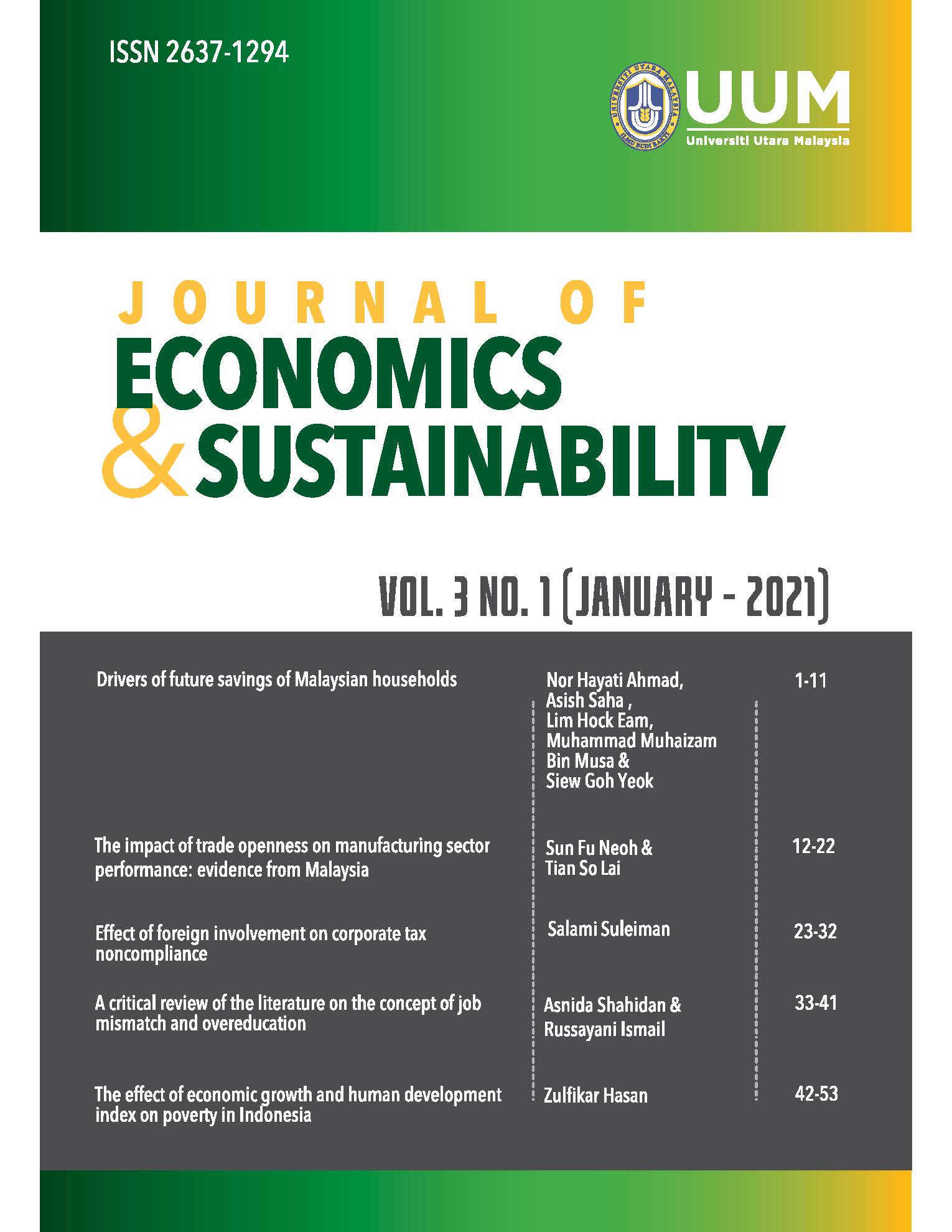
Effect of Foreign Involvement on Corporate Tax Noncompliance
DOI:
https://doi.org/10.32890/jes2021.3.1.3Kata kunci:
Corporate governance, Effective tax rates, foreign directors, tax noncomplianceAbstrak
There exists a potential decline in tax revenue to government among firms with foreign involvement. The main aim of the study is to examine the impact of foreign involvement on corporate tax noncompliance. The study focuses on the effects of foreign CEO, the percentage of foreign executive board members, and the ratio of stocks owned by foreign directors on corporate tax noncompliance. Data on manufacturing firms were utilized based on data availability from 2015 to 2019. Generally accepted accounting principle effective tax rate was utilized as a primary measure of tax noncompliance and fixed effect technique of regression analysis. Controlling for profitability, leverage, firm size and board size, the findings of the study revealed a significant negative effect of the percentage of foreign executives’ shareholding on GAAP ETR. Our result is robust to using cash effective tax rate as an alternative proxy for tax noncompliance. The implication of this finding is that an increase in foreign executive shares will reduce tax proceeds. Given the corporate tax implication, regulatory authorities should weigh the cost and benefit of a benchmark for foreign directors’ equity ownership.
Received 8 May 20. Revised 6 September 20. Accepted 17 September 20.
Rujukan
Armstrong, C. S., Blouin, J. L., Jagolinzer, A. D., & Larcker, D. F. (2014). Corporate governance,incentives and tax noncompliance. Retrieved from https:www.ssrn.com
Chritensen, R. & Murphy, J. (2004). The social responsibility of corporate tax noncompliance: taking CSR to the bottom line. Development, 47, 37-44
Chyz, J. A., Gaertner, F. B., Kausar, A. & Watson, L. (2015). Overconfidence and corporate tax policy. Online Paper. https://ntanet.org/wp-content/uploads/proceedings/2014/043-chyz-overconfidence-aggressive-corporate-tax-policy.pdf
Demirguc-Kunt, A. & Huizinga, H. (1999). The taxation of domestic and foreign banking. Journal of Public Economics, 79, 429-453.
Dyreng, S. D., M. Hanlon, & E. L. Maydew. (2010). The effects of executives on corporate tax noncompliance. The Accounting Review, 85(4), 1163-1189.
Egger, P., Eggert, W. & Winner, H. (2010). Savings taxes through foreign plant ownership. Journal of International Economics, 81, 99-108
Francis, B., Hasan. I., & Sun, X. (2012). CEO Political Affiliation and Firms’ Tax Noncompliance. http://ssrn.com/abstract=2015248
Francis, B., Hasan. I., Wu. Q., & Yan, M. (2014). Are Female CFOs Less Tax Aggressive? Evidence from Tax Noncompliance. Journal of the American Taxation Association, 36 (2), 171-202.
Frank, M. M., Lynch, L. J., & Rego, S. O. (2004). Does aggressive financial reporting accompany aggressive tax reporting (and vice versa)? Online paper. https://www8.gsb.columbia.edu/faculty-research/sites/faculty-research/files/accounting/REGO.pdf
Grubert, H. & Mutti, J. (1991). Taxes, tariffs and transfer pricing in multinational corporate decision making. The Review of Economics and Statistics, 73(2), 285-293
Guenther, D. A. (2014). Measuring corporate tax noncompliance: effective tax rates and book-tax differences. Working paper, University of Oregon.
Hanlon, M. & S. Heitzman. (2010). A review of tax research. Journal of Accounting and Economics, 50, 127-178.
Huizinga, H., & Nicodeme, G. (2003). Foreign ownership and corporate income taxation: an empirical evaluation. Centre for Economic Policy Research. Retrieved from https:www.ssrn.com
Katz, S., Khan, U. & Schmidt, A. P. (2015). Tax noncompliance and future profitability. Electronic copy available at: http://ssrn.com/abstract=2227149
Kubata, A., Lietz, G., & Watrin, C. (2015). Does Corporate Tax Noncompliance Impair Earnings Informativeness? Working paper, University of Münster.
Salihu, I. A., Annuar, H. A., & Obid, S. N. S., (2015). Foreign investors’ involvements and corporate tax noncompliance: Evidence from an emerging economy. Journal of Contemporary Accounting & Economics, 11, 138–147
Yongbo, Li. (2014). Tax-induced earnings management, auditor conservatism, and tax enforcement. Unpublished MPhil Dissertation, Lingnan University. Retrieved from https:www.ssrn.com
Muat turun
Diterbitkan
Terbitan
Bahagian
Lesen
Hak Cipta (c) 2021 Journal of Economics and Sustainability

Kerja ini dilesenkan di bawah Creative Commons Attribution 4.0 International License.




