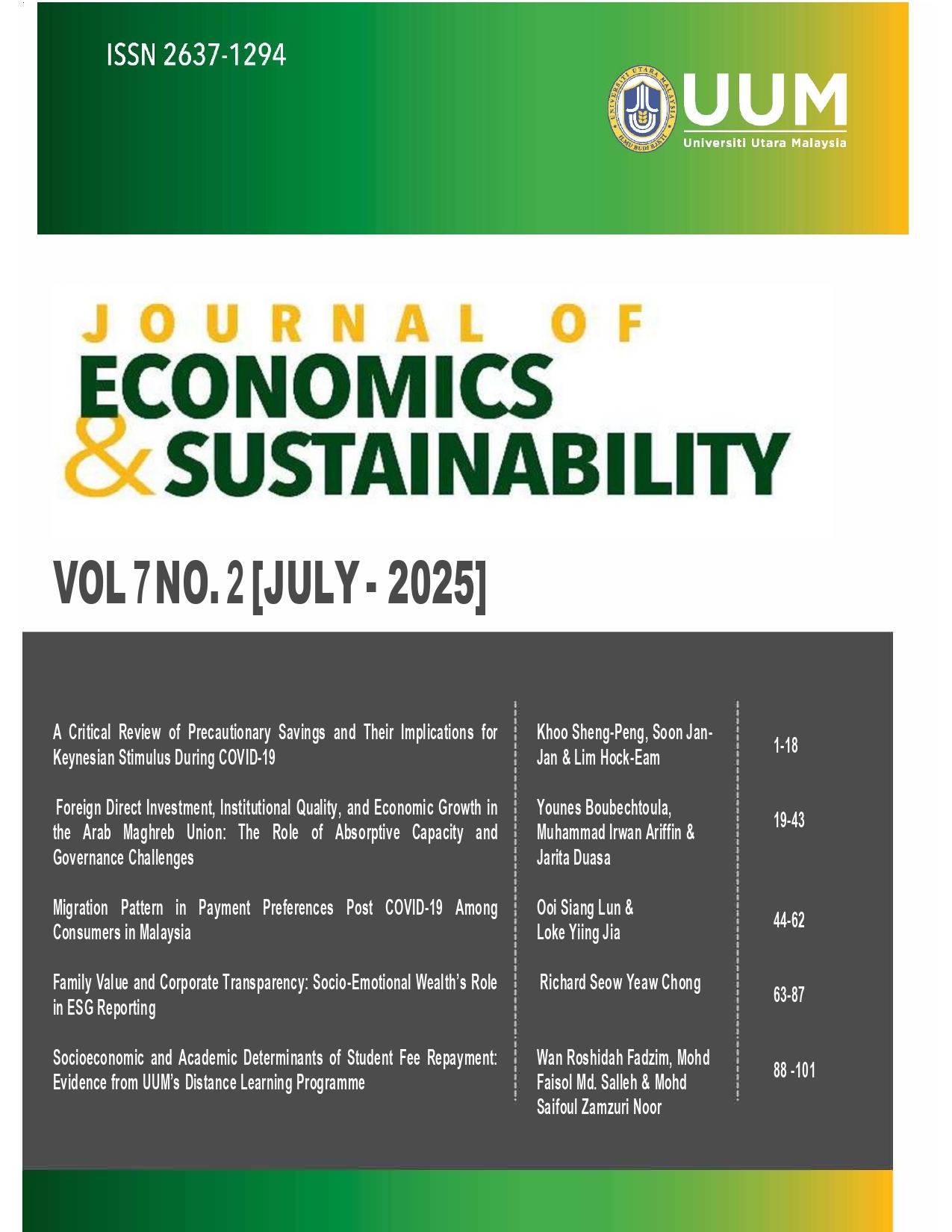
Socioeconomic and Academic Determinants of Student Fee Repayment: Evidence from Uum’s Distance Learning Programme
DOI:
https://doi.org/10.32890/jes2025.7.2.5Keywords:
higher education finance, student debt, tuition fees repaymentAbstract
The increasing burden of student debt, particularly within higher education institutions, presents a significant challenge for both students and funding institutions. This study seeks to identify the factors that contribute to students' inability to repay their academic fees at Universiti Utara Malaysia. With cross-sectional survey of part -time students, this study analyses the likelihood of fee arrears based on student demographic factors – gender, gender, cumulative grade point average (CGPA), employment status, and marital status. This result of study shows that students with tuition fee arrears are ranging from RM1001 to RM 2000, most likely to be male and married with several years of working experience. By means of binary logistic regression, this study sheds light on how these characteristics influence the repayment behaviour, offering insights for targeted financial interventions. These results contribute strategic recommendation for educational institutional to address student debt effectively and refining financial aid repayment policies.
References
Abu Bakar, E., Masud, J., & Md Jusoh, Z. (2006). Knowledge, attitude and perceptions of university students towards educational loans in Malaysia. Journal of family and economic issues, 27(4), 692-701. https://doi.org/10.1007/s10834-006-9035-6
Addo, F. R., Houle, J. N., & Sassler, S. (2019). The changing nature of the association between student loan debt and marital behaviour in young adulthood. Journal of Family and Economic Issues, 40, 86-1. https://doi.org/10.1007/s10834-018-9591-6 Aishah B.A.T., The challenges faced by private higher education in Malaysia from the 1990s to COVID19. Sejarah: Journal of the History Department, University of Malaya, 32(1), 161–181. https://doi.org/10.22452/sejarah.vol32no1.10
Amin, K. A., Ulbrich, T. R., Kirk, L. M., & Gothard, M. D. (2021). Investigating the impact of student loan debt on new practitioners. Journal of the American Pharmacists Association, 61(2), 191-197. https://doi.org/10.1016/j.japh.2020.11.007
Artavanis, N., & Karra, S. (2021). Financial literacy and student debt. In Financial Literacy and Responsible Finance in the FinTech Era (pp. 86-105). Routledge. https://doi.org/10.1080/1351847X.2019.1711435
Awang Long, Z., & Faizuddin Mohd Noor, M. (2023). Factors Influencing Dropout Students in Higher Education. Education Research International, 2023. https://doi.org/10.1155/2023/7704142
Bandura, A., Jeffery, R., & Bachicha, D. L. (1974). Analysis of memory codes and cumulative rehearsal in observational learning. Journal of Research in Personality, 7(4), 295-305. https://doi.org/10.1016/0092-6566(74)90051-8
Baum, S., & Saunders, D. (1998). Life after debt: Results of the National Student Loan Survey selected text from the final report. Journal of Student Financial Aid, 28(3), 1. https://doi.org/10.55504/0884-9153.1102
Brady, S., Miller, J., Balmuth, A., D’Ambrosio, L., & Coughlin, A. J. (2019). Navigating Financial Conversations About Student Loan Debt Among Older Borrowers and Their Families. Innovation in Aging, 3(Supplement_1), S299-S300. https://doi.org/10.1093/geroni/igz038.1099
Chapman, B., & Lounkaew, K. (2015). An analysis of Stafford loan repayment burdens. Economics of Education Review, 45, 89-102. https://doi.org/10.1016/j.econedurev.2014.11.003
Chapman, B., & Lounkaew, K., (2010). Income contingent student loans for Thailand: Alternatives compared, Economics of Education Review, 29(5), 695-709.
Chen, J., Jiang, J., & Liu, Y. J. (2018). Financial literacy and gender difference in loan performance. Journal of Empirical Finance, 48, 307-320. https://doi.org/10.1016/j.jempfin.2018.06.004
Cofer, J., & Somers, P. (1999). An Analytical Approach To Understanding Student Debtload Response. Journal of Student Financial Aid, 29(3), 25-44. ttps://doi.org/10.55504/0884-9153.1095
Cofer, J., & Somers, P. (2000). A Comparison of the Influence of Debtload on the Persistence of Students at Public and Private Colleges. Journal of Student Financial Aid, 30(2), 39-58. https://doi.org/10.55504/0884-9153.1164
Contini, D., & Zotti, R. (2022). Do financial conditions play a role in university dropout? New evidence from administrative data. In Teaching, Research and Academic Careers: An Analysis of the Interrelations and Impacts (pp. 39-70). Cham: Springer International Publishing.
Destin, M., & Svoboda, R. C. (2018). Costs on the mind: The influence of the financial burden of college on academic performance and cognitive functioning. Research in Higher Education, 59, 302-324. https://doi.org/10.1007/s11162-017-9469-8
Dynarski, S. M. (2021). An economist’s perspective on student loans in the United States. In Human Capital Policy (pp. 84-102). Edward Elgar Publishing.
Fan, L., & Chatterjee, S. (2019). Financial socialization, financial education, and student loan debt. Journal of Family and Economic Issues, 40(1), 74-85. https://doi.org/10.1007/s10834-018-9589-0
Galema, R., Plantinga, A., & Scholtens, B. (2008). The stocks at stake: Return and risk in socially responsible investment. Journal of Banking & Finance, 32(12), 2646-2654. https://doi.org/10.1016/j.jbankfin.2008.06.002
Hair, J. F., Black, W. C., Babin, B. J., & Anderson, R. E. (2010). Multivariate Data Analysis: A Global Perspective, 7th Edition. New Jersey: Pearson Educational Inc.
Hussin, F. B., Ali, J., & Noor, M. S. Z. (2014). Kaedah Penyelidikan & Analisis Data SPSS (UUM Press). UUM Press.
Jan, W. S. W. (2020). Malaysia’s Student Loan Company: Tackling the PTPTN Time Bomb. ISEASYusof Ishak Institute.
Jumat, S. S., Gazali, H. M., & Amboala, T. (2022). Factors Influencing Graduate’s Intention To Repay Educational Debt. Labuan Bulletin of International Business and Finance (LBIBF), 20(2), 81-97.
Kenayathulla, H. B., & Tengyue, Z. (2017). Student loans in Malaysia and China: Equity, efficiency and adequacy. MOJEM: Malaysian Online Journal of Educational Management, 4(1), 64-85. https://doi.org/10.22452/mojem.vol4no1.5
Korankye, T., & Kalenkoski, C. M. (2021). The effect of households’ student debt on life satisfaction. Journal of Family and Economic Issues, 42(4), 757-772. https://doi.org/10.1007/s10834-02109753-9
Looney, A., & Yannelis, C. (2015). “A Crisis in Student Loans? How Changes in the Characteristics of Borrowers and in the Institutions They Attended Contributed to Rising Loan Defaults.” Brookings Papers on Economic Activity, *2015*(2), 1–89. https://doi.org/10.1353/eca.2016.0001Malaysian
Department of Statistics. (2016). Report on Malaysian education statistics.
Mbah, R. E. (2022). Theoretical framework in student debt research: Linking economic, finance and education theories to student debt literature. Advances in Social Sciences Research Journal, 9(2), 228-239. https://doi.org/10.14738/assrj.92.11761
New Straits Times. (2024, March 25). The National Higher Education Fund Corporation (PTPTN). https://www.nst.com.my/news/nation/2024/03/ptptn-article-title
Norvilitis, J. M., & MacLean, M. G. (2010). The role of parents in college students’ financial behaviours and attitudes. Journal of economic psychology, 31(1), 55-63. https://doi.org/10.1016/j.joep.2009.10.003 Owusu-Manu, D. G., Asiedu, R. O., Edwards, D. J., Donkor-Hyiaman, K., Abuntori, P. A., & El-Gohary,
H. (2019). An assessment of mortgage loan default propensity in Ghana. Journal of Engineering,
Design and Technology, 17(5), 985-1017. https://doi.org/10.1108/JEDT-01-2019-0016
Santoso, W., Trinugroho, I., & Risfandy, T. (2020). What determine loan rate and default status in financial technology online direct lending? Evidence from Indonesia. Emerging Markets Finance and Trade, 56(2), 351-369. https://doi.org/10.1080/1540496X.2019.1605595
Sharif, D., Pauzi, N. S., Azli, R. M., & Man, N. C. (2019). Sulh Approach in Reforming the Education Loans’ Repayment for the National Higher Education Fund Corporation (PTPTN). International Journal of Academic Research in Business and Social Sciences, 9(4). https://doi.org/10.6007/IJARBSS/v9-i4/5883
Shen, Hua & Ziderman, Adrian, 2008. “Student Loans Repayment and Recovery: International Comparisons,” https://docs.iza.org/dp3588.pdf IZA Discussion Papers 3588, Institute of Labor Economics (IZA).
Wagner, J., & Walstad, W. B. (2023). Gender differences in financial decision-making and behaviours in single and joint households. The American Economist, 68(1), 5-23. https://doi.org/10.1177/05694345221076004
Walsemann, K. M., Gee, G. C., & Gentile, D. (2015). Sick of our loans: Student borrowing and the mental health of young adults in the United States. Social Science & Medicine, 124, 85-93. https://doi.org/10.1016/j.socscimed.2014.11.027
Wong, S. K. E., Nasharuddin, A., & Ismail, K. (2015). Education loan repayment and performances: The Malaysian graduates perspectives. JATI-Journal of Southeast Asian Studies, 20, 158-172. https://doi.org/10.22452/jati.vol20no1.10
Zakaria, N. B., Rasyid, M., Mohamed, N., Daud, D., & Ismail, A. M. (2020). Study Loan Defaults Among Tertiary Graduates. International Journal of Financial Research, 11(3), 125-130. https://doi.org/10.5430/ijfr.v11n3p125
Zulfaris, M. D., Mustafa, H., Mahussin, N., Alam, M. K., & Daud, Z. M. (2020). Students and money management behavior of a Malaysian public university. The Journal of Asian Finance, Economics and Business, 7(3), 245-251. https://doi.org/10.13106/jafeb.2020.vol7.no3.245
Zurlo, K., & Chen, Z. (2021). The Effects of Gender and Marital Status on Accrued Debt in Retirement Planning. Innovation in Aging, 5(Suppl 1), 241. https://doi.org/10.1093/geroni/igab046.930
Published
Issue
Section
License
Copyright (c) 2025 Journal of Economics and Sustainability

This work is licensed under a Creative Commons Attribution 4.0 International License.




