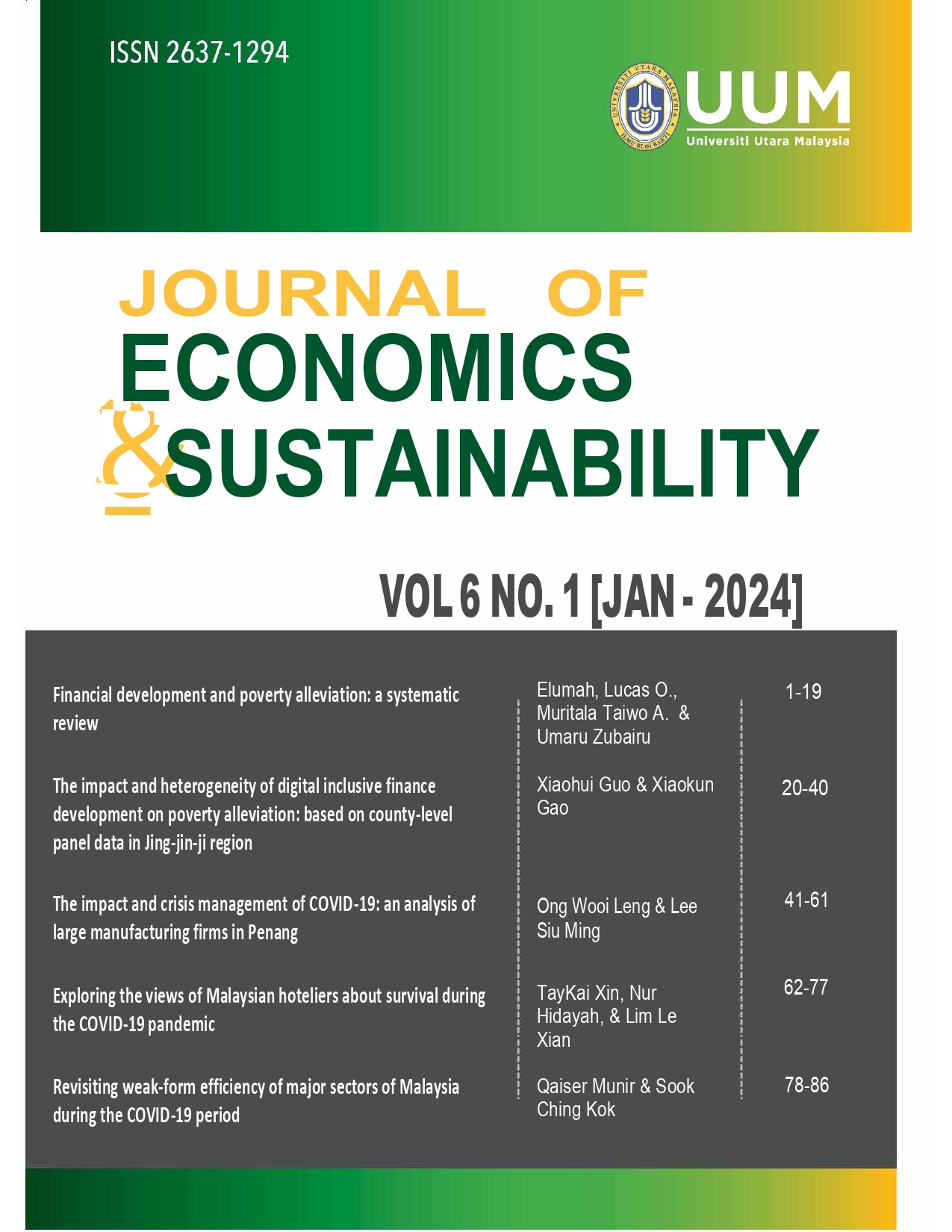
The Impact and Heterogeneity of Digital Inclusive Finance Development on Poverty Alleviation - Based on County-Level Panel Data in Jing-Jin-Ji Region
DOI:
https://doi.org/10.32890/jes2024.6.1.2Keywords:
Jing-Jin-Ji, digital inclusive finance, poverty alleviation, HeterogeneityAbstract
Based on county-level panel data from 2014 to 2017 in Jing-Jin-Ji region, employing SDEM model to analyze the impact and heterogeneity of digital inclusive finance on poverty alleviation. The results show that, first, digital inclusive finance exerts significant poverty alleviation effect, and this effect focuses on local region, having no apparent spillover effects on neighborhood counties. Second, the poverty alleviation effects of digital inclusive finance are heterogeneous, the effects of index of Coverage and Usage, and basic, upgraded and supported digital finance service are different in Jing-Jin-Ji, Hebei and Poverty Area Samples. Third, digital inclusive finance exerts bigger poverty alleviation effect on the less developed region and poverty region, showing the effect of Corner Overtaking.
References
Kai-ming, C. (2011). Aggregation or diffusion: theoretical and empirical analysis on urban size and urban-rural income gap. Economic Theory and Business Management, (8), 14. Dong Yufeng & Zhao
Xiaoming. (2020). Responsible Digital Financial Inclusion: Origin, Connotation and Construction. South China Finance, 215(01), 50-56.
Guo, F., Wang, J., Wang, F., Kong, T., Zhang, X., & Cheng, Z. (2020). Measuring China’s digital financial inclusion: Index compilation and spatial characteristics. China Economic Quarterly, 19(4), 1401-1418.
Kelejian, H. H., & Prucha, I. R. (2010). Specification and estimation of spatial autoregressive models with autoregressive and heteroskedastic disturbances. Journal of econometrics, 157(1), 53-67.
He, X. F. (2018). The policy of poverty alleviation and social security in the anti-poverty strategy of China’s rural areas. Wuhan Univ. J, 71, 147-153.
Huang, Y., & Huang, Z. (2018). The development of digital finance in China: Present and future. China Economic Quarterly, 17(4), 205-218.
Huang, H. (2018). Formation and challenges of digital financial ecosystem—Experience from China. Economist, 4, 80-85.
Huang Q., Hu Z. & Liu Y. (2017). Development level of China's inclusive finance and its poverty reduction effect. Financial Economics Research,32(06),75-84.
Huang Yiping. (2017). The opportunity and the risk of digital inclusive finance. New Finance, (08), 4 -7.
Elhorst, J. P. (2010). Applied spatial econometrics: raising the bar. Spatial economic analysis, 5(1), 9-28.
LeSage, J., & Pace, R. K. (2009). Introduction to spatial econometrics. Chapman and Hall/CRC.
Ming, L., & Zhao, C. (2004). Urbanization, urban-biased economic policies and urban-rural inequality. Economic Research Journal, 6, 50-58.
Lee, L. F., & Yu, J. (2010). Estimation of spatial autoregressive panel data models with fixed effects. Journal of econometrics, 154(2), 165-185.
Lee, L. F., & Yu, J. (2010). Some recent developments in spatial panel data models. Regional Science and Urban Economics, 40(5), 255-271.
Mengliang Zhou. (2018). Research on path innovation for coordinating digital inclusive finance and precise poverty alleviation. Journal of Nanjing Agricultural University (Social Sciences Edition),18(02), 149-156.
Qiu Zhaoxiang & Xiang Xiaojian (2018). Research on problems and counter measures faced in the development of digital inclusive finance. Financial Theory & Practice, 5-9.
Shao, H., & Wang, K. (2017). Poverty reduction effect and the mechanism of action in inclusive finance: empirical analysis based on cross-national panel data. Financial Economics Research, 32(6), 65-74.
Song, X. (2017). Empirical analysis of digital inclusive finance bridging the urban-rural residents’ income gap. Finance & Economics, 6, 14-25.
Gibbons, S., & Overman, H. G. (2012). Mostly pointless spatial econometrics? Journal of regional Science, 52(2), 172-191.
Tan, Y. Z., & Peng, Q. R. (2018). Inclusive financial development and poverty alleviation: direct impact and spatial spillover effect. Contemporary Finance & Economics, (03), 154.
Wang, S. G., & Zeng, X. X. (2018). From regional poverty alleviation and development to precision poverty alleviation: The evolution of poverty alleviation policies in China during the 40 Years of reform and opening-up and the current difficulties and countermeasures for poverty alleviation. Issues in Agricultural Economy, 8, 40-50.
Sangui, W. (2018). China s Large scale Poverty Reduction: Main Driving Forces and Institutional Foundation# br. Journal of Renmin University of China, 32(6), 1.
Wei, W. & Yi-ming, Z. (2018). Inclusive finance and county capital outflow: poverty alleviation or worsen——Evidence from 592 Poverty Counties in China. Economic Theory and Business Management, 37(1), 98.
Fu, Q. Z., & Huang, Y. P. (2018). Digital finance’s heterogeneous effects on rural financial demand: evidence from China household finance survey and inclusive digital finance index. J. Financ. Res, 11, 68-84.
Wu, B., Mao, N. & Guo, L. (2017). The inclusive effect of internet finance in rural areas under "Double Exclusion”, Journal of South China Normal University (Social science edition). 94-100.
Wu Lijuan & Xu Zhongyang. (2018).research on poverty alleviation and rural economy growth of inclusive finance in China: based on survey data of 4023 rural households via rd. regression. South China Journal of Economics. 104-127.
Xu, Y., Liu, F., & Zhang, X. (2007). Reflection on China's rural anti‐poverty policies: transition from social assistance to social protection. Social Sciences in China, 3, 40-53.
YanXing. (2015). The effectiveness and realization of inclusive of finance: review and enlightenment. Global Finance, 24-36.
Yi, X., & Zhou, L. (2018). Does digital financial inclusion significantly influence household consumption? Evidence from household survey data in China. Journal of Financial Research, 11(461), 47-67.
He, Z., & Qinxian, B. (2018). Has digital financial inclusion reduced the urban-rural income gap?- A panel threshold regression analysis based on provincial data in China. Inquiry into Economic Issues, 39(10), 122.
Zhang, Y., Wan, G. H., & Shi, Q. H. (2013). Chronic poverty and transient poverty in rural China: decomposition and their determinants. Economic Research Journal (in Chinese), 4, 119-129.
Zhang Zihao & Tan Yanzhi. (2018). Digital inclusive finance and the urban-rural income gap in China— —Empirical Analysis Based on spatial econometric model. Financial Theory & Practice, 1-7.
Yiming, Z., & Wei, W. (2017). How Does Inclusive Finance Achieve Precise Poverty Alleviation? Journal of Finance and Economics, 43(10), 43-54.
Published
Issue
Section
License
Copyright (c) 2024 Journal of Economics and Sustainability

This work is licensed under a Creative Commons Attribution 4.0 International License.




