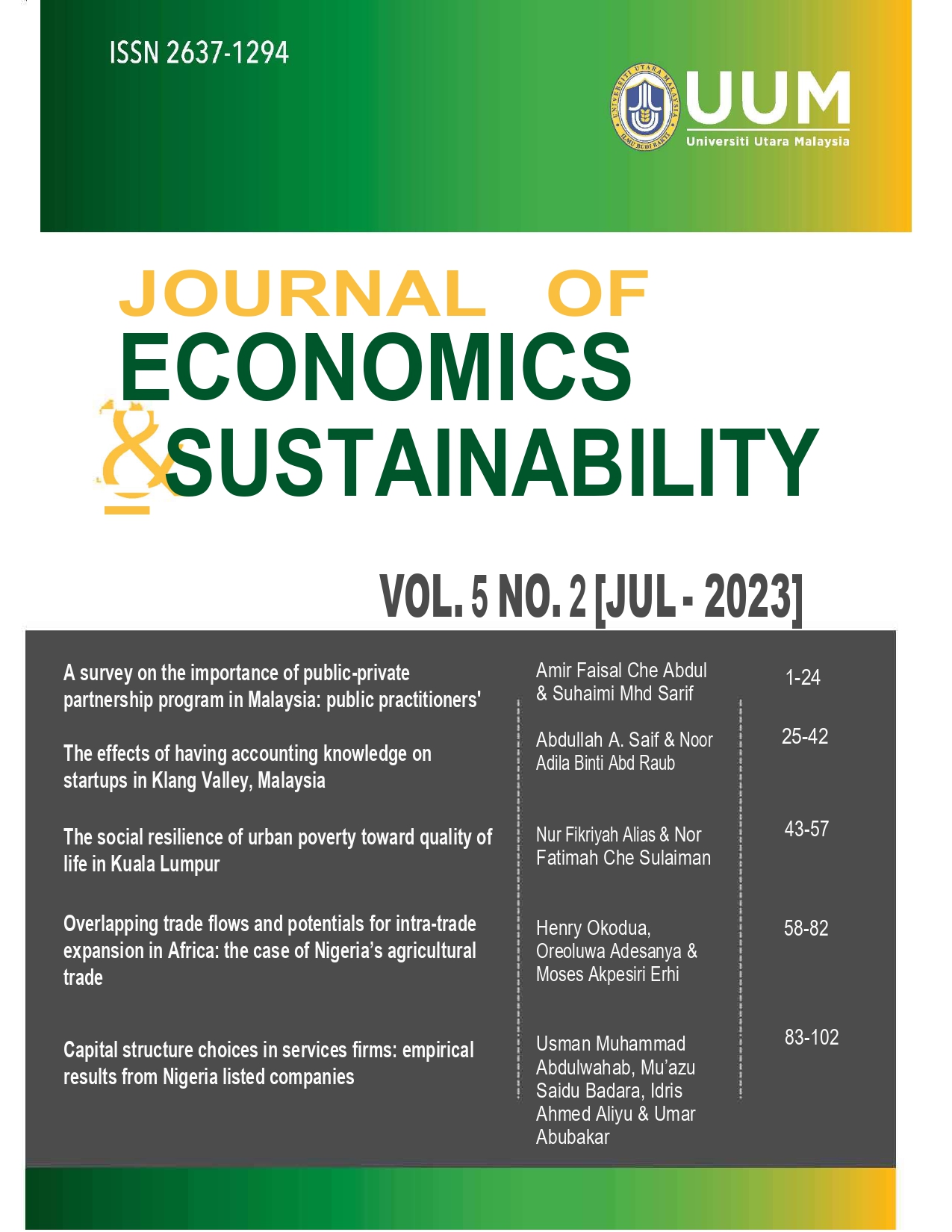
Overlapping Trade Flows and Potentials for Intra-Trade Expansion in Africa: The Case of Nigeria’s Agricultural Trade
DOI:
https://doi.org/10.32890/jes2023.5.2.4Keywords:
African Continental Free Trade Area (AfCFTA), Trade Overlap Index, Trade Expansion Index, Trade Overlap, Agricultural ProductsAbstract
African countries' endorsement of the African Continental Free Trade Area (AfCFTA) agreement framework has been regarded as a potential game-changer for intra-African trade and key to unlocking sustained economic growth and development. The euphoria surrounding this proposed introduction of a single continental market for goods and services, with free movement of businesses, persons, and investments, is closely linked to the positive relationship between trade and development as documented in the literature. However, it needs to be clarified from the literature what role overlapping trade flows may play in limiting the potential of the AfCFTA to boost intra-trade in Africa. This paper constructs trade overlap and trade expansion indices between Nigeria and selected African countries to investigate the scope for expansion of agricultural trade between Nigeria and the selected trading partners. The study finds the existence of considerable trade overlap and export expansion potential for Cassava among other agricultural products, between Nigeria and Equatorial Guinea, Guinea Bissau, Mauritania, and Sierra Leone. The study then opines that any overlapping trade flows that currently exist in the trade of Cassava between the selected partners can be redirected following the expected removal of customs tariffs once the AfCFTA is fully implemented.
References
Abraham, O. A., and Adekola, A. G. (2014). Regional economic integration in developing countries: A case study of Nigeria; a member of ECOWAS. European Scientific Journal, 10(19), 359-374.
African Development Bank Group. (2019). Integration for Africa's economic prosperity. In African Economic Outlook 2019 (pp. 75-130).
Amponsah, W. A. (2002). Analytical and empirical evidence of trade policy effects of regional integration: Implications for Africa. https://www.researchgate.net/publication/228773346
Andrea Cofelice. (2018). African continental free trade area: opportunities and challenges. De Gruyter Open. https://DOI:10.2478/tfd-2018-0032
Anyanwu, J. C. (2014).‘Does intraregional trade reduce youth unemployment in Africa’, African Development Review, Vol. 26, No. 2, June, pp. 286–309.
Arizala, F., Bellon, M., & MacDonald, M. (2018). Africa comes together. Finance & Development, 55(3), 48-51.
Bleaney, Michael, & Katharine Wakelin. (2002). Efficiency, innovation, and exports. Oxford Bulletin of Economics and Statistics 64: 3–15.
Chappelow, J. (2019). Free trade area: Investopedia. October 2. Available at: https://www.investopedia.com/terms/f/free_trade_area.asp. Accessed May 10, 2022.
Che, Yi, Julan Du, Yi Lu & Zhigang Tao. (2015). Once an enemy, forever an enemy? The long-run impact of the Japanese invasion of China from 1937 to 1945 on trade and investment. Journal of International Economics 96: 182–98.
Coyle, William, Mark Gehlhar, Thomas W. Hertel, Zhi Wang, & Wusheng Yu. (1998). Understanding the determinants of structural change in world food markets. American Journal of Agricultural Economics 80: 1051–61.
Dinka, T. & W. Kennes. (2007). Africa’s regional integration arrangements: History and challenges, ECDPM Discussion Paper No. 74, September.
Draper, P., D. Halleson, & P. Alves. (2007). SACU, regional integration, and the overlap issue in Southern Africa: From spaghetti to Cannelloni. South African Institute of International Affairs, SAIIA Trade Policy Report No. 15.
Edris, H. S. (2013). Regional integration and trade in Africa: Augmented Gravity Model Approach. The Horn Economic and Social Policy Institute. Addis Ababa: Horn Economic and Social Policy Institute.
Felix, O., Libby, G. and Keith, W. (2019). Nigeria signs Africa free trade agreement: statement. Business News: Reuters, July. Available at: https://www.reuters.com/article/us-africa-trade-nigeria/nigeria-signs-africa-free-trade-agreement-statement-idUSKCN1U20K7. Accessed: May 10, 2022.
Fuchs, Andreas, and Nils Hendrik Klann. (2013). Paying a visit: The Dalai Lama effect on international trade. Journal of International Economics 91: 164–77.
Gilpin, R., and Gilpin, J. M. (2000). The challenge of global capitalism. The World Economy in the 21st Century, 230-231.
Greenaway, David, Wyn Morgan, & Peter Wright. (1999). Exports, export composition and growth, Journal of International Trade and Economic Development 8: 41–51.
Hoque, Mohammad Monjurul & Zulkornain Yusop. (2012). Impacts of trade liberalization on export performance in Bangladesh: An Empirical investigation. South Asia Economic Journal 13: 207–39.
Krueger, A.O. (1997). Trade policy and economic development, American Economic Review, 87: 1–6.
Lisandro, A., Maria, A. A., Tunc, G., Garth, P. N., & Hector, P.-S. (2019). The African continental free trade agreement: Welfare Gain Estimates from a General Equilibrium Model. International Monetary Fund, African Department. Mario de Zamaróczy.
Pei-Zhi, W., & Xiao-Jing, L. (2015). Comparative Analysis of Export Similarity Index between China and EU. International Conference on Management Science and Management Innovation (MSMI 2015) (pp. 222-227). China: Atlantis Press.
Peter, D. (2010). Rethinking the (European) Foundations of Sub-Saharan African Regional Economic Integration: A political economy essay. Working Paper, OECD Development Centre, Development Centre. Retrieved from https://www.oecd.org/dev/46013902.pdf
Qureshi, M.S. (2013). Trade and thy neighbour’s war. Journal of Development Economics 105: 178–95.
Shobande, O. A. (2019, August 6). Effect of economic integration on agricultural export performance in selected West African Countries. Economies, 7(79), 1-14. doi:10.3390/economies7030079
Steve, K.M., John, C. A., & Pedro, C. (2014). Regional integration in Africa: An introduction. African Development Review, 1-6.
TRALAC. (2018). African Continental Free Trade Area (AfCFTA) FAQs. Trade Law Centre (1 (update)). Retrieved from https://www.tralac.org/resources/by-region/african-union-resources.html
TRALAC. (2019, November). The African Continental Free Trade Area: A Tralac Guide. Trade Law Centre, 28. Retrieved from http://www.tralac.org/
UNCTAD (2019). Economic Development in Africa Report, 2019: Made in Africa – Rules of Origin for Enhanced Intra-African Trade. United Nations. United Nations Economic Commission for Africa, African Union, and African Development Bank (2017). Assessing Regional Integration in Africa VIII: Bringing the Continental Free Trade Area About. Addis Ababa.
UNECA (2006), Assessing regional integration in Africa II: Rationalizing Regional Economic Communities, United Nations Economic Commission for Africa and African Union, Addis Ababa. http://www.uneca.org/aria.
UNECA (2008), Assessing regional integration in Africa 2008: Towards Monetary and Financial Integration in Africa, United Nations Economic Commission for Africa, Addis Ababa. http://www.uneca.org/aria
UNDP (2011). Regional integration and human development: A Pathway for Africa. UNDP, New York.
Downloads
Published
Issue
Section
License
Copyright (c) 2023 Journal of Economics and Sustainability

This work is licensed under a Creative Commons Attribution 4.0 International License.




