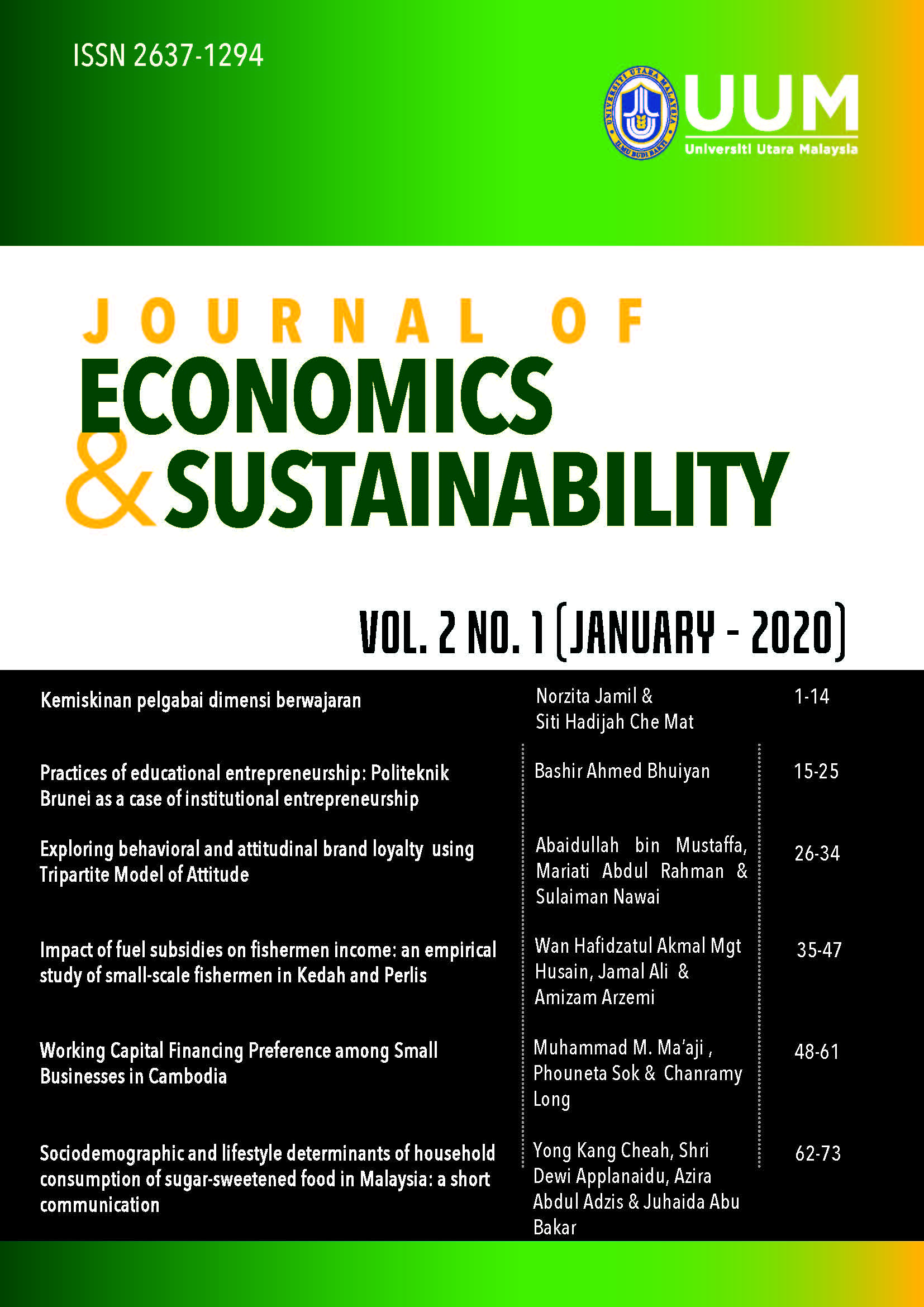
Impact of Fuel Subsidies on Fishermen Income
An Empirical Study of Small-Scale Fishermen in Kedah and Perlis
DOI:
https://doi.org/10.32890/jes2020.2.1.5Keywords:
fishermen, fishing gear, fuel subsidy, incomeAbstract
Even though fuel subsidy can give more profit to the fisheries sector, it also has drawbacks to the ecosystem that tends to lead to overcapacity. This study investigated the impact of fuel subsidies on the income of fishermen operating in Zone A and Zone B in Kedah and Perlis. Focus group discussions with fisherman association committees were conducted to understand the issues related to fuel subsidy. The regression analysis method was used to examine the relationship between the fishermen’s monthly income and various explanatory variables, such as oil subsidy received by the fishermen, the incentive value of catch received, the monthly allowance, the location of fishing activity, and the socioeconomic background of fishermen. The result of the study revealed that Boat B fishermen gained more benefits from the implementation of fuel subsidized policy than Boat A fishermen because the former used larger boat sizes and better fishing gear. In addition, variables, such as fuel subsidy, operating costs, and duration of fishing hours, influenced fishermen's income. Although fuel subsidies may contribute toward overfishing, fuel subsidy is still needed by small-scale fishermen since it can reduce the cost of fishing activities and thus increase their monthly income. This research indicates that it is important to understand the contribution of fuel as the total cost of fishing activities and how fuel subsidies can reduce these costs to improve the income of fishermen in the study area.
Received 18 Apr 19. Revised 25 Oct 19. Accepted 5 Dec 19.
References
Ahasan Habib, Md. Hadayet Ullah, & Nguyen Ngoc Duy. (2014). Bioeconomics of Commercial Marine Fisheries of Bay of Bengal: Status and Direction. Economics Research International, 2014(1), 1–10.
Ali, J., Abdullah, H., Zamhuri, S., Viswanathan, K. K., & Islam, G. N., (2017). The Contribution of Subsidies on the Welfare of Fishing Communities in Malaysia. International Journal of Economics and Financial Issues, 7(2), 641-648.
Barrett, C. B., Lee, D. R., & McPeak, J. G. (2005). Institutional Arrangements for Rural Poverty Reduction and Resource Conservation. World Development, 33(2), 193–197. https://doi.org/10.1016/j.worlddev.2004.07.008
Béné, C., & Friend, R. M. (2011). Poverty in small-scale fisheries old issue, new analysis. Progress in Development Studies, 11(2), 119–144. https://doi.org/10.1177/146499341001100203
Gazi, M., Kusairi, N., Tai, Y., & Aswani, F. (2013). Assessing Environmnetal Damage to Marine Protected Areas. The Journal of Agricultural Science, 5(8), 132-140.
Kuperan, K. Nerrisa, S., Garces,L., & Pomeroy, R.(2008). Managing Excess Capacity in Small-scale Fisheries: Perspective of Stakeholders in Three Southest Areas Country.The Journal of Marine Policy, 32(4), 692-700.
Lambert, G. I., Jennings, S., Hiddink, J. G., Hintzen, N. T., Hinz, H., Kaiser, M. J., & Murray, L. G. (2012). Implications of using alternative methods of vessel monitoring system (VMS) data analysis to describe fishing activities and impacts. ICES Journal of Marine Science: Journal Du Conseil, 69(4), 682–693. https://doi.org/10.1093/icesjms/fss018
Lee, S., & Rahimi, A. (2015). Fisheries self-governance in fishing communities of South Korea. Journal of Marine Policy, 53(C), 27-32
Lindebjerg, E. S., Peng, W., & Yeboah, S. (2015). Do Policies for Phasing Out Fossil Fuel Subsidies Deliver What They Promise? Retrieved from http://mercury.ethz.ch/serviceengine/Files/ISN/186871/ipublicationdocument_singledo cument/aab64a23-5510-4789-9a99-e28349bb3c04/en/Lindebjerg+et+al.pdf
Malaysia, Department of Fishery (DOF) (2014). Laman Utama - Portal Rasmi Jabatan Perikanan Malaysia. Retrieved 15 March 2014, from http://www.dof.gov.my/
Malaysia, Lembaga Kemajuan Ikan Malaysia (LKIM) (2016). Portal Rasmi Lembaga Kemajuan Ikan Malaysia - Laman Utama. Retrieved 15 March 2016, from http://www.lkim.gov.my/
Meliadò, F. (2012). Fisheries Management Standards in the WTO Fisheries Subsidies Talks: Learning How to Discipline Environmental PPMs? Journal of World Trade, 46(5), 1083–1146.
Myers, N.; Kent, J. (2001). Perverse subsidies: how tax dollars can undercut the environment and the economy. Washington, DC: Island Press. ISBN 978-1-55963-835-7.
Nunoo, F. K. E., Boateng, J. O., Ahulu, A. M., Agyekum, K. A., & Sumaila, U. R. (2009). When trash fish is treasure: The case of Ghana in West Africa. Fisheries Research, 96(2-3), 167–172. https://doi.org/10.1016/j.fishres.2008.10.010
Ofori-Danson, P. K., Sarpong, D. B., Sumaila, U. R., Nunoo, F. K., & Asiedu, B. (2013). Poverty measurements in small-scale fisheries of Ghana: A step towards poverty eradication. Journal: Current Research Journal of Social Sciences, 5, 75–90.
Parker, R. W. R., & Tyedmers, P. H. (2014). Fuel consumption of global fishing fleets: current understanding and knowledge gaps. Fish and Fisheries, n/a – n/a. https://doi.org/10.1111/faf.12087
Rife, A. N., Erisman, B., Sanchez, A., & Aburto-Oropeza, O. (2013). When good intentions are not enough … Insights on networks of “paper park” marine protected areas. Conservation Letters, 6(3), 200–212. https://doi.org/10.1111/j.1755-263X.2012.00303.x Journal of Economics and Sustainability
Rijnsdorp, A. (2000). Competitive interactions among beam trawlers exploiting local patches of flatfish in the North Sea. ICES Journal of Marine Science, 57(4), 894–902. https://doi.org/10.1006/jmsc.2000.0576
Sovacool, B. K. (2009). A Game of Cat and Fish: How to Restore the Balance in Sustainable Fisheries Management. Ocean Development & International Law, 40(1), 97–125. https://doi.org/10.1080/00908320802631486
Sumaila, U. R., Cheung, W., Dyck, A., Gueye, K., Huang, L., Lam, V., & Zeller, D. (2012). Benefits of Rebuilding Global Marine Fisheries Outweigh Costs. PLoS ONE, 7(7), e40542. https://doi.org/10.1371/journal.pone.0040542
Srinivasan, U. T., Cheung, W. W. L., Watson, R., & Sumaila, U. R. (2010). Food security implications of global marine catch losses due to overfishing. Journal of Bioeconomics, 12(3), 183–200. https://doi.org/10.1007/s10818-010-9090-9
Sumaila, U. R., Lam, V. W. Y., Miller, D. D., Teh, L., Watson, R. A., Zeller, D., & Pauly, D. (2015). Winners and losers in a world where the high seas is closed to fishing. Scientific Reports, 5, 8481. https://doi.org/10.1038/srep08481
Teh, L. S. L., Teh, L. C. L., & Sumaila, U. R. (2011). Quantifying the overlooked socio-economic contribution of small-scale fisheries in Sabah, Malaysia. Fisheries Research, 110(3), 450–458. https://doi.org/10.1016/j.fishres.2011.06.001
Watson, R., Kachics,V. (2013). The Report on the Fishery Subsidies, Science Direct Journal
World Bank, (2008). Reforming Energy Prices Subsidies and Reinforcing Social Protection. Some Design Issues. Report 43173‐MNA. Washington, DC: The World Bank.
World Bank. (2017, June 5). Oceans, Fisheries and Coastal Economies. Retrieved from http://www.worldbank.org/en/topic/environment/brief/oceans
WWF (2013). Evaluation of the socio-economic and environmental impacts of fisheries subsidies in Malaysia, Kuala Lumpur: World-Wildlife Foundation from http://wwf.panda.org/our_work/governance/policy/wwf_europe_environment/initiative s/fisheries/fisheries_subsidies/




