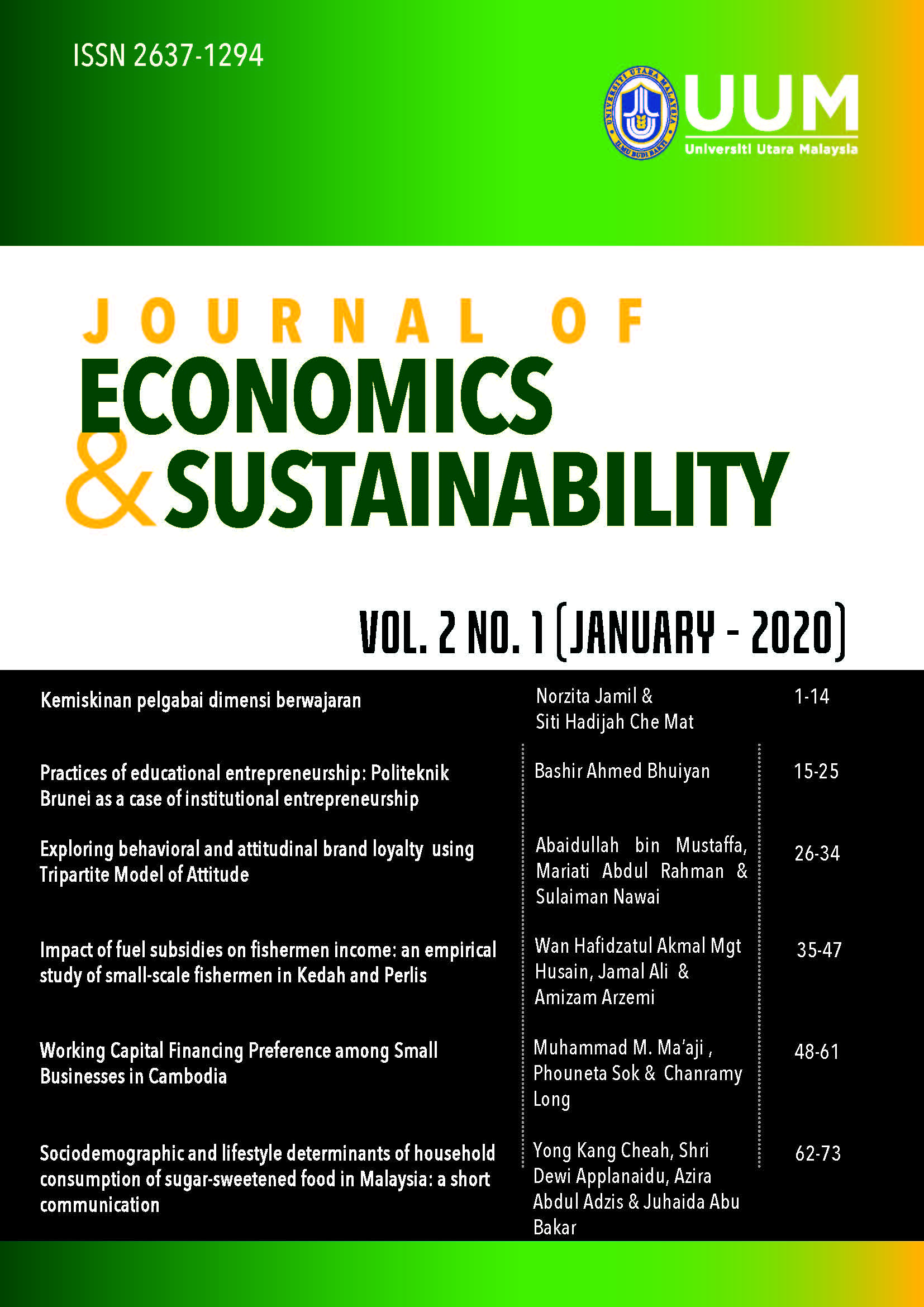
Exploring Behavioral and Attitudinal Brand Loyalty Using Tripartite Model of Attitude

Authors

  • Abaidullah Mustaffa Universiti Utara Malaysia, Malaysia
  • Mariati Abdul Rahman Universiti Utara Malaysia, Malaysia
  • Sulaiman Nawai Geomatika University College, Malaysia

DOI:

https://doi.org/10.32890/jes2020.2.1.4

Keywords:

Tripartite model of attitude structure, brand loyalty, behavioral loyalty, attitudinal loyalty

Abstract

Previously, scholars have studied behavioral and attitudinal brand loyalties separately by. Brand loyalty was first studied with behavior as one dimension in the brand loyalty structure, which predominantly measures brand loyalty by repeat purchase. However, the stochastic paradigm that views behavior as a single dimension cannot explain the motivation for consistent repeat purchase behavior. Subsequently, the stochastic paradigm was replaced with a deterministic paradigm that views attitude as a single dimension of brand loyalty. Since brand loyalty is a psychological abstraction in nature, scholars viewed that a combined approach of behavior and attitude is more appropriate to address the issue of brand loyalty. This paper proposes a Tripartite Model of Attitude to explain the dimensions and determinants of brand loyalty by combining behavioral loyalty and attitudinal loyalty in one framework.

Received 14 May 19. Revised 20 Jul 19. Accepted 2 Aug 19.
References

Abaidullah, M. (2017). Attitudinal loyalty, brand value and brand loyalty in the agriculture produce retail industry. Unpublished PhD thesis, Universiti Teknologi MARA, Malaysia

Aaker, D. A. (1996). Measuring Brand Equity Across Products and Markets. California Management Review, 38(3), 102-120.

Ajzen, I. (1991). The theory of planned behavior. Organizational Behavior and Human Decision Processes, 50(2), 179–211.

Ajzen, I. (2005). Attitudes, Personality and Behavior. In T. Manstead (Ed.). Berkshire: Open University Press.

Bagozzi, R. P. (1977). Convergent and discriminant validity by analysis of covarience structures: The case of the affective, behavioral and cognitive components of attitudes. Advances in Consumer Research, 4, 11-18.

Bagozzi, R. P., & Warshaw, P. R. (1990). Trying to consume. Journal of consumer research,17(2), 127-140.

Bandura, A. (1977). Social Learning Theory. Oxford, England: Prentice-Hall.

Bandyopadhyay, S., & Martell, M. (2007). Does attitudinal loyalty influence behavioral loyalty? A theoretical and empirical study. Journal of Retailing and Consumer Services, 14(1), 35-44

Bobâlcă, C., Gătej, C., & Ciobanu, O. (2012). Developing a Scale to Measure Customer Loyalty. Procedia Economics and Finance, 3, 623-628. doi: http://dx.doi.org/10.1016/S2212-5671(12)00205-5

Breckler, S. J. (1984). Empirical validation of affect, behavior and cognition as distinct components of attitude. Journal of Personality and Social Psychology, 47, 1191-1205. doi: http://dx.doi.org/10.1016/0167-4870(89)90058-5

Copeland, M. T. (1923). Relation of consumer's buying habits to marketing methods. Harvard Business Review, 1(2), 282-289.

Dumitrescu, L., Ţichindelean, M., & Vinerean, S. (2013). Using Factor Analysis in Relationship Marketing. Procedia Economics and Finance, 6, 466-475. doi: http://dx.doi.org/10.1016/S2212-5671(13)00164-0

Fazio, R. H. (1990). Multiple processes by which attitudes guide behavior: The MODE model as an integrative framework. Advances in Experimental Social Psychology, 23, 75-109.

Fishbein, M. (1966). The Relationships between Beliefs, Attitudes, and Behavior. In S. Feldman (Ed.). Cognitive Consistency (pp. 199-223): Academic Press.

Foxall, G. (1984). Evidence for attitudinal-behavioral consistency: Implications for consumer research paradigms. Journal of Economic Psychology, 5(1), 71-92. doi: http://dx.doi.org/10.1016/0167-4870(84)90021-7

Greenwald, A. G. (1968). 14 - On Defining Attitude and Attitude Theory. In A. G. Greenwald, T. C. Brock & T. M. Ostrom (Eds.). Psychological Foundations of Attitudes (pp. 361-388): Academic Press.

Han, H., Kim, Y., & Kim, E-K. (2011). Cognitive, affective, conative, and action loyalty: Testing the impact of inertia. International Journal of Hospitality Management, 30(4), 1008-1019. doi: http://dx.doi.org/10.1016/j.ijhm.2011.03.006

Harris, L. C., & Goode, M. M. H. (2004). The four levels of loyalty and the pivotal role of trust: a study of online service dynamics. Journal of Retailing, 80(2), 139-158. doi: http://dx.doi.org/10.1016/j.jretai.2004.04.002

Hilgard, E. R. (1980). The trilogy of mind: Cognition, affection and conation. Journal of the History of Behavioral Science, 16, 107-117.

Jamaluddin, Mohd Raziff, Hanafiah, Mohd Hafiz, & Zulkifly, Muhammad Izzat. (2013). Customer-based Psychology Branding. Procedia - Social and Behavioral Sciences, 105(0), 772-780. doi: http://dx.doi.org/10.1016/j.sbspro.2013.11.080 Journal of Economics and Sustainability

Malhotra, N. K. (2005). Attitude and affect: new frontiers of research in the 21st century. Journal of Business Research, 58(4), 477-482. doi: http://dx.doi.org/10.1016/S0148-2963(03)00146-2

McGuire, W. J. (1966). The Current Status of Cognitive Consistency Theories. In S. Feldman (Ed.), Cognitive Consistency (pp. 1-46): Academic Press.

McGuire, W. J. (1985). The nature of attitudes and attitude change. In G. Lindzey & E. Aronson (eds). New York: Random House.

Oliver, R. L. (1999). Whence customer loyalty. Journal of Marketing, 63, 33-44.

Ostrom, T. M. (1969). The relationship between the affective, behavioral, and cognitive components of attitude. Journal of Experimental Social Psychology, 5(1), 12-30. doi: http://dx.doi.org/10.1016/0022-1031(69)90003-1

Reichheld, F. F., & Sasser, W. E. (1990). Zero defections: Quality comes to services. Harvard Business Review, 68(5), 105-111.

Rosenberg, L. J., Czepiel, J. A. (1983). A marketing approach to consumer retention. Journal of Consumer Marketing, 1(2), 45-51.

Rosenberg, M. J., & Hovland, C.I. (1960). Cognitive, affective and behavioral components of attitudes. In C. I. Hovland & M. J. Rosenberg (eds). Attitude Organization and Change: An Analysis of Consistency among Attitude Components (pp. 1-14). New Haven: Yale University Press.

Suhartanto, D., (2011), An examination of brand loyalty in the Indonesian hotel industry. Unpublished PhD thesis Lincoln University, New Zealand.

Zanna, M.P., Rempel, J. K. (1988). A new look at an old concept. Cambridge, UK: Cambridge University Press.

Downloads

Published

31-01-2020

How to Cite

Mustaffa, A., Abdul Rahman, M., & Nawai, S. (2020). Exploring Behavioral and Attitudinal Brand Loyalty Using Tripartite Model of Attitude. Journal of Economics and Sustainability, 2(1), 9. https://doi.org/10.32890/jes2020.2.1.4




