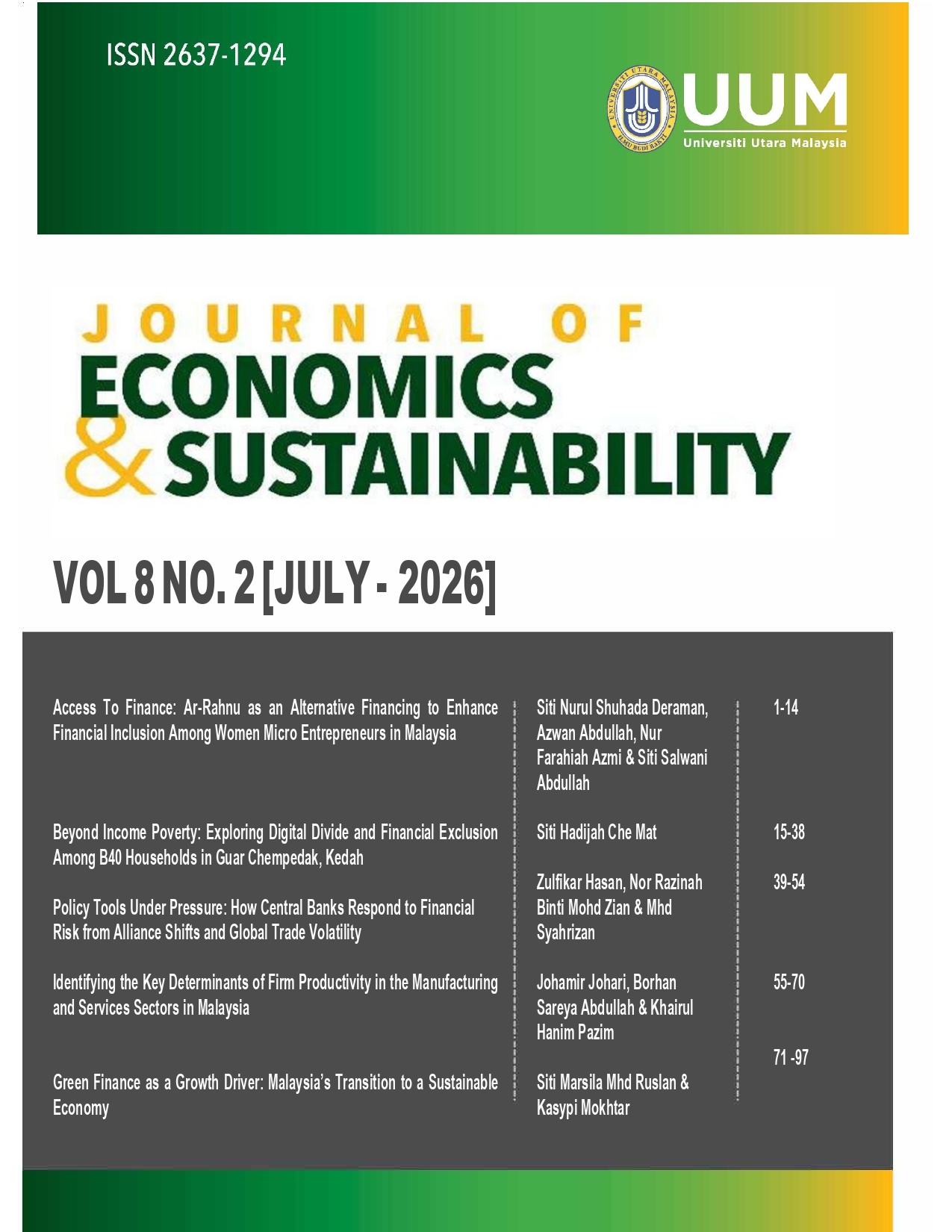
Beyond Income Poverty: Exploring Digital Divide And Financial Exclusion Among B40 Households In Guar Chempedak, Kedah
DOI:
https://doi.org/10.32890/jes2026.8.2.2Keywords:
Socioeconomic status, poverty, rural development, digital divide, financial inclusionAbstract
This study examines the socioeconomic status of households in Yan District, Kedah, with specific focus on the Guar Chempedak state constituency, encompassing the sub-districts (mukim) of Yan, Singkir, and Sala Besar. Despite Yan's classification among Malaysia's poorest districts, it was paradoxically recognized in the Top 10 Happiest Towns list in 2019, suggesting complex relationships between economic indicators and subjective wellbeing that conventional poverty measurements fail to capture. This study advances existing knowledge on socioeconomic inequality in three critical ways. First, it challenges the adequacy of income-based poverty classification by documenting a digital paradox: while 89.8% of households own smartphones, only 9.5% possess home internet access, revealing how conventional poverty metrics overlook emerging dimensions of digital exclusion that fundamentally constrain economic opportunities in the digital economy era. Second, the study extends multidimensional poverty frameworks by demonstrating that basic needs adequacy (99.7% clothing sufficiency, 99.5% never experiencing hunger) coexists with severe financial vulnerability, with 46.2% of households relying on informal credit sources (family loans and pawnshops), exposing systematic financial exclusion invisible in traditional poverty assessments. Third, through granular occupational analysis, the study identifies substantial within-B40 income stratification, with government employees earning nearly three times fishermen's income (RM2,959.83 versus RM1,016.90), challenging the assumption of B40 homogeneity and revealing the need for differentiated policy interventions within income classifications. Primary data were collected through a census-based survey involving face-to-face interviews with 402 household heads using stratified random sampling across five occupational categories. Results indicate that average household incomes in all mukims fall within the B40 classification (RM2,943–RM3,372), substantially below the B40 threshold (RM4,360) and the Kedah state average (RM5,522). These findings contribute to regional development discourse by demonstrating that economic sustainability in rural communities requires integrated interventions addressing not only income poverty but also digital infrastructure deficits and financial inclusion gaps, dimensions inadequately addressed in Malaysia's current poverty alleviation frameworks. The study provides an empirical foundation for reconceptualizing poverty measurement and policy design to encompass digital access and financial inclusion as core socioeconomic status indicators in 21st-century Malaysia.
References
American Psychological Association, Task Force on Socioeconomic Status. (2007). Report of the APA Task Force on Socioeconomic Status. American Psychological Association. https://www.apa.org/pi/ses/resources/publications/task-force-2006.pdf
Andriesse, E., Dinh, T. L. T., Kittitornkool, J., Kodir, A., Kongkaew, C., Markphol, A., Pham, Q. T. N., & Sumadio, W. (2025). Immiserizing growth and the middle-income trap in rural Southeast Asia: Comparing exclusion and coping mechanisms among farming and fishing communities. World Development, 185, 106783. https://doi.org/10.1016/j.worlddev.2024.106783
Bank Negara Malaysia. (2023). Financial inclusion framework (2023–2026) strategy paper. https://www.bnm.gov.my/documents/20124/55792/SP-2nd-fin-incl-framework.pdf
Bourdieu, P. (1986). The forms of capital. In J. G. Richardson (Ed.), Handbook of theory and research for the sociology of education (pp. 241–258). Greenwood Press.
Bradley, R. H., & Corwyn, R. F. (2002). Socioeconomic status and child development. Annual Review of Psychology, 53(1), 371–399. https://doi.org/10.1146/annurev.psych.53.100901.135233
Brune, L., Giné, X., Goldberg, J., & Yang, D. (2011). Commitments to save: A field experiment in rural Malawi (Policy Research Working Paper No. 5748). World Bank. https://documents.worldbank.org
Conger, R. D., Conger, K. J., & Martin, M. J. (2010). Socioeconomic status, family processes, and individual development. Journal of Marriage and Family, 72(3), 685–704. https://doi.org/10.1111/j.1741-3737.2010.00725.x
Department of Statistics Malaysia. (2017). Household income and basic amenities survey report 2016. https://www.dosm.gov.my
Department of Statistics Malaysia. (2020). Household income and basic amenities survey report 2019. https://www.statistics.gov.my/portal-main/release-content/household-income-%26-basic-amenities-survey-report-2019
Duncan, G. J., Magnuson, K., & Votruba-Drzal, E. (2012). The importance of early childhood poverty. Social Indicators Research, 108(1), 87–98. https://doi.org/10.1007/s11205-011-9867-9
Duncan, O. D. (1961). A socioeconomic index for all occupations. In A. J. Reiss Jr. (Ed.), Occupations and social status (pp. 109–138). Free Press.
Ensminger, M. E., & Fothergill, K. E. (2003). A decade of measuring SES: What it tells us and where to go from here. In M. H. Bornstein & R. H. Bradley (Eds.), Socioeconomic status, parenting, and child development (pp. 13–27). Lawrence Erlbaum Associates.
Ensminger, M. E., & Fothergill, K. E. (2014). A decade of measuring SES: What it tells us and where to go from here. In Socioeconomic status, parenting, and child development (pp. 13–27). Routledge.
Jamil, N., & Che Mat, S. H. (2014). The reality of poverty: A theoretical study. Jurnal Ekonomi Malaysia, 48(1), 167–177.
Jeng, C. M., & Zaini, M. H. (2025). The level of use of digital technology for teaching and learning purposes among SJKC teachers in Seberang Perai Tengah District. International Journal of Academic Research in Progressive Education and Development, 14(2), 466–475.
Keling, W., Yap, C. S., & Chieng, F. Y. L. (2025). Assessing the socioeconomic and digital inclusion impacts of Pusat Internet in rural Sarawak, Malaysia. The Electronic Journal of Information Systems in Developing Countries, 91(6), e70038.
Khazanah Research Institute. (2019). The state of households 2018: Different realities. http://www.krinstitute.org
Krieger, N., Williams, D. R., & Moss, N. E. (1997). Measuring social class in US public health research. Annual Review of Public Health, 18, 341–378. https://doi.org/10.1146/annurev.publhealth.18.1.341
Li, X., Wang, Y., Meng, S., & Irfan, M. (2021). Microfinance towards micro-enterprises development in rural Malaysia through digital finance. Discover Sustainability, 2, 66. https://doi.org/10.1007/s43621-021-00066-3
Looi, Y. P., Su, T. T., Jalaludin, M. Y., & Majid, H. A. (2020). Income inequality in quality of life among rural communities in Malaysia: A case for immediate policy consideration. International Journal of Environmental Research and Public Health, 17(23), 8731. https://doi.org/10.3390/ijerph17238731
Mahdzan, N. S., Sabri, M. F., Abdul Rahim, H., Magli, A. S., & Chowdhury, N. T. (2023). Digital financial services usage and subjective financial well-being: Evidence from low-income households in Malaysia. International Journal of Bank Marketing, 41(2), 395–427.
Malaysia Digital Economy Corporation. (2023). National business digital adoption index (BDAI). https://www.mdec.my/publications/reports
Malaysian Communications and Multimedia Commission. (2020). Internet users survey 2020. https://www.mcmc.gov.my
Ministry of Housing and Local Government. (2019). Top 10 happiest towns in Malaysia 2019. https://www.kpkt.gov.my
Mohammed, J. I., Mensah, L., & Gyeke-Dako, A. (2017). Financial inclusion and poverty reduction in Sub-Saharan Africa. African Finance Journal, 19(1), 1–22.
Mueller, C. W., & Parcel, T. L. (1981). Measures of socioeconomic status: Alternatives and recommendations. Child Development, 52(1), 13–30. https://doi.org/10.2307/1129211
Ni, L. B., Shin, C., & Ompok, C. (2025). Bridging the rural education gap in Sabah: Challenges, innovations and inclusive strategies for equitable access and quality learning. Research in Rural Education, 39, 1–22.
Oakes, J. M., & Rossi, P. H. (2003). The measurement of socioeconomic status in health research: Current practice and steps toward a new approach. Social Science & Medicine, 56(4), 769–784.
Ridzuan, A. R., Ismail, N. A., & Che Mohd Hashim, R. (2025). Poverty research in Malaysia: A bibliometric analysis aligned with SDG 1. Multidisciplinary Reviews, 8, e2025050. https://doi.org/10.31893/multirev.2025050
Stephany, F., & Teutloff, O. (2024). What is the price of a skill? The value of complementarity. Research Policy, 53(1), 104898. https://doi.org/10.1016/j.respol.2023.104898
Telecom Review Asia. (2025, February 7). Malaysia’s push for rural connectivity. https://www.telecomreviewasia.com
Vassilakopoulou, P., & Hustad, E. (2023). Bridging digital divides: A literature review and research agenda for information systems research. Information Systems Frontiers, 25, 955–969. https://doi.org/10.1007/s10796-020-10096-3
Wilkinson, R., & Pickett, K. (2009). The spirit level: Why more equal societies almost always do better. Penguin Books.
World Bank. (2020). Malaysia Economic Monitor, June 2020: Surviving the storm. https://documents.worldbank.org
World Bank. (2022). Malaysia poverty assessment: Resetting the poverty agenda. https://documents.worldbank.org
World Bank. (2025). Moving up the ladder: Poverty and shared prosperity in Malaysia. https://documents.worldbank.org
Published
Issue
Section
License
Copyright (c) 2026 Journal of Economics and Sustainability

This work is licensed under a Creative Commons Attribution 4.0 International License.

