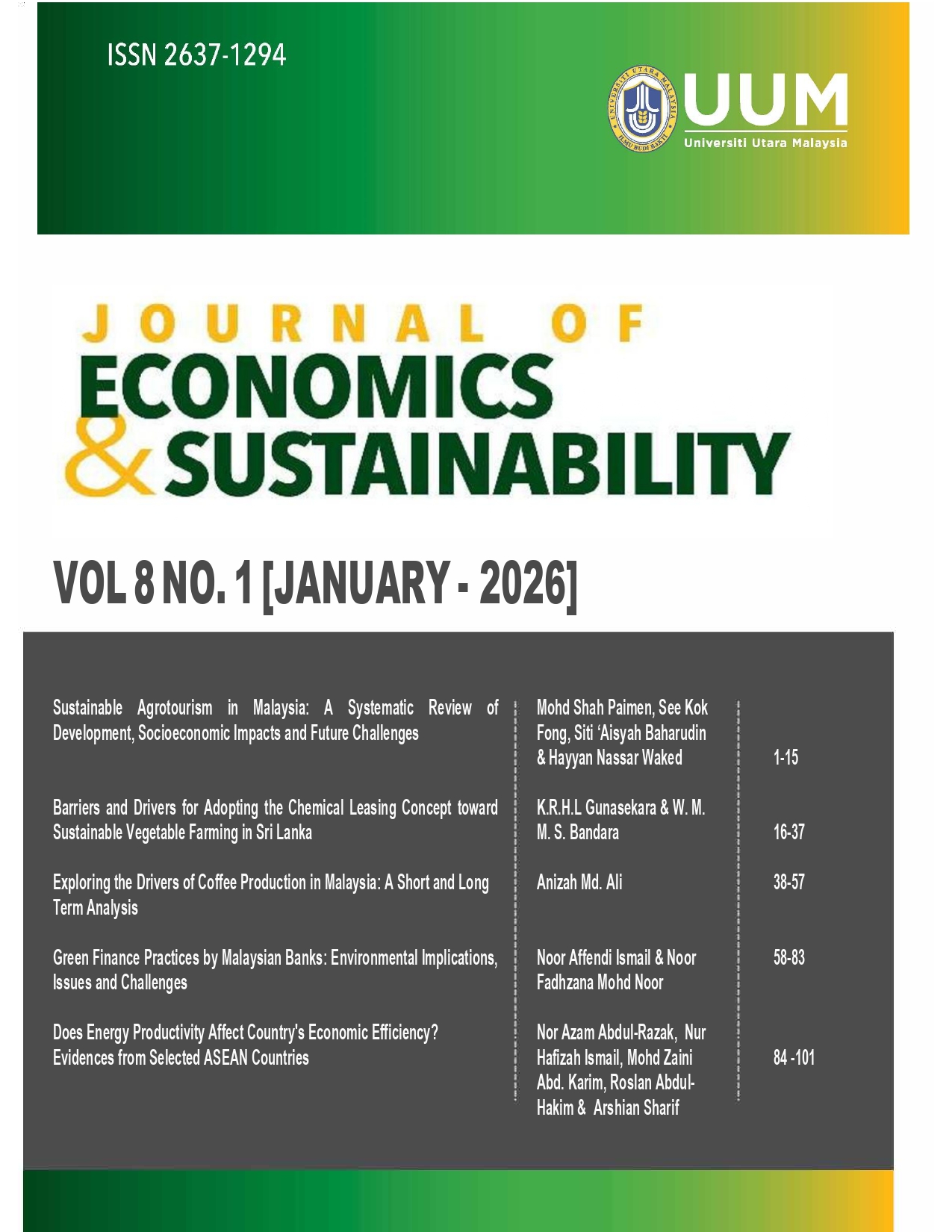
Barriers and Drivers for Adopting the Chemical Leasing Concept Toward Sustainable Vegetable Farming in Sri Lanka
DOI:
https://doi.org/10.32890/jes2026.8.1.2Keywords:
Chemical Leasing, barriers and drivers, sustainable-vegetable-farmersAbstract
The heavy use of synthetic agrochemicals is a common feature of vegetable farming. This excessive use of agrochemicals underlies fundamental problems related to health degradation, higher vegetable production costs, and environmental damage. The Chemical Leasing Concept (CLC) is based on the premise that it can enable users to reduce the costs associated with high chemical use, reduce environmental and health harms, and curb chemical overuse. Thus, the purpose of this study was to identify the barriers and drivers to the adoption of the Chemical Leasing Concept. The study employed a mixed-methods approach, and data were collected from 30 full-time, medium-scale vegetable farmers. The data were analyzed using thematic analysis for qualitative data and the Participatory Ranking Method (PRM) for quantitative data. The findings confirmed that the most significant barriers included: (1) farmers’ unawareness of Chemical Leasing, (2) doubt about the practicality of the Chemical Leasing concept, (3) uncertain weather and climate conditions, (4) Chemical Leasing being viewed as a risk, (5) a lack of norms, standards, and frameworks to implement Chemical Leasing, and (6) soil infertility. In contrast, the most significant drivers identified were: (1) saving farmers’ time through convenience, (2) providing a solution to agrochemical shortages, (3) avoiding the import and use of inferior agrochemicals, (4) reducing costs and increasing profits, (5) producing healthier products, and (6) access to expert knowledge. Further, awareness campaigns, trust-building initiatives, and financial risk management schemes were recommended to overcome the identified barriers
References
Ager, A., Stark, L., & Potts, A. (2010). Participative Ranking Methodology: A Brief Guide: Version 1.1 Evaluation of Child Friendly Spaces in Emergencies View project. https://doi.org/10.13140/RG.2.2.34356.45448
Ali, S. S., Kornaros, M., Manni, A., Al-Tohamy, R., El-Shanshoury, A. E.-R. R., Matter, I. M., Elsamahy, T., Sobhy, M., & Sun, J. (2021). Advances in microorganisms-based biofertilizers: Major mechanisms and applications. In Biofertilizers (pp. 371–385). Elsevier. https://doi.org/10.1016/B978-0-12-821667-5.00023-3
Amarathunga, D., Weerasekara, S., Sureshkumar, Azmy, & Shirantha, R. (2010). Total Suspended Solids and Turbidity Co-relation in Kotmale sub-catchment in Upper Mahaweli Watershed in Sri Lanka. Water Resource Research in Sri Lanka (Proceeding), 2010, 115–124.
Anon. (2016). AgStat, Pocket book of Agricultural Statistics (Vol. 13). Socioeconomics and planning center, Department of agriculture, Peradeniya, Sri Lanka.
Ariyapala, W. S. B., & Nissanka, S. P. (2006). Reasons for an impact of excessive fertilizer usage for potato farming in Nuwara Eliya District. Tropical Agriculture Research, 18, 63–70. http://www.pgia.pdn.ac.lk/files/Annual_congress/journel/v18/6.pdf
Beyer, W. (2008). Evaluation of the Questionnaires. In T. Jakl & P. Schwager (Eds.), Chemical Leasing Goes Global Selling Services Instead of Barrels: A Win-Win Business Model for Environment and Industry (pp. 234–235). Springer - Wien.
Braun, V., & Clarke, V. (2006). Using thematic analysis in psychology. Qualitative Research in Psychology, 3(2), 77–101. https://doi.org/10.1191/1478088706qp063oa
Carter, C. R., & Liane Easton, P. (2011). Sustainable supply chain management: evolution and future directions. International Journal of Physical Distribution & Logistics Management, 41(1), 46–62. https://doi.org/10.1108/09600031111101420
Cederberg, C., Persson, U. M., Schmidt, S., Hedenus, F., & Wood, R. (2019). Beyond the borders – burdens of Swedish food consumption due to agrochemicals, greenhouse gases and land-use change. Journal of Cleaner Production, 214, 644–652. https://doi.org/10.1016/j.jclepro.2018.12.313
Central Bank of Sri Lanka. (2021). Annual Report 2020. https://www.cbsl.gov.lk/en/publications/economic-and-financial-reports/annual-reports/annual-report-2020
de Jesus, A., & Mendonça, S. (2018). Lost in Transition? Drivers and Barriers in the Eco-innovation Road to the Circular Economy. Ecological Economics, 145, 75–89. https://doi.org/https://doi.org/10.1016/j.ecolecon.2017.08.001
Dharmasena, P. B. (2017). Vegetable Cultivation in the Central Highlands of Sri Lanka.
Dilhani, R., Katukurunda, S., Pathirana, S., Marapana, U., Jayasinghe, J., & Navaratne, S. (2015). Assessment of pesticide usage for vegetable cultivation in Nuwara Eliya District. https://doi.org/10.13140/RG.2.1.2586.7603
Drost, A. M., Siebers, A. R., Paillex, A., Misteli, B., Peeters, E. T. H. M., & Robinson, C. T. (2022). Long-lasting effects of experimental flow intermittency on alpine stream macroinvertebrates (Val Roseg, Switzerland). Hydrobiologia, 849(8), 1931–1946. https://doi.org/10.1007/s10750-022-04843-7
German Federal Environment Agency. (2010). Chemical Leasing as a model for sustainable development with test procedures and quality criteria on the basis of pilot projects in Germany. https://www.umweltbundesamt.de/sites/default/files/medien/2332/dokumente/chemical_leasing_u ba_project_2010_final.pdf
Green Industry Platform. (2021). Chemical Leasing: A winning model for better performance and efficiency | Green Industry Platform. Green Industry platform: https://www.greenindustryplatform.org/blog/chemical-leasing-winning-model-better-performance-and-efficiency
Guest, G., Bunce, A., & Johnson, L. (2006). How many interviews are enough? Field Methods, 18(1), 59–82.
Guha, T., Gopal, G., Kundu, R., & Mukherjee, A. (2020). Nanocomposites for Delivering Agrochemicals: A Comprehensive Review. Journal of Agricultural and Food Chemistry, 68(12), 3691–3702. https://doi.org/10.1021/acs.jafc.9b06982
Gunarathne, M.H.V.H.Y. & Duminda, D.M.S. (2014). Escalating chronic kidney diseases of multi-factorial origin in Sri Lanka causes, solutions, and recommendations. Environmental Health and Preventive Medicine. Sri Lankan Journal of Applied Sciences, 19, 375-394
Hale, J. (2021, April 12). Reflections on locating social science in sustainability research and practice collaborations. School of Global Environmental Sustainability, Colorado State University. https://sustainability.colostate.edu/humannature/james-hale/
Hamangoda, I., & Pushpakumari, P. (2018). Agstat (N. Ayoni & J. Galabada, Eds.; Vol. 15). Socio Economics and Planning Centre, Department of Agriculture. https://doa.gov.lk/wp-content/uploads/2020/05/AgstatBK.pdf
Haque, A. K. E., Mukhopadhyay, P., Nepal, M., & Shammin, M. R. (Eds.). (2022). Climate Change and Community Resilience. Springer Nature Singapore. https://doi.org/10.1007/978-981-16-0680-9
Hassan, N. (2019). Up-country Vegetable production and Marketing: Challenges and Opportunities. 4, 21–31.
Hortidaily. (2021). Asia produced approximately three-quarters of all vegetables. Hortidaily. https://www.hortidaily.com/article/9366612/asia-produced-approximately-three-quarters-of-all-vegetables/
Jakl, T. (2008). Chemical Leasing – An Introduction. In T. Jakl & P. Schwager (Eds.), Chemical Leasing Goes Global Selling Services Instead of Barrels: A Win-Win Business Model for Environment and Industry (pp. 1–8). Springer - Verlag/Wien.
Jakl, T., Joas, R., Nolte, R., Schott, R., & Windsperger, A. (2004). Chemical Leasing – An Intelligent and Integrated Business Model with a View to Sustainable development in Materials Management. Springer Wien.
Jakl, T., & Schwager, P. (2008). Chemical Leasing Goes Global Selling Services Instead of Barrels: A Win-Win Business Model for Environment and Industry. Springer Wien. http://ndl.ethernet.edu.et/bitstream/123456789/24592/1/9.pdf
Jayakody, P., Raschid-Sally, L., Abayawardana, S., & M.M.M., N. (2006). Urban growth and wastewater agriculture: A study from Sri Lanka.
Jin, S., Bluemling, B., & Mol, A. P. J. (2015). Information, trust and pesticide overuse: Interactions between retailers and cotton farmers in China. NJAS: Wageningen Journal of Life Sciences, 72–73(1), 23–32. https://doi.org/10.1016/j.njas.2014.10.003
Joas, R. (2008). The Concept of Chemical Leasing. In T. Jakl & P. Schwager (Eds.), Chemical Leasing Goes Global Selling Services Instead of Barrels: A Win-Win Business Model for Environment and Industry (pp. 17–26). Springer - Wien.
Koli, P., Bhardwaj, N. R., & Mahawer, S. K. (2019). Agrochemicals: Harmful and Beneficial Effects of Climate Changing Scenarios. In Climate Change and Agricultural Ecosystems (pp. 65–94). Elsevier. https://doi.org/10.1016/B978-0-12-816483-9.00004-9
Liu, W., Bai, E., Liu, L., & Wei, W. (2017). A Framework of Sustainable Service Supply Chain Management: A Literature Review and Research Agenda. Sustainability, 9, 421. https://doi.org/10.3390/su9030421
Lozano, R., Carpenter, A., & Lozano, F. J. (2014). Critical reflections on the Chemical Leasing concept. Resources, Conservation and Recycling, 86, 53–60. https://doi.org/10.1016/j.resconrec.2014.02.003
MacRae, R. J., Hill, S. B., Henning, J., & Mehuys, G. R. (1989). Agricultural Science and Sustainable Agriculture: a Review of the Existing Scientific Barriers to Sustainable Food Production and Potential Solutions. Biological Agriculture & Horticulture, 6(3), 173–219. https://doi.org/10.1080/01448765.1989.9754518
Maier, J. (2014). With Chemical Leasing Towards a Strong Sustainability Approach. https://www.uv.mx/meae/files/2012/01/Tesis-Julia-Maier-MEAE.pdf
Mandal, S., Choudhury, B. U., & Satpati, L. (2020). Soil site suitability analysis using geo-statistical and visualization techniques for selected winter crops in Sagar Island, India. Applied Geography, 122, 102249. https://doi.org/10.1016/j.apgeog.2020.102249
Mohottige, N. S., Sivayogaiiathan, C., & Wanigasundera, W. A. D. P. (2002). A Discussion Paper On Pesticide Use in Sri Lanka Major Policy Issues [University of Peradeniya]. https://www.ctc-n.org/sites/www.ctc-n.org/files/resources/agro-pesticide_use_in_sri_lanka_-_major_policy_issues.pdf
Nasr, N. (2010). ‘Sustainability’s next frontier.’ Industrial Engineer, 42(12), 24–25.
Nikolaidis, C., Mandalos, P., & Vantarakis, A. (2008). Impact of intensive agricultural practices on drinking water quality in the EVROS Region (NE GREECE) by GIS analysis. Environmental Monitoring and Assessment, 143, 43–50. https://doi.org/10.1007/s10661-007-9955-0
Office of the Assistant Director of Agriculture. (2023). Major Pests and Diseases of vegetable crops - Nuwara Eliya District.
Ohl, C., & Moser, F. (2007). Chemical Leasing Business Models—A Contribution to the Effective Risk Management of Chemical Substances. Risk Analysis, 27(4), 999–1007. https://doi.org/10.1111/j.1539-6924.2007.00938.x
Padmajani, M., Aheeyar, M., & Bandara, S. (2014). Assessment of Pesticide Usage in Up-Country Vegetable Farming in Sri Lanka. https://doi.org/10.13140/2.1.4241.7289
Proudfoot, K. (2023). Inductive/Deductive Hybrid Thematic Analysis in Mixed Methods Research. Journal of Mixed Methods Research, 17(3), 308–326. https://doi.org/10.1177/15586898221126816
Reganold, J. P., Papendick, R. I., & Parr, J. F. (1990). Sustainable Agriculture. Scientific American, 262(6), 112–120. https://doi.org/10.1038/scientificamerican0690-112
Sabarwal, A., Kumar, K., & Singh, R. P. (2018). Hazardous effects of chemical pesticides on human health–Cancer and other associated disorders. Environmental Toxicology and Pharmacology, 63, 103–114. https://doi.org/10.1016/j.etap.2018.08.
Schlosser, T. C. (1999). Local Realities and Structural Constraints of Agricultural Health: Pesticide Poisoning of Jamaican Small-holders. Faculty of the Virginia Polytechnic Institute and State University.
Schwager, P. (2008). Chemical Leasing Toolkit. In P. Schwager & T. Jakl (Eds.), Chemical Leasing Goes Global Selling Services Instead of Barrels: A Win-Win Business Model for Environment and Industry (pp. 129–142). Springer Wien.
Shahid, M., & Khan, M. S. (2022). Ecotoxicological implications of residual pesticides to beneficial soil bacteria: A review. Pesticide Biochemistry and Physiology, 188, 105272. https://doi.org/10.1016/j.pestbp.2022.105272
Singh, D., Singh, S. K., Modi, A., Singh, P. K., Yeka Zhimo, V., & Kumar, A. (2020). Impacts of agrochemicals on soil microbiology and food quality. In Agrochemicals Detection, Treatment and Remediation (pp. 101–116). Elsevier. https://doi.org/10.1016/B978-0-08-103017-2.00004-0
Statista. (2023a, August 4). Global fresh vegetable production in 2021, by region. Statista. https://www.statista.com/statistics/264066/global-vegegable-production-by-region/
Statista. (2023b, August 4). Leading producers of fresh vegetables worldwide in 2021. Statista. https://www.statista.com/statistics/264662/top-producers-of-fresh-vegetables-worldwide/
Su, B., Heshmati, A., Geng, Y., & Yu, X. (2013). A review of the circular economy in China: moving from rhetoric to implementation. Journal of Cleaner Production, 42, 215–227. https://doi.org/10.1016/j.jclepro.2012.11.
Tait, J., & Morris, D. (2000). Sustainable development of agricultural systems: competing objectives and critical limits. Futures, 32(3–4), 247–260. https://doi.org/10.1016/S0016-3287(99)00095-6
The World Bank. (2022, April 1). Agriculture and food. The World Bank. https://www.worldbank.org/en/topic/agriculture/overview
UNEP. (2006). Strategic Approach to International Chemicals Management. SAICM Texts and Resolutions of the International Conference on Chemicals Management, 4–6.
UNIDO. (2002). Manual on the Development of Cleaner Production Policies-Approaches and Instruments Guidelines for National Cleaner Production Centres and Programmes (P. Kazmierczyk, Ed.). Cleaner Production and Environmental Management Branch, Programme Development and Technical Cooperation Division, UNIDO.
UNIDO. (2011). Chemical leasing: A global success story Innovative business approaches for sound and efficient chemicals management. https://www.unido.org/sites/default/files/2014-03/ChL_Publication_2011_0.pdf
UNIDO. (2021). About the model - Chemical Leasing in Practice. United Nations Industrial Development Organization. https://chemicalleasing.com/chemical-leasing-in-practice/#1595648676039-f7389b04-9405
Upatissa, D., RF, N., & Pihilladeniya, A. (2021). Pesticide usage pattern of vegetable cultivation in Nuwara Eliya divisional secretariat division, Sri Lanka.
Upekshani, H. A. N., Dharmakeerthi, R. S., Weerasinghe, P., & Dandeniya, W. S. (2018). Fertilizer Usage and Land Productivity in Intensively Cultivated Vegetable Farming Systems in Sri Lanka: An Analysis Based on a Questionnaire Survey. Tropical Agricultural Research, 30(1),44–55. http://www.pgia.pdn.ac.lk/files/Annual_congress/journel/v30/Journal_No_1/Papers/5-39.Ms.H.A.N.%20Upekshani_edited-rsd-2018.11.09_CA_ref_check-rsd2-Formated_vit.pdf
U.S. Congress. (1990). U.S. Congress. Food, Agriculture, Conservation, and Trade Act of 1990. Public Law 101–624: U.S. Farm Bill.
Valerio, E. A., Perez, J., Sanchez, I., & Joas, R. (2008). Chemical Leasing in Mexico - Sugar Mills. In T. Jakl & P. Schwager (Eds.), Chemical Leasing Goes Global Selling Services Instead of Barrels: A Win-Win Business Model for Environment and Industry. Springer-Wien.
Watawala, R. C., Liyanage, J. A., & Mallawatantri, A. (2010). Assessment of risks to water bodies due to residues of agricultural fungicide in intensive farming areas in the up-country of Sri Lanka using an indicator model. https://publications.iwmi.org/pdf/H042860.pdf
Weerakkody, M. P., Edirisinghe, L. G. L. M., & Sivashankar, P. (2022). Farmers’ attitude towards chemical leasing for sustainability and environmental protection. Current Research in Environmental Sustainability, 4, 100175. https://doi.org/10.1016/j.crsust.2022.100175
Weerakkody, P., & Mawalagedera, M. (2020). Recent Developments in Vegetable Production Technologies in Sri Lanka. In Agricultural Research for Sustainable Food Systems in Sri Lanka (pp. 189–214). https://doi.org/10.1007/978-981-15-2152-2_9
Weerasinghe, W. D. L. P. (2022). Drivers, Barriers, and Challenges for adapting to chemical leasing concept by vegetable farmers in Badulla district. Sri Lanka. [Faculty of Management Studies, Sabaragamuwa University of Sri Lanka]. http://repo.lib.sab.ac.lk:8080/xmlui/handle/susl/3665
Wijewardhana, J. D. H. (2000). Sustainable plant nutrient management in intensive vegetable growing lands in the up country of Sri Lanka. Journal of the Soil Science Society of Sri Lanka, 12, 1–13. http://dl.nsf.gov.lk/handle/1/16278
Wijewardhana, J. D. H. (2001a). Effect of source and levels of liming materials on soil acidity in ultisols of the up-country. Annals of the Sri Lanka Department of Agriculture., 3, 365-372. http://doa.nsf.ac.lk/handle/1/1983
Wijewardhana, J. D. H. (2001b). Effect of sulphur and poultry manure application to vegetable crops. The Journal of Soil Science Society of Sri Lanka, 13, 23–27. https://dl.nsf.gov.lk/handle/1/16325
Wijewardhana, J. D. H. (2001c). Fertilizer and soil amendments use on potato in relation to soil fertility in rice based cropping systems of up-country of Sri Lanka. Annals of the Sri Lanka Department of Agriculture, 3, 353–363. http://doa.nsf.ac.lk/bitstream/handle/1/1982/ASDA-3-353.pdf?sequence=2
Wijewardhana, J. D. H., & Amarasiri, S. L. (1993). Response of vegetable crops in a cropping sequence to K and Mg fertilizers in the up-country intermediate zone. Trop. Agriculturist., 149, 13–22.
Wijewardhana, J. D. H., & Amarasiri, S. L. (1997). Long term use of potassium fertilizer for vegetable crops in the up-country intermediate zone. Journal of the National Science Foundation of Sri Lanka, 25(1), 59–68.
Wijewardhana, J. D. H., Yapa, U. W. S. P., & Yatagama, S. M. K. G. (2001). Drinking water quality of some wells in the intensive vegetable growing lands in the up-country wet zone. The Journal of the Soil Science Society of Sri Lanka, 13, 14–22. http://dl.nsf.ac.lk/handle/1/16323
World Economic Forum. (2022). The Barriers to Circular Approaches. World Economic Forum. https://www.weforum.org/circular-economy-for-net-zero/barriers
Youssef, M. M. A., & Eissa, M. F. M. (2014). Biofertilizers and their role in management of plant parasitic nematodes. A review. E3 Journal of Biotechnology and Pharmaceutical Research, 5(1). http://www.e3journals.org
Published
Issue
Section
License
Copyright (c) 2026 Journal of Economics and Sustainability

This work is licensed under a Creative Commons Attribution 4.0 International License.

