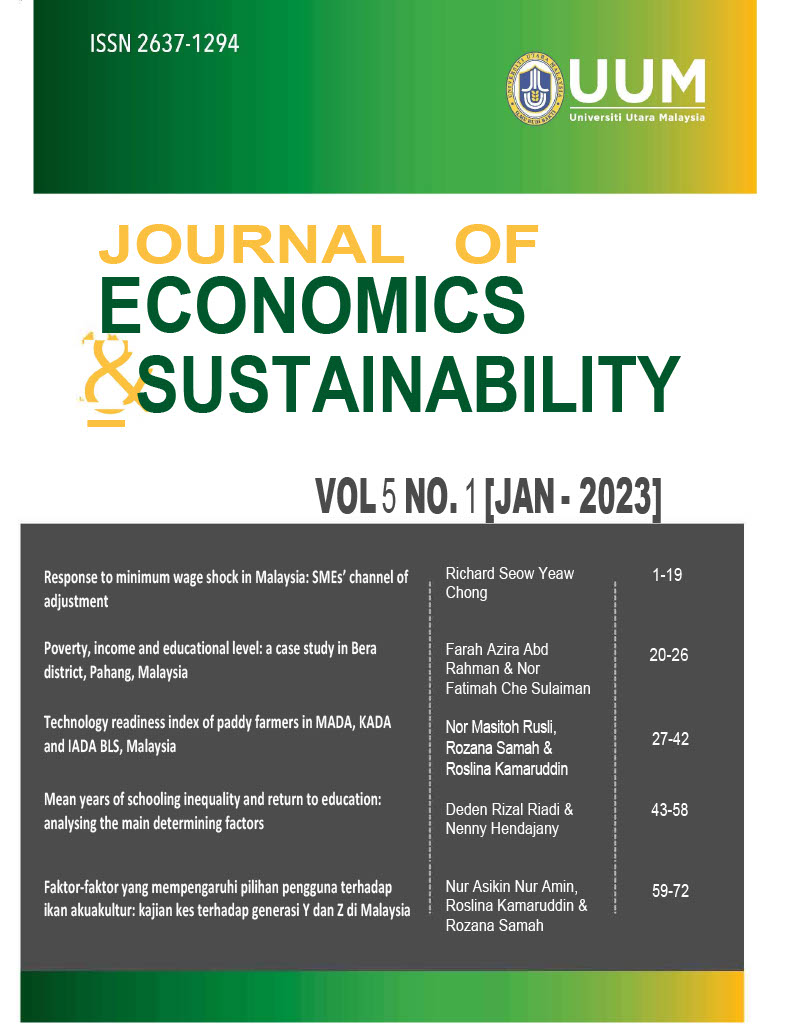
Technology Readiness Index of Paddy Farmers in MADA, KADA, and IADA BLS, Malaysia
DOI:
https://doi.org/10.32890/jes2023.5.1.3Keywords:
Paddy farmers, technology, paddy industry, readiness index, farmersAbstract
This paper aims to determine the technology readiness level of paddy farmers in MADA, KADA, and IADA BLS, Malaysia. Primary data were obtained through a face-to-face survey with paddy farmers in MADA, KADA, and IADA BLS using a structured questionnaire. A total of 315 respondents of MADA, 295 respondents of KADA, and 178 respondents of IADA BLS actively involved in paddy cultivation were interviewed. The technology readiness level of paddy farmers from three main granary areas is evaluated objectively and subjectively. The technology readiness index of paddy farmers is calculated to analyse the readiness level of paddy farmers. Thirty indicators are used to measure four dimensions of technology readiness, i.e., optimism, innovativeness, discomfort, and insecurity. The present study shows that 72.4%, 74.58%, and 74.16% of paddy farmers in MADA, KADA, and IADA BLS have a moderate readiness level to adopt the new technology in paddy cultivation. The four dimensions of the technology readiness index was evaluated to provide a better picture of the technology readiness level. All three granary areas have a score mean index (0.51-1.0) for technology readiness driver, optimism, and innovativeness, which indicate that the paddy farmers have a moderate and high level of optimism and innovativeness to adopt the new technology. However, the score means index for the negative factors of technology readiness for all three granary areas is in the quantile range (0.51-0.75), which means the paddy farmers have a moderate level of discomfort and insecurity. Thus, the result suggests that although the paddy farmers exhibit innovativeness and optimism, they also experience some discomfort and insecurity.
References
Abdullah, F.A., & Abu Samah, B. (2013). Factor impinging farmers’ use of agriculture technology. Canadian Center of Science and Education, 9(3), 120-124. http://dx.doi.org/10.5539/ass.v9n3p120.
Blut, M. & Wang, C. (2020). Technology readiness: a meta-analysis of conceptualisations of the construct and its impact on technology usage. Journal of the Academy of Marketing Science, 48, 649-669. https://doi.org/10.1007/s11747-019-00680-8.
Diao, X., Silver, J., & Takeshima, H. (2016). Agricultural Mechanization and Agricultural Transformation. International Food Policy Research Institute.
Fairuz, K., Idris, A. G., Syahrizan, S., & Hatijah, K. (2017). Assessing farmers’ community readiness towards the enhancement of natural enemy population in rice fields in Malacca. https://aip.scitation.org/doi/10.1063/1.5027943
Farmers’ Organization Authority. (2010). Rancangan mewujudkan skim pemilikan. https://www.lpp.gov.my/document/upload/4VQcuKUPaRICgOZub062KbSZO5RY9NUZ.pdf
Hahn, M. B., Riederer, A. M., & Foster, S. O. (2009). The livelihood vulnerability index: a pragmatic approach to assessing risks from climate variability and change-A case study in Mozambique. Global Environmental Change, 19(1), 74-88.
Hayrol Azril, M. S., Md Salleh, H., & Bahaman, A. S. (2009). Level of Agro-based Website Surfing among Malaysian Agricultural Entreprenuers: A Case Study of Malaysia. J. Agriculture and Social Science, 5, 55-60.
James, W. D., & Jeffrey, G. C. (2018). Diffusion of innovations theory, principles, and practice. Health Affairs, 2 (37), 183-190. https://doi.org/10.1377/hlthaff.2017.1104
Jarrar, Y., Awobamise, A. O., & Sellos, P.S. (2020). Technology Readiness Index (TRI) and the intetion to use smartphone apps for tourism: A focus on in Dubai mobile tourism app. International Journal of Data and Network Science, 4(3), 297-304.
Kamble, S., Gunasekaran, A., & Arha, H. (2018). Understanding the Blockchain Technology Adoption in Supply Chain-Indian Context. International Journal of Production Research, 57(7), 2009-2033. DOI: https://doi.org/10.1080/00207543.2018.1518610.
Khalil, T.M. (2000). Management of technology: The key to competitiveness and wealth creation. McGraw-Hill.
Larasati, N., Widyawan & Santosa, P. I. (2017). Technology Readiness and Technology Acceptance Model in Technology Implementation Process in Low Technology SMEs. International Journal of Innovation, Management and Technology, 8(2), 113-117. https://doi.org/10.18178/ijimt.2017.8.2.713
Lin, C.H., Shih, H.Y., & Sher, P. J. (2007). Integrating technology readiness into technology acceptance: The TRAM model. Psychology & Marketing, 24, 641-657.
MADA. (2022). Industri Padi. https://www.mada.gov.my/?page_id=1662
Maine Suadik & Yusten Karulus. (2010). Teknologi, perubahan amalan pertanian dan isu rasionaliti masyarakat petani di Sabah, Malaysia. Sosiohumanika, 3(1), 41-52.
Mastura Jaafar, T. Ramayah, Abdul Rashid Abdul Aziz., & Basri Saad. (2007). Technology readiness among managers of Malaysian construction firms. Engineering, Construction and Architectural Management, 14(2), 180-191. https://doi.org/10.1108/09699980710731290.
Meng, F., Park, K.S., & Oh, S.W. (2017). The moderating effects of technology readiness, user traits and situational factors on usage attitude and intention to technology-based self-service. J. Korea Serv. Manag. Soc, 18, 69-104.
Mufara, P. (2009). Living the Dream: The Chambeshi Rice Farmers’ Association Story. http://www.bibalex.org/search4dev/files/338041/171518.pdf
Mukerjee. H. S., Deshmukh, G. K., & Prasad, U. D. (2018). Technology readiness and likelihood to use self-checkout services using smartphone in retail grocery stores: empirical evidence from Hyderabas, India. Business Perspectives and Research, 7(1), 1-15.
MyMETRO. (2022, October 4). Lebih RM 1.53 bilion dibelanjakan bantu pesawah. https://www.hmetro.com.my/mutakhir/2022/10/888543/lebih-rm153-bilion-dibelanjakan-bantu-pesawah-metrotv.
Na, T.K., Lee, S.H., & Yang, J.J. (2021). Moderating effect of gender on the relationship between technology readiness index and consumers’ continuous use intention of self-service restaurant kiosks. Information, 12(7), 280. https://doi.org/10.3390/info12070280
Oetting, E.R., Plested, B. A., Edwards, R. W., Thurman, P. J., Kelly, K. J., Beauvais, F., & Stanley, L.R. (2014). Community readiness for community Change (2nd Ed.). Sage Hall.
Parasuraman, A. (2000). Technology Readiness Index (TRI): a Multiple-item scale to measure readiness to embrace new technologies. Journal of Service Research, 2, 307-320.
Parasuraman, A. & Colby, C.L. (2014). An updated and streamlined technology readiness index: TRI 2.0. Journal of Service Research, 18(1), 1-16.
Pattansheti, M., Kamble, S. S., Dhume, S.M. &Raut. R.D. (2016). Development, measurement and validation of an integrated technology readiness acceptance and planned behaviour model for Indian mobile banking industry. International Journal of Business Information Systems, 22 (3), 316–342.
Pericles, J. P., Filho, B. A. D. C., & Cunha, J. C. D. (2008). Technology readiness index (TRI) factors as differentiating elements between users and non-users of internet banking, and as antecedents of the technology acceptance model (TAM). Conference Paper in Communications in Computer and Information Science, 220, 215-229. https://doi.org/10.1007/978-3-642-24355-4_23
Ramayah, T., Muhamad Jantan, Rosmimah Mohd Roslin. & Rusinah Siron. (2003). Technology readiness of owners/managers of SME’s. The International Journal of Knowledge Culture and Change Management Annual Review, 3(1). https://doi.org/10.18848/1447-9524/CGP/v03/59061
Roger, E.M. (2003). Diffusion of innovations (5th ed.), The Free Press.
Shahrina Md Nordin, Shuhaida Mohd Noor, & Moho Stamburi Md Saad. (2014). Innovation diffusion of new technologies in the Malaysian paddy fertiliser industry. Social and Behavioral Sciences, 109, 768-778.
Sobia Mannan, Shahrina Md Nordin, Shameem Rafik.Galea & Ammar Redza Ahmad Rizal. (2017). The ironies of new innovation and the sunset industry: Diffusion and adoption. Journal of Rural Studies, 55, 316-322.
Truong, T. & Ngoc, C. (2008). Factors affecting technology adoption among rice farmers in the Mekong delta through the lens of the local authorial managers: An analysis of qualitative data. Omonrice. 16, 107-112.
Tsourela, M., & Roumeliotis, M. (2015). The moderating role of technology readiness, gender and sex in consumer acceptance and actual use of technology-based services. J. High Technol. Manag. Res., 26, 124-136.
Published
Issue
Section
License
Copyright (c) 2023 Journal of Economics and Sustainability

This work is licensed under a Creative Commons Attribution 4.0 International License.

