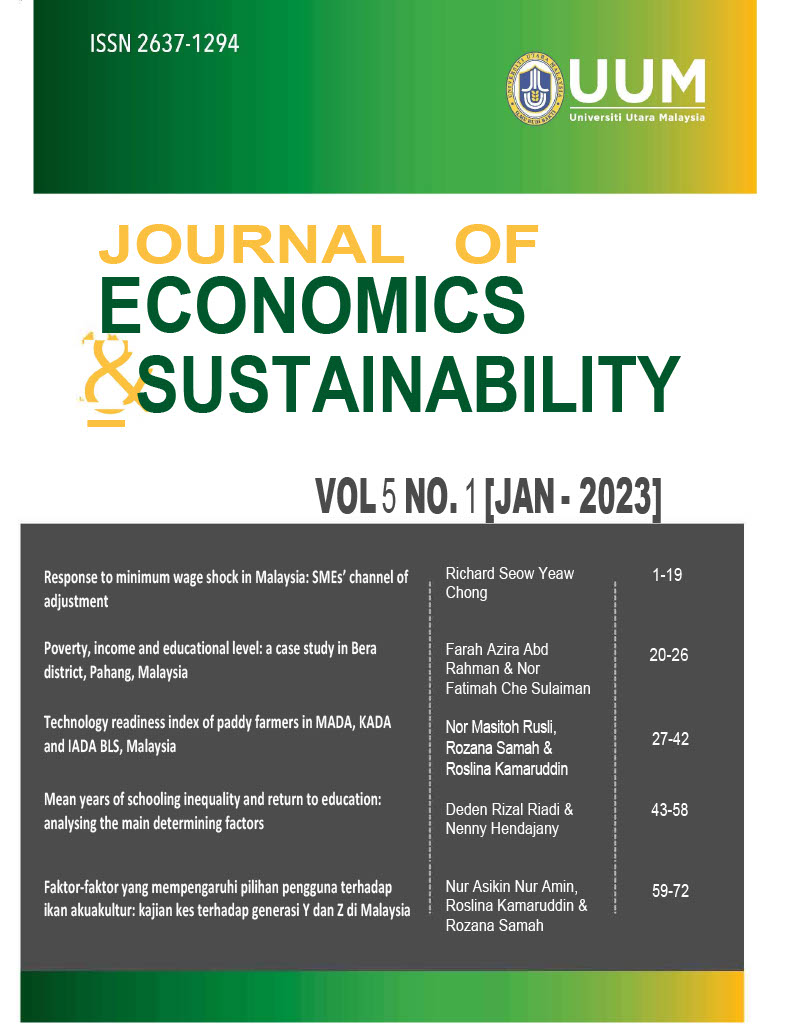
Mean Years of Schooling Inequality and Return on Education: Analysing the Main Determining Factors
DOI:
https://doi.org/10.32890/jes2023.5.1.4Keywords:
Education, human development, principal component analysis, return to educationAbstract
Education is a determining factor in human development. West Java had a mean year of schooling (MYS) of around 8.37 years in 2019, which is still below the compulsory primary school. This study aims to find out the factors that can be attributed to low MYS. Ten variables influence the MYS. Principal Component Analysis (PCA) method was used to simplify the observed variables by reducing the dimensions. The result reduces ten variables to two factors containing five variables. The first factor is infrastructure (road access, distance to schools, and health centres) and the second factor is income (RMW and GRDP). These two factors significantly influence the MYS. This MYS, in turn, directly affects people’s food consumption. A higher percentage of income for non-food represents a higher return to education. Districts have a lower return on education than cities. Two factors (infrastructure and income) do not directly affect the percentage of people’s income for food but are affected through MYS. The central and provincial governments need to pay more attention to districts with an agricultural base on the availability of school infrastructure. In addition, it is necessary to increase people’s income by providing better road access to reach better education.
References
Abebe, A., & Girma, E. (2017). Historical Development and Practical Application of Correlation and Path Coefficient Analysis in Agriculture. Journal of Natural Sciences Research, 7(13), 43-49.
Azhar, M., Suwatno, S., & Mahmud, A. (2018). Determinant return to education in Indonesia. Manajerial : Jurnal Manajemen Dan Sistem Informasi, 17(1), 52–69. https://ejournal.upi.edu/index.php/manajerial/article/view/9761
Bhandari, L. (2006). Social Infrastructure: Urban Health and Education. http://www.un.org.in/JANSHALA/jan1999/fiftyrs.htm
BPS. (2019). Badan Pusat Statistik. https://www.bps.go.id/indicator/30/1435/2/persentase-merokok-pada-penduduk-umur-15-tahun-menurut-provinsi.html
BPS. (2020). Ekspor Menurut Provinsi Asal Barang. https://www.bps.go.id/publication/2022/09/30/4c43f01d794eeab1959367db/ekspor-menurut-provinsi-asal-barang-2021.html
Brennerman, A., & Kerf, M. (2002). Infrastructure and poverty linkages: A literature review. https://www.ilo.org/wcmsp5/groups/public/---ed_emp/---emp_policy/--- invest/documents/publication/wcms_asist_8281.pdf
Bruckner, M. M. G. (2013, April 4). Income and schooling. VOX, CEPR Policy Portal. VOX - CEPR. https://voxeu.org/article/income-and-schooling
Damon, A., Glewwe, P., Wisniewski, S., & Sun, B. (2019). What education policies and programmes affect learning and time in school in developing countries? A review of evaluations from 1990 to 2014. Review of Education, 7(2), 295–387. https://doi.org/10.1002/REV3.3123
Djakaria, I. (2016). Principal Component Analysis pada Klasifikasi Obyek Multivariat. PROSIDING, 10 (556). https://repository.ung.ac.id/karyailmiah/show/556/principal-component-analysis-pada-klasifikasi-obyek-multivariat.html
Efroymson, D., Ahmed, S., Townsend, J., Mahbubul Alam, S., Ranjan Dey, A., Saha, R., Dhar, B., Islam Sujon, A., Uddin Ahmed, K., Rahman, O., & Ahmed M., Alam, A. R., Dey, R., Saha, B., Dhar, A.I., Sujon, K.U., Ahmed, O., & Rahman, S.S. (2001). Hungry for tobacco: an analysis of the economic impact of tobacco consumption on the poor in Bangladesh Work for a Better Bangladesh. Tobacco Control, 10, 212–217. https://doi.org/10.1136/tc.10.3.212
Hendajany, N., & Deden, R. R. (2020). Implications of Women Education and Infrastructure of Health on Quality of Baby Births in Agricultural and Non-Agricultural Regions. Proceedings of the 2nd Social and Humaniora Research Symposium (SoRes 2019), 291–296. https://doi.org/10.2991/assehr.k.200225.061
Hendajany, N., & Rizal, D. (2019). Regional Typology Approach in Education Quality in West Java Based on Agricultural and non -Agrricultural Economic Structure. The International Journal of Business Review (The Jobs Review), 2(2), 107–120.
Imaningsih, N., Priana, W., Sishadiyati, S., Asmara, K., & Wijaya, R. (2020). Analysis of Factors Affecting Human Development Index East Java. https://doi.org/10.4108/EAI.3-10-2019.2291908
Khairunnisa, K., Hartoyo, S., & Anggraeni, L. (2015). Determinan Angka Partisipasi Sekolah SMP di Jawa Barat. Jurnal Ekonomi Dan Pembangunan Indonesia, 15(1), 91. https://doi.org/10.21002/jepi.v15i1.444
Kumar Mohanty, A., Chandra Nayak, N., & Chatterjee, B. (2016). Does Infrastructure Affect Human Development? Evidences from Odisha, India. Journal of Infrastructure Development, 8(1), 1–26. https://doi.org/10.1177/0974930616640086
Kusharjanto, H., & Kim, D. (2011). Infrastructure and human development: The case of Java, Indonesia. Journal of the Asia Pacific Economy, 16(1), 111–124. https://doi.org/10.1080/13547860.2011.539407
Lestari, D. H., & Setyadharma, A. (2019). Determinant Mean Years of Schooling in Central Java. Efficient: Indonesian Journal of Development Economics, 2(3), 524–539. https://doi.org/10.15294/EFFICIENT.V2I3.35905
Lokshin, M., & Yemtsov, R. (2005). Has Rural Infrastructure Rehabilitation in Georgia Helped the Poor? In The World Bank Economic Review (Vol. 19, pp. 311–333). Oxford University Press. https://doi.org/10.2307/40282218
Mashadi. (2018). Principal Component Analysis (PCA) Salah Cara Mengatasi Multikolinearitas. https://mashadi.staff.unri.ac.id/files/2018/10/REGRESI-KOMPONEN-UTAMA.pdf
Mohanty, L. L., & Raut, L. K. (2009). Home Ownership and School Outcomes of Children: Evidence from the PSID Child Development Supplement on JSTOR. American Journal of Economics and Sociology, 68(2), 465-490. https://www.jstor.org/stable/27739780
Pratomo, B. D., & Arifin, Z. (2020). The Effect of School Principal’s Servant Leadership of Vocational Schools in Temanggung Regency. International Journal of Applied Business and International Management, 5(3), 1–12. https://doi.org/10.32535/ijabim.v5i3.975
Rahbari, M., Hajnaghizadeh, F., Damari, B., & Adhami, B. (2014). Dropouts and social determinants of health; policy for the prevention of school dropout, qualitative study of the causes and interventions. International Journal of Preventive Medicine, 5(11), 1396–1404.
Roser, M., & Ortiz-Ospina, E. (2016). Financing Education. Our World in Data. OurWorldInData.org https://ourworldindata.org/financing-education
Rumawas, W. (2018). The role of human capital to the improvement of employee performance in fisheries companies in North Sulawesi Province. International Journal of Applied Business & International Management (IJABIM), 3(2). http://www.ejournal.aibpm.org/index.php/IJABIM/article/view/160/165
Sapkota, J. B. (2014). Access to Infrastructure and Human Development: Cross-Country Evidence. Publications - JICA Ogata Research Institute. https://www.jica.go.jp/jica-ri/publication/workingpaper/author_je.html
Setiabudi, A., Luddin, M. R., & Rahmawati, Y. (2019). Human Resources Development Through Scholarship: A Case Study of Ministry of Public Works and Housing of Indonesia. Journal of Conferencie Proceedings (JICP), 2(2). http://ejournal.aibpm.org/index.php/JICP/article/view/597/591
Singh, R., & Mukherjee, P. (2015). Determinants of Successful Completion of Secondary Education Evidence from Young Lives, Andhra Pradesh. http://www.younglives.org.uk
Straus, S., & Weinberg, J. L. (2017). The Connection Between Education, Income Inequality, and Unemployment. https://www.huffpost.com/entry/the-connection-between-ed_b_1066401
Suryadarma, D., & Suryahadi, A. (2011). The Contrasting Role of Ability and Poverty on Education Attainment: Evidence from Indonesia. SSRN Electronic Journal. https://doi.org/10.2139/ssrn.1458065
Whelan, S. (2017). Does homeownership affect education outcomes? Wol.Iza.Org. https://doi.org/10.15185/izawol.342
Yogiantoro, M., Komariah, D., & Irawan, I. (2019). Effects Of Education Funding In Increasing Human Development Index. JEJAK: Jurnal Ekonomi Dan Kebijakan, 12(2), 482–497. https://doi.org/10.15294/JEJAK.V12I2.23391
Yurekli, A., Guindon, G. E., & Boisclair, D. (2003). Past, Current and Future Trends in Tobacco Use. https://documents1.worldbank.org/curated/en/374771468128405516/820140748_200405160093 654/additional/292650Guindon1Past10current10whole.pdf
Published
Issue
Section
License
Copyright (c) 2023 Journal of Economics and Sustainability

This work is licensed under a Creative Commons Attribution 4.0 International License.

