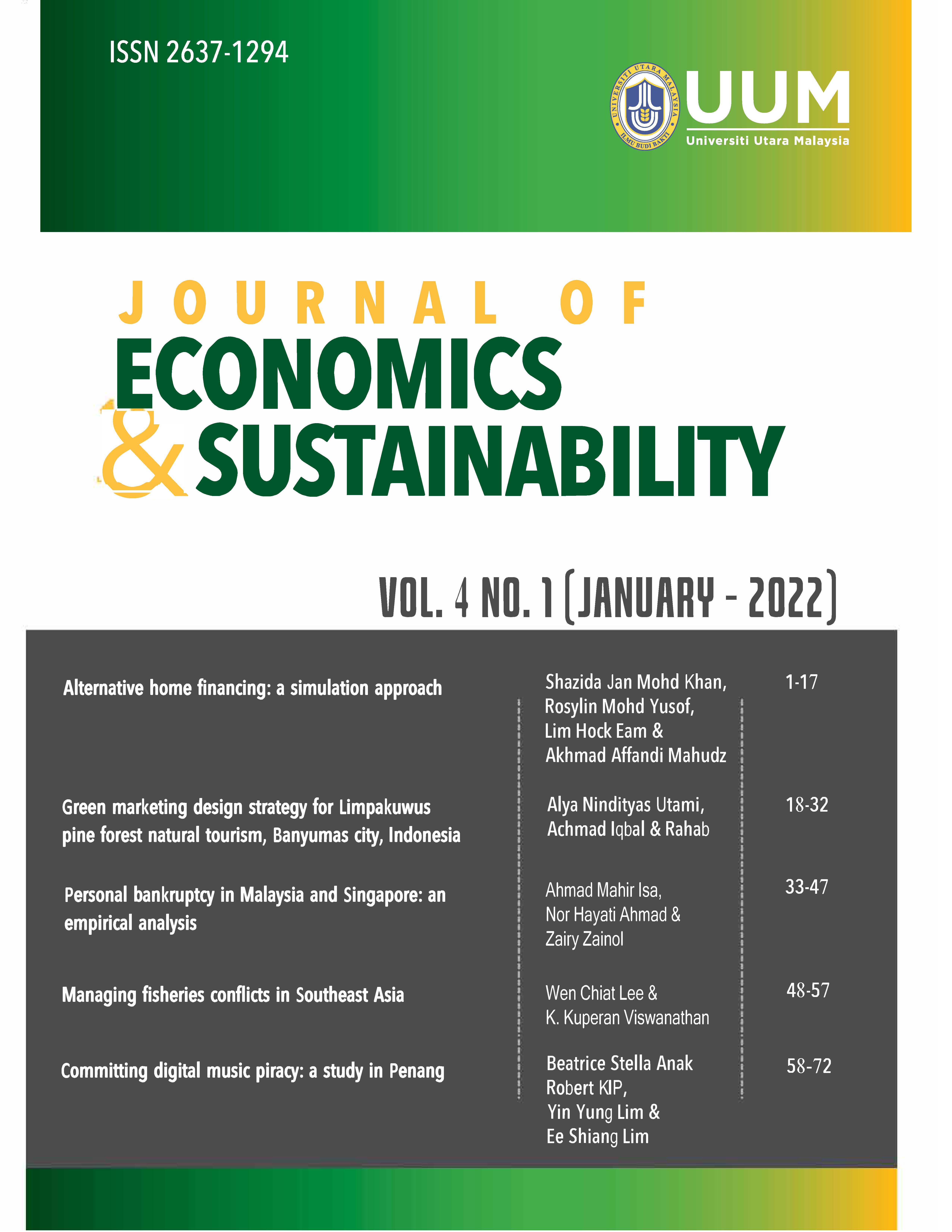
Committing Digital Music Piracy: A Study in Penang
DOI:
https://doi.org/10.32890/jes2022.4.1.5Keywords:
Copyright, files-sharing, illegal downloading, piracy, musicAbstract
Piracy is one of the primary challenges facing the music industry. Music piracy has accounted for substantial revenue losses in this industry in Malaysia, a country in which intellectual property regimes are deemed as a matter of concern. If music piracy is left unchecked, it may destroy the value chain of the music industry. This study aims to explore the extent to which digital music copyright violations prevails in society and examine the characteristics of copyright violators. The analysis was carried out using primary data collected from a survey carried out in Penang, a highly urbanised state in Malaysia. A descriptive approach was used for the analysis. The findings from this study offer insights into the phenomenon of music piracy in Malaysia. The incidence of violating copyright was high, with seven out of ten persons involved in illegally using digital music. Copyright violators have distinguishing characteristics that differentiate them from non-copyright violators. The results found that awareness about intellectual property rights was rather low among violators and that they had misconceptions about music piracy. While most participants agreed that effective enforcement was critical in reducing illegal music activities, fewer perceived the risks of being caught and the high costs associated with punishment. Policies aimed at increasing awareness and understanding of intellectual property rights and the possible societal implications of copyright issues were discussed. The need to enhance copyrightenforcement protection in the country is also highlighted.
References
Al-Rafee, S., and Cronan, T.P. (2006). Digital Piracy: Factors that Influence Attitude Toward Behavior. Journal of Business Ethics, 63, 237–259. https://doi.org/10.1007/s10551-005-1902-9.
Ang, S. H., Cheng, P. S., Lim, E. A. C. and Tambyah, S. K. (2001). Spot the difference: Consumer responses towards counterfeits. Journal of Consumer Marketing, 18(3), 219-235.
Britton, L. M. (2018, March 22). Music piracy grew in 2017 and is now “more popular than ever”. NME. Accessed on December 19, 2018, from https://www.nme.com/news/music/music-piracy-growth2017-2271311.
Chiou, J. S., Huang, Cy., and Lee, Hh. (2005). The Antecedents of Music Piracy Attitudes and Intentions. Journal of Business Ethics, 57, 161–174.
Cox, J., and Collins, A. (2014). Sailing in the same ship? Differences in factors motivating piracy of music and movie content. Journal of Behavioral and Experimental Economics, 50, 70-76.
Coyle, J.R., Gould, S.J., Gupta, P., and Gupta, R. (2009). “To buy or to pirate”: The matrix of music consumers’ acquisition-mode decision-making. Journal of Business Research, 62(10), 1031-1037. Definition of ‘Piracy’ (n.d.). The Economic Times. https://m.economictimes.com/definition/Piracy?from=desktop. Digital habits in Singapore: Assessing movies, music illegally (2017, April 3). The Strait Times. https://www.straitstimes.com/singapore/many-still-accessing-movies-music-illegally
Foong, Y. T., Goh, S. B., Kho, Y.L., Ng, X. Y., and Yau, Y. C. (2012). Factors determining consumer purchasing behaviour of pirated media. Bachelor unpublished research project, Universiti Tunku Abdul Rahman.
Gibson, C.L., Ward, J.T., Wright, J.P., Beaver, K.M., and Delisi, M. (2010). Where Does Gender Fit in the Measurement of Self-Control. Criminal Justice and Behavior, 37(8), 883-903.
Goel, R. K., and Nelson, M. A. (2009). Determinants of Software Piracy: Economics, Institutions, and Technology. The Journal of Technology Transfer, 34(6), 637-658.
Goel, R. K., Miesing, P., and Chandra, U. (2010). The Impact of Illegal Peer-to-Peer File Sharing on the Media Industry. California Management Review, 52(3), 6-33.
Gottfredson, M. (2017). Self-Control Theory and Crime. Oxford Research Encyclopedias of Criminology. Accessed on January 17, 2019, from http://oxfordre.com/criminology/view/10.1093/acrefore/9780190264079.001.0001/acrefore9780190264079-e-252.
Gunter, W. D., Higgins, G.E., and Gealt, R.E. (2010). Pirating Youth: Examining the correlates of Digital Music Piracy among Adolescents. International Journal of Cyber Criminology, 4(1&2), 657-671.
Haque, A., Khatibi, A., and Rahman, S. (2009). Factors influencing buying behavior of piracy products and its impact to Malaysian market. International Review of Business Research Papers, 5(2), 383-401.
Higgins, G. E. (2006). Gender Differences in Software Piracy: The Mediating Roles of Self-Control Theory and Social Learning Theory. Journal of Economic Crime Management, 4(1), 1-30. Institute for Policy Innovation (IPI) (21 August 2007). The True Cost of Sound Recording Piracy to the
U.S. Economy. Institute for Policy Innovation. Accessed on November 29, 2018, from https://www.ipi.org/ipi_issues/detail/the-true-cost-of-sound-recording-piracy-to-the-us-economy
International Intellectual Property Alliance. (2018). 2018 Special 301 on Copyright Protection and Enforcement. International Intellectual Property Alliance. Accessed on January 1 2019, from https://iipa.org/files/uploads/2018/02/2018_SPECIAL_301.pdf.
Jafarkarimi, H., Sim, A. T. H., Saadatdoost, R., and Hee, J. M. (2015). Individual Characteristics and Hacking, Piracy, Online Gambling and Pornography Use among Students: A Study in Malaysia. International Journal of Cyber Behavior, Psychology and Learning (IJCBPL), 5(2), 30-43.
Liu, C. (2009). Music Piracy and Illegal Downloading - A survey of Chinese students in The Netherlands. Unpublished master thesis, Erasmus University Rotterdam.
Lee, S. H., and Yoo, B (2009). A Review of the Determinants of Counterfeiting and Piracy and the Proposition for Future Research. The Korean Journal of Policy Studies, 24(1), 1-38.
Lysonski, S., and Durvasula, S. (2008). Digital Piracy of MP3s : Consumer and Ethical Predispositions. Journal of Consumer Marketing, 25(3), 167-178. M’sia is second in Southeast Asia for content piracy: Irdeto. (2016, May 31). The Sunday Daily. https://www.thesundaily.my/archive/1820964-JSARCH370738
Patiro, S. P. S., and Sihombing, S. O. (2016). Predicting intention to purchase counterfeit products: extending the theory of planned behavior. International Research Journal of Business Studies, 7(2), 109-120.
Penang Institute. (2018). Penang Statistic Quarter 2, 2018. Accessed on December 18, 2018, from https://penanginstitute.org/wpcontent/uploads/jml/files/quarterly_penang_statistics/2018/PQSQ22018.pdf
Piracy is theft. (2017, May 22). The Star Online. from https://www.thestar.com.my/tech/technews/2017/05/22/piracyis-theft/
Popham, J. (2011). Factors influencing music piracy. Criminal Justice Studies, 24(2), 199-209.
Rebelo, M. (2014). Textbook piracy : exploring the decision to pirate or not. Accessed on December 19, 2018, from https://repositorio.ucp.pt/bitstream/10400.14/17176/1/Final%20Version%20%20Textbook%20Piracy.pdf.
Rochelandet, F., and Le Guel, F. (2005). P2P Music Sharing Networks: Why The Legal Fight Against Copiers May Be Inefficient. Review of Economic Research on Copyright Issues, 2(2), 69-82.
Shinar D., and McKnight A.J. (1985) The Effects of Enforcement and Public Information on Compliance. In: Evans L., Schwing R.C. (eds) Human Behavior and Traffic Safety. Springer, Boston, MA.
Why Malaysia, MCMC must prevail against piracy, network abuse (2019, February 18). The Edge Market. https://www.theedgemarkets.com/article/why-malaysia-mcmc-must-prevail-against-piracynetwork-abuse.
Yang, Z., and Wang, J. (2015). Differential effects of social influence sources on self-reported music piracy. Decision Support Systems, 69, 70-81.
Published
Issue
Section
License
Copyright (c) 2022 Journal of Economics and Sustainability

This work is licensed under a Creative Commons Attribution 4.0 International License.

