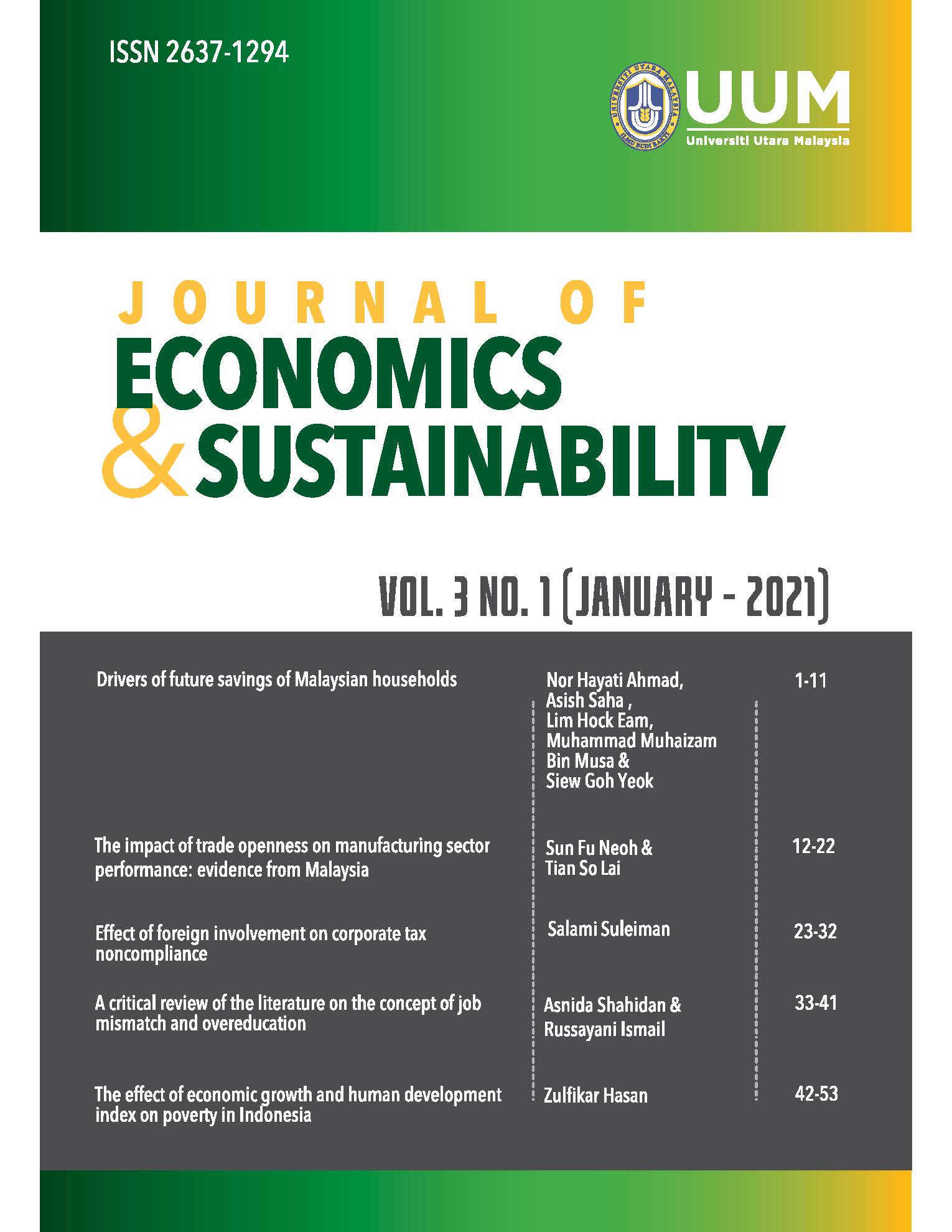
The Impact of Trade Openness on Manufacturing Sector Performance
Evidence from Malaysia
DOI:
https://doi.org/10.32890/jes2021.3.1.2Keywords:
Trade openness, manufacturing production growth, distributed lag modelAbstract
Trade openness plays a vital role in boosting the production of the manufacturing sector. Two opposing perspectives identify trade-growth nexus. One posits that trade openness will stifle industrial productivity while the opposing view believes that manufacturing productivity can be enhanced by a trade liberalization regime. This study investigates the instantaneous and jointly dynamic effect of trade openness along with macroeconomic variables (i.e., Malaysian exchange rate and average lending rate) and the event of economic crises on manufacturing sector performance in Malaysia using data from 1981 to 2016. This study employed a distributed lag model. The Augmented Dickey-Fuller (ADF) unit root test was adopted to determine the stationarity of time series data. The empirical results revealed that the effect of both instantaneous and the jointly dynamic effect of the percentage change in trade openness on manufacturing production growth in Malaysia are positive and significant. However, the effects of the percentage change in exchange rate and percentage change in average lending rate are insignificant. Economic crisis has a significant negative impact on Malaysian manufacturing production growth. Therefore, the results strongly recommend that the direction of trade policy in Malaysia should be formulated based on outward-looking strategies.
Received 8 March 20. Revised 26 June 20. Accepted 7 Jul 20.
References
Adamu, F. M. (2014). Trade openness and industrial performance in Nigeria: evidence from autoregressive distributed lag (ARDL) models. Unpublished doctoral dissertation, Çankaya University.
Aghion, P., Bacchetta, P., Rancière, R., & Rogoff, K. (2009). Exchange rate volatility and productivity growth: The role of financial development. Journal of Monetary Economics, 56(4), 494–513.
Ahmed, G., Khan, M. A., & Afzal, M. (2015). Trade Liberalization and Industrial Productivity : Evidence from Pakistan. MPRA Paper No 70744, Munich Personal RePEc Archive.
Athukorala, P. (2010). Malaysian Economy in Three Crises. ANU Working Paper No, 2010/12, Australian National Univeristy.
Athukorala, P. C. (2013). The Malaysian economy during three crises. In Malaysia’s Development Challenges Graduating from the middle (pp. 109–131).
Bandara, Y. M. W. Y., & Karunaratne, N. D. (2013). Globalization, policy reforms and productivity growth in developing countries: Evidence from Sri Lanka. Global Business Review, 14(3), 429–451.
Baumohl, E., & Lyocsa, S. (2009). Stationarity of time series and the problem of spurious regression (September 30, 2009). Available at SSRN: http://dx.doi.org/10.2139/ssrn.1480682
Chandran, V. G. R., & Munusamy. (2009). Trade openness and manufacturing growth in Malaysia. Journal of Policy Modeling, 31(5), 637–647.
Chete, L. N., & Adenikinju, A. F. (2002). Productivity growth in Nigerian manufacturing and its correlation to trade policy regimes/indexes (1962-1985). AERC Research Paper 127, African Economic Research Consortium.
Dickey, D. A., & Fuller, W. A. (1981). Likelihood ratio statistics for autoregressive time series with a unit root. Econometrica, 49(4), 1057–1072.
Dutta, D., & Ahmed, N. (2004). Trade liberalization and industrial growth in Pakistan: A cointegration analysis. Applied Economics, 36(13), 1421–1429.
Edwards, S. (1998). Openness, productivity and growth: What do we really know? The Economic Journal, 108(447), 383–398.
Fazlzadeh, A., & Seif, G. (2012). Trade Openness and Manufacturing Growth in Iran (September 6, 2010). Available at SSRN: http://dx.doi.org/10.2139/ssrn.1672825
Fukushige, M., & Wago, H. (2002). Using the Durbin-Watson Ratio to Detect a Spurious Regressions : Can We Make a Rule of Thumb ? International Congress on
Environmental Modelling and Software, Lugano, Switzereland, June 24-27, 2002, 592–596. https://scholarsarchive.byu.edu/iemssconference/2002/all/259
Haddad, M. (1993). How trade liberalization affected productivity in Morocco. Policy Research Working Paper Series 1096, The World Bank.
Iftikhar, A. (2012). Trade liberalization and economic growth: What’s the empirical relationship in Bangladesh? IOSR Journal of Business and Management, 1(6), 23–33.
Jayanthakumaran, K. (2002). The impact of trade liberalisation on manufacturing sector performance in developing countries : A survey of the literature. Working Paper 02-07, Department of Economics, Uniersity of Wollongong.
Kapp, D., & Vega, M. (2014). Real output costs of financial crises: A loss distribution approach. Cuadernos de Economia (Spain), 37(103), 13–28.
Kawai, H. (1994). International comparative analysis of economic growth: trade liberalization and productivity. The Developing Economies, 32(4), 373–397.
Kim, E. (2000). Trade liberalization and productivity growth in Korean manufacturing industries: Price protection, market power, and scale efficiency. Journal of Development Journal of Economics and Sustainability Economics, 62(1), 55–83.
Kinuthia, B. (2009). Industrialization in Malaysia: changing role of government and foreign firms. DEGIT XIV Conference Paper, 1–36.
Madhavan, K., Vengedasalam, D., Sundram, K., & Pandiyan, V. (2006). Trade liberalization and manufacturing growth in Malaysia: a co-integration analysis. Social and Management Research Journal, 3(1), 1–9.
Mahadevan, R. (2002). Trade liberalization and productivity growth in Australian manufacturing industries. Atlantic Economic Journal, 30(2), 170–185.
Manwa, F., & Wijeweera, A. (2016). Trade liberalisation and economic growth link: The case of Southern African Custom Union countries. Economic Analysis and Policy, 51, 12–21.
Nazli, A., Siddiqui, R., & Hanif, I. (2018). Trade Reforms and Productivity Growth in Manufacturing Industries of Pakistan. Review of Economics and Development Studies, 4(2), 199–207.
Onakoya, A. B. O., Fasanya, I. O., & Babalola, M. T. (2012). Trade openness and manufacturing sector growth: An empirical analysis for Nigeria. Mediterranean Journal of Social Sciences, 3(11), 637–646.
Paus, E., Reinhardt, N., & Robinson, M. (2004). Trade liberalization and productivity growth in latin american manufacturing, 1970–98. The Journal of Policy Reform, 6(2), 127–127.
Said, S. E., & Dickey, D. A. (1984). Testing for unit roots in autoregressive-moving average models of unknown order. Biometrika, 71(3), 599-607.
Shafaeddin, M. (2000). What did Frederick List actually say? Some clarifications on the infant industry argument. UNCTAD Discussion Papers 149, United Nations Conference on Trade and Development.
Stiglitz, J. E. (2004). Globalization and growth in emerging markets. Journal of Policy Modeling, 26, 465–484.
Succar, P. (2006). The Need for Industrial Policy in LDC’s-A Re-Statement of the Infant Industry ArgumentThe need for industrial policy in LDC’s-A re-statement of the infant industry argument. International Economic Review, 521–524.
Umoh, O. J., & Effiong, E. L. (2013). Trade openness and manufacturing sector performance in Nigeria. Margin: The Journal of Applied Economic Research, 7(2), 147–169.
Wong, S. A. (2009). Productivity and trade openness in Ecuador’s manufacturing industries. Journal of Business Research, 62(9), 868–875.
Yanagihara, T. (1982). A Reformulation of the Infant Industry Argument. The Developing Economies, 20(3), 243–267.
Published
Issue
Section
License
Copyright (c) 2021 Journal of Economics and Sustainability

This work is licensed under a Creative Commons Attribution 4.0 International License.

