Work-Life Balance Challenges of Indigenous Health Management Employees in the Medical Tourism Sector of Kerala, India
- Department of Business Administration, Annamalai University
Journal of Business Management and Accounting 1(1) (2011) · https://doi.org/10.32890/jbma2011.1.1.8918
Abstract
In contrast to the large-scale multinational projects, medical tourism sector in Kerala mainly constitutes indigenous health management practices coupled with local tourism industry. The government and bureaucracy project medical tourism as an engine of economic growth. It is considered as an excellent source of foreign exchange and employment generation to revive the local economy. As it mainly involves indigenous methods and techniques of health care management, further development and sustainability of this sector fully depends on highly committed, skilled and qualifi ed manpower. However, no detailed studies regarding the potential problems faced by the human resource capital in this sector are available. This paper is an attempt to analyze the various challenges associated with the work-life balance (WLB) of the employees working in the indigenous health care management practices linked to the medical tourism industry of Kerala, India. Data for the study were collected from 157 individuals, working in the medical tourism sector spanning around 24 organizations. The results indicated the positive and negative associations of the various challenges with the WLB of the employees.
Keywords: Indigenous health management practice, Medical tourism, Work-life balance, Work-life balance challenges
Introduction
Tourism sector constitutes multifaceted, multiproduct conglomerate of industries capable of offering varied array of products and services. In addition to the economic gains and employment generation (Joseph & Pakkeerappa, 2010), tourism industry can also bring in rapid changes in socio-cultural and even in the environmental sectors. It is not only a major instrument in earning foreign exchange but also opens up new vistas in interpersonal and international relations and cultural exchanges. Like any other * business project, tourism too involves professional management, capital investment, special skills and training. The World tourism organization defines tourists as people who travel to and stay in places outside their usual environment for not more than one consecutive year for leisure, business and other purposes not related to the exercise of an activity remunerated from within the place visited. As per the world travel and tourism council, the tourism industry in India is likely to generate US $ 121.4 billion worth economic activity by 2015 and the hospitality sector alone has the potential to earn US $ 24 billion in foreign exchange by 2015 (Kalshetti & Pillai, 2008). Along with the changing social concepts and globalization, tourism industry has also undergone various transitions and has imbibed the contemporary needs and wishes of the society. Such transitions are evident from the incorporation of services offered by therapeutic centers and sporting activities such as mountaineering (Smyth, 2005) in the itinerary of tourism packages. According to Connell (2006), attempts to achieve better health while on holiday through relaxation, exercise or visits to spas have become more common during the past decade. Such attempts have resulted in the development of a distinct niche in the tourism sector, namely medical tourism or health tourism. As far as India is concerned, among the varied types of tourism activities, medical tourism offers great potentials and is an upcoming and promising concept of interlinking health management practices and hospitality industry. Boosted by medical tourism, India’s $17 billion-ayear health care industry, industry watchers say, is growing at 30% annually (Rajan, 2008; Venkatachalam, 2010) . Even though the government and private sectors promote it, the specialized health care management practices in demand by the needy tourists are largely catered for by the private sector. Even though medical tourism provides a vibrant business opportunity in the service sector industry, its efficient management and successful operation depend mainly on the quality of the highly skilled human capital. In Kerala the indigenous health management segment of medical tourism, a wing of the hospitality industry faces shortage of skilled manpower and it poses a major threat to the overall development of the sector in general and to the work-life issues of the employees in particular. In this context, the present study is an attempt to evaluate the major work-life balance (WLB) challenges faced by the employees working in the field of indigenous health management practices offered by the medical tourism industry in Kerala. Efforts have also been made to explore the status of WLB of these employees who are facing various WLB challenges. 2.
An overview: medical tourism in India
It is an integrated approach of providing cost-effective medical care in specialized treatments in association with the tourism industry. Globalization, competition and entry of many new air transport companies have made air travel comparatively cheaper and such low cost air travel has taken medical tourism to new realms by opening up the sector even to the middle class around the world. Further, new developments in the IT
Work-Life Balance Challenges of Indigenous Health Management Employees in the Medical Tourism Sector of Kerala, India: 99-140 sector and the wide spread ramifications of the internet (Dileep, 2010) along with the networking of tour operators around the world and health specialists have facilitated the rapid forward strides of the medical tourism sector in India. These facilities in combination with the favourable developments in the banking and international economic exchange rates make a conducive environment for further advancement of medical tourism in India. The medical tourism industry offers high potential for India, primarily because of its inherent advantages in terms of cost and quality (Neelakantan, 2003; Venkatachalam, 2010). While analyzing the cost involvement in medical tourism in various countries, Deloitte (2008) has reported that India is one of the cheapest destinations and the average cost is about 20% of that of U.S. Srivastava (2006) is of the view that the sky rocketing costs of medical care and the long waiting lists in developed nations prompt more and more people to travel abroad as an affordable and safe alternative to have treatment at enjoyable destinations while vacationing. He further elaborates that medical tourism alone in the hospitality sector in India is likely to be a US $ 1 billion business by 2012. C.I.I. and McKinsey (2008) also express the same view. On the other hand Cherukara and Manalel (2008) put the figure at US $ 4 billion by 2017. Presently India is considered as the global center for medical tourism and it advertises itself as offering everything from alternative Ayurvedic therapy to coronary bypass and cosmetic surgery (Connell, 2006; Srivastava, 2006; Ranjan, 2008) at much cheaper cost. Bhangale (2008) considers India as one of the leading country promoting medical tourism and is now moving in to a new area of “medical outsourcing” where subcontractors provide services to the overburdened medical care systems in western countries. Kerala, one of the tiny states of India, is considered as one of the world tourist destinations. It has the ambient natural heritage of luxuriant hill stations, world renowned beaches, pilgrim destinations, inland water ways, house boats and an array of modern boarding and lodging facilities. These tourism infrastructure when combined with the time tested Indian systems of indigenous health care practices namely Ayurveda, Naturopathy, Yoga, Meditation and therapeutic massages along with a number of world class allopathy hospitals make Kerala the desired destination for medical tourists (Jacob, 2001; Ramesh, Joseph & Renganathan, 2010; Sindhu, 2010). The official publications of Kerala’s tourism department hail the state as God’s own country. It is also identified by the National Geographic Traveler as one of the two “must see” spots in India (the other being Tajmahal) in the list of 50 such places across the world (Sreekumar & Parayil, 2002) and one of the 13 paradises in the world (Sindhu, 2010). In the recent past, the number of tourists seeking the benefits of Ayurveda, Yoga, Mediation, Naturopathy and other indigenous health management practices is steadily increasing. With all these alternate systems of health care management, Kerala has pioneered health tourism in India (Ranjan, 2008). In general, the number of medical tourists coming to Kerala seeking the indigenous medical practices including Ayurveda, Naturopathy and Yoga are far greater than those coming for modern allopathic remedies.
Review of literature
WLB and tourism sector
While Clark (2000) considers WLB as satisfaction and good functioning at work and at home with a minimum role conflict, Kirchmeyer (2000) considers a balanced life as one in which the individual has to achieve satisfying experiences in all life domains. Further, he elaborates that in order to do so personal resources such as energy, time and commitment should be well distributed across domains. According to Greenblatt (2002), WLB is most usefully described as the absence of unacceptable levels of conflict between work and non work demands. Greenhaus, Collins and Shaw (2003) have defined work-family balance as the extent to which an individual is equally engaged in and equally satisfied with his/her work role and family role and according to Wise and Bond (2003), the term WLB in an organizational context definitely means the organization’s response to help the employees to manage their work and non work time effectively. Employees of hospitality industry in general, reportedly remain in high stress work environments, over worked and are prone to workfamily issues (Karatepe & Sokeman, 2006). Boles, Johnson & Hair (1997) state that work-family issues are no more limited to married individuals or those with children but extend to single parents and other individuals also. In the case of the tourism/ hospitality industry, the situation becomes more complicated due to inadequate pay, low job security, limited training and development opportunities, unsocial work hours and heavy workload (Rowley & Purcell, 2001). Due to all these reasons, they are incapable of balancing role demands originating from work as well as family and social domains (Karatepe & Uludag, 2007) leading to WLB issues of various kinds. This finding should be viewed in the light of the fact that there is a dearth of skilled manpower in this sector and work family conflict is considered as an antecedent of employees’ intention to leave (Netemeyer, Brashear-Alegandro & Boles, 2004). 3.2
WLB challenges
Balancing work and non-work domains of life is of supreme importance because this act has as the potential to affect a broad spectrum of factors such as employee turnover, job stress, job satisfaction and even productivity (Thomas & Ganster, 1995). This is particularly important in view of the changes taking place in the work environment due to globalization, changes in the patterns of the work and technological advancements (Caughlan, 2000; Fisher, 2000). All these factors in turn results in extra time demands on employees leading to WLB issues and prompting researchers (Dermody & Holloway, 1998; Stalcup & Pearson, 2001) to argue that the situation in the hospitality industry also warrants employees’ WLB problems be addressed and only very few empirical studies have been conducted in line with these reports. While O’Connor (2003) considers achieving WLB as the number one personal challenge, Harris, Cleveland, O’Neill &
Work-Life Balance Challenges of Indigenous Health Management Employees in the Medical Tourism Sector of Kerala, India: 99-140
Crouter (2003) are of the view that the hospitality industry has historically faced a number of challenges (WLB challenges) causing various difficulties in attaining WLB (dependent variable). The major WLB challenges (independent variable) identified as causing work-life imbalances are qualification risk, health risk, low salary, dependent care, alternative/flexible work arrangements, long hours of work, job stress and support from supervisors and colleagues. 4.
Research gap and hypotheses
A critical analysis of the literature reveals that even though there are studies pertaining to the human resources issues in the tourism and hospitality industry (Deery & Shaw, 1999; Pizam & Thornburg, 2000; Lam, Prine & Baum, 2003; Karatepe & Sokemen, 2006; Baum, Hearns & Devine, 2007), investigations related to medical tourism sector are scanty (Connel, 2006; Srivastava, 2006) and that of the employees working in the field of indigenous health management practices associated with the medical tourism sector is extremely rare. Further, most of the studies involving WLB issues have been conducted in developed countries and only meager amount of literature is available on WLB issues in Indian conditions (Namasivayam & Zao, 2007). Therefore, there is an increasing need for conducting more research in the WLB issues of employees associated with the indigenous health management practices of the tourism sector of the hospitality industry in developing countries like India. Based on this identified research gap, the present study has been designed to explore the various WLB challenges and their influences in determining the WLB of the employees of indigenous health management practices wing of the health tourism sector of Kerala, India. Attempts have also been made to identify the relative importance of various WLB challenges in causing work-life imbalance and the nature and degree of association of these challenges with WLB of employees. In view of this, we put forward the following hypotheses. The human capital theory of Becker (1985; 1991) argues that employees have access to a finite pool of personal resources namely time (allocated to behaviours) and energy (both physical and psychological). Further, people prioritize broad domains of activities (for example work, family and leisure) that they are willing to allocate resources to and then make the choices about how to spend the resources. However, as a result of the major changes that have taken place both in the composition of the work force and in the nature of work, the integration of work and other life (family) responsibilities are becoming increasingly difficult (Barnett, 1998; Edwards & Rothbard, 2000). Similarly due to the high rate of unemployment, competition, down sizing, demands for higher quality, changes in management style and management structure; employees are under pressure to work harder and for longer hours (Gillespie, Walsh, Winefield, Dua & Stough, 2001; de Klerk & Mostert, 2010) and in doing so the employees have to face an array of challenges leading to negative interactions between the family and work domains (Ferber, O’Farrell & Allen, 1991; Parasuraman & Greenhaus, 1999; Hildebrandt, 2006). Rice (1992) has reported that the conflict between work and nonwork domains could affect various life roles and ultimately influence the quality of life and WLB. The issue of balancing the multiple roles of an individual’s total role system and its importance in the individual’s WLB have been detailed by Kofodimos (1993) and Marks and Mcdermid (1996). Further, Boles and Babin (1996) have reported that as hospitability industry has a stressful working environment, it is probable that employees face work-life challenges and experience WLB issues. According to Shaffer, Harrison, Gilley and Luk (2001), as time and energy are exhaustible commodities, once spent they are not available for other tasks either within the same domain or other domains. Moreover, Montogemerry, Bakke and Shaufeli (2005) have opined that challenges in the form of pressure from the job and family domains often turnout to be mutually incompatible giving rise to imbalances between the two domains. The equal and satisfactory distribution of resources between the work and life domains of employees seems to be a very difficult task and in the process of regularization of these issues, the employees are quite often faced with multiple challenges. In the present study, these challenges are categorized as WLB challenges and the following hypothesis is therefore proposed. H1 : WLB would differ significantly across the various challenges (qualification risk, health risk, low salary, dependent care, alternate work arrangements, long hours of work, job stress and support from supervisors and coworkers) faced by the employees of indigenous health management practices. While discussing the issues and constraints in manpower supply to Indian hospitality industry, Subbarao (2008) has pointed out that the efficient management and successful operation of tourism service industry depend largely on the quality of manpower. He further adds that high standards of service are particularly important in sustaining long-term growth as success of a tourist destination is determined not only by price competitiveness or the range of options available, but also by the quality of the service provided. Therefore, qualified, human capital is of paramount importance. As there is shortage of skilled manpower in the indigenous health management sector, it could act as a major challenge to the overall development of this sector in general and to the WLB of the employees in particular. While studying work-home interactions, Pieterse and Mostert (2005) and Rost (2006) could not find any significant differences in the work-family interaction experiences of persons having different qualifications. On the other hand, Grzywacz and Marks (2000) reported a strong association of lower level of qualification with lower level of positive spill-over from work to home. Many authors (Van Tonder, 2005; Marias & Mostert, 2008; Mostert and Oldfield, 2009) found that employees with a higher level of qualification tended to experience more negative interference from work to home interaction. Mostert and Oldfield (2009) have also found a significantly higher level of negative home-work interactions in the case
Work-Life Balance Challenges of Indigenous Health Management Employees in the Medical Tourism Sector of Kerala, India: 99-140 of highly qualified employees. Fáilete Ireland (2005) and Baum, Hearns and Devine (2007) have also underscored the importance of recruiting well-qualified and trained manpower in the hospitality industry and the need for supporting them through a process of continuous learning and career development. Hildebrandt (2006) considers qualification risk as a part of career risk and has the potential of the employee concerned being separated from the group, which in turn could contribute to WLB problems. Therefore, we propose H2 : Qualification risk is negatively related to WLB A critical analysis of the literature reveals that imbalance between work and life activities could lead to reduced psychological and physical well-being (Sparks, Cooper, Fried & Shirom, 1997; Frone, Russell & Cooper, 1997; Martens, Nijhuis, Van Boxtel & Knottnerus, 1999). During situations of persistent staffing shortages and highly irregular working time schedule, there is a growing risk of excessive workload, which may lead to health risks resulting in impaired WLB. Rosa and Colligan (1997) observed that cutting back on sleep to gain time to accomplish more in the day, if done regularly could have the potential to act as a health risk. While WLB supportive practices are reported to have direct positive health effects and work-family conflicts reduction potential, a lack of support or control could act as a work-life challenge and result in depression, ill health, sleep deprivation and other psychological damages (Thomas & Ganster, 1995; Tregaskis, Brewster, Mayne & Hegewisch, 1998). Frone, Russell & Barnes (1996) and Levin-Epstein (2006) have also reported the negative impacts of absence of WLB on health of the employees. According to Hyman, Baldry, Scholarios and Bunzel (2003), employees perceive the intrusion of work obligations into their personal lives as a work-life challenge causing negative impacts to their health. Bauer (2008) has remarked that health impact of tourism are of concern and many hospitality workers in the absence of strict work regulations, work very long hours with few breaks and microscopic wages that are never enough to lead healthy lives. In view of these findings the following hypothesis is proposed. H3 : Health risk is negatively related to WLB McKey (2001) has reported that even under low pay, the opt out potential from the working time schedule as well as opportunities for employees to choose shorter working hours are limited. This fact implies that low salary could very well act a WLB challenge. Work environment of the hospitality industry has been characterized with low wages and long working hours and in such situations the low earning employees need to work overtime or more than one job (Wharton, 2006; Namasivayam & Zao, 2007), inviting spill over between work and family and highly impaired WLB. According to Devine, Jabs, Washington, Farell and Bisogni (2006) low wage jobs and limited financial resources may demand the low and moderate-income workers to restrict their ability to meet their financial commitments. This situation underscores the WLB challenge status of low wages. Such low wage and WLB challenging situations could force the employees to have relatively high private financial issues (Hildebrandt, 2006). Bauer (2008) is also of the view that many hospitality workers with meager wages are not in a position to lead healthy lives leading to WLB issues. On the basis of these reports, the following hypothesis is put forward. H4 : Low salary is negatively related to WLB Juggling work and family responsibilities is a common experience for many employees (Lee & Duxbury, 1998) and if workers are unable to balance the responsibilities associated with both roles, the potential for conflict between roles increases (Greenhaus & Powell, 2003). Even though workers’ performance and well being depend at least partly on the nature of dependent care management (Friedman & Gallansky, 1992), the effects of care giving arrangements on workers attitudes and behaviour have been under examined (Kossek & Ozeki, 1999). Further, according to Kossek, Colquiff and Noe (2001) care giving decisions refer to the selection of arrangements for the care of a dependent while the decision maker works. Zedeck (1992) has also reported the importance of integrating dependent care needs to WLB. According to Halpern (2005), when work schedules are regular or when workers have some control over their shifts, it is much easier to reduce the conflicts relating to family and work. On the contrary, for families with children where both spouses work full time; finding balance may be a challenge, which would be further exacerbated by shift work (Williams, 2008). Dependent care issues as a work-life challenge and their relevance to WLB have also been reported by Hardy and Adnett (2002) and Hymen and Summers (2007). They are of the view that in terms of child care, employees face growing tension between work and non-work. Mathew and Panchanatham (2009) have reported that long working hours in tandem with dependent care needs of the employees could lead to a cumulative negative impact on their WLB. Similarly, failure to give proper attention to their dependent could also lead to mental worries and work-family imbalance (Mathew & Panchanatham, 2010). Even though most of the employees will have to make care giving decisions during their careers, little attention has been given to its impact on WLB especially in the case of indigenous health management sector. In view of these reports the following hypothesis is proposed. H5 : Dependent care is negatively related to WLB Long and unsocial working hours are generally linked to weekend work, evening and night work and early morning shifts (Colligan & Rosa, 1990; Smith, 1993). They have the potential to assume the role of a WLB challenge and disturb the WLB and may also disrupt the parental and partner roles (Barling, 1990; Barton, Aldridge & Smith, 1998) as well as social and community life (Colligon & Rosa, 1990). While Green (2001) and Taylor (2001) consider work intensification and long working hours as factors that increase work-life tensions, Hyman, Baldry, Scholaris and Bunzel (2003) opined that
Work-Life Balance Challenges of Indigenous Health Management Employees in the Medical Tourism Sector of Kerala, India: 99-140 extended shift working and unpredictable overtime to meet extended work schedules also act against WLB. According to Hoff (2003), WLB is primarily defined in terms of the distribution and duration of the working time and there is increasing evidence for the relationship between increase in working hours and serious health problems, family difficulties and life dissatisfaction (Sokejima & Kajamemuri, 1998; Kivimaki, Vahtera, Pentti & Ferrie, 2000). The role of long working hours as a WLB challenge is also evident from the fact that prolonged work is neither considered healthy nor productive and its impact on the employees life roles are significant (Buick & Thomas, 2001). Lambert and Haley-Lock (2004) have reported that minimum staffing patterns combined with exempt status and specialized job responsibilities mean that workers in professional and technical jobs are often pressed to work beyond contracted hours and are often over worked. Similarly, Golla and Vernon (2006) have mentioned that working in the evening often associated with less time spent with spouse and children resulting in disturbed WLB. In this situation, it is proposed that: H6 : Long working hours is negatively related to WLB Studies relating alternative and flexible work practices with WLB (Morley, Guinningle & Hearty, 1995; Tregaskis, Brewster, Mayne & Hegewisch, 1998) and the advantages of alternative work arrangements such as reduced levels of job-related stress, increased job satisfaction and commitment so and so forth were dealt in detail by various workers (Scandura & Lankau, 1997; Kossek & Ozeki, 1999; Powell & Mainiero, 1999; Rhode, 2001). Even though the previous generations of employees were willing to work long hours and even weekends over time on more or less regular basis, the current work force are of a different view and opinion that there is a need of WLB; and alternative work arrangement is a means of achieving this target (Tulgan, 1996; Schellenbarger, 1998; McCracken, 2000; Guest, 2002). In other words, lack of provision for alternative work arrangement is considered as a potential challenge for WLB. Further, in response to changes in the needs and wants of employees, many firms have adopted alternative work arrangement as a means of assisting employees in managing both their personal lives and work careers (Charron & Lowe, 2005). In general, alterative work arrangements are designed to allow employees to achieve greater WLB and may be considered as a common initiative to attain WLB (Johnson, Lowe & Reckers, 2008). In this context, it is proposed that: H7 : Alternative work arrangement is positively related to WLB A good number of studies relating work-life imbalance and stress on various dimensions are available. Commonly reported negative outcomes of a poor WLB status include job stress, burnout, depression, health issues including the likelihood of mental illness, low level of job accomplishment and increased chances of accidents (Adams, King & King, 1996; Parasuraman, Purohit, Godshalk & Beutell, 1996; Kossek & Ozeki, 1996; Allen,
Herst, Bruck & Sutton, 2000; Copper, 2000). According to Hyman, Baldry, Scholarios and Bunzel (2003), intrusion of work demands into personal life could be related to heightened stress and emotional exhaustion for employees and such work-life imbalance driven high levels of stress (Thomas & Ganster, 1995) could act as a major WLB challenge and influence job satisfaction and absenteeism levels (McCarthy, Galway & Cleveland, 2005) also. The employees of hospitality industry reportedly engage a high degree of face to face interactions with consumers leading to stress and work-life problems (Karatepe & Sokemen, 2006) and according to Böhm, Herman and Trinszek (2004), in case of persistent staffing shortages as well as highly irregular working time schedule, employees have less opportunities of compensating the strain with time off. On the other hand, flexible work arrangements could increase the WLB and can offset work stress (Leven-Epstein, 2006). Further increased working hours and prolonged weekend working hours are well correlated to increased strain not only in the family life but also to a great extent in the social life outside the family (Brandt, Herman, Muhei, Beek & Trachsler, 2008). In general, stressful job characteristics (unfavourable working time schedule, work overload, job control, insufficient career opportunities so and so forth) act as WLB challenge and could lead to negative interactions between work and family domains (de Klerk & Mostert, 2010) resulting in decreased WLB. In line with these reports, it is hypothesised that: H8 : Job stress is negatively related to WLB Social support network has two prominent domains, namely, support that arises in the work place such as that from supervisors and co-workers (Goff, Mount & Jamison, 1990; Allen, 2001) and the support received form outside of the work place such as that provided by family members, friends so and so forth (Greenhaus & Parasuraman, 1994; Carlson & Perrewe, 1999). Employees differentiate the support originating at work place into support from organization and that they receive from their immediate work group or supervisor (Allen, 2001; Jahn, Thompson & Kopelman, 2003; Self, Holt & Schaninger, 2005). They also consider their immediate manager/supervisor and Peers/ co-workers as sources of support that help relieve occupational stress (Savery, 1988; Buunk & Verhoeven, 1991) to attain WLB. Allen (2001) further found that supervisor’s support directly and indirectly influence employees job attitudes, and as the former administer organizational family-supportive benefits, their willingness to allow employees to take advantage of these benefits influences their WLB also. Kram and Isabella (1985) and Ducharme and Martin (2000) have opined that peer support and relationship at work place provide a number of advantages such as exchange of information about work and organization, their confirmation, emotional support and enhanced job satisfaction; and their help to achieve greater WLB. Therefore support from supervisor and co-workers also act as a WLB challenge. As the leadership of immediate supervisor and co-workers have profound impact on employees’ WLB, supportive supervisors and colleagues can make the domain
Work-Life Balance Challenges of Indigenous Health Management Employees in the Medical Tourism Sector of Kerala, India: 99-140 of work less stressful for employees by discussing problems related to their family and being sympathetic and flexible if problems or emergencies occur (Etzion, 1984; Lazarus, 1995). On the other hand, higher levels of work to family conflict have been reported where there is a lack of social support (Greenhaus & Beutell, 1985). It has also been reported that a supportive relationship with one’s supervisor is associated with diminished work-family issues and positive WLB (Major, Fletcher, Davis & Germano, 2008). On the basis of these reports, in the present study it is hypothesized that: H9 : Support from supervisor and coworkers are positively related to WLB. 5.
Research method
Sampling and data collection
The sample population selected for the study consisted of employees working in the field of medical tourism sector in Kerala, who were involved in the indigenous health care practices. A random sampling (Probabilistic) method was adopted and the number of firms covered in the study was 24. A total of 208 employees were contacted personally or by e-mail/letter and invited to participate in the survey. Questionnaires were either given directly or sent by post/e-mail to 208 employees. Out of the 208 questionnaires distributed, only 157 duly filled up questionnaires were returned and the response rate was 75.48% The minimum sample size needed for the study was determined by following Hamburg (1985) and was found to be 136 (N = 208, margin of error = 5%, confidence level = 95%). 5.2
Research instruments
Fisher’s (2001) WLB questionnaire was used to measure the respondents’ status of WLB. The instrument contained a set of 16 statements under three dimensions (work interfering personal life, personal life interfering work and work enhancement/personal life enhancement) concerning their experience in work and family domains. Each item was rated on a 5-point scale (5 = never, 1 = very often) to determine the extent to which it was true for the respondents’ experience. Twelve items were negatively worded and the scores for these items were reversed prior to analysis. Fisher (2001) has reported an overall coefficient of reliability (Cronbach alpha) for this scale as 0.82 and in the present study the overall coefficient of reliability as revealed by factor analysis was 0.87. Kaiser-Meyer-Olkin (KMO) measure of sampling adequacy was 0.929 and Bartett’s test of sphericity was 3737.47. In order to measure the WLB challenges of the employees working in the indigenous health management sector, a measuring tool was developed specifically for the study by conducting in depth interviews among 18 indigenous health management employees belonging to different categories. Open-ended bilingual (English and Malyalam) questions and semi structured interview format were designed to explore the various dimensions (factors) posing challenges to the WLB of the employees. Empirical data generated from these exploratory questions were coded and mind mapped in an iterative manner until eight major dimensions were clustered using dendrogram method. Finally 57 statements addressing the diversity of the challenges of WLB were developed based on literature review and the qualitative research. The content validity ratio of each item in the scale was calculated following Lawsche (1975) and was found to be more than 0.55. To increase the validity and reliability of the instrument as well as to ensure its appropriateness, the statements were subjected to two phases of pilot test conducted with 18 people each, composed of human resource professionals, academic experts and progressive employees of indigenous health management sector. The final questionnaire for this study consisted of two sections. The first section was regarding the socio-demographic details of respondents namely: occupation, gender, marital status, number of dependents and educational qualification (Table 1). Second section that originally contained 57 statements was designed to measure the WLB challenges among the employees of indigenous health management sector. The overall status of WLB as measured by Fisher’s (2002) WLB scale was taken as a dependent variable for correlation and regression analysis for determining the predictors (underlying dimensions) of the challenges of WLB. 5.3
Statistical analysis
The 57 statements of WLB were factor analyzed using principal components analysis with varimax rotation method (Tables 2 and 3) to determine the underlying dimensions. The KMO measure of sampling adequacy and Bartlett’s test of sphericity of the new instrument were also carried out to test the fitness of the data. One-way analysis of variance (ANOVA) (Table 4) was conducted to examine whether there is any significant differences in the status of WLB among the employees of the indigenous health management sector on the basis of their occupation, number of dependents and educational qualifications. Independent sample ‘t’ test (Table 5) was used to assess whether there is any significant differences in the WLB among the respondents on the basis of the gender and marital status. The specific relationship between various challenges (independent variables) and WLB (dependent variable) was determined by Pearson’s correlation analysis (Table 6). Regression analysis was used to find out the strength of association between a set of predictor variables (alternative/flexible work arrangements, support from supervisors and co-workers, long hours of work, health risk, dependent care, low salary, qualification risk, job stress) and the dependent variable (WLB) (Table 7).
Work-Life Balance Challenges of Indigenous Health Management Employees in the Medical Tourism Sector of Kerala, India: 99-140
Findings
Profile of the respondents
The detailed profile of the respondents is given in Table 1. Doctors were mainly parttime visiting physicians including serving Ayurvedic medical practitioners (55%) or retired Ayurvedic medical practitioners (35%). Only the remaining 10% doctors were employed on a full-time basis. The medical supporting staff were mainly persons trained in and traditionally working in the field of Ayurveda and majority (72%) of them were not holding any specific diploma or qualification certificates. Out of the 157 respondents, while 58% were suffering from very low WLB, 12.7% were having low WLB (Fig. 1). On the other hand, while 22.9% were having high level of WLB only 6.4% were reported to have very high WLB. In general vast majority (70.7%) of the respondents were suffering from WLB issues. 6.2
Factor analysis
The result of K.M.O. was 0.75 and Bartlett’s test of sphericity was found to be 1779.01 with a significance level of 0.000. Out of the 57 statements (Table 2) initially considered for the construction of the questionnaire for work-family challenges, 17 were extracted, as their factor loadings were less than 0.5 as presented in the Table 3. The remaining 40 statements belonging to 8 factors/dimensions (alternate work arrangement, support from supervisor and coworkers, long hours of hours, health risk, dependent care, low salary, qualification risk, job stress) constituted the WLB challenges scale (Table 3) used in the present study with an overall coefficient of reliability (Cronbach alpha) 0.75. The overall status of WLB categories as measured by Fisher’s scale is represented in
ANOVA results (Table 4) showed that the status of WLB varied significantly across the employees based on their occupation (F = 22.45, p < 0.001), number of dependents (F = 15.26, p < 0.001) and educational qualification (F = 4.81, p < 0.01). Similarly the independent sample ‘t’ test (Table 6) also revealed significant differences in the WLB of married and single employees (t = 6.44, 6.32; p < 0.001) as well as male and female employees (t = 4.89, 4.15; p < 0.001). In short, H1 received full support from the data as hypothesized (Tables 4 and Table 5). 6.4
Pearson’s correlation analysis
While alternative work arrangements and support from supervisors and co-workers were positively associated with WLB, other attributes were negatively correlated with WLB (Table 6). In the case of alternative work arrangements, Pearson’s correlation was significant (r = 0.99) and therefore it increased the WLB of employees (Table 7). Similarly supervisors and co-workers support (r = 0.99) was also found to increase the WLB of the employees. Thus, as the alternative work arrangements as well as support from supervisors and co-workers increases, WLB also increases as hypothesized in H7 and H9. On the other hand, dependent care was negatively correlated with WLB (r = 0.68) (Table 7). Therefore it is evident that as dependent care increases, WLB decreases indicating its negative association as hypothesized in H5. Similarly low salary (r = 0.94), qualification risk (r = 0.90), health risk (r = 0.98), job stress (r = 0.93) and long hours of work (r = 0.92) were also found to have significant negative associations with WLB and thereby supporting the hypotheses H4, H2, H3, H8 and H6. In other words, as these challenges increases, WLB decreases. 6.5
Regression analysis
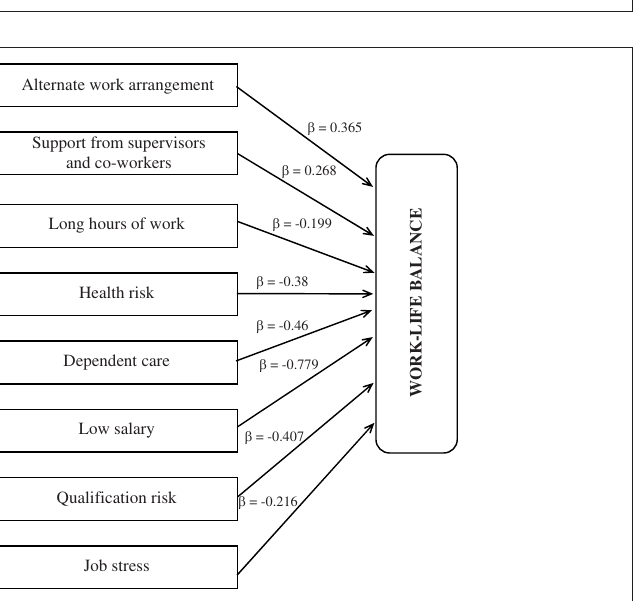
Qualification risk ( = - 0.407), health risk ( = -0.38), low salary ( = -0.779), dependent care ( = -0.465), long working hours ( = -0.199) and job stress ( = -0.216) are the significant negative predictors of WLB (Table 7, Fig. 2). On the other hand alternative work arrangements ( = 0.365) and support from supervisor and co-workers (= 0.268) are the positive predictors of WLB. Hence H2, H3, H4, H5, H6 and H8, which stated that qualification risk, health risk, low salary, dependent care, long hours of work and job stress respectively have negative effect on WLB, received full support from the regression analysis (Table 7, Fig. 2). On the other hand H7 and H9, which stated that alternate work arrangements and support from supervisors and co-workers have positive effect on WLB, also received full support (Table 7; Fig. 2). Finally, H2 to H9 received full support from the data as hypothesised, indicating 60.4 percentage of variance (adjusted R2 = 0.604, F = 406.09, p < 0.001; Table 7). 7.
Discussion
While all the WLB challenges significantly contribute to the WLB of employees surveyed in this study, their direction and extent of influence (Tables 6 and 7) may vary. In the present study, the singular factor exerting maximum influence on the WLB of employees is the alternative work arrangement (factor mean = 4.73, Table 2), which also shows a strong positive correlation with WLB (Table 6). Regression analysis also revealed alternate work arrangement as a positive predictor of WLB (Table 7). Personal interviews with respondents also revealed that alternative work arrangements quite often happens to be a distant dream for majority of the workers due to the specialized nature of work, lack of enough trained and experienced man power and round the clock attention requirements by the patients. Due to the same reasons, the employees have to sacrifice many of their valued personal (family) functions/ duties leading to worklife imbalances. As the involved medical works require high degree of expertise and knowledge in the indigenous procedures, the availability of human capital in the field
Work-Life Balance Challenges of Indigenous Health Management Employees in the Medical Tourism Sector of Kerala, India: 99-140 is less than sufficient. This situation further complicates the issue. Ultimately lack of alternative work arrangements has also compelled many of the employees to quit the job. In addition to this, the changing demography of the new generation work force has also contributed towards work family conflict and it has become a prevalent issue among many of the new age employees as reported by Shockley and Allen (2007). According to Rau (2003), flexible/alternative work arrangements are defined as alternate work options that allow work to be accomplished outside of the traditional temporal and / or spatial boundaries of a standard work day. Two most popular forms of flexible work arrangements are flextime and flex-place. While flextime refers to flexibility in terms of working time, flex place involves flexibility in the location where work is to be completed, often referring to work to be conducted from home. Out of these two situations, only the flextime concept can be accommodated in the present case (provided enough manpower is available) as the health care facilities are permanently installed at a particular place. In other words only 50% (flex time) of the flexible work arrangements are applicable in the field of indigenous health management, that also with restrictions. These restrictions further add to the woes of the employees. Even though monetary compensation could aid in WLB by enabling the employee to make enough money through overtime work, the respondents of the present study consider provisions for flexible/ alternative work arrangements as the key in the effort to help employees to manage competing work and family domains. In order to accomplish the flexible work arrangements in this sector, the availability of enough trained manpower is absolutely essential. However this is acting as a major handicap in the field of the indigenous medical tourism sector of Kerala. The second major challenge confronted by the employees of the present study is the lack of support from supervisors and co-workers (Factor mean = 4.50, Table 2). Both co-worker and supervisor supports are associated with reduced work interference with family, greater job satisfaction and increased WLB (Lazarus, 1995). In the present study also support from supervisors and co-workers is found to have strong positive correlation with WLB (Table 6). Moral and social support extended by supervisors and co-workers could alleviate conflicts at work place, role ambiguity and resultant work family conflict. According to Thompson and Prottas (2005), co-worker and supervisor supports are negatively related to work interference with family. Researchers consistently show that a supportive relationship by one’s supervisor is associated with diminished work family conflict and positive work-life outcomes (Thomas & Ganster, 1995; Major, Fletcher, Davis & Germano, 2008). Support by colleagues and supervisors also make work situations less stressful by discussing family related problems and being flexible when emergencies arise. On the other hand, lack of such social support is related to higher levels of work family conflict (Burke, 1988) and decreased WLB. In the present study also support from supervisors and co-workers is found to be a positive predictor of WLB (Table 7).
Long hours of work, health risk and job related stress are all interrelated (Collingan & Rosa, 1990; Duchon, Smith, Keran & Keehler, 1997; Copper, 2000) and show significant negative association with WLB (Table 6). There are empirical evidences of the correlation between increase in working hours and serious health problems, family difficulties and satisfaction (Sokjima & Kagamimori, 1998; Kivimaki, Vahtera, Pentti & Ferrie, 2000). Further, long hours of work and the absence of any flexibility in existing structures pose high challenges for balancing work and family responsibilities. From employers’ point of view it is more profitable to hire smaller number of people for longer hours than to employ more workers who would then expect paid benefits long working hours are considered to be more productive. However, in the case of the indigenous health management practices, rather than hiring smaller number of people, the situation of long hours of work is basically due to the less availability of qualified manpower. This automatically compels the employer to continuously utilize the available work force for longer hours and even for many shifts altogether. On the other hand workers working longer hours have more workloads, as fewer employees have to deal with the same amount of work. This would lead to physical and mental stress among workers, especially to those who would like to be a fully active parent, partner or spouse willing to perform his/her role in the life domain. Under such stress situations, the possibility of employee quitting the employment in favour of another one is higher. Brandt, Hermann, Muhei, Beck and Trachsler (2008) are also of the view that increased working hours for the entire week is always associated with increased stress and prolonged working hours during the weekend has been correlated with more strain in the family life and among peers (Caruso, 2006) leading to WLB issues. Many respondents in the present study also worked continuously for months together in the place of work, which is away from their family and friends. Therefore, long hours of work, job stress and health risks also act as significant negative predictors of WLB (Table 7). Employees in this medical tourism industry even though provide 24 × 7 services, the personal costs of this provision are largely under estimated by the managements and many of the employees themselves. Employees with prolonged working hours are at the risk of developing symptoms of insomnia and weekend workers are at increased risk of developing problems of managing their social interactions with family and peers; and those with decreased sleep quality are at risk of depression and anxiety leading to higher health risks (Brandt, Hermann, Muhei, Beck & Trachsler, 2008). As the indigenous health management sector needs highly skilled and specialized workers, there is a shortage of qualified employees. Such a situation is comparable to the report of Hildebrandt (2006) that when there are persistent staffing shortages, there is a growing risk of excessive demand being made of the available employees resulting in permanent consequences for their health. The same result is expected in the case of highly irregular working time schedule as witnessed in the present study. In the present study, workers who work in socially undesirable shifts also face WLB problems as they spent less time sleeping or as they are left with little time for sleeping after attending
Work-Life Balance Challenges of Indigenous Health Management Employees in the Medical Tourism Sector of Kerala, India: 99-140 other duties originating in the family domain. Williams (2001) and Akerstedt (2003) have also reported health problems related to sleeplessness. Kerrin & Aguirre (2005), have reported that shift workers find it difficult to fulfill domestic responsibilities in terms of finding a satisfying WLB. Work-life conflict can arise from long or socially undesirable working hours, particularly during evening or weekend (Bohle, Quinlan, Kennedy & Williamson, 2004). The present study has also revealed that increased working hours are negatively correlated with the familial life (Table 6). This may be due to reduced sleeping hours and trespassing of work into time available for family and other activities outside the work domain leading to tiredness and negative impact on the relationships at home, which in turn could increase the sickness absence from work resulting in increased medical expenses also. Employees who are working for long hours without proper sleep and rest are prone to road accidents and other problems including decreased job satisfaction and efficiency at work. Many respondents of this study have also admitted to have frequent risk of sleep complaints such as difficulties in falling asleep, maintaining sleep, waking up early in the morning so and so forth. On the contrary employees with greater supervisor support privately admitted to have less psychological strain and job stress than those who receives less support from their supervisor. The fourth major problem faced by the respondents in balancing their work and life is the issue of dependent care (Table 2), which is a negative predictor of WLB (Tables 7, 8). As they have to spend long hours at work places, they could not successfully take care of their dependents, leading to mental worries and work family problems. According to Aneshensel, Pearlin, Mullan, Zarit & Whitlatch (1995) management of dependent care giving is an “unexpected career”. Care giving needs is of different types as in the case of children and elders. Managing elder care is more complex than managing childcare because it involves the co-ordination of many other activities also. In the present study, employees with elders as dependents privately admitted that they face more work-life imbalances and mental tensions. Many other studies have also revealed that those, who manage elder care are more likely to experience increased depression, anxiety, poor health, stress and family interference with work (Gottleib, Kelloway & Fraboni, 1994; Strawbridge, Wallhagen, Sharma & Kaplan, 1997). In the absence of alternative work arrangements and support from co-workers, dependent care becomes more complicated as observed in the present study. The WLB in the present study should also be analyzed in view of the report of Kossek and Ozeki (1999) that an employee’s work and family climate could impact the consequences of care giving decisions both directly and indirectly. The sixth factor influencing WLB of respondents is the concern about the low salary. As majority of the institutions taking part in the medical tourism projects are in the private sector, the employees are less organized and almost all of them privately admit that the pay and perks are not satisfactory in view of the physical labour and time they spend for the work. The low income from the work when combined with the other factors analyzed (Table 2), make it difficult for the respondents to balance their work and life leading to many financial crisis and WLB issues as reported by Hildebrandt (2006). Even under this situation, due to the highly specialized nature of the work and limited job opportunities, the opt out potential for the employees is also very limited (McKey (2001). This fact is reflected in the results of the correlation and regression analyses and thereby making low salary a negative predictor of WLB. Another challenge subjected to analysis is the qualification risk. Erpenbeck and Sauer (2000) have clearly demarcated the concepts of qualification risks and competence. While qualification refers to abilities and skills in handling known and structured demands, the concept of competence refers to the capacity to deal with unexpected changes and unknown situations. In the present study qualification risk denotes the situation where subordinates or co-workers are under qualified and having less expertise in the field. In such a situation the supervisors or the co-workers have to work overtime to educate or supervise the former and at the same time the under qualified hands themselves will be doubtful about the treatment procedures and would lead to their decreased confidence and self-esteem. All these activities could be counterproductive as far as WLB is concerned (Tables 7, 8) thereby making qualification risk a negative predictor of WLB. 8.
Managerial implications
The findings of the study indicate a number of implications for managerial/ organizational actions. First of all the indigenous health management practices being a part of the hospitality/medical tourism sector, customer (Patient) satisfaction plays a pivotal role in the sustenance of the industry. At this juncture it is worth mentioning that only a satisfied employee could satisfy a customer in the service sector organizations like indigenous health management establishments. Further, as satisfied customers are considered as the marketing assets of the organization, employees play important roles in retaining satisfied and delighted customers. Therefore, the organizations should address the work-life challenges faced by these employees to mitigate their work-family imbalances by implementing a family supportive work environment. Secondly as the study has revealed alternative work arrangements, support from the supervisors and coworkers and long hours of work as the three most important work-life challenges faced by the employees, organizations should take special care to ameliorate these issues while implementing a family-supportive work environment. Thirdly, some sort of communication channels/mediators or mentors should be made available to employees to discuss their WLB issues. These mediators should be encouraged to arrange specific meetings with the employees-in-problem along with their family members to explore an amicable solution so that both organization and employees benefit. This is particularly important in retaining the employees especially in the present situation of scarcity of trained manpower in this field. Other issues such as dependent care problems, low
Work-Life Balance Challenges of Indigenous Health Management Employees in the Medical Tourism Sector of Kerala, India: 99-140 salary, long hours of work and qualification risk should be properly attended to so that job stress and health risk could be avoided and thereby a comparatively good WLB can be achieved. 9.
Conclusion
There is an increasing trend in the number of tourists coming to Kerala for undergoing the indigenous medical practices encompassed in the medical tourism indicating its prime position in the service sector and revenue generation. The availability of a wide spectrum of expert treatment methods in the indigenous medical practices at comparatively low cost is one of the prominent reasons for the success of the hospitality and tourism sector in Kerala. However, the challenges faced by the employees working in this sector is getting very little attention leading to a higher level of work family imbalance and vast majority of the respondents of the present study suffer from WLB issues. Therefore studies concerning the human resource management in general and work-life balance in particular have become imperative in the indigenous health management sector as a consequence of rapid growth and dynamic changes in the concept and framework of tourism industry. From this study it can be concluded that alternative work arrangement along with supervisors’ and co-workers’ support could increase employees’ work-life balance to a great extent. Similarly, it is also absolutely essential to explore the other work-life balance challenges faced by the employees. WLB challenges such as long hours of work, dependent care, low salary, qualification risk, health risk and job stress suggest that employee-friendly policies ought to be implemented in this sector. Such ameliorative actions would have a long lasting and positive impact in taking the industry to new heights. The quality of the services could be improved through creating a family-friendly work environment in the organizations. Also, the present situation of shortages in well-trained and qualified manpower in this sector can be solved to a great extent if employees are able to achieve a satisfactory level of work-life balance in this field of medical tourism.
References
- Adams, G.A., King, L.H., & King, D.W. (1996). Relationships of job and family involvement, family social support, and work family conflict with job and life satisfaction. Journal of Applied Psychology, 81, 411-420.
- Akerstedt, T. (2003). Shift work and disturbed sleep/work fullness. Occupational Medicine, 53, 89-94.
- Allen, T. (2001). Family supportive work environments: the role of organizational perceptions. Journal of Vocational Behaviour, 58, 14-35.
- Allen, T.D., Herst, D.E., Bruck, C.S., & Sutton, M. (2000). Consequences associated with work to family conflict – A review and agenda for future research. Journal of Occupational Health Psychology, 5, 278-308.
- Aneshensel, C.S., Pearlin, L.I., Mullan, J.T., Zarit, S.H., & Whitlatch, C.J. (1995). Profiles in care giving: unexpected career, New York: Academic Press.
- Barling, J. (1990). Employment, stress and family functioning. Chi Chester: John Wiley & Sons.
- Barnett, R.C., (1998). Toward a review and reconceptualization of the work/family literature. Genetic, Social and General Psychology Monographs, 124, 125-182.
- Barton, J., Aldridge, J.M., & Smith, P.A. (1998). Emotional impact of shift work on the children of shift workers. Scandinavian Journal of Work Environment and Health, 24(3), 146-150.
- Bauer, I. (2008). The health impact of tourism on local and indigenous populations in resource poor countries. Travel Medicine and Infectious Disease, 6, 276-291.
- Baum, T., Hearns, N., & Devine, F. (2007). Place, people and interpretation: issues of migrant labour and tourism imagery in Ireland. Tourism and Recreation Research, Special Edition on Interpretation, 32(3), 39-48.
- Becker, G.S. (1985). Human capital, effort and sexual division of labour. Journal of Labour Economics, 3, 35-58.
- Becker, G.S. (1991). A treatise on the family, Cambridge, MA: Harward University Press.
- Bhangale, V. (2008). Medical tourism: Taking off in big way in India. Proceedings of Conference on Tourism in India – Challenges ahead, 15-17 May 2008, IIM Kozhikode, India, 365-368.
- Bohle, P., Quinlan, M., Kennedy, D., & Williamson, A. (2004). Working hours, work-life conflict and health in precarious and permanent employment. Revista De Saude Publica, 38, 19-24.
- Böhm, S.H.C., & Trunczek, R. (2004). Heraus for derung vertrauensarbedsziet, Berlin: Sigma.
- Boles, J.S., & Babin, B. (1996). On the front lines: stress, conflict and the customer service provider. Journal of Business Research, 37, 41-50.
- Boles, J.S., Johnson, M.W., & Hair Jr. J.F. (1997). Role stress, work-family conflict and emotional exhaustion: interrelationships and effects on some work related consequences. Journal of Personal Selling and Sales Management, 17(1), 17-28.
- Brandt, S., Hermann, B., Muhei, M.F., Beck, J., & Trachsler, E.H. (2008). Strain among young students in hospitality and tourism. Industrial Health, 46, 199-209.
- Buick, I., & Thomas, M. (2001). Why do middle managers in hotels burnout? International Journal of Contemporary Hospitality Management, 13(6), 304-309.
- Burke, R.J. (1988). Some antecedents and consequences of work-family conflict. Journal of Social Behaviour and Personality, 3(4), 287-302.
- Buunk, B., & Verhoeven, K. (1991). Companionship and support at work: a microanalysis of the stress-reducing features of social interaction. Basic and Applied Social Psychology, 12, 243-258.
- Carlson, D., & Perrewe, P. (1999). The role of social support in the stressor-strain relationship: an examination of work-family conflict. Journal of Management, 25(4), 513-40.
- Caruso, C.C. (2006). Possible broad impacts of long working hours. Industrial Health, 44, 531-536.
- Caughlan, A. (2000). Family friendly work-life balance policies, Dublin: IBEC.
- Charron, K.F., & Lowe, D.J. (2005). Factors that affect accountants perception of alternate work arrangements. Accounting Forum, 29, 191-206.
- Cherukara, J.M., & Manalel, J. (2008). Medical tourism in Kerala – Challenges and Scope, Proceedings of Conference on Tourism in India – Challenges ahead, 15-17 May 2008, IIM Kozhikode, India, 369-379.
- C.I.I., & McKinsey (2008). Medical tourism, India retrieved 23 January, 2010, from http://chaisamosa.net/index.php/business-update/20080516215.
- Clark, S.C. (2000) Work/family border theory – A new theory of work-life balance. Human Relations, 53(6), 7470-7770.
- Colligan, M.J., & Rosa, R.R. (1990). Shift work effects on social and family life: occupational medicine. State of the Art Review, 5, 315-322.
- Connel, J. (2006). Medical tourism: sea, sun, sand and surgery. Tourism Management, 27, 1093-1100.
- Cooper, C. (2000). Theories of organizational stress. Oxford: Oxford University Press. de Klerk, M., & Mostert, K., (2010). Work home interferences: Examining socio-demographic predictors in the South African Context. South Asian Journal of Human Resource Management, 8, 1-10.
- Deery, M.A., & Shaw, R.N. (1999). An investigation of relationship between employee turnover and organizational culture. Journal of Hospitality and Tourism Research, 23, 381-400.
- Deloitte, (2008). Consumer in search of value: medical tourism and medical traveling. Internal Deloitte Analysis, USA: Deloitte Centre for Health Solutions.
- Dermody, M.B., & Holloway, R.W. (1998). Recruitment and retention of managers. Cornell Hotel and Restaurant Administration Quarterly, 39, 20-25.
- Dileep, M.R., (2010). Electronic marketing in tourism. Indian Journal of Tourism & Hospitality Management, 1, 1-15.
- Divine, C.M., Jabs, M.J.J., Washington, E., Farell, T.J., & Bisogni, C.A. (2006). A lot of sacrifices: work-family spillover and choice coping strategies of low wage-employed parents. Social Science and Medicine, 53, 2591-2603.
- Ducharme, L., & Martin, J. (2000). Unrewarding work, coworker support and job satisfaction: a test of the buffering hypothesis. Work and Occupations, 27, 223-243.
- Duchon, J.C., Smith, T.J., Keran, C.M., & Keehler, E. (1997). Psychological manifestations of performance during work on extended shifts. International Journal of Industrial Ergonomics, 1, 17-49.
- Edwards, J.R., & Rothbard, N.P. (2000). Mechanisms linking work and family: clarifying the relationship between work and family constructs. Academy of Management Review, 25, 178-199.
- Erpenbeck, J., & Sauer, J. (2000). Das forschungs – und Entwicklungs programm “Lesnkulthur Kompenzent Wickling, In: QUEM (Ed). Kompetenzentwicklung 2000, Lernen in Wandel-Wanderdurch Lernen, Münster: Waxman, 289-335.
- Etzion, D. (1984). Moderation effect of social support on the stress – burnout relationship. Journal of Applied Psychology, 694, 615-622.
- Fáilete Ireland (2005). A human resource development strategy for Irish tourism. Competing through people, 2005-2012, Dublin: Fáilete Ireland, National Tourism Development Authority.
- Ferber, M.A., O’Farrel, B., & Allen, L.R. (1991). Work and family: policies for a changing work force, Washington, D.C: National Academy Press.
- Fisher, G. (2001). Work/personal life balance: A construct development study: Doctoral Dissertation, Bowling Greens State University, Bowling Green, Ihio, USA.
- Fisher, H. (2000). Investing in people, family friendly work arrangements in small and medium sized enterprises in Ireland. Dublin: The Equality Authority.
- Friedman, D., & Gallinsky, E. (1992). Work and family issues: A legitimate business concern. In: S. Zedeck (Ed.), Work, Families and Organizations. 168-207, San Francisco: Jossey-Bass.
- Frone, M., Russell, M., & Cooper, L.M. (1997). Relation of work-family conflict to health outcomes: a four-year longitudinal study of employed parents. Journal of Occupational and Organizational Psychology, 70, 325-335.
- Frone, M.R., Russel, M., & Barnes, G.M. (1996). Work-family conflicts, gender and health related outcomes: a study of employed parents in two community samples. Journal of Occupational Health Psychology, 1, 57-69.
- Gillespie, N.A., Walsh, M., Winefield, A.H., Dua, J., & Stough, C. (2001). Occupational stress in universities: Staff perceptions of the causes, consequences and moderators of stress. Work and Stress, 15, 53-72.
- Goff, S., Mount, M., & Jamison, R. (1990). Employer supported child care, work family conflict and absenteeism: A filed study. Personal Psychology, 43, 793-809.
- Golla, A.M., & Vernon, V. (2006). Late for dinner again: Do work schedules and home schedules Clash? Washington, D.C. retrieved 19 December 2009 from, 54P. http://www.sfi.dk/graphics/SF1/pdf/1AJUR 2006/golla%20-%20paper.pdf.
- Gottleib, B., Kelloway, K., & Fraboni, M. (1994). Aspects of elder care that place an employee at risk. Gerontologist, 34, 815-821.
- Green, F. (2001). Its been a hard day’s right: the concentration and intensification of work in late twentieth century Britain. British Journal of Industrial Relations, 39, 53-80.
- Greenblatt, E. (2002). Work-life balance: wisdom or whining. Organizational Dynamics, 31(2), 177-193.
- Greenhaus, G.H., Collins, K.M., & Shaw, J.D. (2003). The relation between work-family balance and quality of life. Journal of Vocation Behaviour, 63, 510-531.
- Greenhaus, J., & Parasuraman, S. (1994). Work-family conflict, social support and well-being. In: M. Davidson & R. Burke (Eds.), Women in management: Current Research Issues, 213-29, London: Paul Chapman.
- Greenhaus, J.H., & Beutell, N.J. (1985). Sources of conflict between work and family roles. Academy of Management Review, 101, 76-88.
- Greenhaus, J.H., & Powell, G.N. (2003). When work and family collide: Deciding between competing role demands. Organizational Behaviour and Human Decision Process, 90, 291-303.
- Grzywacz, J.G., & Marks, N.F. (2000). Re-conceptualizing the work and family interface: An ecological perspective on the correlations of positive and negative spillover between work and family. Journal of Occupational Health and Psychology, 5, 111-126.
- Guest, D. (2002). Perspectives on the study of work-life balance. Social Science Information, 41, 255-279.
- Halpern, D.F. (2005). How time flexible work policies can reduce stress, improve health and save money? Stress and Health, 21, 157-168.
- Hamburg, M. (1985). Basic statistics: A modern approach, 3rd edition San Diego: Houghton Mifflin Harcourt School.
- Hardy, S., & Adnett, N. (2002). The parental leave directive: towards a family friendly social Europe. European Journal of Industrial Relations, 8, 157-172.
- Harris, R.B., Cleveland, J.N., O’Neill, J., & Crouter, A. (2003). Understanding work and family dynamics in global hotel industry: a potential strategic advantage, Paper presented at International Human Resource Management Conference, Limerick, Ireland
- Hildebrandt, E. (2006). Balance between work and life: new corporate impositions through flexible working time or opportunity for time sovereignty. Routlege, 8(2), 251-271.
- Hoff, A. (2003). What the work-life balance can help working operational, retrieved 17 June 2010 from http://www.arbeitszeitberatung.de/06 publikationen/publikation en-inhalt.html.
- Hyman, J., & Summers, J. (2007). Work and life: can employee representation influence balance? Employee Relations, 29¸ 367-384.
- Hyman, J., Baldry, C., Scholarios, D. & Bunzel, D. (2003). Work life imbalance in call centres and software development. British Journal of Industrial Relations, 41, 215-239.
- Jacob, R., (2001). Trends in tourism development in Kerala, with special reference to Ayurveda. Research Report, Unpublished HNB Garhwal University, India.
- Jahn, E., Thompson, C., & Kepelman, R. (2003). Rationale and construct validity evidence for a measure of perceived organizational family support (POFS) because purported practices may not reflect reality. Community, Work and Family, 6(2), 123-140.
- Johnson, E., Lowe, D., & Reckers, P. (2008). A new culture? Evidence of support for diversity in public accounting performance evaluation judgements. Advances in Accounting Behaviour Research, 3, 13-35.
- Johnson, E.N., Lowe, D.J., & Reckers, P.M.J. (2008). Alternate work arrangements and perceived career success: current evidence from the big four firms in the US. Accounting Organization and Society, 33, 48-72.
- Joseph, P.D., & Pakkeerappa, P. (2010). Economic downturn and tourism marketing: impacts and strategies (A case of India). Indian Journal of Tourism & Hospitality Management, 1, 99-116.
- Kalshetti, P., & Pillai, D. (2008). Tourism products development and management – medical tourism shifting paradigm, Proceedings of Conference on Tourism in India – Challenges ahead, 15-17, May, 2008, IIM, Kozhikode, India, 418-421.
- Karatepe, O.M., & Sokemen, A. (2006). The effects of work role and family role variables on psychological and behavioural outcomes of frontlines employees. Tourism Management, 27, 255-268.
- Karatepe, O.M., & Uludag (2007). Conflict, exhaustion and motivation: A study of frontline employees in Northern Cyprus hotels. Hospitality Management, 26, 645-665.
- Kerrin, A., & Aguirre, A. (2005). Improving health safety and profits in extended hours operations (shift work). Industrial Health, 43, 201-208.
- Kirchmeyer, C. (2000). Work-life initiatives: Greed or benevolence regarding workers time. In: C.L. Cooker & D.M. Rousseau (Eds.). Trends in Organizational Behaviour, (79-93), UK: Wiley Chi Chester.
- Kivimaki, M., Vahtera, J., Pentti, J., & Ferrie, J.E. (2000). Factors underlying the effect of organizational down sizing on health of employees: longitudinal cohort study. British Medical Journal, 320, 971-975.
- Kofodimos, J.R. (1993). Balancing act. San Francisco: Jossey-Bass.
- Kossek, E., & Ozeki (1999). Bridging the work family policy and productivity gap: A literature review. International Journal of Community, Work and Family, 2(1), 7-30.
- Kossek, E.E., Colquiff, J.A., & Noe, R.A. (2001). Care giving decisions, well-being and performance: The effects of place and provider as a function of dependent type and work-family climates. Academy of Management Journal, 44(1), 29-44.
- Kram, K., & Isabella, L. (1985). Monitoring alternatives: the role of peer relationships in career development. Academy of Management Journal, 28, 110-134.
- Lam, T., Pine, R., & Baum, T. (2003). Subjective norms: effects on job satisfaction. Annals of Tourism Research, 30(1), 160-77.
- Lambert, S.J., & Haley-Lock, A. (2004). The organizational stratification of opportunities for work-life balance addressing issues of equality and social justice in the work place. Community, Work and Family, 7, 179-195.
- Lazarus, R.S. (1995). Psychological stress in the work place. In: R. Crandall & P.L. Perrewe (Eds.), Occupational stress: a hand book, (3-14), Washington D.C: Taylor and Francis,
- Lee, C.M., & Duxbury, L. (1998). Employed parent’s: support from partners, employers and friends. The Journal of Social Psychology, 138, 303-322.
- Levin-Epstein, J. (2006). Getting punched: The job and family clock. Centre for Law and Social Policy, Washington, D.C. Retrieved January 31, 2010, from, http://www.clasp.org/admin/site/publications/ files/0303.pdf.
- Major, D.A., Fletcher, T.D., Davis, D.D., & Germano, L.M. (2008). The influence of work-family culture and work place relationships on work interference with family: a multi level model. Journal of Organisational Behaviour, 29, 881-897.
- Marias, C., & Mostert, K. (2008). Work-home interaction of police officers in the north-west province: Examining sociodemographic differences. Acta Criminologia, 21, 62-76.
- Marks, S.R., & Mac Dermid, S.M., (1996). Multiple roles and the self: A theory of role balance. Journal of Marriage and Family, 58, 417-432.
- Martens, M.F.J., Nijhuis, F.J.N., Van Boxtel, M.P.K., & Knottnerus, J.A. (1999). Flexible work schedules and mental and physical health: A study of a working population with non traditional working hours. Journal of Organizational Behaviour, 20, 35-46.
- Mathew, R.V., & Panchanatham, N. (2009). Influencers and their role in determining the work-life balance of employees working in the information technology sector. KGEES Journal of Social Science, 1, 17-34.
- Mathew, R.V., & Panchanatham, N. (2010). An empirical analysis of the impact of various dimensions of work-life balance on organizational commitment among service sector employees in India. International Journal of Management Studies, 17, 129-147.
- McCarthy, A., Galway, N.U.I., & Cleveland, J.N. (2005). An investigation of work-family conflict in the Irish hotel sector, Paper presented in Conference of European Academy of Management (EURAN), May 4-7, Munich.
- McCracken, D. (2000). Winning the talent war for women: sometimes it takes a revolution. Hardward Business Review, 78, 159-167.
- McKay, S. (2001). Annual review article, between flexibility and regulation: rights, equality and protection at work. British Journal of Industrial Relations, 39(2), 285-303.
- Montgomery, A.J., Peters, M.C.W., Schaufeti, W.B., & Den Ouden, M. (2003). Work home interference among newspaper managers: Its relationship with burnout and engagement. Anxiety, Stress and Coping, 16, 195-211.
- Morely, M., Gunnigle, P., & Heraty, N. (1995). Developments in flexible working practices in the republic of Ireland: research evidence considered. International Journal of Manpower, 16, 38-58.
- Mostert, K., & Oldfield, G.R. (2009). Work-home interaction of employees in mining industry. South African Journal of Economic and Management Sciences, 12, 81-99.
- Namasivayam, K., & Zhao, X. (2007). An investigation of the moderating effects of organisational commitment on the relationships between work-family conflict and job satisfaction among hospitality employees in India. Tourism Management, 28, 1212-1223.
- Neelakantan, S. (2003). India’s global ambitions. Eastern Economic Review, 6, 1-6.
- Netemeyer, R.G., Brashear-Alegandro, T., & Boles, T.S. (2004). A cross-national model of job-related outcomes of work role and family role variables: a retail sales context. Journal of the Academy of Marketing Science, 32, 49-60.
- O’Connor, M. (2003). Top challenges for managers: Dublin: Irish Management Institute, Centre for Management Research.
- Parasuraman, S., & Greenhaus, J.H. (1999). Integrating work and family: Challenges for a changing world. West Port: Praeger.
- Parasuraman, S., Purohit, Y.S., Godshal, K.V.M., & Beutell, N.J. (1996). Work and family variables, entrepreneurial career success and psychological well-being. Journal of Vocational Behaviour, 48, 275-300.
- Pieterse, M., & Mostert, K. (2005). Measuring the work-home interface: Validation of survey work-home interaction – Nijmegen (SWING) instrument. Management Dynamics, 14, 2-15.
- Pizam, A., & Thornburg, S.W. (2000). Absenteeism and voluntary turnover in Central Florida hotels: a pilot study. International Journal of Hospitality Management, 19, 211-217.
- Powell, G., & Mainiero, L. (1999). Managerial decision making regarding alternative work arrangements. Journal of Occupational and Organizational Psychology, 72, 41-56.
- Ramesh, U., Joseph, K., & Renganathan, R., (2010). Issues and challenges in marketing Ayurveda based wellness tourism in Kerala. Indian Journal of Tourism & Hospitality Management, 1, 76-85.
- Ranjan, R., (2008). Medical tourism in India – Scope and Prospects. Synthesis, 5, 97-106.
- Rau, B.L. (2003). Flexible work arrangements. Sloan Work and Family Research Network. Retrieved January 31, 2010, from http://wfnetwork.bc.edu/encyclopedia-entry.phd?id = 240.
- Rhode, D. (2001). Balanced lives: changing the culture of legal practice. Chicago: American Bar association: Commission on Women in the Profession, ABA.
- Rice, R.W., Frone, M.R., & MacFarlin, D.B. (1992). Work, non-work conflict and the perceived quality of life. Journal of Organizational Behaviour, 13, 155-168.
- Rosa, R.R., & Colligan, M.J. (1997). Plain language about shift work: U.S Department of Health and Human Services. Centres for Disease Control and Prevention. National Institute for Occupational Safety and Health, DHHS (NIOSH) Publication, 97-145.
- Rost, I. (2006). Work wellness of employees in the earthmoving equipment industry, Unpublished Doctoral Dissertation, North West University, Potchefstroom, South Africa.
- Rowley, G., & Purcell, K. (2001). AS cooks go, she went: is labor churn inevitable? International Journal of Hospitality Management, 20, 163-185.
- Savery, L. (1988). The influence of social support on the reaction of an employee. Journal of Managerial Psychology, 13, 169-174.
- Scandura, T., & Lankau, M. (1997). Relationships of gender, family, responsibility and flexible work hours to organizational commitment and job satisfaction. Journal of Organizational Behaviour, 18, 377-391.
- Schellenberger, S. (1998). Study of U.S. workers finds sharp rise in desire to reduce hours. The Wall Street Journal, 15, 1-10.
- Self, D.R., Hott, D.T., & Schaninger, W.S. (2005). Work group and organizational support: a test of distinct dimensions. Journal of Occupational and Organizational Psychology, 78, 133-140.
- Shaffer, M.A., Harrison, D.A., Gilley, K.M., & Luk, D.M. (2001). Struggling for balance amid turbulence on international assignments: Work-family conflict, support and commitment. Journal of Management, 27, 99-121.
- Shockley, K.M., & Allen, T.D. (2007). When flexibility helps: Another look at the availability of flexible work arrangements and work-family conflict. Journal of Vocational Behaviour, 71, 479-493.
- Sindhu, S., (2010). Branding Kerala tourism – an overview. Indian Journal of Tourism & Hospitality Management, 1, 86-98.
- Smith, P.A. (1993). I have worked shifts in the blast furnace for 15 years-so what can you tell me about O.H.S? In: Quinlan, M. (Ed.), Work and health critical readings on the origins, management and negotiation of occupational health, Melbourne: Macmillan.
- Smyth, F. (2005). Medical geography: Therapeutic places, spaces and networks. Progress in Human Geography, 29, 488-495.
- Sokejima, S., & Kagamimori, S. (1998). Working hours as a risk factor for acute myocardial infarction in Japan: Case-control study. British Medical Journal, 317, 775-780.
- Sparks, K., Cooper, C., Fried, Y., & Shirom, A. (1997). The effects of hours of work on health: a meta-analytic review. Journal of Occupational and Organizational Psychology, 70, 391-408.
- Sreekumar, T.T., & Parayil, G. (2002). Contentions and contradictions of tourism as development option, the case of Kerala, India. Third World Quarterly, 23(3), 529-548.
- Srivastava, R. (2006). Indian society for Aphaeresis and aphaeresis tourism in India – Is there a future? Transfusion and Aphaeresis Science, 34, 139-144.
- Stalcup, L.D., & Pearson, T.A. (2001). A model of the causes of management turnover in hotels. Journal of Hospitality and Tourism Research, 25, 17-30.
- Strawbridge, W.J., Wallhagen, M., Sharma, S., & Kaplan, G. (1997). New burdens or more of the same? Comparison of grandparent, spouse and adult-child care givers. Gerontologist, 37, 505-510.
- Subbarao, P.S. (2008). Issues and constraints in manpower supply in Indian hospitality industry working paper, 1-15, No. 2008-02-03, February, 2008, India: IIM Ahemedbad
- Taylor, R. (2001). The future of employment relations. Swindon: Future of Work Programme Seminar Series, Economic and Social Research Council.
- Thomas, L.T., & Ganster, D. (1995). Impact of family supportive work variables on work family conflict and strain: a control perspective. Journal of Applied Psychology, 80, 6-15.
- Thompson, C.A., & Prottas, D.J. (2005). Relationships among organizational family support, job autonomy, perceived control and employee well-being. Journal of Occupational Health Psychology, 10, 100-118.
- Tregaskis, D., Brewster, C., Mayne, L., & Hegewisch, A. (1998). Flexible working in Europe: the evidence and the implications. European Journal of Work and Organizational Psychology, 7, 61-78.
- Tregaskis, O., Brewster, C., Mayne, L., & Hegewisch, A. (1998). Flexible working in Europe: the evidence and implications. European Journal of Work and Organizational Psychology, 7, 61-78.
- Tulgan, B. (1996). Managing generation X. Oxford: Capstone.
- Van Tonder, H.P. (2005). A psychometric analysis of the survey work-home interaction Nigmegen (SWING) in a nursing environment. Unpublished Master’s Thesis, North West University, Potchefstroom, South Africa.
- Venkatachalam, V.B., (2010). Promoting health care tourism: content analysis of hospitals website disclosure. Indian Journal of Tourism of Hospitality Management, 1, 31-47.
- Wharton, A.S. (2006). Understanding diversity of work in the 21st Century and its impact on the work-family area of study. In: M. Pitt-Catsouphes, E. Kossek, & S. Sweet (Eds.) The work and family handbook: multi-disciplinary perspectives and approaches, (17-40), N.J: Lawrence Erlbaum Associates,
- Williams, C. (2001). You snooze, You lose? – Sleep pattern in Canada. Canadian Social Trends, No. 60, Statistics Canada Catalogue, No. 11-008, 10-14.
- Williams, C. (2008). Work-life balance of shift workers. Perspectives, Statistics Canada – Catalogue, No. 75-001-X, 5-16.
- Wise, S., & Bond, S. (2003). Work-life policy: Does it do exactly what says on the tin? Women Management Review, 8(1), 20-31.
- Zedeck, S. (1992). Exploring the domain of work and family concerns: In: S. Zedeck, (Ed.), Work, families and organizations (1-476), San Francisco: Jossey-Bass.