Conceptualizing the relationship quality approach for early internationalization of small businesses
- School of Management, Faculty of Economic and Management Universiti Kebangsaan Malaysia
Journal of Business Management and Accounting 1(2) (2011) · https://doi.org/10.32890/jbma2011.1.2.8911
Abstract
Despite the inherent liability of resource scarcity, superior performance of small and medium enterprises in foreign market operations has made the study of small firm internationalization a focus of many scholars. Although investigation into the phenomenon abound, the complexity of international business generates intricacy into the research process. This paper discusses an investigation grounded on the composite of Internationalization Models, namely the Uppsala MODEL and the Resource-based view. The explication highlights the critical role of organizational resources and capabilities in leveraging relationship quality with a foreign partner to internationalize at a faster rate. The underlying argument is that a lack of financial and human resources pose a constraint to small businesses to internally generate foreign market knowledge to identify opportunities. Small businesses acquire knowledge by leveraging quality relationship with a foreign partner. This paper conjectures relationship quality as a proxy to the level of knowledge acquisition where the relationship acts as a conduit to information flow. Finally, a conceptual model is proposed and several propositions are also suggested.
Keywords: Relationship quality, Small business, Emerging market, Internationalization, Resource based view and Uppsala model
1Introduction
Research in the internationalization of small businesses has attracted considerable interest in the literature in recent years (e.g. Cassiman & Golovko, 2011; Musteen, Francis, & Datta, 2010). This is due to the phenomenon that small businesses, despite the limitation of resource scarcity, are becoming international early after their establishment. Despite the growing trend toward more academic research studies, it is still far from being conclusive (Knight & Cavusgil, 2004). Scholars concluded that the body of research has suffered from several theoretical and methodological problems (Wright, Westhead, & Ucbasaran, 2007) such as a lack of a cohesive conceptual framework
(Weerawardena, Mort, Liesch, & Knight, 2007). This paper intends to examine the theoretical facet by focusing on factors that lead small businesses to internationalize early. As a starting point and consistent with others’ views (e.g. Knight & Cavusgil, 2004; Weerawardena et al., 2007), this paper relies on the view of knowledge resources as a crucial precondition for an early adopter of internationalization.
Literature on internationalization theory is divided into two broad streams: the traditional process model that focuses on the incremental path (IP) and the emerging early model of internationalization that propounds an accelerated process. The incremental path is explained by a gradual accumulation of resources and capabilities in the interplay between foreign market knowledge [experiential] and commitment. A critical theme of interest is the role of knowledge resources as a catalyst to increase commitment in the international market. Process theory has been the subject of criticism (Brouthers, Nakos, Hadjimarcou, & Brouthers, 2009) for its failure to explain about the early internationalization phenomenon.
The early internationalization model proposes that businesses can internationalize quickly and achieve superior international performance by the application of knowledge- based resources. One of the theories that has received growing attention within this stream is the Resource-Based View (RBV) (Ruzzier, Antoncic, Hisrich, & Konecnik, 2007). Drawing from the RBV, small businesses sustain competitive advantage and internationalize early by implementing a strategy that exploits resources controlled by the business (Barney, 1991). However, the novel contribution of early internationalization model is dampened by the struggle to Þnd theoretical and methodological directions (Coviello & Jones, 2004) as well as to reach a precise definition (Lopez, Kundu, & Ciravegna, 2009).
To address the above concern, scholars (e.g. Arranz & De Arroyabe, 2009; Wheeler, Ibeh, & Dimitratos, 2008) suggest that the theoretical study should be viewed in a manner that allows the integration of several theories in the analysis. Hence, this paper conjectures that the two streams are complementary in a way that both recognize the role of knowledge resources, and the need to acquire and use that knowledge to create customer value. When Johanson and Vahlne (1977, p. 35) state that “additional commitments will be made in small steps unless the firm has very large resources and/or market conditions are stable and homogeneous, or the firm has much experience from other markets with similar conditions”, they seem to agree that the internationalization is faster when at least one of the conditions is fulfilled. Since small businesses neither have very large resources nor operate in foreign markets in stable and homogeneous market condition, the third factor of foreign market experiential knowledge is critical for further analysis. Evidence from literature on foreign market knowledge helps businesses to overcome the uncertainties embedded in foreign venture, which on the other hand, impedes the international expansion particularly of small businesses, and increases willingness for greater internationalization (De Clercq, Sapienza, & Crijns,
2005).Since small businesses are known to have limited foreign market knowledge (Brouthers et al., 2009), hence, acquisition of the knowledge becomes a priori (Knight & Liesch, 2002).
Early internationalization overcomes the deficiencies of foreign knowledge of small businesses by leveraging resources and capabilities. In doing so, this paper suggests the capability of customer relationship-building which relates to the ability to establish and maintain close customer relationships. This is because relationship allows the flow of explicit and implicit information (Ambler & Styles, 2000). In addition, past studies (e.g. Harris & Wheeler, 2005; Kaleka, 2002) contend that particular attention should be given to the development and deployment of overseas customer relationship building skills. Hence, this paper intends to examine the synergy between foreign market knowledge acquisition (Uppsala model) with internal resources and capabilities (RBV). Realizing the needs for new theoretical explanation for early internationalization, our focus is on the conceptualization of the following question:
What are the antecedents of relationship quality and the implications for the process of successful early internationalization of small firms?
This paper is divided into six sections, including the present section. Next, section two examines selected theories of internationalization. Then, section three discusses the conceptual framework. After that, section four reviews literature on inter-organizational relationship quality. Drawing from RBV and the Uppsala model in section five, this paper develops a conceptual model and its propositions. Finally, section six discusses the conclusion.
2Selected theories of internationalization
Theories that explain the internationalization behavior of firms are based on two schools of thought: economic and behavioral. Despite the fact that economic theories provide the foundation for the development of the behavioral model, they are losing ground against the firm-level explanation of internationalization. A major loophole of the perspective is their failure to consider a firm‘s behavior. Hence, in the context of this paper, this section discusses the behavioral theories of internationalization.
The behavioral perspective of internationalization consists of five theories: the innovation-related model, the network approach model, the Uppsala international model, the international entrepreneurship model and the Resource-based view.
2.1Innovation-related models
stages could be summarized into three interrelated phases: pre-engagement, initial engagement, and advanced engagement. This model considers each subsequent stage of internationalization as an innovation for the firm (Gankema, Snuif, & Zwart, 2000).
2.2Network approaches
Network approaches are concerned with a network‘s relationships and knowledge of the market. Johanson and Mattson (1988) suggest that a firm‘s success in entering the international market is reliant on its position in the network. Despite the strength of the network approach in explaining the process of internationalization, it neglects the strategic role of individuals (Ruzzier et al., 2007).
2.3International entrepreneurship
The international entrepreneurship approach is an emerging research area. Oviatt and McDougall (1994) define an international new venture as a business organization that from ITS inception, IT seeks to derive signi ficant competitive advantage from the use of resources and the sale of output in multiple countries. To date, the theoretical development of international new ventures is far from perfect (McDougall & Oviatt, 2000). In fact the definition of international entrepreneurship remains elusive (Lopez et al., 2009).
2.4Uppsala internationalization model
The Uppsala international model [U-Model] assumes that [1] initially, firm activities are developed in the domestic market and subsequently internationalized as a result of a series of incremental decisions; and [2] lack of knowledge and resources were the most important obstacles. Successive establishment of international operations is associated with psychic distance. Johanson and Vahlne (1977) define psychic distance as the sum of factors preventing the flow of information TO and FROM the market such as differences in language, education, business practices, culture, and industrial development. Firms initially enter a market that is closer in psychic distance to their home and successively extend their activities in the market with greater psychic distance.
Johanson and Vahlne (1977) explain that the U-Model can be generalized as an interplay between knowledge and commitment of resources. Two important aspects constitute the structures: state aspects – meaning market knowledge and market commitment – and change aspects – meaning commitment decision and current activities. Market commitment is composed of the amount of resources committed and the degree of commitment. The latter refers to the difficulties of finding an alternative use for the resources. Market knowledge consists of objective knowledge and experiential knowledge. Experiential knowledge is seen to be more critical as it is more dif ficult to acquire. Market knowledge and market commitment affect decisions with regard to commitment of resources and the way current business activities take place. The basic tenet is that running successful international activities requires experiential knowledge through a long learning process in international operations. The experiential knowledge is a factor in perceiving problems and opportunities in foreign markets, which in turn influences the decision to commit resources. The U-Model has been criticized as deterministic (Reid, 1981). If firms were to develop in accordance with the model, individuals would then have no strategic choices (Andersson, 2000).
2.5Resource-based view
Barney (1991) states that fi rms obtain sustained competitive advantages by implementing strategies that exploit resources that the firm controls. There are two types of resources, namely tangible and intangible resources (Barney, Wright, & Ketchen, 2001). Intangible resources, particularly information and knowledge, are recognized as more critical in generating competitive advantage (Camison & Villar, 2009) and performance (Knight & Cavusgil, 2004).
Mahoney and Pandian (1992) propose that firms may achieve economic profits through better use of resources rather than through the resources themselves. The ability to combine, develop, and use the resources (Kaleka, 2002), and to explore opportunities and new asset sets (Camison & Villar, 2009) is called capability. Kaleka (2002) proposes four types of capabilities in the context of exporting firms: informational, product development, supplier relationship- building, and customer relationship-building. Informational capability is related to the ability to acquire and capture foreign market and market-related information. Product development is about the development of new products and includes improvement and modification of existing products and adoption of new methods in the manufacturing process. Building relationships with suppliers means identification of supply sources and establishing, developing, and maintaining strong supplier relationships. Customer relationship-building relates to the ability to establish and maintain close export business relationships. Relationships with customers enable firms to indirectly sense market opportunities, access markets, and acquire knowledge about new markets (Harris & Wheeler, 2005). Since internationalization is a process of creatively discovering and exploiting opportunities (Jantunen, Nummela, Puumalainen, & Saarenketo, 2008), hence building strong relationship with foreign partners is suggested to be the focus of small businesses.
The strategic concept of RBV has been embraced and empirically-tested. Scholars conceded that an RBV helped internationalizing firms to identify internal resources to overcome the liability of foreignness particularly among small businesses (Westhead, Wright, & Ucbasaran, 2001).
3Conceptual framework
What normally differentiates small businesses from its bigger counterparts is the internal resource endowment. Smallness somehow is viewed as a liability, defined by the lack of resources such as financial and human resources due to the small size. Smallness creates a disadvantage in the quest to succeed in the resource-hungry activities of international business. However, smallness can also be an asset, that is, as an endowment to be flexible and to learn new things at a faster rate. It gives inherent advantages in a way that small businesses are unfettered by bureaucracy, hierarchical thinking and expensive information systems (Liesch & Knight, 1999).
Smallness is especially important when initial foreign entry requires the task of creating new routines and adapting some of the existing routines (Sapienza, Autio, George, & Zahra, 2006). This means new routine requires adaptation of resources to the new business environment. Knight and Cavusgil (2004)describe the concept of embedded routine in domestic operations as that which inhibits established organizations and that must be unlearned before new routines can be learned, otherwise this becomes an obstacle for internationalization to take place. However, small businesses do not suffer from embedded routines, and due to the smallness they can adopt the new routine quickly. This suggests that the advantage of being flexible works very well in a competitive environment when market environments are dynamic and changing rapidly. In this condition, the firm’s resources and the way it uses these resources must constantly change (Fiol, 2001). Since the internationalization process requires quick adaptation of resources, thus small businesses through smallness possess the advantage to internationalize early.
Early internationalized small businesses obtain foreign market knowledge faster than predicted by the process model. The explanation of the knowledge acquisition process is similar to the knowledge-commitment interaction of the Uppsala model but the process is quicker in early internationalization (Autio, Sapienza, & Almeida, 2000). Accordingly, Reuber and Fischer (1997) argue that small businesses can employ different mechanisms than larger businesses to acquire knowledge resources. Zhou (2007) assert that the difference between early internationalization and the process model lies on the source of knowledge, and as this is consistent with the views of Wu, Sinkovics, Cavusgil and Roath (2007), this paper advances with the developing of the foreign market knowledge from foreign partners as an importance strategic move. This notion is further supported by Schwens and Kabst (2009) who found that early internationalization is positively related to knowledge development through learning from others in a network and negatively related to learning from direct experience.
By establishing exchange relationships with other firms, a firm can overcome any lack of economy of scale and lack of resources (Freeman, Edwards, & Schroder, 2006) as well as achieve better performance (Babakus, Yavas, & Haahti, 2006). This is in accordance with the thought that inter-organization relationships can be viewed either as a resource (Srivastava, Fahey, & Christensen, 2001) or as a source of resources (Gripsrud, Solberg, Ulvnes, & Carl Arthur, 2006). In this context, Grif fith, Myers and Harvey (2006) propound that relationship is a strategic resource that generates a competitive advantage. At the same time, they argue that relationship resources underlie the development of another strategic resource, namely knowledge. Thus, the flexibility of small businesses augments the ability to transform organizational functions and resources into business activities that support greater understanding of the requirement of foreign customers. This capacity enhances the ability of small businesses to act quickly to cater to the needs of the customers and, hence, establishes and maintains close customer relationships to generate resources.
From a dynamic capability of REV’S standpoint to address the rapidly changing environment, and create new routine, organizations need the ability to integrate, build and reconfigure internal and external competencies (Teece, Pisano, & Shuen, 1997) such as organizational processes (Eisenhardt & Martin, 2000). This organizational processes may include among others, strategic decision-making and alliances. Internationalization is always a managerial decision process involving strategic issues such as the rejection or pursuit of the venture (Knight & Liesch, 2002), and thus entrepreneurial factors are regarded as a key to early internationalization (Weerawardena et al., 2007). Knowledge of past experience possessed by the manager significantly influences the coordination of a firm’s resources; however this also explains the notion that a firm’s internationalization does not solely depend on the entrepreneur but on the combination of a firm’s idiosyncratic resources, which include the organizational capabilities such as customer relationship-building. From the Uppsala model’s point of view, the internationalization is strongly associated with foreign market knowledge which in turn depends on the process of experiential learning.
This brings to the belief that to acquire the new knowledge of foreign market, small businesses must leverage the competencies of foreign partners. In other words, small business exporters must develop their capabilities to build a quality relationship with foreign counterparts [importers/distributors] and leverage their partners’ competencies in terms of local market knowledge. Although the inter-organizational relational capability has been the subject of many studies and highlighted as an important ingredient of successful internationalization, yet to our knowledge no study has been done in the context of small businesses of small developing countries. Knight and Cavusgil’ S (2004) study on born global small businesses found that the key strategy to internationalize is by leveraging foreign distributor local market knowledge and competencies. However, this study ignores the insight into relationship development capabilities particularly on the components that constitute inter-organizational relationship quality. In contrast, Harris and Wheeler (2005) insist that to build transformational international development, businesses might look into strong, deep, interpersonal relationships. This paper extends
Knight and Cavusgil’S views/model (2004) by highlighting various components of organizational capabilities and resources relevant to early internationalizing of small businesses in an emerging small market.
4Inter-organizational relationship quality
Relationship quality [RQ] is an overall assessment of the strength of a relationship, conceptualized as a multidimensional construct capturing the different but related facets of a relationship (Palmatier, Dant, Grewal, & Evans, 2006) that help to maintain a smooth, stable, and productive working relationship (Johnson, Sakano, Cote, & Onzo, 1993). the role of RQ in maintaining and evaluating buyer-seller relationships is well documented in the literature (Nguyen, Barrett, & Nguyen, 2007), and thus offers most insights into relationship exchange (e.g. Kumar, Scheer, & Steenkamp, 1995). Scholars disagree on the dimensions that explain the quality of relationships (Naude & Buttle, 2000). Nevertheless, researchers should be aware that RQ does not naturally ßourish but is carefully cultivated (Kumar et al., 1995). Several dimensions prevalent in the interpersonal levels of small businesses’ RQ are social bonding, commitment, trust, satisfaction, communication, and adaptation.
4.1Social bond
Critical to the Asian relationship paradigm is that inter-organizational relationships normally hail from the personal and social relationships of managers. Chinese and Malay ethnics in Malaysia found that focusing on social and relational aspects of business transactions is important, and understanding the interpersonal relationship is a primary value in business (Storz, 1999). The concept of social bond has been validated in the Asian contexts (Mavondo & Rodrigo, 2001) due to its fundamental nature. Social bonding is defined as the investment of time and energy that produces positive interpersonal relationships between the partners (Evans & Mavondo, 2002). Social bonds dispose customers to self-disclosure, listening, and caring, which in turn improve the mutual understanding between the customer and the service provider, their openness, and their degree of closeness (Chiu, Hsieh, Li, & Lee, 2005). Ramstrom (2008) asserts that establishing social bonds requires a sense of closeness between the partners, both mentally and emotionally, and it is an evidence of satisfaction with a relationship partner, for instance, in the form of equity and benevolence.
4.2Commitment
Morgan and Hunt (1994) define relationship commitment as “an exchange partner believing that an ongoing relationship with another is so important as to warrant maximum effort to maintain it; that is, the committed party believes the relationship is worth working on to ensure that it endures indeÞ nitely.”Mavondo and Rodrigo (2001)
define commitment as “the dedication to a long-term interpersonal relationship of individual A with individual B”. When an individual is committed to the relationship with another individual from a foreign firm, he will bring the organization closer and establish strong partnership at the organizational level. Managers’ commitment to relationships is demonstrated by the ability to develop and maintain close relationships with partners (Phan, Styles, & Patterson, 2005).Saleh and Ali (2009) suggest that from an exporter’s perspective, commitment is important because importers facilitate the exporter’s internationalization process by continuously providing access to foreign markets. Morgan and Hunt (1994) maintain that commitment, together with trust, is the “key” to relationships for three reasons. First, commitment encourages marketers to work at preserving relationship investments by cooperating with exchange partners. Second, it promotes a resistance of managers to attractive short-term alternatives in favor of the expected long-term benefits of staying with existing partners. Finally, with commitment, managers view potentially high-risk actions as being prudent because of the belief that their partners will not act opportunistically.
4.3Trust
Trust is the foundation of any business relationship (Nes, Solberg, & Silkoset, 2007). Cavusgil, Deligonul and Zhang (2004) define trust as the confidence or belief that the exchange partner possesses about the credibility and benevolence of other partners. Credibility is the belief that the exchange party is reliable, and in international relationships where both physical and psychic distances are great, the foreign partner must rely heavily on the local partner to manage the partnership on a daily basis (Phan et al., 2005). Benevolence is the belief that a party is genuinely interested both in the welfare of the other party and in joint gains. Trust has been regarded as an alternative to the price and authority in governing a relationship (Bradach & Eccles, 1989). It becomes a mediator to counterbalance the potential harmful effects of cultural differences (Nevins & Money, 2008) and enhances an exporter’s competency to exploit the local market opportunity and effectively curtail a distributor’s opportunism (Wu et al., 2007). In a trusting atmosphere, companies are more prone to disclose information which they under other circumstances would conceal (Gripsrud et al., 2006).Jackson and Crockenberg (1998) suggest that open and honest information exchange between two people is positively associated with the level of trust between them.
4.4Satisfaction
Satisfaction is an affective or emotional state toward a relationship (Palmatier et al., 2006 2006). Satisfaction is defined as a positive affective state resulting from the appraisal of all aspects of an importer’s working relationship with an exporter. It has a cumulative effect over the course of the relationship compared to satisfaction, which is specific to each transaction (Anderson, Fornell, & Rust, 1997). Homburg, Krohmer, Cannon and Kiedaisch (2002) posit that satisfaction [or dissatisfaction] is the result of a comparison process between expected and perceived performance, and perceived performance refers to product or service characteristics. Satisfaction with the relationship is considered to be a key dimension of relationship quality because it has been demonstrated that more satisfied buyers have higher quality relationships with selling firms (Dorsch, Swanson, & Kelley, 1998). Satisfaction is an important indicator of successful relationship management (Homburg, et al., 2002).
4.5Communication
Communication is a means of transmitting from the importer information about the export market. Communication is the extent to which the relationship members exchange meaningful and timely information. Lages, Lages and Lages (2005) posit that communication is the human activity that creates and maintains relationships among the different parties involved. The success of business relationships over the long run is contingent on each partner’s ability to communicate effectively throughout the duration of the relationship (Mohr & Nevin, 1990), where the exchange of information will improve the fl uidity of the relationship and help firms to identify their customers’ needs and their suppliers’ abilities (Dwyer, Schurr, & Oh, 1987). Communication, therefore, becomes more relevant in the establishment and development of the relationships (Polo-Redondo & Cambra-Fierro, 2008). Communication is a bigger challenge in international relations due to the problems of physical distance that reduce face-to- face contact, and also due to language and cultural differences (Nes et al., 2007). Effective inter-organizational communication among members facilitates the bene fi ts of strong relationships in the global marketplace (Griffith & Harvey, 2001). Without effective inter-organizational communication, learning among network partners will be diminished and long term effectiveness of the network will be damaged (Koza & Lewin, 2000).
4.6Adapta tion
If individuals are to interact for more than short periods, they must continue to adapt to each other’s needs (Hallen, Johanson, & Seyedmohamed, 1991). Hallen et al. (1991) suggest that relationship-specific adaptations can be characterized as the investments of products, processes, or procedures to meet the specific needs of an exchange partner. Firms in relationships carry out adaptations for two reasons (Hallen et al., 1991). First, when a business in a long term relationship carries out a considerable number of sales, the firm needs to make significant adjustments to ensure continuous business exchange. Second, the dynamic business relationship requires partner[s] to make necessary adaptations to bring about initial harmony between the needs and capabilities, as well as to fit into changing business environments. From the perspective of the firm, primary attention is on the adjustments undertaken by the firm, or group of firms, in order to satisfy specific international exchange opportunities (Toyne, 1989). Relationship adaptation can improve channel effi ciency (Kent & Mentzer, 2003) and lower customer costs and thus increase sales (Cannon & Homburg, 2001). Conceptualizing the relationship quality approach for early internationalization of small businesses: 83-105 11
5Conceptual model and propositions
This study conceptualizes early internationalization by combining organizational capabilities perspectives of the Resource Based View and foreign market knowledge acquisition of the Uppsala Model. Following recommendations of various scholars, this paper attempts to fill the gap in the literature by addressing the fundamental concept of internationalization in this study. In so doing, this paper is most sympathetic to Kaleka (2002) who advocates customer relationship building and at the same time relies upon Knight and Cavusgil’S(2004) intangible capabilities as the main driver toward early internationalization. This study is specifically examining the capability to build close customer relationships which are useful to overcome the traditional liability of small businesses (Harris & Wheeler, 2005).
Knowledge acquisition processes require resources, and a resource-scarce small business uses its relationship, resources and intangible capabilities to execute the activities. Particularly, this paper is focusing on several business resources and capabilities; namely, export market orientation, learning orientation, entrepreneurship orientation, and human capital. The conceptual model is presented in Figure 1. Building on the above discussion, this paper suggests that the relationship between a firm’s resources and capabilities, and internationalization success is nonlinear. Small businesses exporters use their intangible resource and capabilities to build strong relationships with foreign importers to facilitate early internationalization.
Market Orientation Relationship
2 Quality Internationalization
Learning Orientation
•
Social bond Degree of
• Trust Internationalization
Entrepreneurship 3 •
Commitment Timing of
Orientation •
Satisfaction Internationalization
•
Communication
Human Capital 4 •
Adaptation
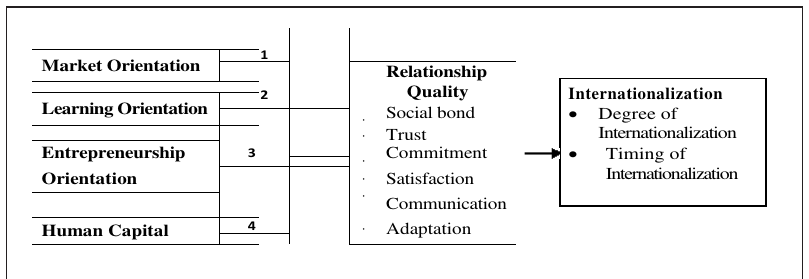
This paper views relationship quality as a source of knowledge resource which may help small businesses to identify opportunities in foreign markets and increase the ability to compete successfully in the international market. Following this premise, this paper further postulates the mediating function of RQ underlying each path of a Þrm’s capabilities. Thus, key propositions are developed in the next sections with regard to relationship quality.
5.1Market orientation
Although market orientation has been extensively studied, the international context of market orientation [MO] has received attention among scholars only in recent decades and therefore is still limited. In recent studies MO has been conceptualized as a firm’s idiosyncratic resources that lead to competitive advantage and performance (Hult, Ketchen, & Slater, 2005; Ketchen, Hult, & Slater, 2007). Several studies on the export context of MO have found positive and signifi cant relationships between MO and performance (e.g. Murray, Gao, Kotabe, & Zhou, 2007; Rose & Shoham, 2002). While there is no justification for the impact of the findings of these studies on small businesses, still not much can be derived to understand the role of MO in small businesses’ internationalization behavior. This study conceptualizes that RQ mediates the effect of MO on competitive advantage, export performance, and internationalization. MO will increase the amount of customer information gathered and disseminated by the export firm and encourage inter-firm cooperation (Racela, Chaikittisilpa, & Thoumrungroje, 2007). While intelligent generation relates to the practice of identifying opportunities and monitoring the environment, intelligent dissemination and responsiveness on the other hand facilitates the ability of an organization [exporter] to predict, react, and capitalize on changes in the environment (Rose & Shoham, 2002). MO provides the employee with a sense of belonging, a sense of direction, and feelings of contributing towards satisfying customer needs (Shoham, Rose, & Kropp, 2005). Based on the strategic marketing literature, MO provides a firm with market-sensing and customer- linking capabilities (Kirca, Jayachandran, & Bearden, 2005). Customers may perceive value in a relationship when they receive relationship benefits from an exchange partner, which increases their willingness to develop relational bonds (Palmatier et al., 2006). The long lasting relationships with partners enable firms to attain competitive positions in the foreign market (Kaleka, 2002). Based on the above arguments, the present study postulates that RQ mediates the relationship between a firm’s market orientation and international outcomes. With that this study proposes that:
Proposition 1: The relationship between export market orientation and internationalization is mediated by exporter-importer relationship quality.
5.2Learning orientation
Learning orientation [LO] is conceptualized as the organizational capability (Nasution & Mavondo, 2008) that facilitates a firm to gain the ability to learn faster, which is said to be the source of sustainable competitive advantage (Slater & Narver, 1995) and superior performance. LO has been found to be positive and signi ficantly related to learning from experience, which is defined as the ability of the firm to perform behavioral actions to absorb and accumulate knowledge and skill portfolios from its past experience with previous alliances (Emden, Yaprak, & Cavusgil, 2005). In inter- organizational relationships, the development of a closed and quality relationship is time consuming and socially oriented. The prospects of continuity in a long term relationship depend on what the partner has learned from past relationships and how the partner acts accordingly to the norms that may potentially extend the term and quality of the relationship. This notion is supported by several studies such as Nguyen et al. (2007) and Gonzalez-Padron, Hult and Calantone (2008). Both studies found that the relationship between LO and RQ was positive and significant. Emden et al. (2005) suggest that the more eager to learn through collaboration the firm is, the more likely it is that it will be able to balance the trade-off between competition and cooperation within the alliance.
Proposition 2: The relationship between learning orientation and internationalization is mediated by the exporter-importer relationship quality.
5.3Entrepreneurship orientation
In the past, investigations into the EO-performance relationship have produced inconsistent results across studies. Some studies report positive results of EO impacts on performance (Jantunen et al., 2008) while others have found the opposite (Stam & Elfring, 2008). The tendency of past studies has been to assume a unilateral positive relationship between EO and performance. However, Hughes and Morgan (2007) propose that “Research into EO would therefore benefit from exploring indirect relationships...” The literature states that for a venture to realize these benefits from internationalization, it must have access to the resources that enables it to do so (Fernhaber, Gilbert, & McDougall, 2008). In addition, the exhibition of an entrepreneurial orientation (EO) will place firms in positions of potentially great uncertainty and vulnerability as a function of the inherently exploratory nature of entrepreneurship (Green, Covin, & Slevin, 2008), particularly involving distinct entities of foreign markets. Since at the heart of entrepreneurship, conceptualization is an opportunity-seeking behaviour (Ireland, Hitt, & Sirmon, 2003), firms may develop the opportunities for new businesses in foreign markets by the creation of foreign market knowledge through relationships with other firms. Johanson and Vahlne (2003, p. 89) assert that “experience [relationship] gives the firm an ability to see and evaluate business opportunities”.
Freeman et al. (2006) assert that managers in smaller entrepreneurial firms respond to the constraints of the internationalization process by developing strategies that allow them to expand rapidly into international markets while sharing the risks. Furthermore, they posit that each strategy is strongly related to relationship networks derived from personal networks that have taken a long time to develop, a phenomenon that reflects the quality of the relationship. Since each relationship in the network is unique due to the characteristics of the relationship partners and the history of the relationship, the impact of international EO on relationship quality is distinct across relationships in a network.
Proposition 3: The relationship between international entrepreneurship orientation and internationalization is mediated by exporter-importer relationship quality .
5.4Human capital
The present study posits that although extant literature acknowledges that a manager’s past international experience helps to develop international market knowledge and positive attitudes toward internationalization, the dynamic of today’s international market warrants an awareness of changing environments. Due to the liability of smallness that restricts SMEs to acquire foreign market knowledge for superior performance, a large section of the literature advocates a strategic role for relational exchanges as a source of that knowledge (Freeman et al., 2006; Haahti, Madupu, Yavas, & Babakus, 2005). This study postulates that A manager’s know-how helps to develop the capabilities to leverage relationship quality with foreign partners to gain knowledge of foreign markets and, ultimately to achieve high performance in the international market. When customers interact with sellers who are competent in terms of knowledge and experience, the customers receive increased value, their relationship becomes more important, and they invest more effort to strengthen and maintain it (Crosby, Evans, & Cowles, 1990).
Proposition 4: The relationship between an entrepreneur’s human capital and internationalization is mediated by exporter-importer relationship quality.
6Conclusions
The explanatory power of RBV in the study of early internationalization continues to grow amid the struggle to develop a cohesive theoretical underpinning that explains how and why some small businesses internationalize early. Meanwhile, the theoretical explanation of the Uppsala Model continues to serve, though in a less dominating appearance, the internationalization research by providing a starting point for theory building. Following Knight and Cavusgil (2004), this paper attempts to build a conceptual framework by focusing on internal capabilities and resources that are controlled by businesses. In so doing, the investigation draws on a symmetrical analysis of internal and external factors, and recognizes the pivotal position of relationships with foreign partners. Then, this paper adopts the relationship building capabilities of Kaleka (2002) to conjecture the process approach of foreign market knowledge acquisition by early internationalization and invite the integration of relationship quality domain which has been ignored by researchers of early internationalization along the course.
However, this model should be scrutinized with cautiousness particularly when the flow of knowledge resources IS conceptualized and illustrated implicitly. Specifically, the danger lies on the notion that this model represents the process of foreign market
Knowledge acquisition which potentially has not been captured by any construct or link between constructs. Perhaps, the novelty of the model can be realized by incorporating several constructs that depict, for example, knowledge outcomes. Nevertheless, the model and the accompanying propositions that have been established here need to be tested empirically and one way to achieve this is by gathering data from both sides of the relationships across the country. Such dyadic method will help to build up the rigor of the model as well as increase the reliability and the generalization of the results.
Finally, this model represents the dynamic nature of the early internationalization process. As such, the model provides the conceptualization of the antecedent and the outcomes of inter-organizational relationship quality, as well as offers an alternative approach of inter-organizational relationship quality, perhaps, toward a more effective path of accelerated internationalization to small businesses and policy makers.
References
- Ambler, T., & Styles, C. (2000). The future of relational research in international marketing: Constructs and conduits. International Marketing Review, 17 (6), 492-508.
- Anderson, E. W., Fornell, C., & Rust, R. T. (1997). Customer satisfaction, productivity, and proÞ tability: Differences between goods and services. Marketing Science, 16(2), 129-145.
- Anders son, S. (2000). The internationalization of the Þ rm from an entrepreneurial perspective. International Studies of Management & Organization, 30 (1), 63.
- Arranz, N., & De Arroyabe, J. C. F. (2009). Internationalization process of Spanish small Þ rms: strategies, transactions and barriers. International Small Business Journal, 27(4), 420-441.
- Autio, E., Sapienza, H. J., & Almeida, J. G. (2000). Effects of age at entry, knowledge intensity, and imitability on international growth. Academy of Management Journal, 43(5), 909-924.
- Babakus, E., Yavas, U., & Haahti, A. (2006). Perceived uncertainty, networking and export performance: A study of Nordic SMEs. European Business Review, 18(1), 4.
- Barney, J. B. (1991). Firm resources and sustained competitive advantage. Journal of Management, 17(1), 99-120.
- Barney, J. B., Wright, M., & Ketchen, D. J. (2001). The resource-based view of the firm: Ten years after 1991. Journal of Management, 2 7(6), 625-641.
- Bradach, J. L., & Eccles, R. G. (1989). Price, authority, and trust - from ideal types to plural forms. Annual Review of Sociology, 15, 97-118.
- Brouthers, L. E., Nakos, G., Hadjimarcou, J., & Brouthers, K. D. (2009). Key factors for successful export performance for small firms. Journal of International Marketing, 17(3), 21-38.
- Camison, C., & Villar, A. (2009). Capabilities and propensity for cooperative internationalization. [Article]. International Marketing Review, 26(2), 124-150.
- Cannon, J. P., & Homburg, C. (2001). Buyer-supplier relationships and customer firm costs. Journal of Marketing, 65(1), 29-43.
- Cassiman, B., & Golovko, E. (2011). Innovation and internationalization through exports. Journal of International Business Studies, 42, 56-75.
- Cavusgil, S. T., Deligonul, S., & Zhang, C. (2004). Curbing foreign distributor opportunism: An examination of trust, contracts, and the legal environment in international channel relationships. Journal of International Marketing, 12(2), 7-27.
- Chiu, H.-C., Hsieh, Y.-C., Li, Y.-C., & Lee, M. (2005). Relationship marketing and consumer switching behavior. Journal of Business Research, 58(12), 1681-1689.
- Coviello, N. E., & Jones, M. V. (2004). Methodological issues in international entrepreneurship research. Journal of Business Venturing, 19(4), 485-508.
- Crosby, L. A., Evans, K. R., & Cowles, D. (1990). Relationship quality in services selling - an interpersonal infl uence perspective. Journal of Marketing, 54(3), 68-8 1.
- De Clercq, D., Sapienza, H. J., & Crijns, H. (2005). The internationalization of small and medium-sized fi rms. [Article]. Small Business Economics, 24(4), 409-419.
- Dorsch, M. J., Swanson, S. R., & Kelley, S. W. (1998). The role of relationship quality in the stratifi cation of vendors as perceived by customers. Journal of the Academy of Marketing Science, 26(2), 128-142.
- Dwyer, F. R., Schurr, P. H., & Oh, S. (1987). Developing buyer-seller relationships. Journal of Marketing, 51(2), 11-27.
- Eisenhardt, K. M., & Martin, J. A. (2000). Dynamic capabilities: What are they? Strategic Management Journal, 21(10-11), 1105-1121.
- Emden, Z., Yaprak, A., & Cavusgil, S. T. (2005). Learning from experience in international alliances: antecedents and firm performance implications. Journal of Business Research, 58(7), 883-892.
- Evans, J., & Mavondo, F. T. (2002). Psychic distance and organizational performance: An empirical examination of international retailing operation. Journal of International Business Studies, 33 (3), 515-532.
- Fernhaber, S. A., Gilbert, B. A., & McDougall, P. P. (2008). International entrepreneurship and geographic location: An empirical examination of new venture internationalization. Journal of International Business Studies, 39, 267-290.
- Fiol, C. M. (2001). Revisiting an identity-based view of sustainable competitive advantage. Journal of Management, 27(6), 691.
- Freeman, S., Edwards, R., & Schroder, B. (2006). How smaller born-global firms use networks and alliances to overcome constraints to rapid internationalization. Journal of International Marketing, 14 (3), 33-63.
- Gankema, H. G. J., Snuif, H. R., & Zwart, P. S. (2000). The internationalization process of small and medium-sized enterprises: An evaluation of stage theory. Journal of Small Business Management, 38 (4), 15-27.
- Gonzalez-Padron, T., Hult, G. T. M., & Calantone, R. (2008). Exploiting innovative opportunities in global purchasing: An assessment of ethical climate and relationship performance. Industrial Marketing Management, 37, 69-82.
- Green, K. M., Covin, J. G., & Slevin, D. P. (2008). Exploring the relationship between strategic reactiveness and entrepreneurial orientation: The role of structure-style fit. Journal of Business Venturing, 23 (3), 356-383.
- Griffi th, D. A., & Harvey, M. G. (2001). Executive insights: An intercultural communication model for use in global interorganizational networks. Journal of International Marketing, 9 (3), 87-103.
- Griffi th, D. A., Myers, M. B., & Harvey, M. G. (2006). An investigation of national culture’s infl uence on relationship and knowledge resources in interorganizational relationships between Japan and the United States. Journal of International Marketing, 14(3), 1-32.
- Reid, S. D. (1981). The decision-maker and export entry and expansion. Journal of International Business Studies, 12(2), 101-112.
- Gripsrud, G., Solberg, C. A., Ulvnes, A. M., & Carl Arthur, S. (2006). The effect of information collection behaviour on market performance: the role of partner relationships. Advances in International Marketing (Vol. Volume 16, pp. 135-155): JAI.
- Haahti, A., Madupu, V., Yavas, U., & Babakus, E. (2005). Cooperative strategy, knowledge intensity and export performance of small and medium sized enterprises. Journal of World Business, 40(2), 124-138.
- Hallen, L., Johanson, J., & Seyedmohamed, N. (1991). InterÞ rm adaptation in business relationships. Journal of Marketing, 55(2), 29-37.
- Harris, W., & Wheeler, C. (2005). Entrepreneurs’ relationships for internationalization: Functions, origins and strategies. International Business Review, 14, 187-207.
- Homburg, C., Krohmer, H., Cannon, J. P., & Kiedaisch, I. (2002). Customer satisfaction in transnational buyer-supplier relationships. Journal of International Marketing, 10(4), 1-29.
- Hughes, M., & Morgan, R. E. (2007). Deconstructing the relationship between entrepreneurial orientation and business performance at the embryonic stage of Þrm growth. Industrial Marketing Management, 36(5), 65 1-661.
- Hult, G. T. M., Ketchen, D. J., & Slater, S. F. (2005). Market orientation and performance: An integration of disparate approaches. Strategic Management Journal, 26(12), 1173-1181.
- Ireland, R. D., Hitt, M. A., & Sirmon, D. G. (2003). A model of strategic entrepreneurship: The construct and its dimensions. Journal of Management, 29(6), 963-989.
- Jackson, S., & Crockenberg, S. (1998). A comparison of suggestibility in 4-year-old girls in response to parental or stranger misinformation. Journal of Applied Developmental Psychology, 19 (4), 527-542.
- Jantunen, A., Nummela, N., Puumalainen, K., & Saarenketo, S. (2008). Strategic orientations of born globals - Do they really matter? Journal of World Business, 43(2), 158-170.
- Johanson, J., & Mattsson, L.-G. (1988). Internationalization in industrial systems: A network approach. In N. a. V. Hood, J.-E. (Eds) (Ed.), Strategies in Global Competition. London: Croom Helm.
- Johanson, J., & Vahlne, J.-E. (2003). Business relationship learning and commitment in the internationalization process. Journal of International Entrepreneurship, 1(1), 83-101.
- Johanson, J., & Vahlne, J. E. (1977). Internationalization process of Þrm - model of knowledge development and increasing foreign market commitments. [Article]. Journal of International Business Studies, 8 (1), 23-32.
- Johnson, J. L., Sakano, T., Cote, J. A., & Onzo, N. (1993). The exercise of interÞ rm power and its repercussions in United States-Japanese channel relationships. Journal of Marketing, 57 (2), 1-10.
- Kaleka, A. (2002). Resources and capabilities driving competitive advantage in export markets: Guidelines for industrial exporters. [Article]. Industrial Marketing Management, 31(3), 273-283.
- Kent, J., & Mentzer, J. (2003). The effect of investment in interorganizational information technology in a retail supply chain. Journal of Business Logistic, 24(2), 155-175.
- Ketchen, D. J., Hult, G. T. M., & Slater, S. F. (2007). Toward greater understanding of market orientation and the resource-based view. Strategic Management Journal, 28(9), 961-964.
- Kirca, A. H., Jayachandran, S., & Bearden, W. O. (2005). Market orientation: A meta-analytic review and assessment of its antecedents and impact on performance. Journal of Marketing, 69(2), 24-4 1.
- Knight, G. A., & Cavusgil, S. T. (2004). Innovation, organizational capabilities, and the born-global Þrm. Journal of International Business Studies, 35, 124-141.
- Knight, G. A., & Liesch, P. W. (2002). Information internalisation in internationalising the Þ rm. [Article]. Journal of Business Research, 55(12), 981-995.
- Koza, M., & Lewin, A. (2000). Managing partnerships and strategic alliances: Raising the odds of success. European Management Journal, 18 (2), 146-151.
- Kumar, N., Scheer, L. K., & Steenkamp, J. B. E. M. (1995). The effects of perceived interdependence on dealer attitudes. Journal of Marketing Research, 32(3), 348-356.
- Lages, C., Lages, C. R., & Lages, L. F. (2005). The RELQUAL scale: A measure of relationship quality in export market ventures. Journal of Business Research, 58(8), 1040-1048.
- Leonidou, L. C., & Katsikeas, C. S. (1996). The export development process: An integrative review of empirical models. Journal of International Business Studies, 27(3), 517-551.
- Liesch, P. W., & Knight, G. A. (1999). Information internalization and hurdle rates in small and medium enterprise internationalization. Journal of International Business Studies, 30(2), 383-394.
- Lopez, L. E., Kundu, S. K., & Ciravegna, L. (2009). Born global or born regional? Evidence from an exploratory study in the Costa Rican software industry. [Article]. Journal of International Business Studies, 40 (7), 1228-1238.
- Mahoney, J. T., & Pandian, J. R. (1992). The resource-based view within the conversation of strategic management [Review]. Strategic Management Journal, 13(5), 363-380.
- Mavondo, F. T., & Rodrigo, E. M. (2001). The effect of relationship dimensions on interpersonal and interorganizational commitment in organizations conducting business between Australia and China. Journal of Business Research, 52 (2), 111-121.
- McDougall, P. P., & Oviatt, B. M. (2000). International entrepreneurship: The intersection of two research paths. Academy of Management Journal, 43 (5), 902-906.
- Mohr, J. J., & Nevin, J. R. (1990). Communication strategies in marketing channels - a theoretical perspective. Journal of Marketing, 54(4), 36-51.
- Morgan, R. M., & Hunt, S. D. (1994). The commitment-trust theory of relationship marketing. Journal of Marketing, 58(3), 20-38.
- Murray, J. Y., Gao, G. Y., Kotabe, M., & Zhou, N. (2007). Assessing measurement invariance of export market orientation: A study of Chinese and non-Chinese Þrms in China. Journal of International Marketing, 15, 41-62.
- Musteen, M., Francis, J., & Datta, D. K. (2010). The inß uence of international networks on internationalization speed and performance: A study of Czech SMEs. [Article]. Journal of World Business, 45(3), 197-205.
- Nasution, H. N., & Mavondo, F. T. (2008). Organisational capabilities: Antecedents and implications for customer value. European Journal of Marketing, 42(3-4), 477-501.
- Naude, P., & Buttle, F. (2000). Assessing relationship quality. Industrial Marketing Management, 29(4), 351-361.
- Nes, E. B., Solberg, C. A., & Silkoset, R. (2007). The impact of national culture and communication on exporter-distributor relations and on export performance. International Business Review, 16 (4), 405-424.
- Nevins, J. L., & Money, R. B. (2008). Performance implications of distributor effectiveness, trust, and culture in import channels of distribution. Industrial Marketing Management, 37 (1), 46-58.
- Nguyen, T. T. M., Barrett, N. J., & Nguyen, T. D. (2007). The role of market and learning orientations in relationship quality: Evidence from Vietnamese exporters and their foreign importers. Advances in International Marketing (Volume 17, pp. 107-133): JAI.
- Oviatt, B. M., & McDougall, P. P. (1994). Toward a theory of international new ventures. [Article]. Journal of International Business Studies, 25 (1), 45-64.
- Palmatier, R. W., Dant, R. R., Grewal, D., & Evans, K. R. (2006). Factors inß uencing the effectiveness of relationship marketing: A meta-analysis. Journal of Marketing, 70(4), 136-153.
- Phan, M. C. T., Styles, C. W., & Patterson, P. G. (2005). Relational competency’s role in Southeast Asia business partnerships. Journal of Business Research, 58 (2), 173-184.
- Polo-Redondo, Y., & Cambra-Fierro, J. (2008). Inß uence of the standardization of a firm’s productive process on the long-term orientation of its supply relationships: An empirical study. Industrial Marketing Management, 37(4), 407-420.
- Racela, O. C., Chaikittisilpa, C., & Thoumrungroje, A. (2007). Market orientation international business relationships and perceived export performance. International Marketing Review, 24 (2), 144-163.
- Ramstrom, J. (2008). Inter-organizational meets inter-personal: An exploratory study of social capital processes in relationships between Northern European and ethnic Chinese fi rms. Industrial Marketing Management, 37(5), 502-5 12.
- Reuber, A. R., & Fischer, E. (1997). The inß uence of the management team’s international experience on the internationalization behaviors of SMEs. [Article]. Journal of International Business Studies, 28 (4), 807-825.
- Rose, G. M., & Shoham, A. (2002). Export performance and market orientation: Establishing an empirical link. Journal of Business Research, 55(3), 217-225.
- Ruzzier, M., Antoncic, B., Hisrich, R. D., & Konecnik, M. (2007). Human capital and SME internationalization: A structural equation modeling study. [Article]. Canadian Journal of Administrative Sciences-Revue Canadienne Des Sciences De L Administration, 24 (1), 15-29.
- Saleh, M., & Ali, Y. (2009). Determinant of importer commitment in international exchange: An agenda for future research. Journal of Management and Organisation, 15(1).
- Sapienza, H. J., Autio, E., George, G., & Zahra, S. A. (2006). A capabilities perspective on the effects of early internationalization on Þrm survival and growth. Academy of Management Review, 31(4), 914-933.
- Schwens, C., & Kabst, R. (2009). How early opposed to late internationalizers learn: Experience of others and paradigms of interpretation. International Business Review, 18, 509-522.
- Shoham, A., Rose, G. M., & Kropp, F. (2005). Market orientation and performance: A meta-analysis. Marketing Intelligence & Planning, 23 (4/5), 435.
- Slater, S. F., & Narver, J. C. (1995). Market orientation and the learning organization. Journal of Marketing, 59(3), 63-74.
- Srivastava, R. K., Fahey, L., & Christensen, H. K. (2001). The resource-based view and marketing: The role of market-based assets in gaining competitive advantage. Journal of Management, 2 7(6), 777.
- Stam, W., & Elfring, T. (2008). Entrepreneurial orientation and new venture performance: The moderating role of intra and extraindustry social capital. Academy of Management Journal, 51 (1), 97-111.
- Storz, M. L. (1999). Malay and Chinese values underlying the Malaysian business culture. International Journal of Intercultural Relation, 23 (1), 117-131.
- Teece, D. J., Pisano, G., & Shuen, A. (1997). Dynamic capabilities and strategic management. Strategic Management Journal, 18 (7), 509-533.
- Toyne, B. (1989). International exchange - a foundation for theory building in international business. Journal of International Business Studies, 20 (1), 1-17.
- Weerawardena, J., Mort, G. S., Liesch, P. W., & Knight, G. (2007). Conceptualizing accelerated internationalization in the born global Þrm: A dynamic capabilities perspective. Journal of World Business, 42(3), 294-306.
- Westhead, P., Wright, M., & Ucbasaran, D. (2001). The internationalization of new and small Þ rms: A resource-based view. Journal of Business Venturing, 16(4), 333-358.
- Wheeler, C., Ibeh, K., & Dimitratos, P. (2008). UK export performance research: Review and implications. International Small Business Journal, 26(2), 207-239.
- Wright, M., Westhead, P., & Ucbasaran, D. (2007). Internationalization of small and medium-sized enterprises (SMEs) and international entrepreneurship: A critique and policy implications. Regional Studies, 41(7), 1013-1029.
- Wu, F., Sinkovics, R. R., Cavusgil, S. T., & Roath, A. S. (2007). Overcoming export manufacturers’ dilemma in international expansion. [Review]. Journal of International Business Studies, 38(2), 283-302.
- Zhou, L. (2007). The effects of entrepreneurial proclivity and foreign market knowledge on early internationalization. Journal of World Business, 42(3), 281-293.