A descriptive analysis of tax evasion as a crime in a least developed country: the case of Yemen
- College of Business, Universiti Utara Malaysia
- College of Business, One Washington Square, San Jose, CA 95192-0066
Journal of Business Management and Accounting 1(2) (2011) · https://doi.org/10.32890/jbma2011.1.2.8908
Abstract
This paper measures the perception of Yemeni citizens on the severity of tax evasion relative to other crimes and violations. Perception of tax evasion may somewhat explain the degree of non-compliance with tax laws. Using data from a self-administered survey and a structured interview, the results of mean and comparative analysis show that the three tax evasion offences were ranked as the least serious crimes among 30 listed crimes. Further, tax evasion is categorized the least serious category out of six categories. The results of this study should be useful to policy makers in Yemen and elsewhere, as it is an alarming signal that tax evasion is relatively ranked as the least serious offence, which could lead to an environment where taxpayers may not be afraid of cheating on their tax returns.
Keywords: Tax evasion as a crime, other offen ces, Yemen
1Introduction
In 2004, the application of system of self-evaluation has been brought in by Yemen to all individuals payer of tax (Aljamaree & Algaylee, 2007). In order to prevent the evasion of tax, a particular public administration was founded. In addition, efforts have been put in place at different levels of public, region, and international with aim of lessening crime associated with Þ nance, and reducing tax evasion which is alarming (Embassy of Yemen, 2007). Studies in the past have proved in their Þ ndings that the execution of system of self-evaluation facilitates those who pay tax to do that accordingly at will which made it possible for the tax authorities to incur reduced cost of gathering the taxes (Brand, 1996). However, failure to comply with tax rules and rates are prevalent in most places thereby making the tax authorities to strive hard to ensure willingness in complying with the tax rules and rates (Hasseldine, 1999).1
The taxpayers in Yemen have been encouraged by this environment where failure of complying with tax payment thrives, to the extent that they never reported or paid their due income tax (Embassy of Yemen, 2007). Research carried out with consideration of tax evasion as a crime indicated that environment where failure of compliance thrives has been made to be in existence from the payers’ view of tax evasion as unserious crime (Karlinsky, 2004; Abdul Manaf & Abdul Jabbar, 2006). As a result, the extent of failure of compliance with the rules and regulations guiding tax could be analyzed by the way tax evasion is viewed. There are also implications for society resulting from the way the public view the crimes been serious (Karlinsky et al., 2004). The results of such studies are however not conclusive in analyzing the different views with respect to tax evasion as a crime. Furthermore, few studies have been carried out in this Þeld and mostly in countries such as USA, Australia, and Malaysia while in Yemen, such study of the view of tax evasion is lacking. Empirical proof on how individual tax payer view tax evasion from the advanced and other developing countries could not be generally applicable in the context of Yemen due to unequal environmental factors like differences in the economy, distinction in business, cultural and regulations differences. As a result, these distinctions are anticipated to make the views of tax evasion different.
With the use of structured personal interview approach, the opinions or feelings of Yemeni people with regard to tax evasionhave been examined to be affected by Islamic religious belief. In particular, Yemen has religious culture which is viewed to be unique. As an Islamic country, where all aspect of life are affected by religion, such that any regulation, rules or laws not in line with Islamic doctrine are neglected. Tax evasion is not only peculiar to Yemeni people but also to other countries such as Americans, Australians and Malaysians. But, the motives behind tax evasion differ from countries to countries. In Islamic countries like Yemen, the main motive is the belief that tax collections are not allowed by religion except Zakat. However, tax payment could be made in a situation of needs of fund by the country for important commitments. Studies carried out in the past to measure the tax evasion from Islamic religious point of view, indicates that Muslims are not all that rigid in their views about tax evasion (McGee, 1998; Murtuza & Ghazanfar, 1998). Therefore, this study measures the Yemenis’ views on the seriousness of tax evasion as a crime in relation to other offences. This paper is organized as follows. The second section provides the literature review followed by the research design and methodology in the third section. Results of the study are discussed in Section 4 followed by discussion and conclusion in Section 5.
2Literatrue review
2.1Crime and tax evasion
Researchers for many years ago have examined the reasons behind payment of taxes by some people and evasion of taxes by others using different approaches. For example, Boylan and Sprinkle (2001) carried out experiments; Fisher, Goddeeris, & Young
(1989) conducted random surveys, while Erard and Ho (2001) made use of available tax databases. The features of payers of tax who fail to comply and the possible motivations to make taxpayers comply have been recognized by authors. In particular, research on tax evasion has viewed this activity as a ‘white-collar crime’ practice or criminal behavior practice (Wentworth & Rickel, 1985; Jackson & Milliron, 1986; Ghosh & Crain, 1995). There was discussion regarding what a white-collar crime is made up of and the way that crime is described in 1939 when the idea was differently described by Edwin Sutherland (Sutherland, 1949). The idea of white-collar crime was questioned by legal scholars’ tradition and Tappan (1947). Tappan was of the argument that the description given by Sutherland was simply on the non-compliance of the rules and regulations by the high ranking managers of the big corporations in U.S. These actions were considered as merely going against the law but not really a crime since criminal law spells out what crime is all about. The ideas of crimes as merely a consequence of written law have been questioned by the sociologists (Braithwaite, 1989; Croall, 1992).
In U.S, many researches on the measurement of the seriousness of crimes have been attempted and these research works could also be observed in the sociology, psychology, and the criminal justice at the international level. However, such studies are lacking in the accounting and tax (Karlinsky et al., 2004). Tax evasionis not considered by the people to be a serious crime in US as distinct from other crimes. This is because tax evasionwas just considered as mere refusing to obey the law rather than being a crime. Refusing to obey the law is an illegal act that attracts the penalty of Þne only while a crime attracts imprisonment as a penalty (Warr, 1989).Thirteen illegal acts have been measured by Australian institute of criminology in a study carried out in 1986. It was stated that an income tax evasion of A$5000 was considered to be in the ninth position, about six times more severed than a stolen bicycle of AU$ 1000. The most and the least severed illegal act are respectively murder and stealing of good from a shop with the value of AU$5, and in between these two is illegal importation of heroine. The comparison of murder with bicycles theft in term of severity of crime shows that murder is twenty-seven more severed than bicycle theft, while stealing of goods was considered as about the same with bicycle theft (Wilson,Walker, and Mukherjee(1986).
In a study carried out by Eicher, Stuhldreher and Stuhldreher (2002) to investigate the distinctions in male and female thought concerning six attitudes. It was indicated that for both sexes, overcharged tax is the second least severed illegal act and 44% of male and 36% of female reported to have given approval in their opinion to the actions. The trafÞ c offence of driving faster than the legal limit was shown to be the least severed illegal act and there is likelihood of males given approval to this behavior when differentiated from females. A study was carried out to measure the views of tax evasion by examining 13 crime items and eight items relating to the disobeying the law with particular examples of white-collar crimes like the crime of buying and selling shares in a company with the help of information within those connected with the business before the information is made public, tax evasion and accounting fraud. These crimes and law disobedience are grouped into two such as victim and victimless (Abdul Manaf & Abdul Jabbar, 2006).
2.2Crime and tax evasion in Yemen
Crime has been categorized into two by the 1994 Yemeni Penal Code Law No. (12), namely severed crimes and non-severed crimes. The severed crimes have to do with the penalty such as execution, chopping off the offender’s organ, and jail for years above three years. On the other hand, non-severed crimes have to do with Þ ne for the offenders to pay and or to serve certain jail term usually below three years. Table 1 below provides examples of the forms of crime (Yemeni Interior Ministry, 1994):
| Serious Crimes | Non-serious Crimes |
|---|---|
| Rape | Pick-pocketing |
| Bribery | Understatement of Taxable Income |
| Drug TrafÞ cking\dealing Sexual Harassment | |
| Financial Fraud | Overstatement of Tax Deductions |
| Murder | Employing Illegal Worker |
| Terrorism | Prostitution |
| Adultery | Shop-lifting |
| Homosexuality | Fail to submit a Tax Return |
| Islamic Abuse | Illegal Gambling |
| OfÞ cial Document Forgery Alcohol Drinking\dealing | |
| Currency Forgery | Begging |
| Robbery with Firearms | Fireworks Acquiring\dealing |
| OfÞ cial Seal Forgery | Running a Red Light |
Next is to distinguish between crimes which are committed by people and the one which are not committed by them. There has been proof that any crimes that are not committed by people are often considered less severed (Karlinsky et al., 2004). It has been pointed out that disobeying the law (violation) is an illegal act since a fine is the penalty as distinct from crime. The penalty for crime used to be associated with imprisonment (Warr, 1989). Most of the disobedient of laws are associated with imprisonment as stated in the 1994 Yemeni Penal Code Law No (12). Therefore, the right classifi cation of crimes in the Yemeni’s context should be on the basis of their severity and on whether crimes are victim or not. For instance, Table 2 gives the grouping of severed and non-severed crimes as victim and victimless:
| Serious Crimes Non-serious Crimes |
| (A1) Victim (A2)Victim |
| Rape Pick-pocketing |
| Financial Fraud Sexual Harassment |
| Murder Shop-lifting |
| Terrorism Intentionally Killing Peoples’ Animals |
| Robbery with Firearms Employee Abuse |
| Robbery without Firearms President Abuse |
| Arson (B2)Victimless |
| Pollution Understatement of Taxable Income |
| Kidnapping Overstatement of Tax Deductions |
| (B1) Victimless Employing Illegal Worker |
| Bribery Prostitution |
| Drug Traffi cking\dealing Failure to submit a Tax Return |
| Adultery Illegal Gambling |
| Homosexuality Alcohol Drinking\dealing |
| Islamic Abuse Begging |
| Offi cial Document Forgery Fireworks Acquiring\dealing |
| Currency Forgery Running a Red Light |
| Offi cial Seal Forgery Speeding |
| Offi cial Stamp Forgery Hiding a person escaping from doing the Military service |
| Even more, the crimes can be divided into six groups based on their types. These |
| include drug related crimes, violent crimes, commercial crimes, property crimes, traffi c |
| offences and other crimes as shown in Table 3: |
| . A descriptive analysis of tax evasion as a crime in a least developed country: the case of Yemen: 23-47 6 |
| Drug Related Crimes Violent Crimes Commercial Crimes |
| ________________________________________________________________ |
| Drug Traffi cking\dealing Rape Understatement of Taxable |
| Alcohol Drinking\dealing Murder Income |
| Terrorism Financial Fraud |
| Other Offences Currency Forgery |
| Robbery with Firearms |
| Islamic Abuse Kidnapping Offi cial Seal Forgery Offi |
| Employing Illegal Worker cial Stamp Forgery |
| Sexual Harassment |
| Prostitution Employee Abuse President Overstatement of Tax |
| Illegal Gambling Abuse Deductions |
| Begging Fail to submit a Tax |
| Fireworks Acquiring\dealing Return |
| Adultery Bribery |
| Homosexuality Traffic Offences |
| Pollution Property Crimes Speeding |
| Hiding a person escaping from Arson Running a Red Light |
| doing the Military service Robbery without Firearms |
| Intentional Killing Peoples’ |
| Animals |
| Shop-lifting |
| Pick-pocketing |
At the international rating, it has been reported that crime rate in Yemeni is at it lowest level and it was reported to be 1.16109 crimes per 1000 people (Yemeni Crime Statistics, 2008). In fact, in Yemen, crimes do not constitute tax evasion and so they never fell under the area of authorities of the security and police administration; and Interior Ministry. However, tax evasion and other issue associated with tax fall under the Yemeni Tax Authority, and Yemeni Finance Ministry which administer them. For the year 1999, different punishments have been put in place by the Yemeni Income Tax Act No.12. These range from fi nes to jail terms for disobeying the stated rules and one of these is associated with tax evasion as given in chapter 7, article (90). Under this code, the deliberate attempt of tax evasion could be described by all or either of the offences stated below:
First, failure to declare the right income in line with the stated provisions of law such that there was omission, decreasing or cancelling of some proportion of income with the consequence on tax realization. Second, falsifi cation of any statements, document and entry while submitting or fi lling document in line with the stated law. Third, forging of books, accounts for preparation, maintenance or permission of such book and accounts, or allowing any incorrect entries that will later be prepared and maintained not to be genuine, hide or spoiled ether by part or whole. Doing these with the aim of hiding or excluding any taxable income under this Law; or some proportion of it with aim of evading tax payment either by part or otherwise; or trying to get an illegal exemption. Fourth, any act of fraudulent approaches in whichever way; or permitting it use to prevent the tax payment or using any means to decrease the amount to be paid. Fifth, presentation of false data or statements concerning any issue or incident which could negatively affect the payment of tax or causes decreases in its amount. Sixth, presenting incorrect reply in writing to a question or a request referred to him for getting data or speciÞ c criteria under this Law, with the aim of evading tax payment either in part or as a whole. Any offender will be penalized for committing any of the above stated offenses if found guilty and such punishment could be to serve the jail term greater than one month but less than one year, or effect the payment of a Þ ne above 50% but below 150% of the beneÞ t gained due to the offense committed or the violation of law. If the offenses are committed twice or repeated then, the penalty on the offenders will also be doubled (Yemeni Tax Authority, 1999).
The six illegal acts listed above are taken to be an action of tax evasion. They can be grouped into three major activities such as understatement of taxable income, overstatement of tax deductions and failure to submit a tax return. There have been evidences indicating that tax evasion is complex to be measured. Previous researchers use experimental approaches to investigate the factors that help to inform the motive behind the payment of tax by the people (Lewis, 1982; Frey, 1997, Alm et al., 1992, 1999; Frey and Feld, 2002; Feld and Tyran, 2002; Torgler, 2002). Also examined were the prior ideas for tax evasion which is a concept known as tax morale.
Information about the number of time cases of tax evasion have occurred in Yemeni has not been available. What was available was just the estimation of the tax gap of $164 Million yearly by the Yemeni tax authority (Yemen Times, 2005). Therefore, the study carried out in Yemen in this Þeld could show a rise in tax evasion with the effect of increasing domestic income and reducing income of government from tax suppose the marginal propensity to expend out of tax evasion is below unity. This is the situation experienced by Peacock and Shaw (1982). Successful tax evasion has severe effects of reducing government’s income as well as promoting a threat to willingness to comply (Clotfelter, 1983).
2.3Islamic perspectives towards tax
Not many researches have been carried out to examine the effect of Islamic religious perspectives on tax evasion. Most of the study carried out on the execution of tax system as a national revenue collection system in Islamic nations paid attention on the leveling of Zakat rather than tax. Two conditions were hypothesized by Peerzade (2005) in the tax system to be viewed as an Islamic tax system. One is that perceived method of Zakat ought to constitute the major effort of mobilizing resource. Two is that the method ought to integrate the Islamic recommendations. This is to complement the current secular rules and regulations concerning rates, exemption levels, and administration. Murtuza and Ghazanfer (1998) investigated the literature religion and pointed out that there is responsibility for Muslims to his God which to assist the poor ones by contribution them. No indication was given regarding the association between the government and the individual.
RaquibuzZaman (1986) argues that it is not unethical for a Muslim to avoid the payment of indirect taxes such as excise taxes, customs duties and most of the corporate income taxes. Furthermore, he emphasizes that Muslims should not pay tax, especially the ones that cause the consumer prices to go up. The Islamic perspective does not support the evasion of taxes but it will not be fair for non-Muslim who avoid the tax to enjoy the beneÞ t of taxes. Al-Awwal (2005) pointed out that individuals who pay taxes could appropriately organize their affairs such that they could bring to the minimum level the incidence of tax without going against the law. There will be tax evasion if the way they organize their affairs violates the provisions of the law. The tax payer under the tax planning is expected to make use of advantages of deductions and exemption very well in order to reduce the incidence given by the statute.
In most of the advanced nations, consultancy on tax planning is very important a business. There were also studies carried out in 1997 and 1998 in which tax evasion could be proved to be appropriate if the tax level raises the prices or if tax is level on income. However, some Islamic philosophers were of the opinion that a Muslim should pay tax for two reasons: one, the essence of tax is to compensate for the services offered and many transactions associated with the life of the taxpayer’s life and trade are made possible. Two, Muslims are expected to pay their tax because taxes evasion could as well causes Zakat evasion (Islamic Economic Program, 2009). The payment of taxes by Muslims could be looked at from three Islamic points of views. Firstly, the collection of tax in all cases by governments is absolutely not allowed. Zakat has been decreed by Allah for all Muslims as stated in the Holy Quran and this is believed to be an ideal system by all Muslims. Besides, the holy Prophet Mohammad (SAW) has given lesson on how Muslim should execute this perfect system. Therefore, introducing new tax system emulated from the non-Muslim, or Western nations to replace the Islamic Zakat system is a completely not allowed. Secondly, having consented with the disallowing of tax collection in Islamic nations as understood from the Þrst point of views of Islamic scholars, there may however, be an exception cases where government can level tax in Islamic nations without any sin committed. These cases must satisfy the following conditions before it could be carried out:
 a)         A situation where the public is lawfully in need of fund for an important
            undertaking;
 b)         A case where there is insufÞ cient lawfully Islamic resources: Kalzkah,
            SayyidQutb, abscess, Ushur.
 c)         Tax can be leveled on condition that wasteful spending has been abolished.
 d)         Tax can be leveled following the discussion of such with Islamic parliament.
 e)         No excess realization is made from tax in which case the tax should be leveled
            based on the amount needed.
 f)         The leveling of such tax should be fair, just and in line with the legitimate Islamic
            resources.
 g)         Expenditure of the proceeds from tax collected should satisfy the interest of the
            citizen.
Thirdly, it is argued under this Islamic perspective that Muslims under an Islamic government should abide by the rules and laws of the government (Verdict Encyclopedia, 2010).
3Research design and methodology
3.1Theoretical framework
Several authors in the Þeld of tax studies have examined the motive behind payment of tax by some people and non-payment by others. For example, Boylan and Sprinkle (2001) carried out experiments to examine these, Fisher et al. (1989) conducted random surveys, while Erard and Ho (2001) made use of available tax databases. The features of payers of tax who fail to comply and the possible motivations to make taxpayers comply have been recognized by authors. In particular, research on tax evasion has viewed this activity as a ‹white-collar crime› practice or criminal behavior practice (Wentworth & Rickel, 1985; Jackson & Milliron, 1986; Ghosh & Crain, 1995).
The payers of taxes in Yemeni have been encouraged by this environment where failure of complying with tax payment thrives, to the extent that they never reported or paid their due income tax (Embassy of Yemen, 2007). Research carried out with consideration of tax evasion as a crime indicated that environment where failure of compliance thrives has been made to be in existence from the payers’ view of tax evasion as unserious crime (Karlinsky et al, 2004; Abdul Manaf and Abdul Jabbar, 2006). As a result, the extent of failure of compliance with the rules and regulations guiding tax could be analyzed by the way tax evasion is viewed. There are also implications for society resulting from the way the public view the crime as been serious. Karlinsky et al., 2004).
Consequently, there will be an increase in the domestic income and reduction in the income of government realize from tax suppose the marginal propensity to expend out of tax evasion is below unity. Successful tax evasion has severe effects of reducing government’s income as well as promoting a threat to willingness to comply (Clotfelter, 1983). Firstly, this research tries to investigate the level of seriousness of tax evasion compared to other offences. A comparison will be made among the rank of each crime and violation given by the respondents as a high or low rank crime or violation. Further, . A descriptive analysis of tax evasion as a crime in a least developed country: the case of Yemen: 23-47 10 the tax evasion crime rank will be identifi ed among the list of the offences to determine the level of the seriousness of this crime compared to other offences. Figure 3.1 below shows the theoretical framework model:
            Level of Seriousness of other                                                         Level of Seriousness of Tax
                      offences                                                                              Evasion

Secondly, the signifi cant difference, if any, in the seriousness of tax evasion between victim and victimless crimes and violations. Crimes and violations will be, further, classifi ed into crimes and violations with and without victims. A comparison will be made among the rank of each victim and victimless crime and violation given by the respondents as a high or low rank. Next, the tax evasion crime rank will be identifi ed among the list of victim and victimless crimes and violations to determine the signifi cant difference in the seriousness of tax evasion between victim and victimless of crimes and violations. Figure 3.2 below shows the theoretical framework model:
Level of Seriousness of Crimes and Violations with victims
Level of Seriousness of Tax Evasion Level of Seriousness of Victimless Crimes and Violations
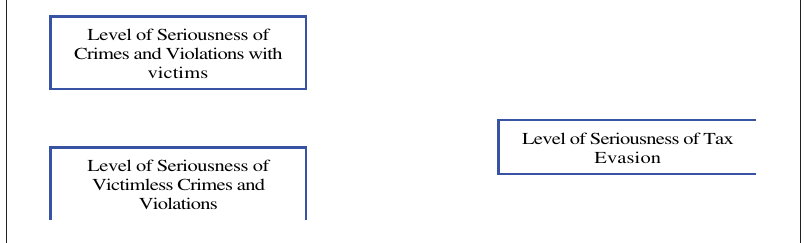
evasion between victim and victimless crimes and violations
3.2Hypotheses development
3.2.1The level of seriousness of tax evasion compared to other offences
The level of seriousness of tax evasion compared to other crimes and violation has been evidenced, previously, by a few studies (Karlinsky et al., 2004; Abdul Manaf & Abdul Jabar, 2006; Warr, 1989). The results of those studies show that there is a signi ficant difference in the perceptions of tax evasion compared with violent crimes, drug related crimes and trafÞ c offences. The results suggest that people do not perceive tax evasion to be as serious as violent crime and drug related crimes. Thus, the following hypothesis is developed to be tested by the current study:
H1: Tax evasion is perceivedas a less serious crime compared to other offences.
3.2.2 The signiÞ cant difference, if any, in the seriousness of tax evasion between victim and victimless of crimes and violations.
The level of signiÞ cant difference in the seriousness of tax evasion between victim and victimless of crimes and violations has been investigated by a few studies. It was found that crimes and violations involving victims are perceived to be more severe than victimless crimes and violations (Karlinsky et al., 2004; Abdul Manaf & Abdul Jabar, 2006). Thus, the following hypothesis is developed to be tested by the current study:
H2: Tax evasion is perceived a less serious crime compared to other victim and victimless of offences.
3.3Data collection
3.3.1Sample selection
As for the sample to be chosen for distributing the questionnaire, the disproportionate stratiÞ ed sampling is applied to select sample subjects that represent the most suitable ones in providing data about the dimensions of the study. This method is chosen in order to select the right sample to represent the whole population.Using the disproportionate stratiÞ ed random sampling, a sample of 400 Yemeni individuals was selected for the current study. These individuals are the most suitable people to provide data about the dimensions of the study. The sample subjects include individuals working for private and governmental sectors, businessmen, students, jobless and self-employed individuals. Around 335 questionnaires were returned, representing a 84% response rate.
3.3.2Procedures
In the current study, data is obtained from primary and secondary sources. Regarding obtaining data from the primary sources, in this research, two appropriate data collection methods are used. This includes: (1) a survey; (2) a personal structured interview.
3.3 .2 .1A survey method
Using this method of data collection, Yemeni individuals were asked to Þll in the self- administered questionnaire. This questionnaire is adopted and adapted from the previous studies conducted to measure the perceptions toward tax evasion as a crime (Karlinsky et al., 2004; Abdul Manaf and Abdul Jabbar, 2006).. The strength of the survey as a primary data collecting approach is that it does not require a visual or other objective perception of the information sought (Cohen, 1988). The questionnaire is divided into two sections. Section A consists of three parts relating to rating the severity of crimes. The first part (questions 1 to 30) measures opinions on 30 offences. The respondents are asked to indicate their agreement on all items using a five-point Likert scale. (1 as not serious to 5 as extremely serious).Question 31 to 32, in Section A, deal with ranking of the top five most serious offences as well as the top five least serious offences. The respondents need to provide ranking based on the offences identifi ed from questions 1 to 30.
Section B of the questionnaire is designed to obtain demographic characteristics of the respondents. Questions asked in this part relate to age, gender, marital status, education, source of income, and level of income. One major change made to the original questionnaire is by breaking up the general ‘tax evasion’ item into three specifi c types of tax evasion behavior. These specifi c tax evasion behavior items refer to understatement of income, overstatement of deductions and failure to submit a tax return. Prior similar studies have focused on ‘tax evasion or ‘tax fraud’ or both as a general item only (Karlinsky et al., 2004). Originally, the listing of 30 offences in the questionnaire was organized randomly without stating the category of offences. The reason is to ensure that respondents fully and carefully read the questions before answering. Finally, to ensure gaining high response rate, the questionnaires were personally distributed out to the individuals.
3.3.2.2 A personal structured interview
Using this method of data collection, two predetermined questions were asked personally to the respondents. The questions were (a) How do you perceive tax evasion as a crime? (b) Are Muslims obliged to obey the Islamic leader to pay tax? Thirty individuals were interviewed personally. As the respondents expressed their views, the researcher noted them down. The same questions were posed to everyone in the same manner. The main purpose of the interview was to support the results measured by the survey instrument and to investigate the Islamic religious perceptive towards tax evasion as a crime. Regarding obtaining data from secondary sources, in this study, data was retrieved from existing sources such as the governmental websites, articles, magazines, internet, newspaper, governmental publications, journals, doctoral dissertations as well as master theses. Secondary data saves time and costs of acquiring information (Zikmund, 2003).
4Results
4.1ProÞ le of respondents
As indicated earlier, a total of 335 questionnaires were gathered from the survey. As shown in Table 4, the majority of the respondents (78.2%) were male, and 2 1.8% were . A descriptive analysis of tax evasion as a crime in a least developed country: the case of Yemen: 23-47 13 female. The largest group (62.4%), in terms of age, was those aged between 30 and 49. SpeciÞ cally, 27.2% were aged between 18 and 29, while 10.4% were aged 50 and above. In terms of marital status, the majority of the respondents (73.4%) were married, 23% was single, and 3.6% was either divorced or widowed. Regarding the level of education, 41.8% of the respondents were bachelor degree holders, 21.2% high school certiÞ cate holders, 19.4% diploma holders, 14% pre-high school certiÞ cate holders, and 3.6% was master and PhD degree holders.
| Gender | |
|---|---|
| Male 262 | 78.3 |
| Female 73 | 21.7 |
| Age (years) | |
| 18-29 30-49 91 | 27.2 |
| 50 and above 209 | 62.4 |
| Marital Status 35 | 10.4 |
| 77 | 23 |
| Single 246 | 73.4 |
| Married | |
| 12 | 3.6 |
| Other | |
| Education | |
| Before high school | |
| High school 47 | 14 |
| Higher diploma 71 | 21.2 |
| Bachelor degree 65 | 19.4 |
| Postgraduate (master & PhD) 140 | 41.8 |
| Source of income 12 | 3.6 |
| Private income source 86 | 25.7 |
| Governmental income source 188 | 56.1 |
| Owning business or self-employed source of income 24 | 7.2 |
| Other sources of income 37 | 11 |
| Occupation | |
| Private sector employee | |
| Governmental sector employee | |
| Businessmen or self-employed individuals 86 | 25.7 |
| Others 188 | 56.1 |
| 24 | 7.2 |
| 37 | 11 (continued) |
| Demographic Variables Frequency (n=335) Percent % | |
| Level of income | |
| 240000 and below 112 33.4 | |
| 240001-500000 135 40.3 | |
| 50000 1-1000000 58 17.3 | |
| 1000001-2000000 12 3.6 | |
| 200001-5000000 0 0 | |
| 5000000 and above 18 5.4 | |
| Tax return preparer | |
| Yourself 18 5.4 | |
| Assisted by a friend, a spouse or a relative 31 9.3 | |
| Tax agent 68 20.3 | |
| Others 218 65.1 |
4.2Perceptions towards tax evasion compared to other offences
The objective the current study is to measure the level of seriousness of tax evasion as perceived by the respondents compared to other offences. This section highlights perceived differences in perception of tax evasion offences compared to other offences. Table 5 highlights the Mean Scores and Rank of the 30 offences examined under this study.
| Offences | Mean | SD | Rank |
|---|---|---|---|
| Islamic abuse | 4.86 0.5 17 | 1 | |
| Murder | 4.77 0.70774 | 2 | |
| Drug trafÞ cking\dealing | 4.45 0.73214 | 3 | |
| Adultery | 4.41 0.75219 | 4 | |
| Prostitution | 4.37 0.74592 | 5 | |
| Kidnapping | 4.32 2.189 | 6 | |
| Rape | 4.29 0.961 | 7 | |
| Robbery with Þrearms | 4.26 0.766 | 8 | |
| Terrorism | 4.14 1.02613 | 9 | |
| Alcohol drinking\dealing | 4.12 0.96101 | 10 | |
| Arson | 4.05 0.7 89 | 11 | |
| Bribery | 3.92 1.081 . A descriptive analysis of tax evasion as a crime in a least developed country: the case of Yemen: 23-47 | 12 (continued) | 37 |
| Offences | Mean | SD | Rank |
| Homosexuality | 3.90 1.019 | 13 | |
| Offi cial seal forgery | 3.88 0.943 | 14 | |
| Currency forgery | 3.80 0.974 | 15 | |
| Financial fraud | 3.77 0.83837 | 16 | |
| Offi cial document forgery | 3.76 0.757 | 17 | |
| Illegal gambling | 3.61 1.05250 | 18 | |
| Pollution | 3.59 1.057 | 19 | |
| Shop- lifting | 3.57 1.00015 | 20 | |
| Sexual harassment | 3.51 1.11292 | 21 | |
| Pick- pocketing | 3.15 1.07675 | 22 | |
| Robbery without fi rearms | 3.10 0.995 | 23 | |
| Employing illegal worker | 3.07 1.01653 | 24 | |
| Offi cial stamps forgery | 2.81 1.063 | 25 | |
| Fireworks acquiring\dealing | 2.77 0.952 | 26 | |
| Begging | 2.40 1.012 | 27 | |
| Understatement of taxable income | 2.39 | 1.3595 1 28 | |
| Overstatement of tax deductions | 2.078 | 1.1425 1 29 | |
| Failure to submit a tax return | 2.04 1.01988 | 30 |
As shown in Table 5, the most five serious crimes are Islamic abuse, murder, drug traffi cking\dealing, adultery and prostitution. On the other hand, the least serious offences are ranked as failure to submit a tax return, overstatement of tax deductions, understatement of taxable income, begging and fi reworks acquiring\dealing. It is obvious that the three offences related to tax evasion are ranked 28th, 29th and 30th respectively. The reasons that make Yemenis perceive Islamic abuse as the most serious crime are religious and cultural factors. Yemen is an Islamic country regulated by Islamic laws and codes. In Islam, the biggest sin is abusing any Islamic sign. Further, murder in Islam is considered one of the more severe sins.
Even though drug related crimes are victimless, as mentioned earlier, they are considered as severe because of their implications and consequences, including the potential of leading to other violent crimes. Furthermore, the culture in Yemen goes close with Islamic teachings in a way that Yemenis are more conservative people and they consider prostitution and adultery among the biggest sins. Importantly, the results of the previous studies ranked the fi rst five offences to be murder, rape and child molestation, drug traffi cking and robbery with firearms and the least serious crimes as failure to submit a tax return, driving while using mobile phone, speeding, overstatement of tax deductions and understatement of taxable income (Abdul Manaf & Abdul Jabbar, 2006).
In the study by Karlinsky et al., (2004), it was found that the fi rst three offences were ranked as murder, rape and child molestation. In the Australian study, heroin traffi cking is ranked as the second most serious offence (Wilson et al., 1986). While in Canada, three drugs related offences (high level of drug traffi cking, drug importing and selling drugs on the street) are ranked amongst the top six most serious offences in 2000 and 2001. However, drug related offences are ranked lower (12th and 14th most serious offences) in 2003 and 2004 (Criminal Intelligence Service Alberta, 2005). It is important to note that drug offences have been reworded as ‹drug importing, exporting and traffi cking> and ‹street-level drug traffi cking> in 2003 and 2004 (Abdul Manaf & Abdul Jabbar, 2006). Further, the ranking is made in terms of category of crimes. There are six categories identifi ed in this study. The results are depicted in Table 6.
| Category of offences | Items | Mean | SD | Rank |
|---|---|---|---|---|
| Drug related crimes | 2 | 4.29 | 0.68457 | 1 |
| Violent crimes | 6 | 4.21 | 0.60121 | 2 |
| Other offences | 9 | 3.66 | 0.4608 1 | 3 |
| Commercial crimes | 6 | 3.65 | 0.64551 | 4 |
| Property crimes | 4 | 3.47 | 0.75208 | 5 |
| Tax evasion | 3 | 2.17 | 1.00923 | 6 |
It is important to note from Table 6 that tax evasion is sixth out of six categories of offences. The first rank is drug related crimes followed by violent crimes, other crimes, commercial crimes and property crimes. The rank of the first two categories, drug related crimes and violent crimes, goes in the same line with the previous study of Abdul Manaf and Abdul Jabbar (2006). Importantly, tax evasion category is ranked as the last in terms ofseriousness. Previous studies in the US (Cabrera, 1999), the UK (Bennett, 2000), and Australia (Makkai, Fitzgerald and Doak (2000) found that there is a relationship between drug abuse and involvement in criminal activities. Consistent with those, a study on drug addicts with and without criminal history, in Penang, Malaysia, confi rms that there is a positive relationship between drug abuse and involvement in criminal offences (Karofi , 2005).
The category of tax evasion is also compared with other category of crimes and offences (5 items) and the summary of paired t-test results are shown in Table 7.
The results indicate signifi cant differences in perceptions of seriousness of tax evasion compared with drug related crimes, violent crimes, property crimes, other crimes and commercial crimes. People do not perceive tax evasion to be as serious as violent, drug related, property, other crimes and commercial crimes. In other words, tax evasion as a crime is the least perceived offence related to the other groups of crimes. This result is in line with the previous study of Abdul Manaf and Abdul Jabbar (2006) and Karlinsky et al., (2004) who suggest that tax evasion is less likely to be perceived as serious as violent, drug related and commercial crimes.
| Pair of Offences | t-value | Sig |
|---|---|---|
| Tax Evasion – Drug Related Crimes | 34.355 | 0.000* |
| Tax Evasion – Violent Crimes | 39.841 | 0.000* |
| Tax Evasion – Property Crimes | 22.289 | 0.000* |
| Tax Evasion – Other Crimes | 29.667 | 0.000* |
| Tax Evasion- Commercial Crimes | - 30.052 | 0.000* |
| Significant at 0.05 level |
The results indicate that tax evasion related items are ranked 28th, 29th and 30th out of 30 offences. The general trend of perceptions seems to be similar and consistent with the previous studies (Karlinsky et al., 2004; Abdul Manaf and Abdul Jabbar, 2006). However, this study shows tax evasion relatively ranked as the least serious offences. This means that people in Yemen perceive tax evasion as a non-serious crime compared to the other crimes and offences. This fact leads to an environment where Yemenis practice tax evasion as an ordinary behavior. From Tables 5, 6 and 7, it appears that people in Yemen are less likely to perceive tax evasion as a serious crime compared to other crimes and offences. Thus, hypothesis H1, Tax evasion is perceived a less serious crime compared to other offences, is accepted.
4.3 Perceptions towards the seriousness of tax evasion between victim and victimless of offences
The second objective in the current study is measuring the perception of seriousness of tax evasion compared with victim and victimless of crimes and violations. This section focuses on this second objective. As stated earlier, a violation is an offence that is usually punishable by a Þ ne only compared to crime, which is often punishable with imprisonment (Warr, 1989). The majority of the offences in the Yemeni Penal Code Law No (12), (1994) are punished with imprisonment and they are categorized into serious crimes and non-serious crimes. Specifically, the Yemeni Penal Code Law No. (12), (1994) classifies crime into two types: serious crimes and non-serious crimes. Serious crimes refer to the crimes punished by executing, cutting off one organ or more than one, and\or imprisoning for more than three years. Non-serious crimes refer to the crimes punished by fining and/or imprisoning for less than three years. All 30 crimes and violations in this study are further classifi ed into crimes and violations with and without victims as shown in Table 8.
Table 8 shows that a serious crime that involves a victim is perceived as more severe than a serious crime without a victim and a non-serious crime. Also, a non-serious crime that involves a victim is perceived as more severe than a non-serious crime without a victim. It is worth to note that the severity of the first five crimes is ranked so due to Islamic and cultural factors. In Islam, the first two offences, Islamic abuse and murder, are considered the most serious sins punished by God. Drug related crimes are, also, relatively as serious as the fi rst two crimes because drugs harms society and may lead to all types of crimes. The fourth and fifth crime, adultery and prostitution, are considered very serious sins to be committed by women in Yemen culture and in Islam.
| Rank Offences Serious\ Serious\ Non- Non- |
| Victim Victimless serious\ serious\ |
| Victim Victimless |
| 1 Islamic abuse 4.86 |
2Murder 4.77
3         Drug traffi cking\dealing                           4.45
4         Adultery                                           4.41
5         Prostitution                                                                                4.37
6         Kidnapping                    4.32
7         Rape                          4.29
8         Robbery with fi rearms         4.26
9         Terrorism                     4.14
10        Alcohol drinking\dealing                                                                    4.12
11Arson 4.05
12        Bribery                                            3.92
13        Homosexuality                                      3.90
14        Offi cial seal forgery                              3.88
15        Currency forgery                                   3.80
16        Financial fraud                                    3.77
17        Offi cial document forgery                          3.76
18        Illegal gambling                                                                            3.61
. A descriptive analysis of tax evasion as a crime in a least developed country: the case of Yemen: 23-47                           41
Rank                               Offences                            Serious\          Serious\            Non-      Non-serious\
                                                                       Victim           Victimless          serious\    Victimless
                                                                                                            Victim
19           Pollution                                                    3.59
20           Shop-lifting                                                                                     3.57
21           Sexual harassment                                                                                3.51
22           Pick-pocketing                                                                                   3.15
23           Robbery without Þrearms                                      3.10
24           Employing illegal worker                                                                                      3.07
25           OfÞ cial stamps forgery                                                        2.81
26           Fireworks acquiring\dealing                                                                                   2.77
27           Begging                                                                                                       2.40
28           Understatement of taxable income                                                                              2.39
29           Overstatement of tax deductions                                                                               2.07 8
30           Failure to submit a tax return                                                                                2.04
In Yemen, it is considered a blow to the tribe’s reputation and name in society if a female is engaged in prostitution or adultery. In some tribes, they might be killed by the family if they have committed these sins. Importantly, tax evasion offences are considered the least serious crimes to be committed. In the previous studies, researchers divided crimes into four categories. These include: crimes with victims, crimes without victims, violations with victims and violations without victims (Karlinsky et al., 2004; Abdul Manaf and Abdul Jabbar, 2006). It was found that crimes with victims are more serious than victimless crimes and violations. And violations involving victims are more severe than victimless violations.
From Table 8, it appears that people in Yemen perceive serious crimes involving victims as more severe than victimless serious crimes and non-serious crimes. Also, non-serious crimes involving victims are considered more severe than victimless non-serious crimes. As for the tax evasion crimes, the three items included under this category are perceived as the least serious crimes comparing to other offences. Thus, hypothesis H2, tax evasion is perceived a less serious crime compared to other victim and victimless offences is accepted.
5Discussions and conclusions
5.1Discussion
This study measures the perceptions of Yemeni citizens as to the severity of tax evasion relative to other offences. As it is stated earlier that one major contribution of this study is the introduction of three speciÞ c types of tax evasion behavior in Yemen.
Largely, this survey utilizes insights of a questionnaire used in previous studies with some modifi cations to suit the context of Yemen. In this research, comparison has been made to measure the Yemeni citizens› perceptions towards tax evasion and other 30 offences. The Mean Scores on the perception of the 30 crimes were analyzed and ranked. In addition, a paired t-test was applied to compare the category of tax evasion with other category of offences as stated earlier in Section Four. The results of the analysis indicate that Yemeni citizens perceive tax evasion as the least serious crime compared to the other given offences and there is a difference between the category of tax evasion as a crime and the other categories of crimes in terms of their severity. The three offences related to tax evasion were ranked as 28th, 29th and 30th out of 30 crimes and the tax evasion category was ranked the last with a Mean score of 2.17 on a 5 point Likert scale. Accordingly, hypothesis H1 , namely, tax evasion is perceived a less serious crime compared to other offences, is accepted. Furthermore, a comparison was made to measure the Yemeni citizens’ perceptions towards the seriousness of tax evasion with victim and victimless offences. The 30 given crimes have been divided into four groups that include: serious crimes with victims, serious victimless crimes, non-serious crimes with victims and non-serious victimless crimes. The analysis of the Mean Scores show that the three items of tax evasion were ranked as the least non-serious victimless crimes compared to the other crimes. Therefore, hypothesis H2, namely, that tax evasion is perceived a less serious crime compared to other victim and victimless offences, is also accepted.
Furthermore, from the interviews conducted, it seems that respondents perceive tax evasion as the least serious crime. This perception is infl uenced by the Islamic perceptions towards collecting taxes. It appears that the majority of respondents agree with the first two Islamic perspectives towards collecting taxes (see section 2.2).
5.2Conclusion
Theoretically, this study has reasonably achieved its objectives to measure the perceptions of Yemeni citizens as to the severity of tax evasion relative to other offences. The objectives of the study have been achieved through the result after conducting the analysis of Mean Scores and paired T-test. The first objective deals with whether there is a signifi cant difference in the perception of the seriousness of tax evasion compared to the given 27 offences. The results highlight that tax evasion related items are ranked 28th, 29th and 30th out of 30 offences. The general trend of perceptions seems to be similar and consistent with the previous studies of Karlinsky et al., (2004) and Abdul Manaf and Abdul Jabbar (2006). This study reaf fi rms that tax evasion is ranked the least serious crime compared to the other 27 given offences (28th, 29th and 30th out of 30 offences). As for the other categories, tax evasion category (3 tax evasion items) is ranked sixth (out of six categories). It is evident that tax evasion as a category of offences is found to be the least serious than the other five categories of offences.
The second objective of the study deals with whether there is a signifi cant difference in the perception of the seriousness of tax evasion compared to other victim and victimless crimes. In general, serious crimes are perceived more severe than non-serious crimes and crimes involving victims are perceived more severe than victimless crimes. Tax evasion is perceivedas the least non-serious victimless crime among the other serious and non-serious victim and victimless crimes.
As for the interviews conducted, it appears that there is an obvious infl uence of the Islamic perspectives on the perceptions of Yemeni people towards tax evasion. The majority of respondents believe that either tax collection by Governmentis completely prohibitedin all cases or tax collection is permitted only in some cases as stated in section 2.2.Specifi cally, Yemen is a unique country in its culture with Islam infl uencing all aspects of life, even to the extent of ignoring regulations and laws that go against Islamic teachings. Like many Americans, Australians and Malaysians,Yemenis evade tax, but the reason for evading tax is different from the reasons stated by the other studies. The most important reason is that Islam forbids collecting tax because Muslims are subject to pay only Zakat. Moreover, tax payment is valid only in circumstances where the country is in need for further funds.
This study is still subject to some limitations. One of the limitations of this study is that this paper has reported 335 respondents’ opinion towards tax evasion. Thus, the results have not shown a whole picture of all people in Yemen. Future research is required to extend the results of this research and fill in this gap. The second limitation of this study is that it only considers the perception of people in 2008. Hence, it is suggested that future research takes into account an extended period to examine if perceptions change over time. Finally, this study has explored the perception of Yemeni people towards tax evasion using questionnaires and interviews. Therefore, the results found in this study are limited to the methodological approach used. Future research is required to extend and confi rm these results by using different methodological approaches and introducing several variables such as the country-specifi c factors: religion, culture, political system, economic development and comparing perceptions of people in South and North Yemen because they were two countries in the past, before 1990.
References
- Abdul Manaf, N., & Abdul Jabbar, H. (2006). A survey of perception towards tax evasion as a crime. Further Global Challenges in Tax Administration. Fiscal Publications.
- Al-Awwal, R. (2005). Tax planning from an Islamic perspective. From http:iislam iccenter.kaau.edu.sa/english/Forum/Islahi_01.pdf
- Aljamaree, Y., & Algaylee, A. (2007). Financial ministry implements transparency principle to reform the Þnancial regulations and laws. Retrieved June 10, 2008 from http://www.sabanews.net/ar/news 13 1480.htm
- Alm, J., B. Jackson, & M. McKee (1992). Estimating the determinants of taxpayer compliance with experimental data. National Tax Journal, 45 (1), pp. 107-14.
- Alm,J.,McClelland, G.H., & Schulze,W.D.(1999). Changing the social norm of tax compliance by voting. KYKLOS, 48 (1), pp. 41-171.
- Bennett, T. (2000). Drugs and crime: The results of the second development of the new ADAM programs home ofÞ ce study.
- Boylan, S. & G. Sprinkle (2001). Experimental evidence on the relation between tax rates and compliance: The effect of earned vs. endowed income. Journal of the American Taxation Association, 23 (1), pp. 75-90.
- Braithwaite, J. (1989). Crime, shame and reintegration. Cambridge University Press: Cambridge, UK.
- Brand, P. (1996). Compliance: A 21st century approach. National Tax Journal 49 (3), pp. 413-420.
- Cabrera, S. (1999). Drug use among hispanic youth: Examining common and unique contributing factors. Hispanic Journal of Behavioral Sciences 2 (1).
- Clotfelter, Charles T. (1983). Tax evasion and tax rates: An analysis of individual return. Review of Economics and Statistics 65(3), pp. 363–73.
- Cohen, J. (1988). Statical power analysis for the behavioral science. Hillsdale, New Jersey: Lawrence Erlbaum. Criminal Intelligence Service Alberta, Provincial public opinion survey on organized crime (2001) and (2004). (2005). Criminal intelligence service Alberta. Retrieved November 10, 2005 from http://www.cisalberta.ca/surveys /2004 %20public %20opinion%20survey.pdf
- Croall, H. (1992). White collar crime. Open University Press: Philadelphia.
- Eicher, J., Stuhldreher, T., & Stuhldreher, W. (2002). Men, women, taxes, and ethics. tax notes, 40 1-406. Embassy of Yemen.(2007). Structure and features of the Yemeni economy. Retrieved June 10, 2008 from http://www.yemenembassy.org/economic/ YemeniEconomy.htm.
- Erard, B. & C. Ho (2001). Searching for ghosts: Who are the nonÞ lers and how much tax do they owe? Journal of Public Economics 81, pp. 25-50.
- Feld, L.P. & Tyran, J.R. (2002). Tax evasion and voting: an experimental analysis. KYKLOS 55 (2), pp. 197-222.
- Fisher, R., J. Goddeeris, & J. Young, (1989). Participation in tax amnesties: The individual income tax. National Tax Journal, 42 (2), pp. 15-27.
- Frey, B.S. (1997). Not Just for the Money – An economic theory of personal motivation, Edward Elgar Publishing Limited, Cheltenham.
- Frey, B.S. & Feld, L.P. (2002). Deterrence and morale in taxation: an empirical analysis, Working Paper No. 760, CES ifo, Munich.
- Ghosh, D., & Crain, T. (1995). Ethical standards, attitudes toward risk, and international non-compliance: An Experimental Investigation. Journal of Business Ethics 14 (5), pp. 353-365.
- Hasseldine, J. (1999). Gender differences in tax compliance. Asia-PaciÞ c Journal of Taxation 3 (2), pp. 73-89.
- Islamic Economic Program. (2009). Al kharaj and related issues: A comparative study of early Islamic scholarly thoughts and their reception by Western economists. Available at http://www.islamic-world.net/economics/al_kharaj.htm
- Jackson, B., & Milliron, V. (1986). Tax compliance research, Þndings, problems and prospects. Journal of Accounting Literature 5, pp. 125-16 1.
- Karlinsky, S., Burton, H., & Blanthorne, C. (2004). Perceptions of tax evasion as a crime. E – Journal of Tax Research 2 ( 2), pp. 226-240.
- KaroÞ, U. (2005). Drug abuse and criminal behavior in Penang, Malaysia: A multivariate analaysis. Bangladesh e-Journal of Sociology 2(2), 1-26. retrieved December 7, 2005 from http://www.bangladeshsociology.org/BEJS%20-%20 2.2%20KaroÞ %20-20Drug%20abuse.pdf
- Lewis, A. (1982), The psychology of taxation, Martin Robertson Publishing Limited, Oxford.
- Makkai, T., Fitzgerald, J., & Doak, P. (2000). Drug use among police detainees. Bulletin on Crime and Justice.
- McGee, R.W. (1998). The ethics of tax evasion in Islam: A comment. Journal of Accounting, Ethics & Public Policy, 1, pp. 162-168.
- Murtuza, A. & Ghazanfar, S. (1998). Taxation as a form of worship: exploring the nature of zakat. Journal of Accounting, Ethics and Public Policy, vol. 1, No 3, 134-161.
- Peacock, A., & Shaw, G. (1982). Tax evasion and tax revenue loss. Public Finance, 37, pp. 268-278.
- Peerzade, S. (2005). Towards self-enforcing Islamic tax system: An alternative to current approaches. J.KAU: Islamic Econ., Vol. 18, No. 1, pp. 3-12
- Pommerehne, W., Hart, A. & Frey, B.S. (1994), Tax morale, tax evasion and the choice of policy instruments in different political systems, Public Finance 49, pp. 52-69.
- RaquibuzZaman, M. (1986). Monetary and Þ scal policies of an Islamic state. The American Journal of Islamic Social Sciences, vol. 3, No. 1, pp. 125 140.
- Sutherland, E. (1949). White-collar crime. Dryden Press: New York.
- Tappan, P. (1947). Who is the criminal? American Sociological Review 12.
- Torgler, Benno. (2002). Does culture inß uence tax morale? evidence from different european countries.WWZ (WirtschaftswissenschaftlichenZentrum der Universita¨t Basel) Discussion Paper, 02/08.
- Warr, M. (1989). What is the perceived seriousness of crimes? Criminology 28, pp. 795-82 1.
- Wentworth, D., & Rickel, A. (1985). Determinants of tax evasion and compliance. Behavioral Science & the Law 3 (4), pp. 455-466.
- Wilson, P., Walker, J., & Mukherjee, S. (1986). How the public sees crime: An Australian survey. Australian Institute of Criminology Trends and Issues in Crime and Criminal Justice.
- Yemen Times. (2005). Auditing body to Þght corruption. Transparency International’s Quarterly Newsletter. Retrieved July 12, 2008 from http://www. transparency. org/content/download/2270/14250/version/1/Þ le/ti_q_jun2005.pdf Yemeni Crime Statistics.(2008). Retrieved July 5, 2008 from http://www.nation master. com/ country/ym-yemen/cri-crime..
- Yemeni Interior Ministry.(1994). The Yemeni penal and crime code no.(12). Retrieved July 4, 2008 from http://www.police-info.gov.ye/Laws/Pun02.htm.
- Yemeni Tax Authority. (1999). The income tax law (law No. -12-of 1999) (as amended). Retrieved June 2, 2008 from http://www.tax.gov.ye/rules.php?address=5
- Zikmund, W. (2003). Business research methods. Thomson, South-Western, Seventh Edit