Internet usage as a learning tool among Malaysian universities students
- College of Business, Universiti Utara Malaysia, Kedah
Journal of Business Management and Accounting 2(1) (2012) · https://doi.org/10.32890/jbma2012.2.1.7279
Abstract
The study examined the factors influencing the usage of the Internet for academic purposes amongst final year business students in public universities in Malaysia. The research model employed the variables from the theory of acceptance model (TAM), namely perceived usefulness, perceived ease of use, intention, and behavior. A structured, self-administered questionnaire was used to elicit responses from a randomly selected sample of 422 respondents. Regression analyses were employed to analyze the data. The results indicated that perceived ease of use had an effect on the perceived usefulness (at the R2 value of 0.14), which in turn influenced students’ intention to use the Internet for academic purposes. In addition, with a significant â value of 0.367, perceived usefulness was also found to mediate the impact of perceived ease of use on students’ intention to use the Internet. Finally, intention was also found to influence the actual behavior at 45 percent. In view of the results, it can be concluded that the Internet application is a useful tool to assist students’ learning. Thus, academicians should be open and opportunistic in applying this dynamic tool in their teaching.
Keywords: Theory of Acceptance Model, the Internet, University students, Technology
Introduction
In the past few decades, the Internet technology has shaped and transformed the way people live, both at the personal and professional levels. At the personal level, the Internet is now used as an important means of communication. It is common nowadays for people to use the Internet to make their purchases online, do online banking, or make payments for their bills. At the professional level, the Internet is used to communicate with clients and to share knowledge across organizations, to name a few. Because the Internet has been able to open up to various possibilities unthinkable then, it is no longer a jargon. In fact, since it enables people to update themselves with varieties of information, the Internet is also called a gateway of information. The Internet also affects the way people learn especially in higher learning institutions.Indeed, to stay abreast with the current technological development it is imperative for universities to remain competitive. Thus, many universities now have begun to integrate the current technology in their learning and teaching activities. To further enhance the teaching and learning experiences, many universities have also installed the necessary infrastructure around their campuses. For example, the installation of wireless hotspots have enabled students to access the Internet easily and readily at anytime and anywhere at their convenience. This means that they can use the Internet to search for information, interact with lecturers, access library materials and download notes from their lecturers’ websites. Learning therefore is no longer restricted to classroom interactions and teaching, but it is extended beyond the normal class schedule. Whilst the Internet can be beneficial for students in their learning experiences as it allows them to obtain relevant academic information, it also offers other possibilities that may be harmful to their academic experience. Previous studies that focused on the general pattern of the Internet usage among students in tertiary education found that they tend to use the Internet less for academic purposes but more for social activities. For example, a study by Pew Internet and American Life (as cited in Asfaw & Bo, 2003) found that college students used the Internet more for social activities like communicating with friends rather than for academic-related tasks. A study by Chan and Fang (2007) to investigate the use of Internet among young people in Hong Kong found that the Internet was used for different purposes such as for making friends, shopping, listening to music, having fun, doing homework and finding information for further education. In a different study, Hinson and Amidu (2006) investigated the impact of the Internet on the use of up-to-date information by final year students in Ghana by looking at the purposes of Internet usage. At the local front, Noor Ismawati (2003) investigated computer usage and perceptions among accounting students in Universiti Malaya. This study also sought information on the usage of the Internet for communication, online purchasing, doing assignments, personal activities and searching academic resources. She also found that students highly used the Internet for social and entertainment purposes compared to academic activities. Based on the descriptive scenario above, concerns are raised on why students use the Internet less for academic activities and more for social purposes. Such phenomenon is unfortunate because it may affect the students’ academic performance hence their future career. A study therefore needs to be conducted to examine the factors that motivate and influence the students’ intention to use the Internet for academic purposes in Malaysia. As this study is exploratory in nature, the researchers focused the research among final year business undergraduates enrolled in the Malaysian public universities only.
2Literature review and hypotheses
The Theory of Reasoned Action (TRA) (Fishbein & Ajzen, 1975) is a well established theory in psychology research. The TRA postulates two independent determinants of intentions i.e. attitude toward behavior and subjective norms. Behavioral performance in the theory can be predicted from people’s intentions (Fishbein & Ajzen, 1975). TRA’s focus is on behavioral intention as antecedents to the actual behavior. While TRA is an established behavioral theory, it may not be appropriate to apply in the Internet usage setting considering the focus of that theory, i.e. attitude and subjective norms. This is due to the fact that the use of the Internet is not fully volitional behavior.
It does not merely depend on one’s willingness to behave in a particular manner, but requires the knowledge and skills. That is the motivating factor to the theoretical extension to TRA, known as the Technology Acceptance Model (TAM) by Davis (1989). In essence, TAM focuses on the behavioral intention to accept the usage of information technology (IT). TAM is a widely studied model based on its application and replication by various studies involving technology especially the use of computers (Davis, Bagozzi & Warshaw, 1989; Miller, Rainer & Corley, 2003; Taylor & Todd, 1995) and is recognized as one of the most cited theoretical frameworks (Park, Lee, & Cheong, 2007). TAM has also been used to explain the intention to use the Internet in both student subject and non-student subject related studies. Among the student subject related studies on the application of TAM theoretical framework and the Internet were done by Cheung, Lee, and Chen (2002), Fusilier and Durlabhji (2005), Miller, Rainer, and Corley (2003), Park Luan and Teo (2008), and Vasileiou and Spais (2007).
The studies discussed above have shown that TAM can be used to explain behavioral intention to accept the usage of information technology mainly the Internet (Davis, Bagozzi, & Warshaw, 1989). TAM is IT specific and suitable for various contexts (Hu, Chau, Sheng, & Tam, 1999). Basically there are two fundamental variables that determine user acceptance of technology namely perceived usefulness and perceived ease of use. Figure 1 illustrates the TAM framework.
Perceived Usefulness Behavioral Intention to Use
Actual System Use
Perceived Ease of Use
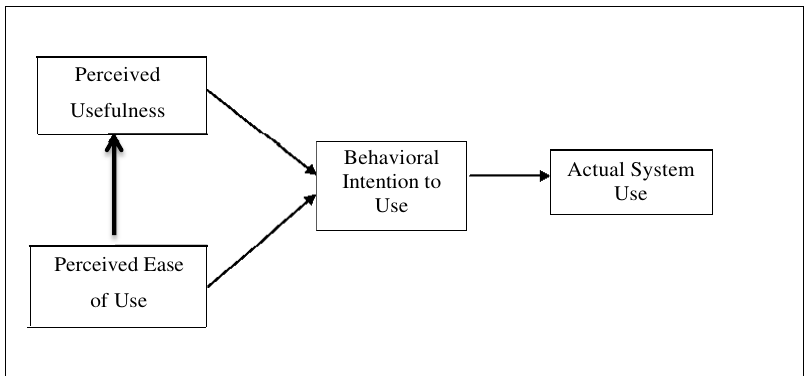
TAM claims that behavioral intention is determined by an attitude which is influenced by perceived usefulness and perceived ease of use (Davis, Bagozzi & Warshaw, 1989). Thus, the constructs of perceived usefulness and perceived ease of use will be used as predictors of intention to use technology. Unlike the previous studies, TAM was used in this study, to predict the students’ intention to engage in the Internet for academic purposes (rather than general purposes). Perceived usefulness explains the tendency of a person to believe that using technology might improve job performance. The implied link between use and performance is crucial because perceived usefulness has a direct effect on behavioral intentions to use technology (Davis, 1989). In the context of this study, perceived usefulness can be interpreted whether or not the usage of the Internet for academic purposes would help students improve their curriculum related outcomes. There is an extensive empirical evidence to suggest the impact of perceived usefulness on behavioral intention. Research done in various contexts such as teleworking, computer and telemedicine (e.g. Davis, Bagozzi & Warshaw, 1989; Hu, Chau, Sheng & Tam, 1999; Perez, Sanchez, Carnicer & Jimenez, 2004) found that perceived usefulness was significant in predicting attitude and intention to use technology. In the case of the Internet usage by students, studies done by Cheung, Lee, and Chen (2002), and Fusilier & Durlabhji (2005) supported the hypothesis that perceived usefulness predicts students’ intention to use the Internet. These findings are also aligned with the finding by Park, Lee, and Cheong (2007), who discovered that perceived usefulness has a direct effect on behavioral intention, as suggested by Davis (1989) in the original TAM model. The same result was obtained by Vasileiou and Spais (2007). They demonstrated that perceived usefulness played an important role in the increment of the Internet usage for academic purposes. Therefore, it is expected that students who perceived the usefulness of the Internet would develop an intention to use the Internet for academic purposes. Davis (1989, p. 320) defined perceived ease of use as “the degree to which a person believes that using a particular system would be free of effort”. This definition can be related to this study in order to see how the Internet is easy to work with from the perspective of students. A number of studies have indicated that perceived ease of use is a predictor of behavioral intention and acceptance of technology directly and indirectly through its significant influence on perceived usefulness since the enhancement of perceived ease of use may affect to the improvement of performance (Lu, Yu, Liu, & Yao, 2003). From the view of non-students subject studies, Cheong and Park (2005) revealed that perceived ease of use does influence in predicting attitude in using mobile internet in Korea. Another research finding also indicated that perceived of use had a direct influence on behavioral intention in using electronic courseware (Park, Lee, & Cheong, 2007).
In applying TAM to the Internet usage by students, Davis, Bagozzi, and Warshaw (1989) found that perceived ease of use influenced intention in accepting computer based technology. Taylor and Todd (1995) also claimed that perceived ease of use has a significant effect on behavior towards information technology usage. Another study by Cheung, Lee, and Chen (2002) indicated that perceived ease of use influenced students’ attitude towards internet-based learning. Fusilier and Durlabhji (2005) later found a similar pattern when they found that perceived ease of use did significantly affect attitudes towards the acceptance of the Internet. A review of the above literature undoubtedly suggests the extensive use of TAM in predicting technology acceptance studies. Nevertheless, not much has been written on its adoption in the context of the Internet use for academic purposes particularly among university students. This is quite surprising considering the wide use of the Internet among this young intellectual group. This gap provides the basis for the researchers to undertake this study as it would extend the literature on TAM. Having said that, this study applied the TAM model and developed the research hypotheses in the context of internet usage for academic purposes as follows: H1: H2: H3: H4: H5:
Perceived ease of use of the Internet for academic purposes will positively influence its perceived usefulness. Perceived ease of use of the Internet for academic purposes will positively influence its intention to use. Perceived usefulness of the Internet for academic purposes will positively influence its intention to use. Perceived usefulness of the Internet for academic purposes will mediate the relationship between its perceived ease of use and intention to use. Intention to use the Internet for academic purposes will positively influence the Internet usage.
Diagrammatically, the hypotheses can be expressed as follows:
Perceived
Usefulness Intention to Use the Internet for H1 H4
Academic H2
Purposes
Actual Use of the Internet for Academic Purposes
Perceived Ease of Use
Figure2: Technology acceptance model as applied to the internet use for academic purposes
Methodology
This study is cross sectional in nature. It involved random distribution of questionnaires to final year business undergraduates in public universities in Malaysia. Final year business students were chosen to participate in this study because they have been within the higher education environment longer than junior students and are better exposed to the Internet applications in their academic experiences. While including students from various disciplines could be more relevant and insightful, the use of business students is considered as a good proxy for university students in general as long as they are exposed to common learning environment, skills and settings such as facilities and methods of teaching. Furthermore, the fact that business discipline is deemed not very much technical, their behavioral usage of the Internet could be comparable to other groups of students from similar nature. The questionnaire was divided into two sections: Section A (demographic), and Section B (items on constructs i.e. perceived usefulness, perceived ease of use, intention and actual behavior). Respondents were asked to indicate their agreement or disagreement to several statements on a fivepoint Likert scale with 1=strongly disagree to 5=strongly agree. The items used to measure all constructs were adapted from Taylor and Todd (1995), and Fusilier and Durlabhji (2005). There were four items on perceived usefulness, three items on perceived ease of use, three items on intention, and two items on actual behaviour.
Findings
This section presents the survey findings. It starts with a description of the general characteristics of the respondents and variables. This is followed by examination of reliability and validity test of research instrument. Finally, the students’ perceptions of computers from the viewpoint of perceived usefulness, perceived ease of use, intention, and usage were examined.
4.1Descriptive analysis
A total of 650 questionnaires were sent to key informants in seven public universities in Malaysia, who later distributed them randomly to the respondents. Out of these, 450 respondents returned the completed questionnaires. However, only 422 questionnaires were usable for data analysis. The respondents consisted of 59% female and 41% male students. The gender split is consistent with the overall trend in Malaysian universities where in the recent past the intake of female students was much higher than that of male students. More than half of the respondents scored cumulative grade point average (CGPA) quite well between 3.00 and 3.66 (58%). Slightly more than a third of them scored between 2.00 and 2.99 (34%). The respondents are studying in various public universities in Malaysia, and are taking various business-related programs.
A basic descriptive analysis was run to determine the average score and the dispersion of score for the constructs of perceived usefulness, perceived ease of use, intention to use the Internet, and actual behavior for academic purposes as shown in Table 1.
4.2Reliability analysis
Table 1 also shows the reliability coefficients of each construct. These coefficients were obtained from reliability analysis of each construct. Reliability test was performed to ensure the consistency of the items used to measure the variables. Internal consistency was measured by applying the Cronbach’s alpha test to the individual scales. The Cronbach alphas obtained for the constructs of perceived usefulness, perceived ease of use, intention, and behavior were .83, .80, .79, and .83, respectively. The reliability coefficients were all above 0.70, and these are considered good (Nunnally, 1978).
| Variable/ constructs | Mean | Standard Deviation |
|---|---|---|
| Perceived Usefulness ( = .80) | á | |
| 1) Improves performance | 3.81 | .735 |
| 2) Enhances effectiveness | 3.76 | .693 |
| 3) U s e f u l | 3.88 | .703 |
| 4) Improves productivity | 3.84 | .727 |
| Perceived Ease of Use ( = .73) á | ||
| 1) Easy to do work | 3.97 | .826 |
| 2) Clear and Understandable | 3.84 | .810 |
| 3) Eas y to u se | 4.07 | .769 |
| Intention to use the Internet = .79) (α | ||
| 1) Next time | 3.83 | .735 |
| 2) P r e d i c t | 3.77 | .705 |
| 3) Recommend | 3.84 | .767 |
| Actual Behavior ( = 0.83 1) á | ||
| 1) Use | 3.73 | .772 |
| 2) Continue to use | 3.89 | .783 |
4.3Factor analysis
Factor analysis was performed to ascertain that the variables of perceived usefulness, perceived ease of use, and intention were distinct constructs. Using principle component analysis with varimax rotation, the identified factors were used as inputs for regression analysis. As shown in Table 2, all factor loadings can be observed to be above .5 in table 4 and 5, indicating that they are practically significant (Hair, Anderson, Tatham & Black, 1998). The KaiserMeyer-Olkin (KMO) values for perceived usefulness, perceived ease of use, and intention were .79, .70 and .70, respectively. Those scores are above the recommended value of .70 (Hair, et al, 1998). The variance explained for the constructs ranged between 66.225 and 70.935. The Bartlett’s Test of Sphericity for all constructs was statistically significant at .000 level, indicating support for factor analysis to be run. These results confirm that each of these constructs is unidimensional and factorially distinct and that all items used to measure a particular construct loaded on a single factor.
| Variable/ construct | Factor Loading | KMO | Variance Explained |
|---|---|---|---|
| Perceived Usefulness | .832 | .79 | 66.225 |
| 1) Improves performance | .799 | ||
| 2) Enhances effectiveness | .797 | ||
| 3) Useful | .827 | ||
| 4) Improves productivity | |||
| Perceived Ease of Use | .836 | .70 | 70.935 |
| 1) Easy to do work | .840 | ||
| 2) Clear and Understandable | .836 | ||
| 3) Easy to use | |||
| Intention to use the Internet | .849 | .70 | 70.342 |
| 1) Next time | .839 | ||
| 2) Predict | .828 | ||
| 3) Recommend | |||
| Note: KMO = Kaiser-Meyer-Olkin |
4.4Multicollinearity
A correlation matrix was performed to examine the relationship between the different constructs of TAM. The results in Table 3 show that the constructs are positively and significantly intercorrelated. The highest correlation is between the perceived ease of use and intention variables (r = .655). Because the correlation values are below .80, there is no indication of serious multicollinearity problem (Hair et al., 1998). Besides, two methods were used in order to determine the presence of multicollinearity among independent variables. This involves calculation of tolerance test and variance inflation factor (VIF) (Kleinbaum, Kupper & Muller, 1988). The results of these analyses are shown in Table 4. None of the tolerance levels are < .01 and all VIF values are below 10.
| Perceived | Perceived | Intention to | Actual usage |
|---|---|---|---|
| usefulness | ease of use | use | |
| Perceived usefulness - | .376** | .655** | .581** |
| Perceived ease of use | - | .367** | .341** |
| Intention to use | - | .672** | |
| Actual usage | - | ||
| **All correlations are significant at .01 level. |
| Variables | Tolerance | VIF |
|---|---|---|
| Perceived usefulness | .487 | 1.770 |
| Perceived ease of use | .751 | 1.33 1 |
| Intention to use | .760 | 1.3 17 |
4.5Relationship between perceived ease of use and perceived usefulness
In order to examine the direct effect of the perceived ease of use of the Internet on its perceived usefulness, a linear regression was performed. The results which are presented in Table 5 show the R 2 value of 0.142. This value indicates that perceived ease of use can explain about 14% of the variance in the perceived usefulness. In addition, the standardised beta value of 0.376 (with significance level of 0.01) provides further evidence on the direct relationship between the variables. Hence, hypothesis 1 is supported.
| Independent variable | Standardized beta |
|---|---|
| Perceived ease of use | .376** |
| R2 | .142 |
| Adjusted R2 | .140 |
| F-value | 69.011** |
| Note. **p<0.01 |
4.6Relationship between perceived ease of use and intention
In order to determine whether there is a direct effect of the perceived ease of use of the Internet on its intention to use, a linear regression was performed. Results in Table 6 indicate that perceived ease of use may explain 13% of the variance in students’ intention to use the Internet. The standardised beta value of 0.367 (with significance level of 0.01) further supports the direct relationship between the variables. Thus, hypothesis 2 is supported.
| Independent variable | Standardized beta |
|---|---|
| Perceived ease of use | .367** |
| R2 | .134 |
| Adjusted R2 | .132 |
| F-value | 64.888** |
| Note. **p<0.01 |
4.7Relationship between perceived usefulness and intention
In order to examine the direct effect of the perceived usefulness on intention, a linear regression was performed. The results which are presented in Table 7 show the R 2 value of 0.42. This value indicates that perceived usefulness can explain about 42% of the variance in intention to use. In addition, the standardised beta value of 0.655 (with significance level of 0.01) provides further evidence on the direct relationship between the variables. Hence, hypothesis 3 is supported.
| Independent variable | Standardized beta |
|---|---|
| Perceived usefulness | .655** |
| R2 | .429 |
| Adjusted R2 | .428 |
| F-value | 315.558** |
| Note. **p<0.01 |
4.8Mediating effect of perceived usefulness
According to Baron and Kenny (1986, p.1 177), mediating effect is generally present when these four conditions are fulfilled. First, when the independent variable (perceived ease of use) significantly affects the mediator (perceived usefulness). Second, if the independent variable (perceived ease of use) significantly affects the dependent variable (intention) in the absence of the mediator. Third, the mediator (perceived usefulness) has a significantly unique effect on the dependent variable (intention). Fourth, when the effect of the independent variable (perceived ease of use) on the dependent variable (intention) shrinks upon the addition of the mediator to the model. In order to observe the presence of mediating effect of perceived usefulness on the relationship between perceived ease of use and intention to use, a summary of the regression analyses results (which tested hypotheses 1-3) are presented in Table 8. It appears that the perceived ease of use has a significant (at the 0.01 significance level) positive influence on the perceived usefulness with a of 0.376. Additionally, the perceived ease of use also has a positive influence on intention to use with a of 0.367 (at the 0.01 significance level). Furthermore, Table 8 indicates that perceived usefulness has significantly influenced intention to use with a of 0.655 (at the 0.01 significance level). In short, these results indicate that the three conditions to prove the mediating effect of perceived usefulness are met. â
In order to test the presence of the fourth criteria, multiple regression analyses were performed. From
| Independent | Dependent | Standardized | Summary | Fulfillment of the | |
|---|---|---|---|---|---|
| variables | variables | beta | statistics | criterion | |
| Perceived | Perceived | 0.376 | R :0.142 | Criteria 1 met | |
| ease of use | usefulness | Adj. R2 :0.140 F-value: 69.011* | |||
| Perceived | Intention | 0.367 R2 : 0.134 Adj. | Criteria 2 met | ||
| ease of use | R2 :0.132 F-value: 64.888* | (continued) | |||
| Independent | Dependent | Standardized | Summary | Fulfillment of the | |
| variables | variables | beta | statistics | criterion | |
| Perceived | Intention | 0.655 | R2 : 0.429 Adj. | Criteria 3 met | |
| usefulness | R2 :0.428 | F-value: 3 15.558* | |||
| Perceived | Intention | 0.138 R2 : 0.450 | Criteria 4 met | ||
| ease of use | Adj. R2 :0.448 F-value: 170.801* | ||||
| Perceived | 0.637 | ||||
| usefulness | |||||
| Note. *P<0.01 | |||||
influenced intention to use. According to Baron and Kenny (1986), the effect of the independent variable on the dependent variable must be less than the effect of mediator on dependent variable. In this case, the standardised beta for perceived ease of use on intention is less than the standardised beta for perceived usefulness on intention. Based on these results, it gives the evidence for perceived usefulness being a mediator in predicting internet usage. Hence, H4 is also supported.
| Independent | Dependent | Standardized | Summary | Fulfillment of the | |
|---|---|---|---|---|---|
| variables | variables | beta | statistics | criterion | |
| Perceived | Perceived | 0.376 | R :0.142 | Criteria 1 met | |
| ease of use | usefulness | Adj. R2 :0.140 F-value: 69.011* | |||
| Perceived | Intention | 0.367 R2 : 0.134 Adj. | Criteria 2 met | ||
| ease of use | R2 :0.132 F-value: 64.888* | (continued) | |||
| Independent | Dependent | Standardized | Summary | Fulfillment of the | |
| variables | variables | beta | statistics | criterion | |
| Perceived | Intention | 0.655 | R2 : 0.429 Adj. | Criteria 3 met | |
| usefulness | R2 :0.428 | F-value: 3 15.558* | |||
| Perceived | Intention | 0.138 R2 : 0.450 | Criteria 4 met | ||
| ease of use | Adj. R2 :0.448 F-value: 170.801* | ||||
| Perceived | 0.637 | ||||
| usefulness | |||||
| Note. *P<0.01 | |||||
Criteria 4 met
Note. *P<0.01
4.9Relationship between intention to use and internet usage
In order to examine the direct effect of the intention to use and actual internet usage, a linear regression was performed. The results which are presented in Table 9 indicate that intention to use can explain about 45% of the variance in the actual internet usage. In addition, the standardised beta value of 0.672 (with significance level of 0.01) provides further evidence on the direct relationship between the variables. Hence, hypothesis 5 is supported.
| Independent variable | Standardized beta |
|---|---|
| Intention | .672** |
| R2 | .452 |
| Adjusted R2 | .451 |
| F-value | 346.284** |
| Note. **p<0.01 |
5Discussion
This research paper investigates behavioral intention to use the Internet for academic purposes amongst university students. Technology Acceptance Model (TAM) was used as the underlying theoretical framework. The present study developed five hypotheses. The results provide support that perceived ease of use did influence the perceived usefulness. The positive relationship suggests that students in public universities viewed the Internet as an easy tool to work with which would consequently improve their curriculum related outcomes. Perceived ease of use was also found to have significant influence on intention to use the Internet for academic purposes. These findings are consistent with previous studies in Information Communication Technology (ICT) which documented that when an individual perceives the new technologies to be useful, the more likely he or she will embrace and use it (Chu & Tsai, 2009; Uli, D’Silva, Shafrill & Samah, 2010). Since the Internet has been an important technological breakthrough which opens up numerous possibilities (Bakardjieva, 2005), it is therefore not surprising to receive such an overwhelming response. This is particularly true when the respondents in this study were relatively young and more receptive to new developments. Similar to perceived ease of use, perceived usefulness also had a significant influence on intention to use the Internet for academic purposes. This suggests that university students’ belief that the Internet may improve their academic performance has motivated them to use this technology device. This is in line with previous studies such as by Cheung, Lee and Chen (2002), Fusilier and Durlabhji (2005) and Park, Lee and Cheong (2007). In addition, perceived usefulness was also found to mediate the impact of perceived ease of use on students’ intention to use the Internet. The findings could be attributed to the fact that students who enroll in universities are required to use the Internet to complete their assignments, which therefore created the perceptions that the Internet would be useful for them in performing their academic tasks. These perceptions consequently lead to their intention to use the Internet. Additionally, intention was also found to influence the actual usage of the Internet among university students. In essence, the present study showed the applicability of TAM in predicting the intention to use and the internet usage within the academic environment. This finding is consistent with the previous works in the similar environment (e.g. Fusilier & Durlabhji, 2005; Noor Ismawati, 2003). Furthermore, the findings provide support to the previous studies conducted in a number of different fields (e.g. Adams, Nelson & Todd, 1992; Taylor & Todd, 1995; Yuan, 2005).This study contributes to the literature by validating the use of TAM in Malaysian Education environment by focusing internet usage for academic purposes. This provides an answer to the call by Zeithaml, Parasuraman & Malhotra (2000) in order to extend the model to different contexts and cultures to enhance its generalizability. The results of this study have important implications to the management of universities in seeking for ways to enhance students’ learning experiences with the use of the Internet for academic purposes. Web-based learning and on-line communications are some of the measures that can be taken towards this end. In addition to providing relevant and appropriate learning infrastructure, the management of universities can consider offering training courses and modules related to the Internet usage to further capitalize on the Internet technology. By having these facilities in place, universities can keep up with the ever-changing demand of students for enjoyable yet meaningful learning. This is especially true with the current trend of pursuing distance learning and independent learning among adult learners, where information is very important. In doing so, proper mechanisms of monitoring and controlling should also be in place to minimize the possibility of any academic crime, such as plagiarism. The findings should be interpreted by taking into account the limitations of the present study. Firstly, because of the limited scope of participation, generalizing the findings to wider population of students may be cautioned. Secondly, different learning environment across higher educational settings may differently shape students’ perceptions and opinions on the Internet usage. For these reasons, it is recommended that future research should be extended by considering a wider student population both in public and private universities in Malaysia. It is also suggested that future research explore other determinants of intention to use the Internet and the Internet usage because some of the variance remains unexplained. Perhaps, other relevant theories may be invoked towards this end to add to the existing insight obtained from the present study. Respondents of the present study only cover final year business students in selected Malaysian public universities. This group of students is chosen due to the reason that they have been adequately exposed to the higher education environment. Thus, it can be assumed that they have the relevant experience and knowledge of information technology especially the Internet applications. Therefore, the findings may not be able to be generalized to all university students in Malaysia. Different learning environment and settings such as facilities and methods of teaching might cause differences in students’ perceptions and opinions on the Internet usage. For these reasons, it is recommended that future research be extended by examining public and private universities in Malaysia and consider students from various programs such as social sciences and pure sciences. In addition, the application of modified TPB model and TAM should be explored to maximize the predictive effectiveness of the models. An integration analysis on both models by using a more rigorous application such as Structural Equation Modelling (SEM) may provide a more meaningful explanation on the relationship between TPB, TAM, and the intention of using the Internet for academic purposes.
Conclusion
The study had examined the applicability of TAM in Malaysian education environment. The results showed the relationships among the TAM constructs (perceived usefulness, perceived ease of use, intention and behavior) as were predicted in the previous literature (e.g. Davis, Bagozzi and Warshaw, 1989; Cheung, Lee & Chen, 2002; and Fusilier & Durlabhji, 2005). Additionally, there was evidence from this study to support the applicability in explaining technology acceptance of public university students to use the Internet for academic purposes in Malaysia. This indicates that the booming of information over the Internet across various fields have helped the students in their learning process. We cannot deny the fact that, the Internet which has been widely regarded as the socializing network, may also contribute to the learning process of the students, provided appropriate training and monitoring mechanisms are in place.
References
- Adams, D. A., Nelson, R.R. and Todd, P.A. (1992). Perceived usefulness, ease of use, and usage of information technology: A replication. MIS Quarterly, 16, 2, 227-247.
- Asfaw, T. T., & Bo, C. C. (2003). Student use of internet in China: A study on Huazhong University of Science and Technology (HUST). Pakistan Journal of Information and Technology, 2(1), 25–29.
- Bakardjieva M. (2005). Internet Society: The Internet in Everyday Life. London, Thousand Oaks, New Delhi : Sage.
- Baron, R. M., and Kenny, D. A. (1986). The moderator-mediator variable distinction in social psychological research: Conceptual, strategic and statistical considerations. Journal of Personality and Social Psychology, 51(6), 1173–1182.
- Chan, K., & Fang, W. (2007). Use of internet and traditional media among young people. Young Consumers, 8(4), 244–256.
- Cheong, J. H., & Park, M. C. (2005). Mobile internet acceptance in Korea. Internet Research, 15(2), 125-140.
- Cheung, C. M. K., Lee, M. K. O., & Chen, Z. (2002). Using the internet as a learning medium: An exploration of gender difference in the adoption of FaBWeb. Proceeding of the 35th Hawaii International Conference on System Sciences. Big Island: IEEE Computer Society.
- Chu, R. J. & Tsai, C. (2009). Self directed learning readiness, internet self-efficacy and preferences towards constructivist internet based learning environments among higher-aged adults. Journal of Computer Assisted Learning, 25(5), 489-501.
- Davis, F. D. (1989). Perceived usefulness, perceived ease of use and user acceptance of information technology. MIS Quarterly, 13(3), 319-340.
- Davis, F. D., Bagozzi, R. P., & Warshaw, P. R. (1989). User acceptance of computer technology: A comparison of two theoretical models. Management Science, 35(8), 982-1003.
- Fishbein, M. & Ajzen, I. (1975). Belief, attitude, intention and behavior: An introduction to theory and research. Reading, MA: Addison-Wesley.
- Fusilier, M. & Durlabhji, S. (2005). An exploration of students’ use in India: The technology acceptance model and theory of planned behavior. Campus Wide Information Systems, 22(4), 233-246.
- Hair, J. F., Anderson, R. E., Tatham, R. L., & Black, W. C. (1998). Multivariate data analysis (5th ed.). New Jersey: Prentice Hall.
- Hinson R., & Amidu M.(2006). Internet adoption amongst final year students in Ghana’s Oldest Business School. Library Review, 55(5), 314-323.
- Hu, P. J., Chau, P. Y. K., Sheng, O. R. L., & Tam, K. Y. (1999). Examining the technology acceptance model using physician acceptance of telemedicine technology. Journal of Management Information Systems, 16 (2), 91-112.
- Kleinbaum, D.G., Kupper, L.L. & Muller, K.E. (1988). Applied regression analysis and other multivariate methods. Boston, MA: PWS.
- Lu, J., Yu, C. H., Liu, C., & Yao, J. E. (2003). Technology acceptance model for wireless internet. Internet Research: Electronic Working Applications and Policy, 13(3), 206-222.
- Miller, M. D., Rainer, R. K., & Corley, J. K. (2003). Predictors of engagement and participation in an on-line course. Online Journal of Distance Learning Administration, 6(1), Retrieved 1 March, 2010 from the World Wide Web: http://www.westga.edu/~distance/ojdla/spring61/miller61.htm
- Nunnally, J. C. (1978). Psychometric theory (2nd ed.). New York: McGraw Hill. Noor Ismawati Jaafar (2003). Computer usage and perception among accounting students: A survey in a public university. Jurnal Pendidikan, 23, 57-69.
- Park, N., Lee, K. M., & Cheong, P.,H. (2007). University instructors’ acceptance of electronic courseware: An application of the technology acceptance model. Journal of Computer-Mediated Communication, 13(1), 163-186.
- Perez, M., Sanchez, A. M., Carnicer, P. D. L., & Jimenez, M. J. V. (2004). A technology acceptance model of innovation adoption: The case of teleworking. European Journal of Innovation Management, 7(4), 280-29 1.
- Uli, J., D’Silva, J.L., Shafrill, H.A.M., & Samah, B. (2010). The attitude, belief, support and knowledge level of the youth and their acceptance towards agriculture contract farming, Journal of Social Science, 6(3), 350-355.
- Vasileiou, K. Z., & Spais, G. S. (2007). A revision of technology acceptance model for the measurement of business school students’ intention to increase OC and internet use for academics purposes. Journal of Business and Society, 20, 190-203.
- Venkatesh, V., Morris, M. G., Davis, G. B., & Davis, F. D. (2003). User acceptance of information technology: Toward a unified view. MIS Quarterly, 27(3), 425-478.
- Yuan, G. (2005). Applying the technology acceptance model (TAM) to educational hypermedia: A field study, Journal of Educational Multimedia and Hypermedia, 14(3), 237-247
- Zeithaml, V.A., Parasuraman, A., & Malhotra, A. (2002). Service quality delivery through web sites: A critical review of extant knowledge. Journal of the Academy of Marketing Science, 30, 362-375.