Investigating the relationship between monetary rewards and flexible work schedule on intention to stay in ICT companies
- College of Business, Universiti Utara Malaysia, Kedah
Journal of Business Management and Accounting 2(1) (2012) · https://doi.org/10.32890/jbma2012.2.1.7264
Abstract
Retaining existing employees, especially the skilled information technology (IT) employees is becoming more important due to business growth, imbalance between demand and supply, and high turnover rate. The paper seeks to investigate the relationship between rewards and flexible work schedule on intention to stay among professional IT employees. The two factors investigated in this study are monetary rewards (salary and bonus) and flexible work schedule. Results from 178 participants indicate that both monetary rewards (salary and bonus) and flexible work schedule were significantly positively related to intention to stay. Though salary, bonus and flexible work schedule indicate significant positive relationship with intention to stay, salary makes the strongest contribution to intention to stay. Implications of the findings, potential limitations of the study, and directions for future research are suggested
Keywords: Monetary rewards, flexible work schedule, intention to stay, information technology workers
1.0Introduction
Employee retention is a part of normal business activities where employees come and go as their life situations change. Most of the companies have identified employee retention as a critical issue to the sector’s effort to meet its anticipated skill and knowledge needs. In the context of ICT industry in Malaysia, retaining skilled information technology employees is highly crucial due to business growth, imbalance between demand and supply, and high turnover rate (Azlan, 2009; Hamisah, 2009). The global economy slowdown in 2009 caused the growth of information technology (IT) business to decelerate as the percentage decreased from 7.6% in 2008 to between 4.4% to 7% in 2009. Despite this, the growth in the IT industry is encouraging as many IT companies increase their investments. However, these companies are unable to function properly because they are incapable to have adequate information technology workers, and this problem occurs because of the imbalance between demand and supply of information technology workers in Malaysia (“ MSC Malaysia supply-demand study of the ICT industry ”, 2009). For example, the demand of information technology workers by MSC companies was 63,895 in 2008, while the supply of these targeted employees is only 27,428 respectively. To make matters worse, this situation contributes to the high rate of turnover among information technology workers. This is because when the demand for skilled IT workers is higher than the supply, the problem of job hopping becomes uncontrollable. In fact, as reported by Patrick (2008), a high turnover rate was recorded between 32% to 39% per annum in 2008, particularly in the ICT based- business such as outsourcing and shared business services.
The problem of employee retention can be addressed through a variety of pro-active retention strategies. In the current study, the issue of intention to stay is more relevant in the current research because of the difficulties encountered by organization in retaining their skilled IT workers as discussed above. It is because when a business loses employees, it loses skills, experience and knowledge. Hence, it is imperative that organizations prevent this problem from continuing, and to do so there is a need to examine the factors that influence the intention to stay among information technology skilled workers.
A review of the literature has identified the influence of organizational factors as a key element and strategies to encourage employees to stay in organization (Coombs, 2009; Humayun & Zhao, 2009; Lockwood & Ansari, 1999; Punia & Sharma, 2008). Organizational factors are the factors related to an organization such as organization administrative policies and strategies, structure and design of the organization, and working conditions (Lockwood & Ansari, 1999). However, existing studies have not discussed the influence of organizational factors such as monetary rewards and flexible work schedule on intention to stay among information technology skilled workers. To date, skilled information technology employees have come to expect a certain level of monetary rewards such as a good salary, and benefits package as crucial components that strongly influence their desire to remain in organizations. This is because, in order to compete for the most talented workers, information technology companies need to provide an adequate basic package of financial rewards as their main retention strategy. Meanwhile, flexibility in dealing with employees is increasingly important in satisfying them in the workplace especially in helping them to balance between jobs and family roles (Clark, 2001). Flexibility takes many forms including flex-time, work-at-home schedules, and job sharing. Given the current demographic changes in the workplace, information technology companies need to offer employees more flexibility in their work lives if they are to successfully recruit and retain qualified workers.
Given the paucity of existing research on the role of monetary rewards and flexible work schedule, the present study aimed to explore the issue further. Hence, this research attempts to answer the following questions: Investigating the Relationship between Monetary Rewards and Flexible Work Schedule on Intention to Stay: 1-18 3
1.         Do monetary rewards influence intention to stay in organization?;
2.         Does flexible work schedule influence intention to stay in an organization?
2.0Research framework and hypotheses development 2.1 Research
framework
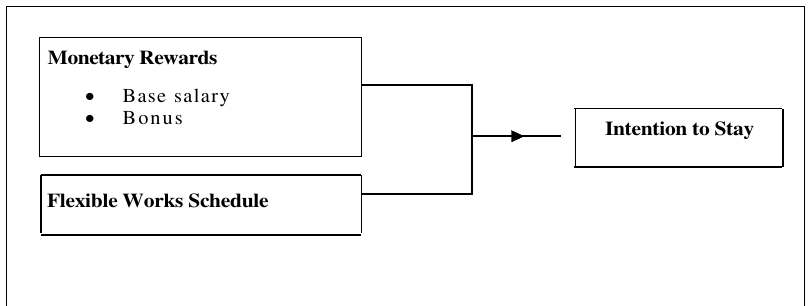
A theoretical framework is a conceptual model of how one theorizes or makes logical sense of the relationships among several factors that have been identified as important to the problem in the study (Hair et. al., 2007). The proposed examination over possible relationships between independent variables and dependent variable and hypotheses development are presented in Figure 1 below. The dependent variable of this study is intention to stay. Meanwhile, monetary rewards and flexible work schedule are the independent variables of this study. The linkages between independent variables and dependent variable were discussed in the following sections.
Monetary Rewards
Base salary
Bonus
Intention to Stay
Flexible Works Schedule
2.2Intention to stay
In general terms, intention to stay refers to the desire of workers to remain working in the current organization (Cho et al., 2009; Coombs, 2009; D’Amato & Herzfeldt, 2008; Ellenbecker, 2004). Previous researches also used the concept of intention to stay as a proxy to explain employee retention (Coombs, 2009; Chew & Chan, 2008; Ellenbecker, 2004). This approach provides further validation to the assumption by Ajzen (1991) that intention is the strongest cognitive precursor of behavior. For example, Ellenbecker (2004) found that intention to stay has significant positive relationship with employee retention. Based on this, this study used the same approach whereby intention to stay was used as a proxy for understanding employee retention. This has been done before by Coombs (2009) who used intention to stay as an alternative to measure retention among information technology workers.
2.3Monetary rewards and intention to stay
Monetary rewards are the independent variable in this study. Generally, rewards can be classified into two categories which are monetary rewards and non-monetary rewards (Bergman & Scapello, 2002; Martocchio, 2006; Milkovich & Newman, 2005). Monetary rewards refer to the pay received directly as cash (e.g., base pay, merit, incentives and cost of living adjustments) and indirectly as benefits (e.g., pensions, and medical insurance). On the other hand, non-monetary rewards refer to nonfinancial returns from work such as status, employment security, challenging work and opportunities to learn (Milkovich & Newman, 2005). However, in this study, monetary rewards are referred to salary and bonus.
Salary or base pay is the cash rewards that an employer pays for the work performed, and it tends to reflect the value of the work or skills (Bergman & Scapello, 2002). Previous studies have conceptualized salary in terms of the level actual pay itself or in terms of perceptions of satisfaction with the amount of salary received, and this study conceptualized salary as the latter. Though many studies have discussed the influence of salary level on intention to stay (Brown, Sturman & Simmering 2003; Burnett, Williamson & Bartol, 2009; Chew & Chan, 2008), none actually studied the relationship between salary (perception of satisfaction) and intention to stay. For example, Chew and Chan (2008) studied employees perceptions of pay (salary) justice and the desire of employees to remain employed in the organization, and this study found a significant positive relationship between the two variables. This finding is consistent with studies that found increases in base salary was the main factor that drives information technology workers in the United States (Lockwood & Ansari, 1999), and employees in the banking sector in China and Hong Kong to remain in the organization (Chiu, Luk & Tang, 2002). Based on these findings, it can be implied that if employees are satisfied with their current salary level, they will stay with their current organizaiton. Based on the above discussion, we proposed the following hypothesis: H1: Perceptions of base salary have positive relationship with intention to stay. With regard to bonus, it is referred to cash incentives that tie pay directly to employee performance (Martocchio, 2006). Bonus does not increase the base wage, and so must be re-earned each pay period (Milkovich & Newman, 2005). In this study, bonus refers to perceptions of satisfaction with the amount of bonus received. In theory, incentives such a bonus have an influence on intention to stay because it gives organization the flexibility in dealing with internal and external environment uncertainties such as employment opportunities and labor market conditions (Blakemore, et al., 1987). Several studies have highlighted the influence of bonus on the desires of workers to remain in the organization (Flood, Turner, Ramamoorthy et al., 2001; Gaylard, Sutherland & Viedge, 2005; Joseph & Kalwani, 1998). Specifically, the study by Gaylard et all (2005) among information technology workers in Europe, Australia and South Africa found that bonuses are important factors that could encourage workers to remain in the organization. Based on the above discussion, we proposed the following hypothesis:
H2: Perceptions of bonus satisfaction have positive relationship with intention to stay.
2.4Flexible work schedule and intention to stay
The second independent variable in this study is flexible work schedule. In general, flexible work schedule refers to the perception of employees on working time flexibility options in the organization (Clark, 2001). Flexible work schedule is a management practice that aims to allow employees maximum latitude in scheduling their work hour, and allow employees to distribute their working hours (Dalton & Mesch, 1990). Some researchers have reported that flexible work schedule is related to increased intention to stay (Gaylard, Sutherland & Viedge, 2005; Richman et al., 2008; Scholarios & Marks, 2004). For example, the research conducted by Richman et all (2008) found that perception of flexible work sechedule has significant positive relationships with employees expectation. Pierce and Newstrom (1980), for example, suggest that the link between flexible work schedule and employee behavior (e.g., intention to stay) depends on employees ability to harmonize more closely the competing demands on the work and personal time. Nonetheless, intention to stay should increase as the amount of descretionary time afforded by flexible scheduling increases, and employees do enjoy more autonomy and responsibility with regard to the selection of work hours than in typical, more restricted scheduling arrangements (Scholarios & Marks, 2004). Based on the above discussion, we proposed the following hypothesis:
H3: Perceptions of workschedule flexibility have positive relationship with intention to stay.
3.0Research method
3.1 Sampling design, subjects and procedures
The study population includes all IT workers in the software development sector with MSC status in Malaysia. A cluster sampling method was used to select the sample for this study. The steps recommended by Gay and Diehl (1986) were implemented. They are: 1. Define the population. In this study, the population is the entire information technology workers in MSC companies in software development sector in Selangor , Kuala Lumpur, Pulau Pinang and Johor. The total population is 30,102. 2. Determine the desired sample size. The desired sample size for 30,102 population size is 379, which was determined by using the table from Krejcie and Morgan (1970). 3. Select a logical cluster and then calculate the average size of a cluster. To determine the average size of a cluster, the total number of population was divided by the total number of logical clusters considered. This means that each cluster has approximately 940 information technology workers (30,102 information technology workers divided by 32 districts in four states). 4. Determine the number of cluster needed by dividing the sample size by the average size of a cluster. This means that 0.403 cluster or 1 was needed (379 divided by 940). Then choose at random one cluster using sample random sampling without replacement. 5. Finally, all information technology workers in selected cluster were chosen randomly. In this study, information technology workers in Cyberjaya, Selangor, Bukit Jalil, Kuala Lumpur, Bandar Bayan Baru, Pulau Pinang and Johor Bahru, Johor were chosen randomly as targeted respondents.
A total of 832 questionnaires were mailed to a representative of the organizations that have agreed to participate in this study. The representatives then distributed the questionnaires to their IT employees. Each participant received one set of questionnaire attached with a cover letter explaining the purpose of the study and instructions on how to answer the questionnaire. Participants were also provided with a pre-addressed and postage-paid envelope so that they could post the questionnaire back to the researcher. A total of 220 questionnaires were returned, and only 178 were usable for further analysis, representing a response rate of 2 1.39%.
3.2Measurement
All constructs were measured at the individual level. For this study, intention to stay refers to employees’ conscious and deliberate willingness to stay with the organization (Cho et al., 2009; Chew & Chan, 2008; Coombs, 2009). To measure participants’ intention to say, three items were adapted from Coombs (2009) and another three items from Stassen and Ursel (2009). One example of the item used is “I have the desire and intend to remain working at this company”. In this study, each of the adapted question asked how strongly the respondents agreed or disagreed with the intention to stay statements on a five-point scale whereby, 1 = strongly disagree, and 5 = strongly agree. For this measure, the higher the score, the greater the feeling to stay with the organization.
The predictor variables used in this study are salary, bonus and flexible work schedule. In this study, salary is operationalized as employees perceptions of satisfaction with the current salary and total salary (including allowances and financial benefits) received in the organization (Dreher, 1981; Heneman & Schwab, 1985). Respondents’ perceptions toward salary satisfaction were assessed using four adapted items from Heneman and Schwab (1985). An example of the item used is “My level of basic salary”. Bonus is operationalized as employees perceptions of satisfaction with the amount of bonus received, and were measured by three items developed by Sturman and Short (2000). An example of the item used is “The level of bonuses I have received in the past”. In this study, each of the adapted question asked how satisfied the respondents were with regard to both the salary and bonus statement on a five-point scale whereby 1 = very Investigating the Relationship between Monetary Rewards and Flexible Work Schedule on Intention to Stay: 1-18 7 dissatisfied and 5 = very satisfied. For this measure, the higher the score, the greater the feeling of satisfaction.
Flexible work schedule is operationalized as employee perceptions of flexibility to choose hours of work in organization (Clark, 2001; Thomas & Ganster, 1995). Respondents’ perceptions about the extent of flexible work schedule were measured using five items adapted from Clark (2001). An example of the item used is “I am able to arrive and depart from work when I want”. In this study, each of the adapted questions asked how strong the respondents agreed or disagreed with the flexible work schedule statements on a five-point scale whereby, 1 = strongly disagree, and 5 = strongly agree.
3.3Method of analysis
In this study, the hypotheses were tested using multiple regression. Multiple regression analysis involved the testing of the relationship between a dependent variable and two or more independent variables (Hair Jr., et al., 2007). Prior to conducting analysis, the data was tested for normality, linearity, homoscedasticity, and independence of the error terms.
4.0Results
4.1Profile of respondents
Table 1 shows the demographic profile of the participants. 53.9% of the 178 participants in this survey were males. 54.2% were unmarried and 76.4% hold a bachelor degree. Software engineer constitute 19.7% of the survey participants, followed by 18.5% system programmers and 16.3% system analyst. The average age of participants was 31 years old. On average, the participants had been in their present position for 4.99 years, and had served their organization for 4.21 years.
| Demographic variables | Frequency | Percentage (%) |
|---|---|---|
| Gender Male | 96 53.9 | |
| Female | 82 46.1 | |
| Marital status Married | 81 45.5 | |
| Single | 96 54.2 (continued) | |
| Demographic variables Frequency | Percentage (%) | |
| Highest education Diploma 34 | 19.1 | |
| qualification Bachelor/degree 136 | 76.4 | |
| Master’s degree 5 | 2.8 | |
| Other 3 | 1.7 | |
| Position in the Software Sales Manager 3 | 1.7 | |
| organization | ||
| IT Procurement Specialist 10 | 5.6 | |
| Security Analyst 6 | 3.4 | |
| System Analyst 35 | 19.7 | |
| Software Engineer 29 | 16.3 | |
| SAP Consultant 6 | 3.4 | |
| IT Manager 19 | 10.7 | |
| System Programmer 33 | 18.5 | |
| Network Engineer 3 | 1.7 | |
| IT Architecture and Integration 7 | 3.9 | |
| Consultant | ||
| Head of IT Business Operation 1 | . | |
| Others 26 | 14.6 | |
| 26 | 14.6 | |
| Mean | Standard Deviation | |
| Age (years) 31.4 | 5.33 | |
| Number of years in present position 4.99 | 3.39 | |
| Number of years with present | ||
| organization 4.21 | 2.63 |
4.2Factor analysis
To address the validity of the measure, a factor analysis with principle component analysis employing an orthogonal varimax rotation was carried out on four constructs. The criteria used by Igbaria et al. (1995) were adapted to identify and interpret the factors. Each item should load 0.50 or greater on one factor and 0.35 or lower on the other factor. A factor analysis was first carried out on intention to stay measures. As shown in Table 1, factor analysis with varimax rotation was also run to validate the dimensionality of intention to stay. The result showed single factor solution with eigenvalues greater than 1.0 and the total variance explained was 72.48%. The Kaiser-Meyer-Olkin (KMO) measure of sampling adequacy was 0.92 indicating sufficient intercorrelations while the Bartlett’s Test of Sphericity was significant (Chi square=738.42, p< 0.01). These results confirmed that intention to stay is unidimensional and all items used to measure a particular construct loaded on a single factor. Investigating the Relationship between Monetary Rewards and Flexible Work Schedule on Intention to Stay: 1-18 9
| Intention to Stay Items | Component 1 | |
|---|---|---|
| 1. | I have the desire and intend to remain working at this company. | .89 |
| 2. | I plan to continue working for this company in the future. | .87 |
| 3. | For me, continuing to work for this company is very likely. | .87 |
| 4. | I expect to work at my present company for as long as possible. 5. Barring unforseen circumstances, I would remain in this company definitely. 6. If I were completely free to choose, I would prefer to continue working in this company. Eigenvalue Percentage of variance explained (%) Kaiser-Meyer-Olkin Bartlett’s Test of Sphericity Approx. Chi Square | .86 .84 .78 4.35 72.48 .92 738.42 |
| df | Significance Level | .000 |
As for monetary rewards dimension, two factors solution explaining 70.24% variance was found. KMO measure of sampling adequacy was 0.82 indicating sufficient intercorrelations while the Bartlett’s Test of Sphericity was significant (Chi square=1 116.09 p< 0.01). Table 3 presents the result.
| Monetary Rewards Items | Components | |
|---|---|---|
| 1 | 2 | |
| Factor 1: Salary | ||
| 1. My level of basic salary. | .87 .19 | |
| 2. My level of current salary. | .88 .19 | |
| 3. My overall level of salary including allowances and other | .87 . | |
| monetary incentives (gross salary). | .84 .24 | |
| 4. My level of take home pay (net salary). | ||
| Factor 2: Bonus | ||
| 1. Level of my most recent bonus. | .14 .89 | |
| 2. The level of bonuses I have typically received in the past | .29 .84 | |
| 3. How my bonuses are determined. | .26 .81 (continued) | |
| Monetary Rewards Items | Components 1 2 | |
| Eigenvalue | 4.21 1.48 | |
| Percentage of variance explained (%) = 70.24 | 35.10 12.33 | |
| Kaiser-Meyer-Olkin = 0.82 |
Bartlett’s Test of Sphericity Approx. Chi Square = 1116.09 df = 66 Significance Level = .000
Finally, for flexible work schedule dimension, one factor solution explaining 62.3 8% variance was found. KMO measure of sampling adequacy was 0.82 indicating sufficient intercorrelations while the Bartlett’s Test of Sphericity was significant (Chi square=623.48 p< 0.01). Table 4 presents the result.
| Flexible work schedule | Component 1 |
|---|---|
| 1. I am able to arrive and depart from work when I want. | .86 |
| 2. I am free to work the hours that are best for my schedule. | .85 |
| 3. There is no flexibility in my work. | .79 |
| 4. There is no problem with my employer if I work at home. | .59 |
| 5. I would easily take a day off or work, if I want to. | .55 |
| Eigenvalue | 4.21 |
| Percentage of variance explained (%) | 62.38 |
| Kaiser-Meyer-Olkin | .82 |
| Bartlett’s Test of Sphericity Approx. Chi Square | 623.48 |
| df | 18 |
| Significance Level | .000 |
4.3Correlation analysis
First, the results were interpreted from correlations analysis. Table 5 presents the means, standard deviations, scale reliabilities and Pearson correlations of variables for the 178 participants. Due to changes in the wording and translation of the scale, the reliability of the new adapted scale in this study was compared to previous studies. Coefficient alpha for the adapted scales were: salary = .92, bonus = .86, flexible work schedule = .80 and intention to stay = .92. Salary was significantly positively correlated with intention to stay (r = .35, p<.01). This result indicates that participants who report higher satisfaction with the salary received tend to report a higher intention to stay. There was also significant positive correlation between bonus and intention to stay (r= .18, p<.05). Investigating the Relationship between Monetary Rewards and Flexible Work Schedule on Intention to Stay: 1-18 11
Hence, the higher the feeling of satisfaction towards the bonus received, the higher the intention to stay. In addition, flexible work schedule was also found significantly positively correlated with intention to stay (r = .19, p<.05). The result suggests that the higher the flexibility to choose hours of work in organization, the higher the intention to stay.
| Variables | Mean | SD | ITS | S | B | FWS |
|---|---|---|---|---|---|---|
| Intention to stay (ITS) | 3.71 | .74 | (.92) | |||
| Salary (S) | 3.29 | .80 | .35**(.92) | |||
| Bonus (B) | 3.22 | .85 | .18* .46*(.86) | |||
| Flexible work schedule | 3.22 | .82 | .19* .12 .07(.80) | |||
| (FWS) | ||||||
| Note: *p<.05, **p<. |
4.4Regression results
To test H1, H2 and H3, a multiple regression was conducted. Specifically, intention to stay was regressed on the three independent variables, namely salary, bonus and work schedule flexibility. To draw accurate conclusions about the regression analysis, assumptions of linearity, homoscedasticity, normality, independence of the error terms, and multicollinearity need to be examined. Variance inflation factor (VIF) and tolerance statistics are the two statistical methods that can be used to assess multicollinearity. It is generally believed that any VIF value exceeds 10 and tolerance value below than .10 indicates a problem of multicollinearity. In addition, Durbin-Watson can be used to test independence of error terms. If the Durbin-Watson value is between 1.5 and 2.5, the assumption of independence of the error terms is not violated. In this study, the evaluation on assumptions of linearity, homoscedasticity, normality, independence of the error terms, and multicollinearity revealed no significant violation of assumption. Table 6 presents the results of this analysis.
It is noted that the 39.8% of the variance in intention to stay had been significantly explained by the salary, bonus and work schedule flexibility (R 2 = .357; F = 9.71, p <.05). In other words, all these predictors accounted for 39.8% of the variation in the intention to stay among information technology skilled workers. In the model, all the three measures were statistically significant with salary recording a higher beta value =.27, p<.001) than bonus ( =.17, p<.05) and work schedule (β â flexibility ( =.20, p<.001). Thus H1, H2, and H3 were supported. â Investigating the Relationship between Monetary Rewards and Flexible Work Schedule on Intention to Stay: 1-18 12
| Predictors | Dependent variable | Significance | Tolerance | VIF |
|---|---|---|---|---|
| (Intention to stay) | (p) | |||
| (Std.β) | ||||
| Salary | .27*** | .000 | .729 | 1.371 |
| Bonus | .17* | .033 | .659 | 1.518 |
| Flexible work schedule | .20** | .004 | .892 | 1.121 |
| F value | 9.71 | |||
| R2 | .398 | |||
| Adjusted R2 | .357 | |||
| Durbin Watson | 1.60 | |||
| Note: *p<.05, **p<.01, ***p<. | ||||
5Discussion
5.1Findings
The aim of this study was to examine the relationship between monetary rewards and work schedule flexibility on intention to stay among information technology skilled workers. In this study, monetary rewards such as salary and bonus are found to be related with intention to stay. In earlier intention to stay researches, the importance of salary and bonus has been emphasized for their ability to retain employees in organization (Chew & Chan, 2008, Gayland et al., 2005; Humayun & Zhao, 2009, Joseph & Kalwani, 1992; Lockwood & Ansari, 1999). The current results provide support for the monetary effect on intention to stay.
One possible explanation may be because salary is the main factor that an individual would consider when accepting a job, and their willingness to stay with one organization will depend on their perception towards the salary they received. When the salary received is considered to be fair, either in terms of external or internal justice, and competitive as compared to other organizations, the willingness of employees to remain in the organization will increase. Earlier studies have shown how higher wages boost employees intention to stay in an organization (Deckop et al., 2006; Lockwood & Ansari, 1999).
Similar reason also applies to bonus. Employees who felt satisfied with how the bonus being administered and distributed, may have higher intention to stay in organization. As argued by Blakemore et all (1987), bonus received in regard to individual employee performance, organizational performance and external environment can affect the desire to remain in the organization. As a conclusion, competitive and fair monetary rewards are a fundamental starting point in most strategies to attract and retain employees. However, there is a general agreement that salary and bonus level do not single- handedly guarantee employee retention. There is evidence to suggest that adequate and flexible benefits can demonstrate to employees that a company is supportive and fair. This is consistent with the findings of current study. The study found that flexibility in work schedule was related to intention to stay. The importance of balancing work and life demands has been identified to have an influence on intention to stay in previous studies (Gaylard et al., 2005; Richman et al., 2008; Smith, 2005). Thus, the current findings provide support for the flexible work schedule on intention to stay. One possible explanation may be because the nature of certain workers especially the IT skilled workers has created greater challenges to balance between family and career. As argued by Raghawan et al. (2008) and Rethinam and Maimunah (2008), job functions and irregular working hours among IT skilled workers have directly affect the quality of their work/life. In fact, according to several authors, the inability to balance work and family demands has been identified in connection with work stress among information technology workers (Raghawan et al., 2008; Scholarios & Marks, 2004).
5.2Implications
Findings from the present study have several implications for both theoretical and practice. From the theoretical perspective, the present study has contributed new information to the body of literature especially one that is related to employee retention. The present findings provided empirical evidence on the direct relationships between monetary rewards and flexible work schedule on intention to stay. Previous researchers have not investigated these relationships in the contexts of information technology skilled workers. As such, the present findings further clarify the role of monetary rewards and flexible work schedule in the effort of retaining employees especially the IT skilled workers in the organization.
In terms of implications for practice, the current research findings have several implications for the managers. The research results demonstrate that IT skilled workers can be retained when managers focus more on the monetary rewards and flexible work schedule. Since monetary rewards have a direct relationship with intention to stay, managers must ensure that the salary they offered is competitive, fair and in accordance with their employees’ contribution, experience, knowledge and skill. Similarly, the bonus offered must be properly managed and fairly distributed for retention purposes. In summary, when monetary rewards are required, it is important for managers to design compensation system appropriately and use it in a targeted way.
Apart from that, managers should also focus on work / life balance initiatives as a means of promoting job satisfaction and retention of their employees. Flexible work schedule also creates opportunities for IT skilled workers especially to reap the benefits of structuring work around their lives. Employees who perceived their employers as uncaring may not be happy working with the organization and the tendency for them to leave the organization will be high. Therefore, providing family-friendly work environment is very important as it promotes more positive job attitude and less conflict. In conclusion, it is hoped that results from the study will encourage new thinking among the managers on how to retain their skilled workers.
5.3Limitations and directions for future research
There are limitations in the design of this study that might influence the interpretations and generalizations of these findings. These issues are discussed next. First, the findings were from employees’ perceptions, and thus, subject to possible biases. For instance, individual perceptions of salary and bonus satisfaction may not match the reality of the policy. Second, the data were collected from one particular group of employees (information technology workers) within ICT companies with MSC status, and thus, the findings cannot be generalized to other types of skilled workers or IT workers in other types of companies. Also, the study is limited with the number of variables tested. Therefore, there is a need for future research to extend the exploration of the influence of monetary rewards and work schedule flexibility on other types of skilled workers in other types of organizations, or to include other variables into the study. In summary, while there are some limitations associated with the approach used here and given the exploratory nature of the study, the results of this research provide useful findings that should be of interest to both researchers and practitioners.
6Conclusion
The aim of this study was to investigate factors that influence the intention to stay in an organization. The main concern of this study was the role of monetary rewards and work schedule flexibility on intention to stay. An important contribution made by this study is that both factors are direct predictors of intention to stay among information technology skilled workers. These findings may have valuable contribution to the management of employee retention. Since both factors are related with intention to stay, management of organization should focus more on improving the compensation practices and to consider the importance of work / life balance of their employees. It is hoped that through the examination of these factors on intention to stay, a complete understanding of the best approach to retain employees will be achieved.
References
- Azlan, A.B., (2009, July 22). ICT sector resilient, may post 7 percent growth this year. New Straits Time, p. B6.
- Bergman, T.J., & Scarpello, V.G. (2002). Compensation decision making (4th ed.). Ohio: South-Western.
- Blakemore, A.E., Low, S.A., & Ormiston, M.B. (1987). Employment bonuses and labor turnover. Journal of Labor Economics, 5(4), 124-135.
- Brown, M.P., Sturman, M.C., & Simmering, M.J. (2003). Compensation policy and organizational performance: The efficiceny, operational and financial implications of pay levels and pay structure. The Academy of Management Journal, 46(6), 752-762.
- Burnett, M.F., Williamson, I.O., & Bartol, K.M. (2009). The moderating effects of personality on employees’ reactions to procedural fairness and outcome favorability. Journal of Business Psychology, 24, 469-484.
- Chew, J., & Chan, C.C.A. (2008). Human resource practices, organizational commitment and intention to stay. International Journal of Manpower, 29 (6), 503-522.
- Chiu, R.K., Luk, V.W.M., & Tang, T.L.P. (2002). Retaining and motivating employees: Compensation preferences in Hong Kong and China. Personnel Review, 31(4), 402-43 1.
- Cho, S., Johanson, M.M., & Guchait, P. (2009). Employees intent to leave: A comparison of determinants of intent to leave versus intent to stay. International Journal of Hospitality Management, 28, 374-38 1.
- Clark, S.C. (2001). Work cultures and work/family balance. Journal of Vocational Behavior, 58, 348-365.
- Coombs, C.R. (2009). Improving retention strategies for IT professionals working in the public sector. Information and Management, 46, 233-240.
- D’Amato, A., & Herzfeldt, R. (2008). Learning orientation, organizational commitment and talent retention across generations. Journal of Managerial Psychology, 23(8), 929-953.
- Deckop, J.R., Konrad, A.M., Perlmutter, F.D., & Freely, J.L. (2006). The effect of human resource management practices on the job retention of former welfare clients. Human Resource Management, 45(4), 539-559.
- Dreher, G.F., Ash, R.A., & Bretz, R.D. (1988). Benefit coverage and employee cost: Critical factors in explaining compensation satisfaction. Personnel Psychology, 41(1), 237-254.
- Ellenbecker, C.H. (2004). A theoretical model of job retention for home health care nurses. Journal of Advanced Nursing, 47(3), 303-310.
- Flood, P.C., Turner, T., Ramamoorthy, N., & Pearson, J. (2001). Causes and consequences of psychological contract among knowledge workers in the high technology and financial services industries. The International Journal of Human Resource Management, 12 (7), 1152-1165.
- Gay, L.R., & Deihl, P.L. (1996). Research methods for business and management. Singapore: Prentice Hall International Inc.
- Gaylard, M., Sutherland, M., & Viedge, L. (2005). The factors perceived to influence the retention on information technology workers. South African Journal of Business Management, 36 (3), 87-97.
- Hair Jr. J.F., Money, A.H., Samouel, P., & Page, M. (2007). Resarch method for business. West Sussex: John Wiley & Sons Ltd.
- Hamisah, H. (2009, May 27). SMEs still spending on IT: IBM study. New Straits Times, p.B8.
- Heneman, H.G., & Schwab, D.P. (1985). Pay satisfaction: Its multidimensional nature and measurement. International Journal of Psychology, 20, 129-143.
- Humayun, R. & Zhao, L. (2009). Power of Involvement over rewards for retention likelihood in IT professionals. World Academy of Science, Engineering and Technology. 60, 816-821.
- Igbaria, M., Juhani, I., & Maragahh, H. (1995). Why do individuals use computer technology? A Finnish case study. Information and Management. 29, 227-238.
- Joseph, K., & Kalwani, M.U. (1998). The role of bonus pay in salesforce compensation plans. Industrial Marketing Management, 27, 147-159. in ICT Companies: 1-
- Lockwood, D., & Ansari, A. (1999). Recruiting and retaining scarce information technology talent: A focus group study. Industrial Management and Data Systems, 99(6), 251-256.
- Martocchio, J.J. (2006). Strategic compensation: A human resource management approach (4th ed.). New Jersey: Pearson International Edition.
- Milkovich & Newman (2005). Compensation (8th ed.). New York: McGraw Hill.
- MSC Malaysia supply-demand study of the ICT industry. Access on 12th January 2009 at http://www.kdi.mscmalaysia.my/DsiplaNews.action?id=18.
- Patrick, S. (2008). Meeting outsourcing challenges. Retrieved on 29 Mei 2008 from, htttp://star-techcentral.com/tech/story.asp?file=itfeature.
- Pierce, J.L., & Newstrom, J.W. (1980). Toward a conceptual clarrification of employee responses to flexible working hours: A work adjustment model. Journal of Management, 6, 117-134.
- Punia, B.K., & Sharma, P. (2008). Employees’ perspective on human resource procurement practices as a retention tool in Indian IT sector. The Journal of Business Perspective, 12(4), 57-69.
- Raghawan, V.V., Sakaguchi, T., & Mahaney, R.C. (2008). An empirical investigation of stress factors in information technology professionals. Information Resource Management Journal, 21 (2), 38-62.
- Rethinam, G.S., & Maimunah, I. (2008). Constrcuts of quality of work life: A perspective of information and technology professionals. European Journal of Social Science, 7(1), 58-70.
- Richman, A.L., Civian, J.T., Shannon, L.L., Hill, E.F., & Brennan, R.T. (2008). The relationship of perceived flexibility, supportive work-life policies, and use of formal flexible arrangements and occasional flexibility to employee engagement and expected retention. Community, Work & Family, 11(2), 183-197.
- Scholarios, D., & Marks, A. (2004). Work-life balance and the software worker. Human Resource Management Journal, 14 (2), 54-74.
- Smith, B.D. (2005). Job retention in child welfare: Effects of perceived organizational support, supervisor support and intrinsic job value. Children and Youth Services Review, 27, 153-169.
- Sturman, M.C., & Short, J.C. (2000). Lump-sum bonus satisfaction: Testing the construct validity of a new pay satisfaction dimension. Personnel Psychology, 53, 673-700.
- Thomas, L.T., & Ganster, D.C. (1995). Impact of family-supportive work variables on family conflict and strain: A control perspective. Journal of Applied Psychology, 80(1), 6-15.