Disentangling the Empirical Evidence between Personality, Work Experience, and Improvisation among Middle Management Government Officers
- School of Business Management, College of Business, Universiti Utara Malaysia, Kedah
Journal of Business Management and Accounting 4(1) (2014) · https://doi.org/10.32890/jbma2014.4.0.8881
Abstract
This study examined the empirical association between personality traits, work experience, and improvisation. Big five personality traits (Extraversion, Agreeableness, Conscientiousness, Neuroticism, and Openness) and individual work experience were the independent variables; whereas individual improvisation was the dependent variable. Data were collected from middle management level of government officers from various ministries in Putrajaya, Malaysia. Results revealed that Extraversion and Openness had a significant and positive contribution towards improvisation while other traits (Agreeableness, Conscientiousness, and Neuroticism) did not demonstrate a significant association with improvisation. The findings of this study could contribute to the collective knowledge of management and be useful to both theorists and managers.
Keywords: Improvisation, big five personality traits, work experience
Introduction
In the past decade, authors have begun to discuss improvisation in the workplace which is a relatively new concept in the management field. Most organizational theories attest that organizations need strategic planning and work experience to make decisions for the organization. In Malaysia, the government is claimed to be complacent because procedures, rules, regulations, and processes are developed based on strategic planning and successful experience. However, the Malaysian public is no longer tolerating complacency (News Straits Times, 2012). The Malaysian public increasingly demands good government performance (Tan Sri Abu Bakar; Jabatan Perkhidmatan Awam, 2011). In response, the government has initiated several changes as evidenced in the Government Transformation Program (GTP) (PEMANDU, 2010) and the Economic Transformation Program (ETP) (PEMANDU, 2010). As a result of these changes, improvisation and work experience among staff is vital in today’s organizational environment to fit with the fast changing situation. *
Improvisation suggests a creative and spontaneous process of achieving an objective in a new way (Vera & Crossan, 2005). It is argued that improvisation exists in various organizations (Moorman & Miner, 1998). Organizational improvisation has its earliest roots in the form of metaphors taken from jazz improvisation and theatrical improvisation (Vera & Crossan, 2004). Most studies have focused on group and organizational improvisation and in turbulent or fast-changing environments such as new product development (Kyriakopoulos, 2011) and information and technology industries (McKnight & Bontis, 2002). Organizational improvisation offers the opportunity to get the best from both processes of strategic planning and implementation as well as the use of available resources at a manager’s disposal to enable him or her make decisions and perform well. Arshad and Hughes (2009) and Vera and Crossan (2005) noted that one way to demonstrate optimal performance is to improvise. Vera and Rodriguez-Lopez (2007) also stated that improvisation might happen in a state of efficiency in daily organizational activities. Barret and Peplowski (1998) stated that “managers often try and deny the existence of improvisation but people in organizations are often jumping into action without clear plans, making up reasons as they proceed, discovering new routes once action is initiated, proposing multiple interpretations, navigating through discrepancies, combining disparate and incomplete materials and then discovering what their original purpose was”, which means that not only improvisation happens daily, but its existence is often denied by managers and perhaps even by those who are improvising. There are different levels of improvisation discovered by Moorman and Miner (1998). The individual level is the basis for improvisation at other levels. Moorman and Miner also noted that improvisation is collective when it is the combined effort of several individuals, a group or an organization while improvisation is individual when it is the result of a single person. Previous studies on individual improvisation tend to focus on front-line employees of the public sector (Weiss, 1980). According to Weiss (1980), public servants are forced to use their experience, judgment, and intuition when faced with situations that demand an immediate response. The response or the act of improvisation then sets a standard which eventually evolves into a policy for the organization. One such example of this situation is evident in Weiss’ (1980) study. In the Malaysian public service, the Malaysian central government develops various strategic plans to be implemented by various ministries and agencies. However, it is logical to assume that the central plans are not able to cater to all situations that may arise. Indeed, previous authors asserted that there will be events and circumstances not covered by the strategic plans (Cunha, Kamoche, & Cunha, 2003; Moorman & Miner, 1998). Therefore, managers would spontaneously and creatively use whatever resources and processes in place to deal with the events at hand. This process is known as improvisation.
Improvisation among Middle Management Government Officers: 75-85
The act of improvisational activity is dependent on a person. Individual personality traits and the length of work experience are likely to encourage organizational improvisation at the individual level (Crossan & Sorenti, 1997). Such questions like “do individual personality traits influence improvisation?” and “do significant differences exist in improvisation regarding employee work experiences?“ still need answers to enrich the improvisation literature. Hence, this study aimed to investigate the influence of individual personality traits and work experience on individual improvisation. One of the gaps that still exist in the literature in individual improvisation is the lack of studies on the antecedents of improvisation from the individual point of view (Leone, 2010). This research attempts to add to existing studies and theories by focusing on individual improvisation in non-turbulent environments, specifically amongst government officers. Improvisation should be examined because it affects managerial practice and organizational outcomes (Leone, 2010). In this context, this study attempts to shed some light on the factors purported to contribute to improvisation amongst Malaysian government officers.
Improvisation and Personality Traits
As previously mentioned, factors of individual improvisation, namely, the characteristics of the individual are purported to have a significant effect on improvisational behavior in organizations. These characteristics include personality, skills, and background (Cunha, Cunha, & Kamoche, 1999; Orlikowski & Hofman, 1997). Personality traits refer to individual characteristics which are likely to be stable over time (Woodman, 1993). According to Cunha et al. (1999), characteristics have a significant effect on improvisation in an organization (Cunha, Cunha, & Kamoche, 1999). In this regard, one of the characteristics considered highly important is creativity trait, which allows for departure from current organizational practices (Weick, 1998). John and Srivasta (1999) suggested that the Big Five Traits should be used for research purposes because they are replicable, can be generalized, and have sufficient empirical data to enable evaluation of the strength of each trait in determining individual behavior. 2.1
The Big Five Personality Traits
The Big Five Traits theory was developed from the terms people usually use to describe themselves and others. The theory was not developed to replace other theories and systems, but instead, it integrated the various and diverse systems of personality description into a common framework (John & Srivastava, 1999). The Big Five theory has been extensively researched and is supported by past research (John & Srivastava, 1999).
Vera and Crossan (1999) argued that individuals who are assertive, adventurous, and enthusiastic are likely to improvise. Extraversion as one of the traits often used to describe assertiveness. The dimension of agreeableness measures an individual’s cooperativeness, trust and warmth. Individuals are likely to improvise when they feel secure enough to do so. The feelings of security tend to develop due to the level of trust and close relationships between individuals which creates the feeling of a ‘safety net’ in an organization. Barret (1998) found that the ability to manage own emotions (possibly anxiety due to performing) is a useful characteristic for improvisation. A similar argument is made by Cunha et al. (1999) that failure to manage anxiety or emotions would mean an inability to improvise and reap the benefits of improvisation. Such individual characteristics relate to Neuroticism in the Big Five Traits Theory. Finally, for individuals to improvise to find solutions or achieve targets, they must be willing to put aside their usual learned responses first when facing unexpected events or demands (Weick, 1996). In the Big Five theory, the dimension of openness to new experience relates to this characteristic. Individuals must be open to new experiences to improvise to solve problems or deal with new situations (by using creativity and curiosity). Even though personality and improvisation are purported to be associated, there is a lack of empirical evidence to confirm such proposition. Based on past literature, it is hypothesized that: Hypothesis 1 :
There exists a relationship between an individual’s personality trait and improvisation.
For each personality trait, it is hypothesized that: Hypothesis 1A : Hypothesis 1B : Hypothesis 1C : Hypothesis 1D : Hypothesis 1E : 2.2
There exists a relationship between an individual’s level of extraversion and improvisation. There exists a relationship between an individual’s level of agreeableness and improvisation. There exists a relationship between an individual’s level of conscientiousness and improvisation. There exists a relationship between an individual’s level of emotional stability (neuroticism) and improvisation. There exists a relationship between an individual’s level of openness and improvisation
Improvisation and Working Experience
Bird (1994) defined working experience as “accumulations of information and knowledge embodied in skills, expertise and relationship acquired through a sequence
Improvisation among Middle Management Government Officers: 75-85 of work experience”. On the other hand, Simon (1989) stated that the ability to respond rapidly to a situation is a skill that requires intuition and judgment based on many years of experience and training. Based on these definitions, it can be concluded that working experience is a combination of information, knowledge, expertise and skills which enable a person to respond rapidly to situations. Weick (1993) linked working experience with the improvisation of firefighter survivors of the prairie fire disaster. Berliner (1994) also claimed that improvisation depends on the individual’s knowledge, which in turn contributes to ideas which then leads to improvisation. Lastly, Weick (1998) concluded that it is the level of knowledge, practice, and experience which have the most effect on improvisation. Crossan and Sorenti (2002) also noted that the more experienced a manager is, the more likely he/ she is to be intuitive and therefore has a higher tendency to improvise. Therefore, it is hypothesized that: Hypothesis 2
There exist significant differences between incidences of
improvisation across different levels of working experiences.
Research Framework
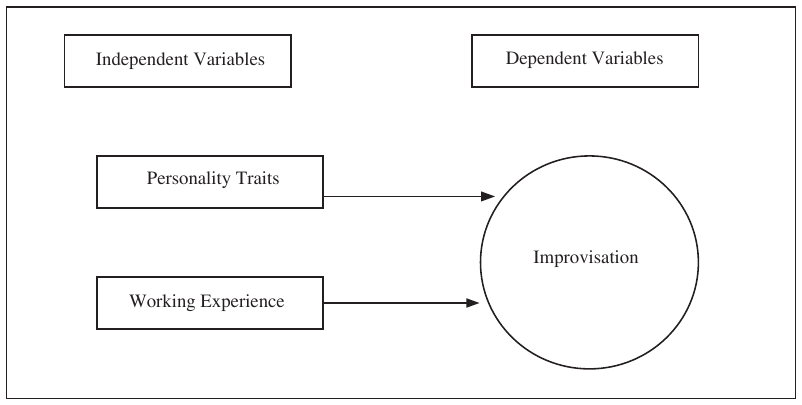
The conceptual framework for this research is presented in Figure 1 based on a review of previous works on improvisation, personality, and work experience.
Independent Variables
Dependent Variables
Personality Traits
Improvisation Working Experience
Analysis and Results
The study was conducted amongst a random sample of Malaysian government officers working at various ministries in and around Putrajaya. The participants of this study were 174 managers of grades 41 to 54. This group of participants was chosen because they have some authority to make decisions in the organization. The research was conducted using the quantitative method. Instruments to measure each variable were either adopted or adapted from previous studies. For individual improvisation factors, this research adapted seven items from Arshad (2011), covering factors of creativity and spontaneity. The personality items were adopted in their entirety from a study of Big Five Trait Taxonomy by John and Srivasta (1999). The items were taken from their study because they were simple to understand and the instrument was reported to have high reliability. In all, 44 items were used without any changes made to them. To measure work experience, questions were categorical in nature. Data analysis was conducted using SPSS 19.0. Results showed that data were normally distributed. The values of kurtosis and skewness for each construct ranged from -0.254 to 0.161 at .05 probability level while the kurtosis statistics ranged from -0.396 to 1.086 at 0.01 significance level. The factor analysis resulted in the Kaiser Meyer Olkin (KMO) measure of 0.738. To establish reliability, data were tested for consistency and stability. For this study, a reliability coefficient of 0.6 (see Table 1) was used for the Cronbach’s alpha value (Coakes & Steed, 2003). Collinearity diagnostics performed before regression showed a low possibility of multicollinearity. Table 1 presents the means, standard deviations, Pearson intercorrelations, and construct reliabilities for the different scales used.
| Variables | Mean | SD | 1 | 2 | 3 | 4 | 5 | 6 | |
| 1 | Improvisation | 2.079 | .944 | (0.699) | |||||
| 2 | Extroversion | 3.834 | .397 | .391** | (0.643) | ||||
| 3 | Agreeableness | 3.337 | .466 | .349** | .255** | (0.654) | |||
| 4 | Conscientiousness | 3.621 | .466 | .289** | .117 | .547** | (0.726) | ||
| 5 | Neuroticism | 3.856 | .409 | -.299 | -.366 | -.530 | -.459** | (0.75) | |
| 6 | Openness | 2.584 | .549 | .441** | .309** | .409** | .244** | -.292** | (0.693) |
| 7 | Working Experience ** p<0.01; *p<0.05 | - | - | .141 | -.006 | .245** | .209** | -.092 | 0.161* |
Improvisation among Middle Management Government Officers: 75-85
Hypotheses 1A through to 1E and Hypothesis 2 were tested using a standard multiple regression analysis. The result of the relationship between all the independent variables (personality traits and working experience) and improvisation is illustrated in Table 2. The result showed that 30.4% of the variance in improvisation was explained by six factors (extraversion, agreeableness, conscientiousness, neuroticism, openness, working experience), which was significant as indicated by the F-value of 12.283. However, individually, some variables did not show a significant relationship with improvisation; only the traits of Extraversion and Openness demonstrated a significant link with improvisation. The details of the results are as depicted in Table 2.
| Personality Traits, Experience | Variables | Hypothesis | Improvisation (b) |
|---|---|---|---|
| and Improvisation | |||
| Independent Variables | Extraversion | H1A | .262** |
| Agreeableness Conscientiousness Neuroticism Openness Experience | H1B H1C H1D H1E H2 | .072 .133 -.015 .286** .049 | |
| Summary statistics | R2 | .304 | |
| F | 12.283 | ||
| p | <0.001 | ||
| Note: *p<0.05; **0.01 | |||
Discussions and Conclusion
Previous literature has focused on improvising individuals (Magni et al. 2010; Aram & Walochik, 1997; Hmielski & Corbett, 2006). However, the number of literature which focuses on individual improvisation is small (Arshad, 2011). The objective of this study was to determine which personality traits are most likely to encourage improvisation. Even though personality traits are theoretically linked to individual improvisation, they have not been widely explored (Leone, 2010). To achieve this objective, we ran a regression analysis to test the influence of each of the five traits (Extraversion, Agreeableness, Conscientiousness, Neuroticism and Openness) on improvisation. The result indicated that Extraversion and Openness had a positive relationship with improvisation.
For Hypothesis 1A, the finding of the regression analysis supports Vera and Crossan’s (2005) proposition that individuals who are assertive, adventurous and enthusiastic tend to improvise. These adjectives describe individuals who have the trait of Extraversion. Therefore, we can conclude that Hypothesis 1A was accepted. According to Vera and Crossan (2005), improvisation is more likely to happen when individuals trust one another. Trust is a facet of the trait Agreeableness. However, the result of the regression analysis showed that Agreeableness did not show any positive link with improvisation. Hence, hypothesis 1B was rejected. The non-significant finding can be explained by the fact that Vera and Crossan’s (2005) talked about teamwork improvisation and not individual improvisation. In a context of a team environment, they argued that improvisation is likely to happen when team members trust and cooperate with one another. The result may also be explained from the compliance perspective. When an individual improvises, he or she has to deviate from standard procedures, implying spontaneity and creativity. For Hypothesis 1C, the result showed that Conscientiousness was one of the least significant traits that contributed towards improvisation. The trait Conscientiousness comprises facets of dutifulness and deliberation, which means that individuals with this trait may not attempt to improvise because they lack impulsiveness and refuse to be seen as careless. By the definition of improvisation as a spontaneous and creative process (Vera & Crossan, 2004), improvisation indeed goes against the nature of individuals with the trait Conscientiousness. Hypothesis 1D was not supported in this study. Barret (1998) found that a useful characteristic of individuals is the ability to manage their emotions. Failure to manage anxiety or emotions is translated into an inability to improvise and therefore failure to reap the benefits of improvisation (Cunha et al., 1999). This ability was measured as Neuroticism in this study. The beta value for Neuroticism in the regression analysis was negative but insignificant. Weick (1996) argued that for individuals to improvise, to find new solutions or to achieve targets, they must at first be willing to put aside their usual learned responses in facing unexpected and unplanned events. According to the Big Five Traits theory, this description reflects the Openness trait, which is translated to openness to new experiences (John & Srivastava, 1999). The result of the regression analysis showed that Openness had contributed the most toward improvisation among all traits. Therefore, the finding support the argument by Weick (1996). In other words, Hypothesis 1E was supported. Previous works such as Simon (1989) argued that managers need to be able to respond to situations rapidly, a skill that requires intuition and judgment based on many years of experience and training. Weick (1998) asserted that it is the level of knowledge, practice, and experience which have the most effect on improvisation. According to
Improvisation among Middle Management Government Officers: 75-85
Crossan and Sorenti (1997), the more experienced a manager is, the more likely they are to be intuitive, and therefore the higher the tendency to improvise. However, the result of this study is not consistent with previous works as H2 failed to receive empirical support. Based on the regression analysis, no significant relationship between working experience and improvisation was found. One of the reasons to explain the result is the research setting. In a non-turbulent environment, such as in this study, public officers may have limited exposure to urgent situations and hence limited improvisational activities, regardless of the length of work experience they have. It is hoped that the findings of this study add to the reservoir of knowledge on improvisation literature and fill the gap of research on individual improvisation at the workplace and the personality traits of those who are inclined to improvise. With regards to the directions for future research, it is suggested that other antecedents of individual improvisation should be investigated, such as an individual’s level of knowledge and skills and cognitive reasoning.
References
- Aram, J. D., and Walochik, K., (1997). Improvisation and the Spanish manager. International Studies of Management & Organization, 26(4), 73-89.
- Arshad, D., (2011). Understanding organizational improvisation: Foundations and performance implications. Loughborough, Leicestershire, England.
- Arshad, D. and Hughes, P., (2009). Examining organizational improvisation: The role of strategic reasoning and managerial factors. International Journal of Social, Behavioral, Educational, Economic and Management Engineering, 3(6), 948-954.
- Barret, F., and Peplowski, K., (1998). Minimal structures within a song: An analysis of “all of me”. Organization Science, 9(5), 558-559.
- Barrett, F. J., (1998). Coda: Creativity and improvisation in organizations: Implications for organizational learning. Organization Science, 9(5), 605-622.
- Coakes, S. J., and Steed, L. G., (2003). SPSS analysis without anguish: Version 11.0 for Windows. Australia: John Wiley & Sons.
- Crossan, M. M., and Sorenti, M., (1997). Making sense of improvisation. Advances in Strategic Management, 14(14), 155-180.
- Crossan, M., Cunha, M., Vera, D., and Cunha, J., (2005). Time and organizational improvisation. Academy of Management Review, 30(1), 129-145.
- Cunha, M. P., Cunha, J. V., and Kamoche, K., (1999). Organizational Improvisation: What, when, where, how and why. International Journal of Management Review, 1(3), 299-341.
- Hmieleski, K., and Corbett, A., (2006). Proclivity for improvisation as a predictor of entrepreneurial intentions. Journal of Small Business Management, 44(1), 45-63.
- John, O. P., and Srivastava, S., (1999). The big-five trait taxonomy: history, measurement, and theoretical perspectives. In L. P. (Eds.), Handbook of personality: Theory and research (2nd ed.). New York: Guilford.
- Kyriakopoulos, K., (2011). Improvisation in new product development: The contingent role of memory and information flows. Organization Studies, 32(8): 1051–1078.
- Leone, L., (2010). A critical review of improvisation in organizations: Open issues and future research directions. Opening Up Innovation: Strategy, Organization and Technology (p. 36). London: Imperial College London Business School.
- MAMPU, Kerajaan Malaysia., (1991). Pekeliling Kemajuan Pentadbiran Awam Bilangan 2, available at: http://www.mampu.gov.my/accessed April 2012.
- McKnight, B., and Bontis, N., (2002). Improvisation: collaborative groupware technology expands the reach and effectiveness of organizational improvisation. Knowledge & Press Management, 9(4), 219-227.
- Moorman, C., and Miner, A. S., (1998). Organizational improvisation and organizational memory. The Academy of Management Review, 23(4), 698-723.
- News Straits Times., (2012). GP Urges Men Not To Be Complacent. March 25.
- Orlikowski, W. J., and Hofman, J. D., (1997). An improvisational model for change management. Sloan Management Review, 38(2): 11.
- Pallant, J., (2007). SPSS Survival Manual (3rd ed.). New York: McGraw-Hill.
- PEMANDU., (2010). ETP Overview. Retrieved from: http://etp.pemandu.gov.my/ Overview-@-Overview_of_ETP.aspx/ accessed April 2012.
- PEMANDU., (2010). GTP Overview. Retrieved from: http://www.pemandu.gov.my/ gtp/About_GTP-@-GTP_Overview.aspx/ accessed April 2012 Improvisation among Middle Management Government Officers: 75-
- Quinn, J. B., (1978). Strategic change: Logical incrementalism. Sloan Management Review, 7-28.
- Robbins, S. P., and Judge, T. J., (2011). Organizational behaviour. In S. P. Robbins, & T. J. Judge, Organizational Behaviour (p. 111). New Jersey: Pearson Asia.
- Sekaran, U., (1992). Research methods for business (2nd ed.). New York: Wiley.
- Vera, D., and Crossan, M., (2005). Improvisation and innovative performance in teams. Organization Science, 16(3), 203-224.
- Vera, D., and Crossan, M., (2004). Theatrical improvisation, lessons for organizations. Organization Studies, 25, 727-749.
- Weiss, C. H., (1980). Knowledge creep and decision accretion. Knowledge: Creation, Diffusion, Utilization, 1, 381-404.
- Woodman, R. W., (1993). Toward a theory of organizational creativity. Academy of Management Review, 18, 293-321.