Research and Development Evaluation Remodelling in Malaysia: An Idealistic Framework
- School of Technology Management and Logistics, College of Business, Universiti Utara Malaysia, Kedah
Journal of Business Management and Accounting 4(1) (2014) · https://doi.org/10.32890/jbma2014.4.0.8878
Abstract
This paper provides an idealistic conceptual framework for Research & Development (R&D) evaluation. R&D is very important in higher level decision making. In Malaysia, though the spending is on increasing term, only a small proportionate of Gross Domestic Product (GDP) is allocated to fund R&D as compared to the required tasks in the vast fields of research. A lot of efforts were spent in R&D, the undertakings of which should be monitored and well-funded to ensure the results of the research are considered in making decisions that could be shared, implemented, improvised, and evaluated. Public research which focuses more on educational know-how in the development of human resource/human capital could be assimilated in R&D of private sectors which focus more on scientific, technology, material handling, and information and communication technology (ICT). The more advances occur in science and technology fields, the demand for manpower in the related fields would increase. In spite of this, any improvement from the implemented research result could not be assured even with functional R&D systems if there is no constant evaluation and post decision valuation. The collaboration of public-private R&D institutions would generate a new breed of innovative entrepreneurs that could assist Malaysia to achieve developed nation status as set out in Vision 2020. The outcome of this paper is a proposed model of the Malaysian R&D evaluation in public agencies, private sectors, and universities to construct an idealistic R&D decision evaluation framework for future application. The model presents the interconnected interactions that take place within the stakeholders circle in R&D network. Basically, the model is drawn up under the principle that virtually there are balanced interactions and the interested parties are inter-related.
Keywords: R&D, public-private R&D institutions, evaluation decision
1.0Introduction
Research and Development (R&D) is a systematic problem solver by utilising the limitless sources of knowledge. Various complex crises need different approaches and research to tackle the problems. Undertaking R&D projects in any field is time consuming, utilising limitless manpower, seeping funding, digging up piles of literature and knowledge to ensure the desired outcome. In the wake of Asia’s outburst trends in current R&D innovation along with more competitive and challenging playing fields, Malaysia has invested and will continue to invest in R&D to keep track on the development and effectively monitor the results, all of which would lead to post decision evaluations. This paper analyses the evaluation strategies by highlighting the shortfalls encountered in order to re-model an idealistic framework for effective R&D evaluation. The elaboration will start by putting forward the issues that have emerged that need attention. It is followed by the analysis of funds before moving into the R&D evaluation effective model. The content of the article is expanded further by claiming the contribution of the study before being concluded with recommendation and suggestion.
2.0Issues
An investment is expected to yield profit and a country expects to gain favourable benefit on research investment. Huge amounts of funds were invested in R&D in order to keep enterprises to be sustainably and economically competitive. Although some research were successfully implemented and produced rewarding results, many research tasks ended there and have never been kept track or re-evaluated. Even though people are aware of the rapidly changing research landscape, most of the implemented research do not go through an after decision evaluation. Research could not always be completed within the specified period and budget because there will be occasions where a research encounters unexpected obstacles and challenges which require an extended time frame and additional funding.
Steps are taken to increase the public-private collaboration in R&D institutions since public institutions are currently focusing mainly more on fundamental/experimental research as compared to the private institutions which are more on applied research. However, as stated by Othman (2009), public-private cooperation R&D in Malaysia is still at a minimal level.
R&D institutions in Malaysia are made up of public related agencies, private-owned companies, and the universities. During the 10th Malaysian Plan (2010-2015), budget for R&D has been increased from 21.8% in the 9th Malaysia Plan to 40% to facilitate a wider collaboration between Malaysia State Companies (MSC) and institutions of higher learning with the purpose to gear up more innovation driven research communities. A lot of the research have been completed and implemented, as well as on-going research. Some of the on-going research have over-stayed their expected tenure and stretched the time frame beyond the stipulated period. As funding is a major component in accomplishing a research, lack of fund is considered as the main reason for some over dateline research. Margolis and Kammen (1999) stressed that R&D success is parallel with sufficient fund that comes alongside it where limited resources will constrict and limit the progress. This is supported by Kroll, Stahlecker, Peter, and Leon (2012) who stated that R&D faces multiple challenges which requires smooth and sufficient flows of funds because some R&D systems are found not experienced enough to generate “scientific merit” and unable to compete in the international circle, possess narrow industrial perspective, and have poor intermediaries system. In some instances, intellectual properties on commercially viable ventures are generally overlooked and unprotected since no mechanisms are available that could allow researchers to survive through critical phases from the original idea stages to finally materialise it commercially. Also, no specialised department is formed to accumulate and disseminate commercially usable knowledge that can be capitalised from research institutions.
Polanyi (1967) stated that remuneration impact, dearth of inspiration, contentment crisis, and diminishing performance are a list of obstacles in carrying out R&D. On the other hand, Von Zedtwitz (2002) was of the opinion that productivity and innovation are the greatest challenges in R&D, as well as narrowing the gap by widening of the scope of the researchers, but he declined to realise the need for post decision evaluation. Callon, Laredo, Rabeharisoa, Gonard, and Leray (1992) noticed that morality is the drawback in conducting R&D.
To be competitive regionally and globally, Hishamt (2010) recognised that there are six obstacles that Malaysia should overcome;
1.        Culture clash – local companies and research institutions have no proper
          alignment.
2.        Research applicability – failure to realise whether the research is applicable or
          otherwise. The Intellectual Property laws resulted in dispute and unnecessary
          marketing delay.
3.        Depriving the SMEs – R&D is not stretched out to cover SMEs.
4.        Limited qualified researchers – only a few supported with limited facilities.
5.        Narrowly based grants – government funds are for selected fields only.
The aforesaid 10th Malaysia Plan was launched and took into consideration what Hishamt (2010) had pointed out above. Above all that, the government’s budget has additional allocation for follow-up research and post decision evaluation. The key issue is how to intensify research and innovation performance by sourcing foreign knowledge, conducting post decision evaluation, and building up collaboration between research institutions and innovation networks in order to jointly develop and manipulate latest knowledge and technologies.
According to Othman (2009), Malaysia through the Ministry of Higher Education had taken a step further in 2007 to enhance the R&D by recognising Universiti Sains
Universiti Malaya (UM), Universiti Kebangsaan Malaysia (UKM), a Malaysia (USM), Universiti Malaya (UM), Universiti Kebangsaan Malaysia (UKM), Malaysia (UPM) as the “Research-intensified Universities” with the and Universiti Putra Malaysia (UPM) as the “Research-intensified Universities” with intellectual the aim to secure more property intellectual rights property andandinnovation. rights innovation. As As researchers researchers from univ from universities aremore on fundamental focusing and experimental more on fundamental research, and experimental it is a welcoming research, it is a move welcoming move if the private sectors which are more specialised in applied research which are more specialised in applied research could work hand-i could work hand-in-hand not only in intellectual transfer, but also in securing more intellectual funds from the private transfer, but also in securing more funds from the private inst institutions.
2.1                2.1
      Analysis of Funds      Analysis of Funds
                     The for
The allocation of budget   allocation  of budget
                              R&D funding           for R&D
                                              in Malaysia         funding
                                                          is distributed   in Malaysia
                                                                         amongst         is distributed
                                                                                 the public
sector, private sector, and the universities.
                     sector, private sector, and the universities.
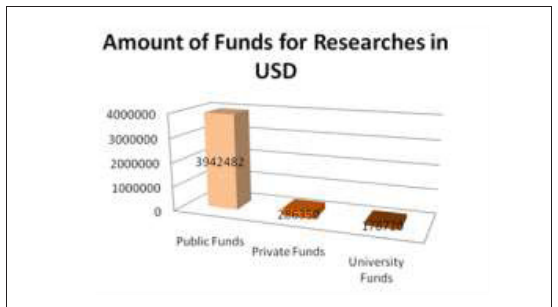
some financers believe it should be a unanimous effort, conflicts are inevitable in terms of who should play certain roles and how to get involved. This situation would warrant extended research periods in some cases and this would generate more obstacles which would require more funds as well as manpower. Figure 1 considers the amount of funds budgeted for the research. Referring to this figure, according to 10th Malaysia Plan 2010, the publicly funded research were allocated a sum of RM3,942,482 (89.4%), private sector at RM286,350 (6.5%), and university at RM178,720 (4.1%). Basic research is intended to progress fundamental scientific thoughts and advancement of revolutionary ideas, and innovation makes research by universities a priority, but since they are risky, private investors would not commit. In contrast, USA, France, China, Brazil, India, and UAE are making moves to increase R&D Research and Development Evaluation Remodelling in Malaysia: An Idealistic Framework: 45-55 49 funding at the universities especially. The next analysis is on the status of research in public sectors. Refer to Figure 2. The next analysis is on the status of research in public sectors. Refer to Figure 2.
The figure itself is in the PDF version.
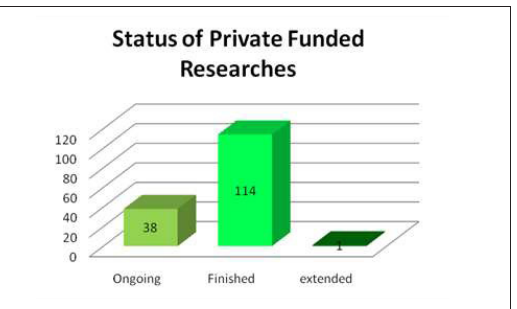
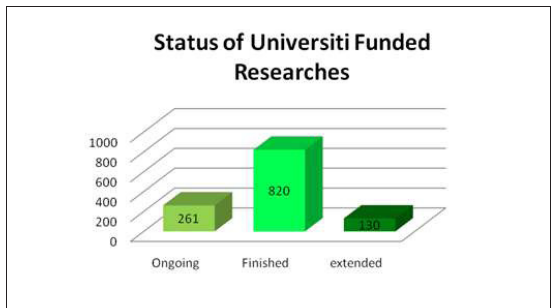
The analysis that follows is on the status of university funded research in Malaysia. The analysis that follows is on the status of university funded research in Malaysia. Figure 3 illustrates that out of 153 privately funded research in Malaysia, have completed their research, 38 or about 24% are still on-going, a represents slightly 1%, is having the research extended beyond the time fr Kammen (1999) and Kroll et al. (2012) indicated that the success of research is due to their capability to assist a handful of high level organ easier to manage with less expenditure. Apart from being well-funded research also has the luxury of easier information flows.
The analysis that follows is on the status of university funded research in M
3.0R&D Evaluation Effective Model
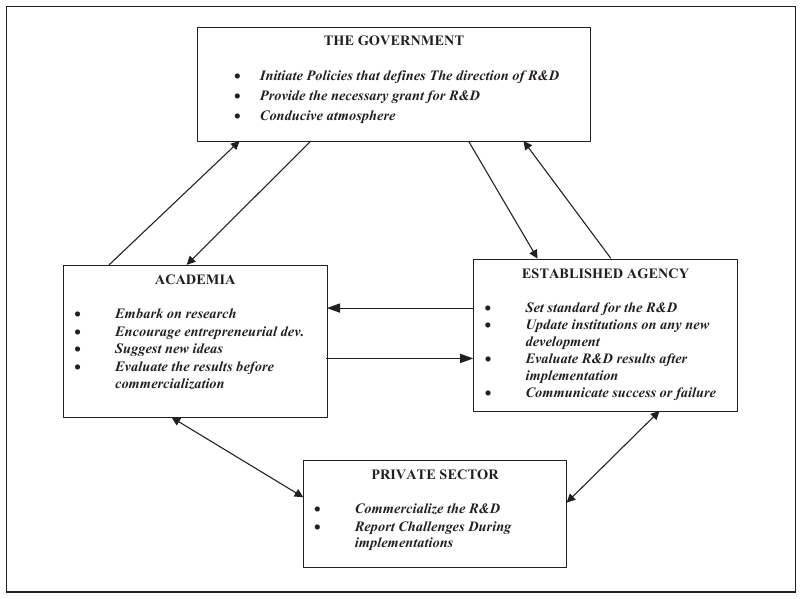
This study proposed that R&D performance measures could be consistently monitored if an interwoven relationship exists amongst: a) the government, b) an established agency in charge of R&D activities, c) the academia, and d) the private sector. Figure 5 illustrates an idealistic model of stake holder interaction for R&D evaluation.
The model presents the interconnected interactions that take place within the stakeholders circle in the R&D network. Basically, the model is drawn up under the principle that virtually there are balanced interactions and the interested parties are inter-related. The government makes the first move by inventing the associated policies. Later, the agency sets the required regulation as a guide to be adhered to by the academia in carrying out the R&D research. The academia will flourish the research culture by knowledge sharing and development. New discoveries in research are expected to be communicated to the agency. The agency will then later request the government to allocate a constructive environment for further research in those stipulated fields. When the research is completed, a pilot test will be run by the academia and pre- implementation evaluation will be conducted. At this point, any necessary omissions and commissions will be adjusted and vetted. The tested results will then be presented Research and Development Evaluation Remodelling in Malaysia: An Idealistic Framework: 45-55 51 to the private sector. The private sector later makes an effort to commercialise it. All communication channels are open amongst the stakeholders and if anything comes up during the implementation, the stakeholders will be kept in touch on the updates. Lee, Cho, and Lee (2013) suggested performance factors in evaluating even a simple collaboration research project such as experience of collaboration on joint technology done, frequency of contact and depth of communication with counterpart institutes, and the level of mutual trust. Thus, after the result was implemented and the product has been commercialised, a mechanism exists to administer the feedback since there will always be room for improvement. Therefore, this is inherently a continuous relationship. In the future, innovation will require another new R&D initiative and the process will keep on going.
THE GOVERNMENT
Initiate Policies that defines The direction of R&D
Provide the necessary grant for R&D
Conducive atmosphere
ACADEMIA ESTABLISHED AGENCY
Embark on research Set standard for the R&D
Encourage entrepreneurial dev. Update institutions on any new
development
Suggest new ideas
Evaluate R&D results after
Evaluate the results before
implementation
commercialization
Communicate success or failure
PRIVATE SECTOR
Commercialize the R&D
Report Challenges During
implementations
Othman (2009) recommended that Government Link Companies (GLCs) could play a substantial part in assisting the collaboration of public-private R&D since the government has interest in the ranks of senior managers and above. To relate this point in this study, if the government needs research in a certain field, the request could be relayed to the board of directors who could directly communicate with the R&D departments.
On the other hand, the government could play a very important role by monitoring and evaluating all the funded research through an established agency. As an example, South Korea since 2005 has redirected KISTEP’s (Korea Institute of S&T Evaluation and Planning) main functions to strategic planning, coordinating, and evaluating national S&T and R&D. It includes evaluating national R&D programmes and government- funded research institutes. They implemented meta-evaluation, in-depth evaluation, and government-funded research institute evaluation, in addition to developing and providing guidelines for performance measurement and standard performance indexes to comply with changes in the evaluation systems (KISTEP, 2013).
If any research pertains to the field that needs academic study, it can be directed to the universities to get the researcher that specialises in that field. As such, more progressive R&D could be initiated.
4.0Contribution of the Study
The proposed idealistic model is predicted to generate the following outcomes: 1. A cutting-edge centre will be established and provided with high quality R&D facilities, and will have the ability to interact internationally with results that are useful in the applications sector. 2. Enable to secure regional R&D capacity designed for the generation and transfer of the research outcomes to strengthen the collaboration between the R&D insti- tutions and the applications sector. 3. Enable to secure conditions for transmission of technology, security, results dis- tribution and application, R&D popularisation, access to scientific information, and efficiency in the improvised R&D policy. 4. Create support for education and facilities in the universities that are associated with research. This move will influence directly in enhancing the quality and increasing the number of affected researchers that are well prepared before en- tering the job market. 5. The existence of R&D facilities that are continuously developed with improved quality which will assist in developing entrepreneurial skills for graduates to boost their employability and also motivate them to further their studies. 6. An attractive atmosphere in R&D that would expose researchers to a world of economic knowledge where the graduates could enjoy flexibility and creativity using up-to-date wide-ranged mechanisms that support the complete process of innovation.
Ultimately, this endeavour is to create pools of resilient and educated human resource which are adaptable and flexible in encountering and overcoming the growing challenges in the competitive global economy, so as to ensure sustainable economic and education development in Malaysia for the future.
5.0Conclusion
Global knowledge resources distribution requires Malaysia to acquire a revamp in the development of R&D to be at least on par with others, particularly in the Asian region. The innovation in science and technology fields demands Malaysia to formulate strategies on how to be as competitive as other R&D giants such as China, India, and Singapore amongst others. Although Malaysia has to learn the hard way to catch-up to the achievement of others, Malaysia is capable of providing substantial prospects for research and education collaboration that could benefit the participating partners. Trade exchange in knowledge-intensive goods and services could be materialised both bilaterally and internationally. This article has elaborated on the R&D concept, the request for post decision evaluation and R&D status of funded research in public sector, private sector, and university. The major issue refers to the fact that a progressive R&D is actually functioning in a continuous circle and exposed in an ever-changing environment with constant innovation updates needed. This recommends the need to re-model the concept of R&D where post decision evaluation is necessary after the completion of a project. The funding of R&D particularly in the universities which represent the academia should be increased because they present the highest number of completed and extended research. Being one of the stakeholders in the circle, sufficient funding is very important to ensure that research could be completed within the specified time frame. The proposed idealistic model framework that encourages interactive participation amongst the government, private, academia, and established R&D agencies has the potential to provide the desired solution.
References
- Callon, M., Laredo, P., Rabeharisoa, V., Gonard, T., & Leray, T., (1992). The management and evaluation of technological programs and the dynamics of techno-economic networks: The case of the AFME. Research Policy, 21(3), 215-236.
- Hishamt, E. S., (2010). Global problems, global solutions: towards better global governance. Geneva 21: World Trade Organisation.
- KISTEP., (2013). http://www.kistep.re.kr/en
- Kroll, H., Stahlecker, T., Peter, V., and Leon, L. R., (2012). Regional innovation in the innovation union. Directorate-General for research and Innovation Capacities Belgium.
- Lee, S. H., Cho, H., and Lee, D., (2013). Analysis of performance-improving factors of international R&D collaborations conducted by universities in South Korea. Asian Research Policy, 4, 99-113.
- Margolis, R. M., and Kammen, D. M., (1999). Underinvestment: the energy technology and R&D policy challenge. Science, 285(5428), 690-692.
- Othman, N. H., (2009). Public-private collaboration in research and development in Malaysia. Tech Monitor, 19-23.
- Polanyi, M., (1967). The tacit dimension. London.
- Tetroe, J. M., Graham, I. D., Foy, R., Robinson, N., Eccles, M. P., Wensing, M., Adily, A., (2008). Health research funding agencies’ support and promotion of knowledge translation: an international study. Milbank Quarterly, 86(1), 125-155.
- Von Zedtwitz, M., (2002). Organizational learning through post–project reviews in R&D. R&D Management, 32(3), 255-268.