Factors Associated with Employees' Choice of Mandatory Retirement Plan: The Case of Malaysian Public Universities
- School of Economics, Finance and Banking, College of Business Universiti Utara Malaysia
Journal of Business Management and Accounting 4(1) (2014) · https://doi.org/10.32890/jbma2014.4.0.8877
Abstract
This study examines the factors that influence public sector employees in making a decision to enroll in either one of the two types of mandatory retirement plans. A survey of 348 Malaysian public universities employees was conducted, and the data obtained were analyzed using a logistic regression model. The results show that knowledge, plan feature, sources of retirement income, health status, job mobility, and extending work are the contributing factors of the choice of the retirement plan. Apart from extending the extant literature on retirement plan, this study provides further understanding of the employees’ retirement decision in a different scenario of retirement systems.
Keywords: Choice, pension plan, employee provident fund (EPF), defined benefit plan, defined contribution plan
Introduction
Sufficient retirement savings are important to ensure that retirees have quality of life during their retirement years. The provision for old-age economic security is an important agenda for both the government and the society. In many countries, a retirement program is compulsory, and the government or the employer has the responsibility for managing the retirement fund. The issue of aging has made planning for retirement a crucial decision to be made by workers. Tolos et al. (2014) highlight further a number of emerging issues in retirement, such as the increasing retirement age, the extending of the duration of a working life, and the shift towards defined-contribution (DC) pension plans. The change in the pension plan from the defined-benefit (DB) plan to the DC plan has particularly made the decision-making process more complex for the workers. Most retirement programs can be categorized into a defined-benefit (DB) plan and a defined-contribution (DC) plan. In Malaysia, private sector workers have to participate * in the Employee Provident Fund (EPF), which is a defined-contribution (DC) plan. Public sector workers can choose to take part in either the government pension program (PENSION), a defined-benefit (DB) plan, or the EPF. The decision to opt either plan is irrevocable1 and the option is offered to the civil servants upon confirmation of service. The EPF is a government agency under the Ministry of Finance that manages the fund. In 2007, the Pension Trust Fund Act 1991 (Act 454) was succeeded by the Retirement Fund Act 2007 (Act 662). Under the new act, Kumpulan Wang Persaraan (KWAP) (Diperbadankan) or the Retirement Fund (Incorporated) was established to manage the government pension fund. The main feature of the fund as a defined-benefit plan remains. Apart from these two compulsory (i.e., mandatory) schemes, employers may also set up their own voluntary pension plan by purchasing a private retirement scheme from insurance companies. However, the private retirement scheme is still at an infancy state in Malaysia as a contribution to EPF is compulsory. Individual workers may also purchase an annuity policy from an insurance company to complement their savings for retirement. Until recently, the most prominent model for the public service pension plan is the DB plan in both developed and developing countries (Mitchell, 2004). According to Coggburn and Reddick (2007), DB plans are dominant in the public sector; approximately 90 percent of government workers are covered by the DB plans. However, many contributing factors, such as the aging population, have led to a widespread shift from the DB plans towards the DC plans in many countries (Bryne, 2007; Even & Macpherson, 2007; Ross, 2000). As the DC plans allow more flexibility to workers in managing the retirement fund, the shift increases the workers’ responsibility for retirement savings decisions (Ross, 2000). While extensive works on retirement schemes exist in developed countries, there is a dearth of literature on retirement schemes in developing nations of which Malaysia is not an exception. The few existing works on the pension scheme in Malaysia include Sim (2002) who conducted a study on aging in Malaysia, Kassim (2009) on the experience of pension design and marketing in Malaysia, and Subrahmanya (2002) on the security needs of older persons. A study on the factors that influence the choice of a retirement plan by public sector workers in Malaysia is virtually non-existent. Therefore, this study intends to fill the gap by considering public sector workers’ decision in making the options of choosing between the DB (PENSION) and DC (EPF) plans. The findings provide valuable inputs to policy makers and insurance companies in understanding workers’ decision in choosing a retirement plan.
On 1st Jan 2009, public servants who had already opted for EPF scheme were given a one-time second option to re-opt for the PENSION scheme under Akta Pencen 1980 (Akta 227) Akta Pencen Pindaan (No. 2) 2008 / Akta Pencen Pihak-Pihak Berkuasa Berkanun dan Tempatan 1980 (Akta 239) with Akta Pencen Pihak-Pihak Berkuasa Berkanun dan Tempatan (Pindaan) (No. 2) 2008.
The rest of the paper is organized as follows. The next section presents the literature review and research framework. The methods employed in this study are discussed in section three followed by the findings in section four. Finally, the conclusion and recommendation are presented in section five. 2.0
Literature Review and Research Framework
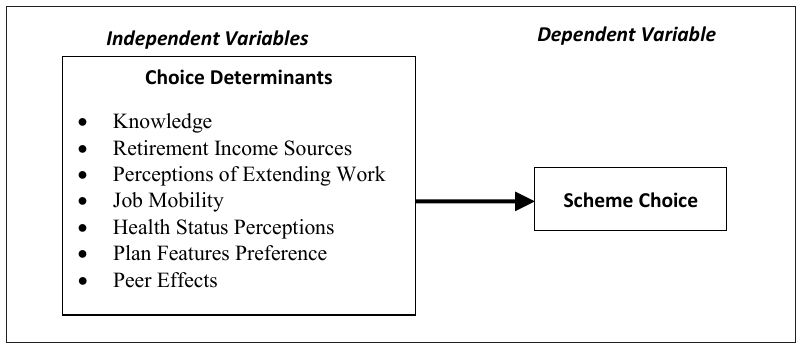
Based on the relevant literature, Figure 1 summarizes the factors considered to play a role in influencing the choice of retirement schemes in Malaysia. Each factor is discussed in relation to the specific function it plays and the way in which it influences the choice decision as well as the development of the respective hypotheses. Independent Variables
Dependent Variable
Choice Determinants
Knowledge Retirement Income Sources Perceptions of Extending Work Job Mobility Health Status Perceptions Plan Features Preference Peer Effects
Scheme Choice
Knowledge
Knowledge is an important predictor of a retirement plan choice (Chan & Stevens, 2008; Gallery et al., 2011; Luchak & Gunderson, 2000; Peggs, 200). Information is perceived to be critical to knowledge acquisition. Individuals tend to use multiple sources of information for making decisions on choosing a retirement plan (Gallery et al., 2011). However, the decision-making process is not simple. For employees, there are challenges and complexities in understanding the different kinds of retirement plans. Ramesh (2004) observed the lack of information (and studies) on pension schemes for civil servants in Malaysia while Luchak and Gunderson (2000) found low levels of understanding of pension plans among employees. With limited information, it is rather difficult for employees to ensure that they are choosing the best retirement plan that could provide sufficient income in their old age. Previous literature also examined the role of knowledge in investment decision on DC plans (Clark-Murphy & Gerrans, 2001; Dulebohn, 2002; Dulebohn & Murray, 2007;
Gallery et al., 2011). Gallery et al. (2011) found financial literacy to be associated with the superannuation investment choice decisions. Therefore, this study hypothesizes that: H1: Knowledge will have a significant impact on the choice of a retirement scheme. 2.2
Retirement Income Sources
Retirement income typically comes from three sources although different countries rely more on some sources than the others. The sources are social security, employerprovided pensions, and personal savings. Studies found that employees rely more on employer-sponsored retirement plans (Blank, 1999; Devaney & Su, 1997; Childs et al., 2002; Shuey & O’Rand, 2004). Employees want to have confidence in their retirement fund so that their retirement income is secured and confirmed. As the informal family support system in Malaysia is diminishing, the need for consistent income streams after retirement increases (Asher, 1998; Beattie, 2000; Caraher, 2003; Subrahmanya, 2002). Dan (2004) found that government workers are more confident in their future retirement benefits than nongovernment workers. These studies suggest that the reliability of the retirement income sources may influence the choice of retirement schemes. Hence, this study posits that: H2: The source of retirement income will have a significant impact on the choice of a retirement scheme. 2.3
Perceptions of Extending Work
The lengthening of the employee’s life cycle increases employee expectation for extending employment or engaging in a part-time employment after retirement. Mitchell and Fields (1984) revealed that extending work patterns depend on the retirement plans. Friedberg and Webb (2000) found that workers with DC plans tend to retire later from those with DB plans. Similarly, Kim and Devaney (2005) claimed that older workers with a DB plan or with both DB and DC plans are more likely to retire entirely. The literature shows that extending work after retirement age may influence the choice of the retirement scheme among employees. Therefore this study proposes that: H3: Perceptions of extending work will have a significant impact on the choice of a retirement scheme. 2.4
Job Mobility
Disney and Emmerson (2002) examined the choice of retirement schemes and mobility in Britain. They reported that individuals who subsequently moved jobs have selected retirement arrangements that impose lower costs on mobility. Dulebohn et al. (2000)
related mobility to the selection of employer-sponsored pension plans which they call “portability” in their study. Sundali et al. (2008) investigated the conditions in which employees consider whether the benefits gained by shifting to DC plans exceed the associated costs. Clark and Pitts (1999) adopted actual service-length as measured in administrative records as a proxy for mobility expectations. Manchester (2007) assessed the effect of mobility in the expected utility of DB plans. In the US, O’Rourke (2000) found that with increased job mobility, employees might be faced with a making a retirement decision eight times more than during their working career. In Malaysia, EPF imposes no cost on mobility. However, civil servants who decide to leave the civil services will lose their eligibility for a pension income. This makes the choice of retirement plans more crucial because the decision made is irrevocable. Thus, mobility should be addressed to analyze the impact of retirement scheme choices on employee expectations of job changes and retirement funds. Thus, this study hypothesizes that: H4: Job mobility will have a significant impact on the choice of a retirement scheme. 2.5
Health Status Perceptions
Access to health care is imperative during the retirement years as retirees normally need more health care than the average population. Studies on the influence of health status on retirement decision are numerous (French, 2005; Klaauw & Wolpin, 2006; Szinovacz & Davey, 2005). It was found that retirement behaviors are influenced by health insurance costs (Johnson et al., 2003; Klaauw & Wolpin, 2006). In Malaysia, the importance of health in retirement decision was documented in Arokiasamy (2000), Goh (2005), Sim (2002), and Wong (2006). Therefore, this study posits that: H5: Health status perceptions will have a significant impact on the choice of a retirement scheme. 2.6
Preferences for Plan Features
Plan features have been considered in many studies on the choice of retirement plans. However, they mostly paid attention to employer choice rather than employee choice and, to a lesser extent, to investment aspects rather than plan participation. Dulebohn et al. (2000) stated that plan features include lump-sum payment, benefit determination, investment choice, portability, and survivor benefits. An earlier study by Foster (1998) demonstrated that under employer-provided retirement plans, benefit formulae, length of service, and pre-retirement earnings influence the DB choice while contributions amount and investment earnings influence the DC choice. French (2005) also showed that the tax structure of retirement schemes is the key determinant of the high job exit rates for employees of 62 and 65 years old. On the contrary, Dorn and Sousa-Poza (2005) indicated that generous early retirement provisions of the social security system not only make voluntary early retirement more attractive to individuals but also induce employers to encourage more employees to retire early. For these reasons, this study proposes that: H6: Preferences for plan features will have a significant impact on the choice of a retirement scheme. 2.7
Peer Effects
An employee makes decision independently or dependently (influenced) on others such as peers, spouse or family. Duflo and Saez (2002) found that peer effects influence a retirement savings decision because individuals do not carefully think through the pros and cons of particular plans themselves. Instead, they rely on information given by peers to make the decision. Moreover, belief and about social norms will influence the choice made because of the desire to behave similarly to those in their social group (Berkowitz, 2003). Thus, this study hypothesizes that: H7: Peer effects will have a significant impact on the choice of a retirement scheme. 3.0
Data and Methods
Sources of Data
Data for this study came from the field survey of employees of public universities in Malaysia. In all, 3000 questionnaires were sent to 20 universities, of which 377 responses were returned. However, only 348 were included in our analysis because of incomplete responses, representing 12 percent response rate. The survey instrument used for this study was adapted from previous studies. 3.2
Data Analysis
The response obtained from the field survey was analyzed using the logistic regression 𝑃𝑃 = 𝑃𝑃(𝑌𝑌 1|𝐗𝐗𝐗𝐗) method. Logistic regression was run to estimate the = effect of the independent variables on the choice of retirement schemes, and it revealed the patterns in choice behavior. The specification of the model is briefly outlined as follows. Let Y be a binary variable that takes the value of either 1 or 0. The logit model, from which the logistic function is derived, was based on the odds of an event taking place. Given 𝑃𝑃 = 𝑃𝑃(𝑌𝑌 = 1|𝐗𝐗𝐗𝐗) as 𝑃𝑃 the probability of an event taking place, is then the corresponding odds. The 1 − 𝑃𝑃 logit of a number between 0 and 1 is defined as:
𝑃𝑃 𝐿𝐿𝐿𝐿𝐿𝐿𝐿𝐿𝐿𝐿 (𝑃𝑃) = 𝐿𝐿𝐿𝐿 ( ) 𝑃𝑃 which is the corresponding 1 −The 𝑃𝑃 logit model states that the 𝐿𝐿𝐿𝐿 ( ) =odds 𝐗𝐗𝐗𝐗 in the logarithm. − 𝑃𝑃 place are a linear function of a given set of explanatory log odds of an event1taking variables, i.e.: 𝑃𝑃
𝐿𝐿𝐿𝐿 ( ) = 𝐗𝐗𝐗𝐗 𝑃𝑃𝑃𝑃 ) = 𝐗𝐗𝐗𝐗 1 − 𝐿𝐿𝐿𝐿 𝑃𝑃𝐿𝐿𝐿𝐿( (1 − 𝑃𝑃 ) = 𝐗𝐗𝐗𝐗 (2) 1 − 𝑃𝑃 𝑃𝑃 𝐿𝐿𝐿𝐿 ( exp(𝐗𝐗𝐗𝐗) ) = 𝐗𝐗𝐗𝐗 The probability 𝑃𝑃 = 𝑃𝑃(𝑌𝑌 = 1|𝐗𝐗𝐗𝐗) can be𝑃𝑃solved as: =1 − 1 + exp(𝐗𝐗𝐗𝐗)
exp(𝐗𝐗𝐗𝐗) exp(𝐗𝐗𝐗𝐗) 𝑃𝑃 = 𝑃𝑃(𝑌𝑌 = 1|𝐗𝐗𝐗𝐗) = exp(𝐗𝐗𝐗𝐗) (3) 𝑃𝑃 = 𝑃𝑃(𝑌𝑌 = 1|𝐗𝐗𝐗𝐗) 1 + exp(𝐗𝐗𝐗𝐗) 𝑃𝑃 = 𝑃𝑃(𝑌𝑌 = 1|𝐗𝐗𝐗𝐗) == 1 + exp(𝐗𝐗𝐗𝐗) 1 + exp(𝐗𝐗𝐗𝐗) exp(𝐗𝐗𝐗𝐗) 𝑃𝑃 = 𝑃𝑃(𝑌𝑌 = 1|𝐗𝐗𝐗𝐗) is = a vector of the corresponding where X is a vector of explanatory variables, 1 + exp(𝐗𝐗𝐗𝐗) coefficients. The dependent variable, represented by Y is binary in nature. Y = 1 when the participant chooses EPF and Y = 0 when the participant chooses PENSION. The independent variables included in the model are: X1 = Knowledge X2 = Source of retirement income X3 = Extending Works X4 = Health Status X5 = Job Mobility X6 = Plan Feature X7 = Peer Effect 4.0
Results and Discussion
The full model that contains all predictors was statistically significant, χ2 (7, N = 348) = 69.076, p< 0.001, indicating that the model can distinguish between the participants who chose the EPF scheme against those who chose the PENSION scheme. The difference between the model containing only a constant (-2Log Likelihood (-2LL) = 283.227) and the model containing all variables (-2LL = 283.051) yielded a significant value of χ2 = 69.076 with 7 degrees of freedom. The non-significant value of the Hosmer and Lemeshow (H&L) test (p = 0.847) and significant Omnibus test (p = 0.000) showed good performance of the model. As a whole, the model itself explained between 18 (Cox and Snell R2) to 28.3 percent (Nagelkerke R2) of the variance in choosing the dependent variable (EPF or PENSSION). The classification table shows that of
277 of the participants who chose PENSION scheme, 268 were classified correctly. Alternatively, of 71 who chose EPF, 20 were predicted correctly. Overall, the model correctly classified 82.8 percent of the cases, which is higher than its baseline of 79.6 percent, leading to an excellent model performance. The goodness of fit is given by the -2LL value and H&L test. A good fit is attained if there is a larger reduction between the initial and final steps in the -2LL value and a weaker outcome in the H&L test. The Cox and Snell R2 and also the Nagelkerke R2 are also used as indications of the goodness of fit of the model. Cox and Snell R2 and also the Nagelkerke R2 focus on the model’s explanatory power, as both test the statistical significance between group differences, the weaker the test, the better the fit of the model estimates. Table 1 presents the results of the analysis. It reveals that all the variables in the model – knowledge, peer effects, sources of retirement income, health status of the employee, work extension beyond retirement age, job mobility and plan features – had significant effects on the choice of retirement pension provider chosen by the university employees under study. The choice of scheme preferred based on these variables differed according to the analysis of the feedback from the participants. Knowledge, health status, work extension and plan feature are variables revealed to choice of the participants to be in EPF scheme with their positive coefficients. On the other hand, other variables revealed preference to be in PENSION scheme and their coefficients are negative.
| Odds | 95.0 % C.I.for Odds ratio | |||||||
| Variables | B | S.E. | Wald | df | Sig. | ratio | Lower | Upper |
| Knowledge | .393 | .193 | 4.152 | 1 | .042* | 1.482 | 1.015 | 2.163 |
| Source | -.758 | .197 | 14.826 | 1 | .000** | .469 | .319 | .689 |
| Extending work | .453 | .164 | 7.609 | 1 | .006** | 1.573 | 1.140 | 2.171 |
| Health status | .677 | .198 | 11.749 | 1 | .001** | 1.969 | 1.336 | 2.900 |
| Job mobility | -.637 | .160 | 15.915 | 1 | .000** | .529 | .387 | .723 |
| Plan feature | .508 | .187 | 7.396 | 1 | .007** | 1.662 | 1.152 | 2.396 |
| Peer effort | -.704 | .157 | 20.127 | 1 | .000** | .494 | .364 | .673 |
| Constant | -1.173 | 1.230 | .908 | 1 | .341 | .310 |
Source
Constant
* Significant at the 5% level, ** Significant at the 1% level.
Table 1 shows that the participants appear to prefer EPF to PENSION. Those who have good knowledge of annuities and insurance policies are likely to choose EPF. This is evident by the result where the coefficient of the knowledge factor is positive and statistically significant. The odds ratio of 1.482 also corroborates this assertion. The simple interpretation is that an employee that has good knowledge of annuities and insurance policies is about 50 percent more likely to choose EPF over PENSION. Therefore, selecting EPF is related to the overall understanding of the retirement system. Being knowledgeable enables employees to choose the best retirement scheme that suits them. Plan feature is also the variable in the model on which employees prefer EPF to PENSION. It has a positive coefficient with an odds ratio of 1.662. This shows that participants are likely to prefer EPF 60 percent to PENSION due to the added features of the EPF plan. The added feature in this study is the benefits of tax relief for EPF contributors. This finding supports the assertion of Dulebohn et al. (2000) who state that plan feature plays a significant role in the choice of a retirement scheme. Other variables that play a significant role in employee choice of retirement schemes which support EPF are work extension and health status. People who would like to extend work after retirement are more likely to opt for EPF, evident by the positive and significant coefficient of the variable, with an odds ratio of 1.14. That is, people who intend to work after retirement are slightly more likely to opt for EPF than those who do not. Likewise, participants with good health status are more likely to opt for EPF, with a positive coefficient for the variable that is significant at the 1 percent level and an odds ratio of 1.969. This suggests that employees with good health status are twice more likely to choose EPF than PENSION. The results indicate the influence of peer effect on the choice of PENSION in comparison to EPF. University employees are more likely to choose PENSION over EPF when the majority of their peers choose the PENSION scheme. The coefficient of the variable is negative and significant at the 1 percent level, and its odds ratio is 0.494. This odd ratio reveals that employees are more than twice likely to choose PENSION over EPF due to peer influence. This is expected as most of the employees are on the PENSION scheme (more than 73% of the participants). The bandwagon effect suggests that an employee will choose the scheme prevalent among his/her peers, hoping that it is the best. The findings support Duflo and Saez (2002) and Berkowitz (2003) who indicated that individuals rely on information given by peers to make a decision. Source of retirement income is another significant variable in the model with a negative coefficient sign and 0.469 odds ratio. This indicates that employees are more than twice confident that their pension contribution is more guaranteed with the PENSION scheme which is offered to public servants only over the EPF scheme. Hence, based on guaranteed retirement income, PENSION is preferred. This finding supports Blank (1999) who found that workers with a DB scheme appear to have more retirement income sources than those with a DC scheme. Job mobility is the third variable in the model with a negative coefficient in which the participants prefer PENSION over EPF. With an odds ratio of 0.387, employees are twice likely to prefer PENSION over EPF if they want to stay with their current employer, i.e., the government sector. This is expected as employees can only receive PENSION benefits once the vesting requirement is met.
5.0Conclusion and Recommendations
Unlike other countries, Malaysian public sector workers need to choose a compulsory retirement scheme in the first three years of employment, subsequent to a confirmation status granted to them. As retirement is a future event, the validity of the decision is limited. Upon retirement, priorities might change, leading to different views that might affect the decision. In some circumstances, these future views might result in regret. In addressing this issue, this paper examines the factors that influence employees’ choice of retirement plan between the EPF and the government PENSION scheme using logistic regression analysis. It was found that knowledge, health status, work extension and plan feature are the most important variables that determine the choice of EPF as the retirement scheme. Employees who possess higher levels of knowledge would opt for EPF. In particular, employees with more knowledge of annuities and insurance policies are likely to enroll in EPF. With regards to feature plan, EPF tax relief is revealed as one of the contributing elements for employees opting for EPF. Understanding the retirement plan features allows employees to make a comparison and subsequent choice that suits their needs. Efforts, such as having a designated officer to handle the management of the retirement plan including attending to employees’ queries and organizing workshop or seminars on the retirement plan, may give added value to the employees. Moreover, employees who would like to extend work after retirement are more likely to opt for EPF, so do those with a good health status. This study also found that sources of retirement income, job mobility, and peer effect are contributing factors in the retirement scheme choice as well. Employees are more likely to opt for EPF if they have supplementary sources of retirement income. Employees with job mobility attitude are more likely to stay with PENSION. Due to the influence of peers, participants are more likely to choose PENSION over EPF as the majority of the peers choose the same retirement scheme which is PENSION. This indicates that individuals mimic peers because they wish to behave similarly like the majority.
It is recommended that future research looks into retirees’ satisfaction of their chosen retirement scheme. To evaluate the choice made. The study can employ in-depth interviews or other qualitative techniques to gain an understanding of this issue and explore new factors that could influence employee choice.
References
- Arokiasamy, J. T., (2000). Demography and epidemiology aspects of aging in the developing world: Focus on Malaysia. Gerontological Association of Malaysia.
- Asher, M. G., (1998). The future of retirement protection in Southeast Asia. International Social Security Review, 51(1), 3-30.
- Beattie, R., (2000). Social protection for all: But how? International Labor Review, 139(2), 129-148.
- Berkowitz, A. D., (2003). Applications of social norms theory to other health and social justice issues. In H. W. Perkins (Ed.), Social norms approach to preventing school and college age substance abuse (259-279). San Francisco: Jossey-Bass.
- Blank, E. C., (1999). Pension type and retirement wealth. Industrial Relations, 38(1), 1-10.
- Byrne, A., (2007). Employee saving and investment decisions in defined contribution pension plans: Survey evidence from the UK. Financial Services Review, 16(1), 19-40.
- Caraher, K., (2003). Malaysia: Approaches to income security in old age. Social Policy & Society, 2(4), 295-304.
- Chan, S., and Stevens, A. H., (2008). What you don’t know can’t help you: Pension knowledge and retirement decision making. The Review of Economics and Statistics, 90(2), 253-266.
- Childs, P. D., Fore, D., Ott, S. H., and Lilly, C. C., (2002). Defined benefit vs. defined contribution? Optimal employee and employer retirement plan choice. TIAA-CREF Institute Working Paper 9-060102. New York.
- Clark-M. M., and Gerrans, P., (2001). Consultation and resource usage in retirement savings decisions: Australian evidence of systematic gender differences. Financial Services Review, 10(1-4), 273-290.
- Clark, R. L., and Pitts, M. M., (1999). Faculty choice of a pension plan: Defined benefit versus defined contribution. Industrial Relations, 38(1), 18-45.
- Coggburn, J. D., and Reddick, C. G., (2007), Public pension management: Issues and trends. International Journal of Public Administration, 30(10), 995-1020.
- Dan, A. A., (2004). What are people doing to prepare for retirement? Structural, personal, work and family predictors of planning. Unpublished doctoral thesis. Case Western Reserve University.
- Devaney, S. A., and Su, Y. P., (1997). Factors predicting the most important source of retirement income. Compensation & Working Conditions, 2(3), 25-31.
- Disney, R., and Emmerson, C., (2002). Choice of pension scheme and job mobility in Britain. IFS Working Papers W02/09. Institute of Fiscal Studies.
- Dorn, D., and Sousa-Poza, A., (2005). Early retirement: Free choice or forced decision. CESifo Working Paper No. 1542, Category 4: Labor Markets September 2005. Munich.
- Duflo, E., and Saez, E., (2002). Participation and investment decision in a retirement plan: The influence of colleagues’ choice. Journal of Public Economics, 118(3), 815–842.
- Dulebohn, J. H., (2002). An investigation of the determinants of investment risk behavior in employer-sponsored retirement plans. Journal of Management, 28(1), 3-26.
- Dulebohn, J. H., and Murray, B., (2007). Retirement savings behavior of higher education employees. Research in Higher Education, 48(5), 545-582.
- Dulebohn, J. H., Murray, B., and Sun, M., (2000). Selection among employer-sponsored pension plans: The role of individual differences. Personnel Psychology, 53(2), 405-432.
- Even, W., and Macpherson, D. A., (2007). Defined contribution plans and the distribution of pension wealth. Industrial Relations, 46(3), 551-580.
- Foster, A. C., (1998). Factors affecting employer-provided retirement benefits. Compensation and Working Conditions, 3(Winter), 10-17.
- French, E., (2005). The effects of health, wealth, and wages on labor supply and retirement behavior. Review of Economic Studies, 72(2), 395-427. The Case of Malaysian Public Universities: 31-
- Friedberg, L., and Webb, A., (2000). The impact of 401(k) plans on retirement. Discussion Paper 2000-30. University of California, San Diego, CA.
- Gallery, G., Newton, C., and Palm, C., (2011). Framework for assessing financial literacy and superannuation investment choice decisions. Australasian Accounting Business and Finance Journal, 2(5), 3-22.
- Goh, V. H., (2005). Aging in Asia: A cultural, socio-economical and historical perspective. Aging Male, 8(2), 90-96.
- Kassim, Z. A. M., (2009). Pension Design and Marketing: The Annuity Malaysia Experience. Retrieved January 26, 2010, from http://www.oecd.org/ dataoecd/63/50/2638128.pdf
- Kim, H., and Devaney, S. A., (2005). The selection of partial or full retirement by older workers. Journal of Family and Economic Issues, 26(3), 371-394.
- Klaauw, W. V. D., and Wolpin, K. I., (2006). Social security and the retirement and savings behavior of low-income households. Pier Working Paper Archive 05-020. Penn Institute for Economics Research, Department of Economics, University of Pennsylvania.
- Luchak, A. A., and Gunderson, M., (2000). What do employees know about their pension plan? Industrial Relations, 39(4), 646-670.
- Manchester, C. F., (2007). The effect of pension plan type on retirement age: Distinguishing plan incentives from career length preferences. Working Paper Series. Industrial Relations Center, University of Minnesota.
- Mitchell, O. S., and Fields, G. S., (1984). The economics of retirement behavior, Journal of Labor Economics, 2(1), 84-105.
- Mitchell, O. S., and Mulvey, J., (2004). Potential implications of mandating choice in corporate defined benefit plans. Journal of Pension Economics & Finance, 3(3), 339-354.
- O’Rourke, J., (2000). Retirement benefits innovation: Carving new solutions for today’s changing workforce. ACA News, 43(2), 14-18.
- Peggs, K., (2000). Which pension? Women, risk and pension choice. Sociological Review, 48(3), 349-364.
- Ramesh, M., (2004). Review article issues in globalization and social welfare in Asia. Social Policy & Society, 3(3), 321-327.
- Ross, S. G., (2000). Doctrine and practice in social security pension reforms. International Social Security Review, 53(20), 3-116.
- Shuey, K. M., and O’Rand, A. M., (2004). New risks for workers: Pensions, labor markets, and gender. Annual Review of Sociology, 30(1), 453-477.
- Sim, O. F., (2002). Ageing in Malaysia: A review of national policies and programs. In Philips, D. R., Chan, A. & Chan, C.M. (Eds.), Ageing and long-term care. National policies in the Asia-Pacific, Social Issues in Souteast Asia 26,107-149, ISEAS-Yusof Ishak Institute: Online ISBN: 9789812307163, Cambridge University Press, Cambridge.
- Subrahmanya, R. K. A., (2002). Addressing income security needs of older persons in developing countries income security for older people: An Asian perspective. International Social Security Review, 55(1), 49.
- Sundali, J., Westerman, J. W., and Stedham, Y., (2008). The importance of stable income sources in retirement: An exploratory study. Journal of Behavioral and Applied Management, 10(1), 18-42.
- Tolos, H., Wang, P., Zhang, M., and Shand, R., (2014). Retirement systems and pension reform: A Malaysian perspective. International Labour Review, 153, 489-502.
- Wong, C. N., (2006). Policy response for the aging in Malaysia aging East Asia. Policy Responses and Regional Cooperation Conference, sponsored by Policy Research Institute, Ministry of Finance and Asian Development Bank Institute, Japan.