The Impact of Product Cues and Brand Attitude towards Purchase Intention of Automobiles
- School of Business Management, Col
- Multimedia University, Cyberjaya, Selangor
- School of Management, Universiti Sains Malaysia
Journal of Business Management and Accounting 4(1) (2014) · https://doi.org/10.32890/jbma2014.4.0.8876
Abstract
The varying characteristics reflective of the actual diversity in how intentions are conducted have found that intentions are significantly better predictors of purchase behavior for existing products and durable than for non-durable products. These results are remarkable because, in practice, intentions are often used to predict sales for new non-durable products, and they are better predictors of behaviors over a short horizon. Branding is also important because it communicates a brand’s business proposition. The most successful visual expression of a brand is its core attributes, and a positive emotional relationship between the brand and its audience needs to be established. Building a local, regional, or national brand with a clearly defined and understood target audience is difficult and even more difficult when a global brand is at stake. Some global brands are strongly associated with their country of origin. In certain categories, this is part of the essence of the brand. Automobiles are the most notable example. The objective of this study is to understand the variables influencing consumers’ purchase intention related to automobiles. In particular, this study provides insight into the perception of Malaysian consumers with regards to their purchase intention of a certain brand of automobiles.
Keywords: Product cues, attitude towards brand, automobile
1.0Introduction
In the era of a competitive business environment, automobile manufacturers and assemblers need to be proactive to ensure that consumers have a high intention to purchase their products. The level of purchase intention among consumers needs to be enhanced so that companies enjoy strong growth and profitability and increased market share through higher sales. The importance of purchase intention is well-documented in the literature (Ahmed & d’Astous, 1993; Diamantopoulus, Schlegelmilch & Du Preez, 1995; Liefeld, 2004; Rodrigue & Biswas, 2004; Veloutsou, Gioulistanis & Moutinho, 2004). This concept can be usefully applied to products marketed domestically or internationally. Previous studies (e.g., Dabholkar & Bagozzi, 2002; Erickson & Johansson, 1985; Page & Yuding, 2003; Teng, Laroche, & Zhu, 2007) on purchase intention have identified a variety of determinants of purchase intention and the relationships between these determinants and purchase intention.
2.0Literature Review
Past research on purchase intention has focused mainly on country of origin as a contributing factor (Pecotich, Pressley, & Roth, 1996). Factors affecting attitude toward a brand contribute to the theoretical and empirical perspectives of purchase intention. Purchase intention is formed by continuous marketing efforts. It is well recognized that attitude toward a brand is important in the formation of purchase intention. For example, previous studies have found that country of origin, country image, and warranty are factors that affect purchase intention (Bearden & Shimp, 1982; Han, 1988; Pecotich et al., 1996).
Agarwal and Malhotra (2005) indicated that intrinsic cues are a contributing factor affecting purchase intention. Extrinsic cues, such as country of origin, country image, and warranty, also are factors influencing purchase intention. However, perceived risks and prices were not found to contribute towards purchase intention (Bearden & Shimp, 1982; Maxwell, 2001; Snoj, Korda, & Mumel, 2004).
2.1Product Cues
Consumers evaluate products on two characteristics. The first one is the intrinsic cues like the serviceability, technical advancement, design, etc. The second is the extrinsic cues like country of origin, country image, warranty, price, and perceived risks (Bilkey & Nes, 1982; Field, 2003; Zhang & Zarb, 1996). Intrinsic cues are the attributes that cannot be changed or manipulated without changing the physical characteristics of the product itself (Gutman & Alden, 1985). Consumers find it difficult, if not impossible, to evaluate the intrinsic cues accurately. Take the case of Proton Savvy, a model of Proton uses the engine from Renault. Even though consumers have the opportunity to test drive the car, they might not know the actual performance of the automobile. Only a few consumers may have the knowledge and experience to determine the actual performance of the automobile before purchasing the automobile, even though there are methods that can help them evaluate.
Nevertheless, consumers will form their own perceptions on these cues, irrespective of their accuracy. Some of these intrinsic cues could be hypothesized as having little consequence to consumers when evaluating an automobile. However, Monroe and Krishnan’s (1985) study produced a contrary result. Their findings showed that intrinsic cues were likely to have a greater impact on product evaluations than extrinsic cues. In this study, the dimensions of intrinsic cues consist of technical advancement, serviceability, durability, and design (Han, 1988; Haubl, 1996; Herche, 2003; Nagashima, 1970).
An automobile purchase is a high involvement product, and it is difficult for consumers who do not have any technical background to evaluate. Since the automobile is a tangible product, consumers frequently evaluate the product more by using intrinsic cues (color, design, and specifications of a product) and extrinsic cues (price, brand name and warranties) (Bilkey & Nes, 1982; Zhang & Zarb, 1996). Moreover, it is perceived to be risky and is highly self-expressive (Reed, Story, & Saker, 2004).
2.2Attitude towards Brand
For researchers, evaluations are important as they form the basis for consumer behaviors, such as brand choice. Attitude toward the brand was defined by Ajzen and Fishbein (1980) as a predisposition to respond consistently in a favorable or unfavorable manner to a particular brand. Also, Mitchell and Olson (1981) defined attitude toward a brand as consumers’ overall evaluation of good or bad of the brand. Branding is important for an organization. Some may think it is just a logo or package. It is a combination of all the physical and emotional characteristics of a company, product, or service encountered by the consumer at all points of contacts (Kotler & Armstrong, 2001). Branding is important because it communicates a brand’s business proposition. The most successful visual expression of a brand is its core attributes, and there is a need to establish a positive emotional relationship between the brand and its audiences, both internal and external. Building a local, regional, or national brand with a clearly defined and understood target audience is difficult enough, but the challenges increase geometrically when a global brand is at stake (Kotler & Armstrong, 2001).
Some global brands are strongly associated with their country of origin. In certain categories, this is part of the essence of the brand. Automobiles are the most obvious examples. The German cultural psyche is embodied in Mercedes-Benz, Porsche, and BMW, and what is more Italian than a Ferrari. Other categories are defined by their region of origin: Dom Perignon Champagne, Jack Daniels whiskey, and Jose Cuervo Tequila could exist as such if they did not evoke specific areas within France, Tennessee, and Mexico (Roelling, 2001). The relationship between country of origin effects and branding has recently attracted renewed attention. Ettenson (1993) suggested that objective product-country knowledge can, under certain circumstances, increase consumers’ reliance on the country of origin in judging a product, particularly if the brand name of that product is unfamiliar. It seems that more knowledgeable consumers may be more sensitive to a product’s country of origin than less knowledgeable consumers (Schaefer, 1997). In contrast, Cordell (1992) found that brand familiarity did not reduce the importance of or reliance on country of origin. Consumers may consider not buying an unfamiliar foreign brand simply because they may make unfavorable inferences about the quality of the brand from the lack of familiarity with products from the country (Han, 1990).
The effect of price on the perception of purchase value was found to be not significant. A brand name was a more important informational cue than “made-in” for Belgian consumers, but not for Canadian consumers (Han, 1989). On the other hand, there are brands that still emphasize the value of “made-in” (e.g., Audi) and/or point out the value of “German engineering” (Mercedes) (Diamantopoulos, Schlegelmilch, & Du Preez, 1995). In a comparative study between country-of-origin of brand and country of manufacture, Han and Terpstra (1988) found that while both countries of manufacture and brand name affected consumer perceptions of product quality, country of manufacture was found to have a more powerful effect than the brand name on consumer evaluations of bi-national products. Khatchaturian and Morganosky (1990) found that associating a brand with less industrialized countries could potentially lower the quality image of that brand type. The discussion of intrinsic cues is important in this study as it has been largely used to explain consumer attitude towards a brand of a particular product. There is still a lack of research whether consumers from Southeast- Asia would make the same distinction for domestic brands.
2.3Purchase Intention
“What we think, we will buy” represents purchase intention (Blackwell, Miniard, & Engel, 2001). Purchase intention is defined as the degree to which a person has formulated conscious plans to perform or not to perform some specified future behavior (Warshaw & Davis, 1985). A high level of intention to purchase was related to positive belief as compared to consumers with a low level of purchase intention (Shim & Drake, 1990). Purchase intention is the consumers’ tendency to act toward an object and is measured by intention to buy (Kim, 2003).
Purchase intention is an important factor for an organization and is used routinely to make strategic decisions concerning both new and existing products and the marketing program that supports them (Morwitz, Steckel, & Gupta, 2006). Numerous studies have been performed to explain the determinants of purchase intentions. The gripping reasons that interest marketers on purchase intention research are: • For a new product, purchase intention is used in concept tests to help managers determine whether a concept merits further development (Li, 2004). • In product tests, to direct attention whether a new product merits launch.
• Purchase intention helps marketing managers decide which geographic markets and segments the product should be launched (Sewall, 1978; Silk & Urban, 1978; Urban & Hauser, 1993). • For existing products, purchase intention is used to forecast future demand (Armstrong, Morwitz, & Kumar, 2000)
These forecasts are useful inputs to decide whether to increase or reduce production levels, whether to change the size of the sale forces, and whether to initiate a price change. In addition, purchase intentions are used to pretest advertising and evaluate proposed promotions for both new and existing products (Morwitz et al., 2006). Purchase intentions are also extensively used by academic researchers as proxy measures for purchase behavior (Ajzen & Fishbein, 1980; Akaah, Korgaonkar & Lund, 1995; Akhter & Durvasula, 1991; Schlosser, 2003).
In a meta-analysis study by Morwitz et al. (2006) that examined the varying characteristics reflective of the actual diversity in how intentions are conducted, they found that intentions were significantly better predictors of purchase behavior for existing products and durable than for non-durable products. These results are remarkable because, in practice, intentions are often used to predict sales for new non- durable products (Gruber, 1970; Haley & Case, 1979; Jamieson & Bass, 1989; Pringle, Wilson & Brody, 1982). Morwitz et al. (2006) also found that intentions were better predictors of behaviors over short horizons.
3.0Beliefs-Attitudes-Behavioral Intentions Model
The purpose of this study was to investigate the relationship between respondents’ perceptions of product cues, attitude towards brand, and purchase intentions. This study made use of Fishbein and Ajzen’s (1967) model of beliefs-attitudes-behavioral intentions to explain the relationships between consumers’ perceptions of product cues (intrinsic and extrinsic cues) (beliefs), attitude towards brand (attitudes), ethnocentrism and purchase intentions (behavioral intentions). Fishbein and Ajzen (1967) developed a conceptual model to explain the relationship between beliefs, attitudes, and behavioral intentions.
The underpinning of Fishbein and Ajzen’s (1967) model is grounded in the distinction between beliefs, attitudes, intentions, and behaviors. Beliefs are the primary blocks in the model. Based on direct observation or information received from outside sources or by way of various inference processes, a person learns or forms a number of beliefs about an object. Then, he or she associates the object with various attributes. Consequently, a person forms beliefs about oneself, about other people, about institutions, behaviors, or events. The entirety of a person’s beliefs serves as the informational base that ultimately determines his or her attitudes, intentions, and behaviors. Attitude can be described as a learned predisposition to respond in a consistently favorable or unfavorable manner on a given object. Meanwhile, a behavioral intention refers to a person’s subjective probability that he or she will perform some “specific” behavior.
Based on Fishbein and Ajzen’s (1967) conceptual framework, a person’s intentions, in the final analysis, are a function of certain beliefs. Some of these beliefs influence the person’s attitude toward the behavior. Specifically, a person’s attitude toward performing a given behavior is related to his or her beliefs that performing the behavior will lead to certain consequences and his or her evaluation of those consequences. The assumption is that the more favorable a person’s attitude toward an object, the more he or she will intend to perform positive behaviors (and the less he or she will intend to perform negative behaviors) with respect to that object.
The criterion variable in Fishbein and Ajzen’s (1967) model is the individual’s behavioral intention. Fishbein and Ajzen (1967) stated that behavioral intentions serve as an intervening variable between one’s attitudinal and obvious behavior. Fishbein and Ajzen (1967) believe that the best predictor of a given behavior should be the person’s intention to engage in that behavior. To predict a specific behavior (purchase intention), it is necessary to measure the person’s attitude and intentions toward performing that behavior. Thus, if one can predict behavioral intentions, one can also predict actual behavior (Hemdi, 2005; Newberry, Klemz & Boshoff, 2003).
3.1The Research Framework
Based on the literature discussed above, the theoretical framework for this research is shown in Figure 1.0. The framework attempts to explain the influence of product cues on consumers’ attitude towards brand and purchase intention. The independent variable is product cues. The mediating variable is attitude towards brand and the dependent variable is purchase intention.
H1 & H4
PRODUCT CUES
Intrinsic Cues
design H2 ATTITUDE TOWARDS H3 PURCHASE
Extrinsic Cues BRAND INTENTION
country of origin
price
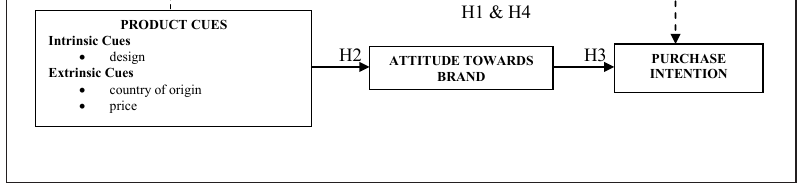
Product cues were measured by nine items adapted from Agarwal and Teas (2002), Field (2000), and Nagashima (1970). The nine items reflect respondents’ perceptions of intrinsic cues of automobiles. The dimensions of product cues are design, price, and country of origin. A five-point Likert scale ranging from strongly disagree to strongly agree was used to determine the respondent’s agreement on all items measuring their perceptions of the intrinsic cues. On the other hand, attitude towards brand was measured based on Burton, Lichtenstein, Netemeyer, and Garretson’s (1998) measurement. A five-point Likert scale ranging from strongly disagree to strongly agree was used to determine the respondent’s agreement on all items measuring their attitude towards brand. Purchase intention was measured based on Agrawal and Teas (2002) measurements.
To test the study framework, the following research hypotheses were formulated:
  H1       There is a positive and significant relationship between product cues and purchase intention.
           H1a       There is a positive and significant relationship between design and purchase
                     intention.
           H1b       There is a positive and significant relationship between country of origin and
                     purchase intention.
           H1c       There is a positive and significant relationship between price and purchase intention.
  H2       There is a positive and significant relationship between product cues and attitude towards
           brand.
           H2a       There is a positive and significant relationship between design and attitude towards
                     brand.
           H2b       There is a positive and significant relationship between country of origin and attitude
                     towards brand.
           H2c       There is a positive and significant relationship between price and attitude towards
                     brand.
  H3       There is a positive and significant relationship between attitude towards brand and purchase
           intention.
  H4       Attitude towards brand mediates the relationship between product cues and purchase
           intention.
           H4a       Attitudes towards brand mediates the relationship between design and purchase
                     intention.
           H4b       Attitudes towards brand mediates the relationship between country of origin and
                     purchase intention.
           H4c       Attitudes towards brand mediates the relationship between price and purchase
                     intention.
Hierarchical regression analyses were carried out to examine the relationship between the independent variables and the dependent variable in the model. To test the mediating effect, Baron and Kenny’s (1986) approach was implemented. Specifically, hypothesis 4 posited that attitude towards brand mediates the relationship between product cues and purchase intention. Multiple regression analysis was carried out to test the mediating effect of attitude towards brand on the relationship between product cues (design, country of origin and price) and purchase intention.
4.0Methodology
A total of 564 questionnaires were returned from 865 questionnaires that were distributed to part-time students of seven public universities in Malaysia. The response rate was 65.20%. Of 564 questionnaires returned, 35 were rejected due to several reasons such as incomplete answers. Therefore, only 529 (61.17%) questionnaires were coded and analyzed. The sample was deemed suitable as part-time students form a big portion of automobile owners and represent a cross-section of consumers in the Malaysian market.
5.0Results
The respondents’ profile of this study is shown in Table 1.0. They were asked questions about age, gender, ethnicity, marital status, and income. The majority of the respondents were in the 25-35 age group (58.2%), followed by less than 25 age group (19.5%), the 36-45 age group (19.3%), 46-55 age group (2.6%) and the > 56 age group (4%). Regarding gender, female outnumbered male respondents. There were 293 females compared to 236 males. In terms of ethnic group, the majority were Malays (84.1%), followed by Chinese (7.2%), Indian (5.1%), and other races (3.6%). In terms of marital status, 319 or 60.3% were married, and 210 (39.7%) are single. On income, 40.3% of the respondents earned between RM 1000 and RM 2000 monthly, followed by those earning between RM 2001and RM 3000 (27.4%). Meanwhile, 12.1% of the respondents earned less than RM 1000 and between RM 3001 and RM 4000. A small percentage of 8.1% had a monthly income of more than RM 4001.
| Demographic Profile | Categories | Frequencies | Percentage |
|---|---|---|---|
| Age < 25 | 103 | 19.5 | |
| 25 – 35 | 308 | 58.2 | |
| 36 – 45 | 102 | 19.3 | |
| 46 – 55 | 14 | 2.6 | |
| > 56 | 2 (continued) | .4 | |
| The Impact of Product Cues and Brand Attitude towards Purchase Intention of Automobiles: 15-30 | 23 | ||
| Demographic Profile Categories | Frequencies | Percentage | |
| Gender Male | 236 44.6 | ||
| Female | 293 55.4 | ||
| Ethnic Malay | 445 84.1 | ||
| Chinese | 38 7.2 | ||
| Indian | 27 5.1 | ||
| Others | 19 3.6 | ||
| Marital Status Single | 210 39.7 | ||
| Married | 319 60.3 | ||
| Monthly Income ≤ RM 1000 | 64 12.1 | ||
| RM 1000 – RM 2000 | 213 40.3 | ||
| RM 2001 – RM 3000 | 145 27.4 | ||
| RM 3001 – RM 4000 | 64 12.1 | ||
| ≥ RM 4001 | 43 8.1 |
5.1Goodness of Data
The internal reliability of intrinsic cues was examined by computing Cronbach’s alpha. Cronbach’s alpha value was adopted as a tool for reliability examination. A bigger alpha value indicates higher internal consistency. The reliability of measurement is considered fairly high if the alpha value is bigger than the acceptable reliability of .60 (Sekaran, 2000). Results from this study showed that the Cronbach alpha was greater than .60, suggesting that it was highly reliable (see Table 2.0). The Cronbach’s alpha for intrinsic cues was above .80. The dependent variable, attitude towards brand, also had a good reliability coefficient exceeding .80. Therefore, the internal consistency of the measures used in this study was considered acceptable.
| Variable | Number of | Cronbach Alpha |
|---|---|---|
| items | ||
| Independent variable | ||
| (Product cues) | ||
| Design | 4 | .81 |
| Country of origin | 5 | .91 |
| Price | 7 | .91 |
| Mediating variable | ||
| Attitude towards brand | 5 | .88 |
| Dependent variable | ||
| Purchase intention | 4 | .89 |
5.2Hypotheses Testing
Hierarchical multiple regressions were used to investigate the relationship between the independent variables and the dependent variable as posited in the research hypotheses. Regression analysis is considered appropriate for this study since both the independent and dependent variables were measured on a continuous scale. The four assumptions underlying multiple regressions analysis as suggested by Hair, Anderson, Tatham and Black (2006) were initially examined and followed.
5.3The Relationship between Product Cues and Purchase Intention
The results (Table 3) demonstrated that the two dimensions of product cues explained 34.60% (R2 = .35) of the variance in Purchase Intention. The dimensions of product cues namely design (ß= .16***, p< .01), country of origin (ß= .11, p< .01), and price (ß= .32***, p< .01) were positively and significantly associated with purchase intention. Therefore, H1a and H1d were supported. The results of the hypotheses testing are summarized in Table 4.
| Dependent Variable Independent Variables Beta |
| Purchase Intension Design .16*** |
| Country of origin .11 |
| Price .32*** |
| R2 .35 |
| Adjusted R2 .34 |
| F 39.36*** |
Note. Significance levels *p < .05, **p < .01, ***p < .001
| Hypotheses testing Results |
| H1 There is a positive and significant relationship between product cues and Supported |
| purchase intention |
| H1a There is a positive and significant relationship between Supported |
| design and purchase intention. |
| H1b There is a positive and significant relationship between Not Supported |
| country of origin and purchase intention. |
| H1c There is a positive and significant relationship between price Supported |
| and purchase intention. |
| The Impact of Product Cues and Brand Attitude towards Purchase Intention of Automobiles: 15-30 25 |
5.4The Relationship between Product Cues and Attitude towards Brand
Hypotheses H2 (and its corollary hypotheses) indicated having a positive and significant relationship between all dimensions of product cues and attitude towards brand as presented in Table 5. To test the hypotheses, multiple regression analysis was carried out to determine the relationship between product cues (design, country of origin and price) and attitude towards brand.
The results indicated that the two dimensions of product cues explained 50% (R2 = .50) of the variance in attitude towards brand. The dimensions of product cues namely design (ß= .17***, p< .01), country of origin (ß= .15***, p< .01), and price (ß= .32***, p< .01) were positively and significantly associated with attitudes toward brand. Therefore, it could be concluded that H2a, H2b, and H2c were supported. The results of hypotheses testing are summarized in Table 6.
| Dependent Variable Independent Beta |
| Variables |
| Attitude Towards Brand Design .17*** |
| Country of origin 015 *** |
| Price .32*** |
| R2 .50 |
| Adjusted R2 .49 |
| F 73.28*** |
Note. Significance levels *p < .05, **p < .01, ***p < .001
| Hypotheses testing Results |
| H2 There is a positive and significant relationship between product cues and Supported |
| attitude towards brand. |
| H2a There is a positive and significant relationship between design Supported |
| and attitude towards brand. |
| H2b There is a positive and significant relationship between country of Supported |
| origin and attitude towards brand. |
| H2c There is a positive and significant relationship between price and Supported |
| attitude towards brand. |
5.5The Relationship and Attitude towards Brand and Purchase Intention
Multiple regression analysis was carried out to test the direct relationship between attitude towards brand and purchase intention. The results (Table 7) demonstrated that attitude towards brand explained 41.10% (R2 = .41) of the variance in purchase intention. Attitude towards brand (ß= .64**, p< .01) was positively and significantly associated with purchase intention. Therefore, it could be concluded that H3 was accepted. The results of hypotheses testing are summarized in Table 8.
| Dependent Variable Independent Variables Beta |
| Purchase Intention Attitude Towards Brand .64*** |
| R2 .41 |
| Adjusted R2 .41 |
| F 367.57*** |
Note. Significance levels *p < .05, **p < .01, ***p < .001
Hypotheses testing Results
H3 There is a positive and significant relationship between attitude Supported towards brand and purchase intention.
5.6The Mediating Effect of Attitude towards Brand on the Relationship between
Product Cues and Purchase Intention
Multiple regression analysis was carried out to test the mediating effect of attitude towards brand on the relationship between product cues (design, price, and country of origin) and purchase intention. However, based on the conditions discussed by Baron and Kenny’s (1986), only design and price were included to test the mediation effect.
Hypotheses H4 indicated that attitude towards brand mediates the relationship between product cues (design and price) and purchase intention. To test the hypotheses, hierarchical regression analysis were carried out to determine the mediation effect of attitude towards brand.
As shown in Table 9, attitude towards brand mediated the relationship between the two dimensions of product cues (design and price) and purchase intention. The inclusion of attitude towards brand resulted in a significant standard beta coefficient in step 2 for the independent variables. Therefore, it could be concluded that H4 was accepted (Table 10).
| Relationship between Product Cues and Purchase Intention |
| Dependent Variable Independent Variable Std Beta Step 1 Std Beta Step 2 |
| Purchase Intention Design .25*** .11*** |
| Price .41*** .19** |
| Mediating |
| Attitude Towards Brand .47*** |
| R2 .33 .45 |
| Adjusted R2 .32 .44 |
| R2 Change .33 .12 |
| F Change 127.28*** 113.96*** |
Note. Significant levels *p < .05, **p < .01, ***p < .001
| Hypotheses testing | Results |
|---|---|
| H4 Attitude towards brand mediates the relationship between product cues and | Supported |
| purchase intention. | |
| H4a Attitudes towards brand mediates the relationship between design | Supported |
| and purchase intention. | |
| H4c Attitudes towards brand mediates the relationship between price and | Supported |
| purchase intention. |
6.0Discussion and Conclusion
The objective of this study was to understand the impact of intrinsic cues on attitude towards brand of automobile among Malaysians which has been met. From the research, we conclude that product cues (design and price) have a significantly positive influence on consumers’ attitude towards brand. This study offers practical implications for the Malaysian automobile company, Proton, and other automobile assemblers or distributors of automobiles in Malaysia. It provides an insight into the perception of Malaysian consumers with regards to their attitude towards a certain brand of automobiles. More importantly, it would help the marketer of Malaysian brand,
Proton, to formulate strategies to promote the Proton brand among Malaysians. For export market, Proton needs to examine the attitude of foreign consumers about their attitude towards a particular brand. Proton needs to develop an appropriate marketing strategy to attract consumers’ attention and increase their purchase intention. This study discovers that product cues are an important factor in influencing consumers’ attitude towards a particular brand. Therefore, in developing marketing strategies, manufacturers, assemblers, and distributors of automobiles must first understand the consumers’ formation of attitude towards a certain brand to increase the effectiveness of their marketing strategy.
6.1Theoretical Contributions
The theoretical relationships posited in the theoretical framework were empirically supported. Specifically, this study established the linkage between respondents’ perceptions of product cues (intrinsic and extrinsic cues), attitude towards brand, and purchase intention. In other words, this study adds further knowledge to the importance of product cues as the predictor of purchase intentions. This study also provides evidence of the importance of attitude towards brand as the intervening variable and purchase intentions. By indicating the existence of significant direct and indirect effects of product cues, attitude towards brand and purchase intentions, and this study provides evidence that product cues are important in nurturing respondents’ positive attitudes.
This study also provides empirical support for the conceptual framework developed by Fishbein and Ajzen (1967) about the beliefs – attitudes - behavioral intentions relationships. Their suggestion that a person’s beliefs about an object would influence the person’s attitudes toward that object and that the person’s attitudes toward the object would influence the person’s intentions toward the object were empirically substantiated. This study adds further knowledge to the behavioral intentions process. Specifically, this process is sequential as follows: cognitive attitude, affective attitude, and behavioral intentions. Most importantly, this study provides evidence of the independent effects of cognitive attitude and affective attitude on behavioral intentions.
Within the Malaysian context, this study enhances the understanding of the role attitude towards brand among Malaysian consumers. In particular, to the researcher’s knowledge, this is the first local study that examines the relationships among consumers’ perception of product cues, attitude towards brand and purchase intentions. From the results of this study, marketers can understand more about psychological effects that affect the consumers’ attitudes and behavioral intentions.
References
- Agarwal, J., and Malhotra, N. K., (2005). An integrated model of attitude and affect: Theoretical foundation and empirical investigation. Journal of Business Research, 58, 483-493.
- Agarwal, S., & Teas, R. K., (2002). Cross-national applicability of a perceived quality model. The Journal of Product and Brand Management, 11(4/5), 213-237.
- Bearden, W. O., & Shimp, T. A., (1982). The use of extrinsic cues to facilitate product adoption. Journal of Marketing Research, 19, 229-39.
- Bilkey, W. J., & Nes, E., (1982). Country-of-origin effects on product evaluations. Journal of International Business Studies, 8(1), 89-99.
- Burton, S., Lichtenstein, D. R., Netemeyer, R. G., & Garretson, J. A., (1998). A scale for measuring attitude toward private label products and an examination of its psychological and behavioral correlates. Journal of the Academy of Marketing Science, 26(4), 293-306.
- Cordell, V.V., (1992). Effects of consumer preferences for foreign sourced products. Journal of International Business Studies, 23(2), 251-269.
- Diamantopoulos, A., Schlegelmilch, B. B., & Du Preez, J. P., (1995). Lessons for pan-European marketing? The role of consumer preferences in fine-tuning the product-market fit. International Marketing Review, 12(2), 38-52.
- Ettenson, R., (1993). Brand name and country of origin effects in the emerging market economies of Russia, Poland and Hungary. International Marketing Review, 10(5), 14-36.
- Field, J. R. B., (2000). An empirical investigation of consumers’ perceptions and purchase intentions of counterfeit products: A means-end chain analysis. Unpublished doctoral thesis. Mississipi State University.
- Gutman, J., & Alden, S.D., (1985). Adolescents’ cognitive structures of retail stores and fashion consumption: a mean-end chain analysis of quality. In J. Jacoby & J. Olson (Eds.), Perceived quality: How consumers view stores and merchandise (pp. 99-114). Lexington: MA: Lexington Books.
- Han, C. M., & Terpstra, V., (1988). Country of origin effects for uni-national and bi-national products. Journal of International Business Studies, 19, 235-255.
- Han, C. M., (1988). The role of consumer patriotism in the choice of domestic versus foreign products. Journal of Advertising Research, 28(3), 25-32.
- Han, C. M., (1989). Country image: Halo or summary construct? Journal of Marketing Research, 26, May, 222-9.
- Han, C. M., (1990). Testing the role of country image in consumer choice behavior. European Journal of Marketing, 24(6), 24-39.
- Haubl, G., (1996). A cross-national investigation of the effects of country of origin and brand name on the evaluation of a new car. International Marketing Review, 13, 76-97.
- Khachaturian, J. L., and Morganosky, M. A., (1990). Quality perceptions by country of origin. International Journal of Retail & Distribution Management, 18(5), 21-30.
- Kotler, P., and Armstrong, G., (2001). Principles of marketing (9th ed.), Prentice Hall, New Jersey.
- Malaysian Automobile Association., (2006).
- Maxwell, S., (2001). An expanded price/brand effect model: A demonstration of heterogeneity in global consumption. International Marketing Review, 18(3), 325-343.
- Mitchell, A. A., and Olson, J. C., (1981). Are product attribute beliefs the only mediator of advertising effects on brand attitude? Journal of Marketing Research, 18, 318-332.
- Monroe, K. B., and Krishnan, R., (1985). The effect price on subjective product evaluations. In Jacoby, J., & Olson, J. (Eds.) Perceived quality: How consumers view store and merchandise (pp. 55-60). Lexington, MA: Lexington books.
- Nagashima, A., (1970). A comparison of Japanese and US attitudes towards foreign products. Journal of Marketing, 34, January, 69-74.
- Pecotich, A., Pressley, M., and Roth, D., (1996). The impact of country of origin in the retail service context, Journal of Retailing and Consumer Services, 3(4), 213-224.
- Reed, G., Story, V., and Saker, J., (2004). Information technology: Changing the face of automotive retailing? International Journal of Retailing & Distribution Management, 32(1), 19-33.
- Roelling, L., (2001). Designing global brands: Critical lessons. Design Management Journal, 12(4), 40-47.
- Schaefer, A., (1997). Consumer knowledge and country of origin effects. European Journal of Marketing, 31(1), 56-72.
- Sekaran, U., (2000). Research methods for business: A skill-building approach (3rd ed.). John Wiley & Sons, Inc. USA.
- Snoj, B., Korda, A. P., and Mumel, D., (2004). The relationships among perceived quality, perceived risk and perceived product value. Journal of Product and Brand Management, 13(3), 156-167.
- Zhang, Y., and Zarb, F. G., (1996). Chinese consumers’ evaluation of foreign products: The influence of culture, products types and product presentation format. European Journal of Marketing, 30(12), 50-68.