Creating Shared Values through Human Resource Activities: Toward an Effective Transformation Programme
- UUM City Campus, Kuala Lumpur
Journal of Business Management and Accounting 5(1) (2015) · https://doi.org/10.32890/jbma2015.5.0.8866
Abstract
Numerous literature works emphasised on shared values and the role it plays in the organisation. The value and system form the basis of a strong culture that enables the organisation to better react to any transformation plan. As with most of the public organisations in Malaysia, the government has set up the Government Transformation Programme (GTP), an ambitious, broad-based programme of change to fundamentally transform the government organisation into an efficient and citizen-centred institution. Hence,all Malaysian government organisations need to work fast and smart in order to realise the objectives of Vision 2020. The shared values concept is considered as the prerequisite to shape the standards and expectations held by employees of these organisations that help to guide aspects of practice performance. Generally in services, the core values of support, respect of choice, collaboration, and customer service form the basic foundation of a trusting therapeutic relationship. Hence, this paper presents acase of a government agency which is in the process of implementing a transformation plan. Before the department can move forward with the transformation agenda, it is critical to understand the current values and practices, which would subsequently enable to identify the values that can be formed through human resource activities. The case provides valuable insight into the necessary parts of the transformation process, particularly in developing the right values and practices in the government sector.
Keywords: Transformation plan, shared values, human resource activities, government department
Introduction
The shared values concept has been considered as the key building block for developing trust and a harmonious environment, which subsequently can enhance the effectiveness of organisational strategy. Shared values refer to the fundamental beliefs, concepts, and expectations held by the members of an organisation (Amah & Ahiazu, 2014). These values guide decisions and behaviour of the employees, management, and members, and underlie as the culture of the organisation. These shared values would make one organisation’s culture to be very unique from another. From the business perspective, this concept of shared values can be extended as policies and operating practices that would enhance the competitiveness of an organisation while simultaneously advancing the economic and social conditions in the communities in which it operates (https://hbr. org/2011/01/the-big-idea-creating-shared-value). Porter and Kramer (2011) claimed that shared value ‘‘involves creating economic value in a way that also creates value for society by addressing its needs and challenges’’. Due to its significant importance for organisations, it has led many proponents of the shared values concept to search for the best strategies to cultivate these shared values, particularly values that are able to enhance the organisation’s effectiveness and productivity. All organisations aim to be productive, profitable, and sustainable even with the ever increasing challenges of coping with changes in the environment. The need to achieve these goals has triggered the company to find ways in motivating the workers. According the Cares and Porter (1997), the performance toward achieving enhanced productivity is usually influenced by the strategic group memberships and associated collective behaviour. This is related to the shared values concept, which forms the basis of strong culture and central source for integration, coordination, and control. Hence, one of the best medium to create and shape shared values is obviously through human resource (HR) activities. Previous research indicated that HR activities commonly include personnel administration, training, and staffing tasks, which are delivered as HR services through the use of concentrated resources, such as information technology, and human resource knowledge and skills (Bondarouk et al., 2004). According to Farndale et al. (2009), the challenges in dealing with HR activities are to achieve cost reductions by centrally bundling resources while, at the same time, responding to business unit and end-user needs through delegating control over HR service delivery to the business units. In balancing the liabilities and benefits of HR management, organisations expect to reap concrete benefits such as quick decision-making, consistent implementation of HR policies and processes, creation of synergies, increased productivity, better management information, greater transparency of cost of services, reduced administrative HR workloads, and an increased strategic contribution from HR professionals (Cooke, 2006).
Creating shared value strategies has been considered as an emerging field in the intersection of development studies (Sink, 1991; Nelson, 2006), strategy (Porter, 1980; Prahalad & Hart, 2002; Hart & Milstein, 2003; Porter & Kramer, 2011), stakeholder theory (Freeman, 1984; Freeman et al., 2004; Spitzeck & Hansen, 2010), and innovation (Chesbrough, 2003; Ayuso et al., 2006; Hansen et al., 2009; Florin & Schmidt, 2011). Despite this emerging concept and strategy of shared values, little empirical evidence exists in developing countries, particularly in the public sector.
To bridge this gap in the literature, this study aimed to identify the shared values perceptions among government employees through their human resource activities. These shared values are one of the important elements in the McKinsey 7S model, in helping to identify the impact of changes in an organisation (Palatkova, 2011). Peter and Waterman (2004) who introduced the 7S McKinsey model in 1981 claimed that for an effective organisation, all the 7S components, namely structure, strategy, system, style, staff, skills, and shared values should be aligned and well connected. Hence, this implies that shared values reflect the readiness level of an organisation to accept and implement any new changes or plans. Generally, government departments are mainly concerned with their achievement related to the national target performance. Many initiatives and high commitment have been given out in order to meet the objectives of the Economic Transformation Programme (ETP). The ETP has been designed to transform Malaysia to be a developed country as well as a high-income country, as contained in the Vision 2020. In this respect, government departments need to strategise their efforts to be aligned with ETP, yet there may be challenges in nurturing the right values shared by all in the organisation to support the organisational plan strategy. The ETP implementation obviously requires government agencies to change from its current state to some desired future state. However, these change initiatives may invite resistance among employees who seem to be unsecure and threatened with the new policy and working system. Consequently, the new plan could possibly fail due to the manner in which change has been visualised, announced, and implemented, and also through the internal resistance it builds. Employees, in other words, would sabotage those changes as they view it as antithetical to their own interests. Hence, it is very important to tackle the soft elements of an organisation in adapting to these changes. Soft elements in this context would refer to the human resource activities and the shared values that would be highly influenced by organisational culture. As mentioned earlier, this paper is interested in exploring the perception of employees on HR activities and shared values, which seem to be relevant in supporting the organisational transformation plan. One of the government agencies, MALA Department (not the real department’s name) was chosen in order to investigate the status quo of practices in adapting to the strategy, as required in the ETP. MALA has established its vision and mission to support the government strategic vision, particularly in ensuring the sustainability of the country. Having 13 branches and 28 offices in all states in Malaysia, MALA acts as a disseminator of information, expertise, and ideas for development of the society toward the appreciation of the natural environment on an on-going basis. This includes promoting the concept of self-compliance by the industry and the public.
Economic Transformation Programme
The Economic Transformation Programme (ETP) is an initiative by the Malaysian government to turn Malaysia into a high income economy by the year 2020. It is managed by the Performance Management and Delivery Unit (PEMANDU), an agency under the Prime Minister’s Department of Malaysia. Launched on 21 September 2010, it is a comprehensive economic transformation plan to propel Malaysia’s economy into becoming a high income nation. This programme is expected to lift Malaysia’s Gross National Income (GNI) to US$523 billion by 2020, and raise per capita income from US$6,700 to at least US$15,000, thus meeting the World Bank’s threshold for a high income nation. It is projected that Malaysia will be able to achieve the targets set if GNI grows by 6% per annum. The MALA department, as being under the Ministry, is committed to take necessary action to align itself with the seven key areas of the Government’s Transformation Programme (GTP). GTP is linked to the Economic Transformation Programmes (ETP) which is aimed at turning Malaysia into a high income economy by the year 2020. Therefore, as one of the strategic entities, MALA has integrated its actions so as to be able to help achieve these goals. In order to establish greater effectiveness in performing the above responsibilities and streamline all management activities in relation to the Ministry’s five year plan, it is therefore critical for an assessment on the internal factors, particularly the HR activities that are able to shape the values needed to successfully execute the transformation plan. 3.0
Methodology
This exploration study was conducted as a cross sectional survey with the unit of analysis being the employees. All management level employees were included and the micro analysis was adopted. Data for the study were collected through online questionnaires distributed electronically among the MALA employees. Prior to that, the instrument development was developed through a series of workshops with the “transformation troopers”, i.e., the group of MALA staff representatives selected for the purpose of designing, planning, and implementing the transformation plan. The questionnaire consisted of three parts, namely demographics, the level of current practices, and perception of shared values and human resource activities. The respondents comprised MALA staff members from all levels of employment and areas of specialisation. Respondents were asked to rate their perceptions on several items of shared values. Using a four-scale measurement (where 1 = “strongly disagree” to 4 = “strongly agree”), the scores given by the respondents were taken as a grouped percentage. These percentage scores were then surmised as a certain level of performance, according to the following as:
85-100: good performance, 70-84: moderate performance, and less than 70: below par performance. Teleconferencing was held on 13 September 2012 by the MALA offices throughout Malaysia. The teleconferencing was intended to provide an introduction to the developed survey website (namely the service provided by Survey Monkey) and guidance to staff in order to answer the questionnaire. The period for completing the questionnaire was approximately a week, from 13 to 24 September 2012. Hence, the questionnaire survey was expected to be able to cover all MALA employees ranging from the top management to the lowest level of support workers. The survey result was finalised on 25 September 2012. There were 752 respondents who participated in the survey. However, the actual number of respondents who answered the questions was less than the total number of MALA employees due to the fact that some of them were involved in activities that were held in remote areas and could not have access to the Internet. There are also respondents that have to be excluded from the survey due to missing answers and incomplete questionnaires. Nevertheless, the data seems to be meaningful in achieving the objectives of the study. The survey results served as the basis for the second phase of the data collection that was through the qualitative approach. Three series of workshops were conducted using focus groups representing MALA employees mainly from the managerial and professional levels, and one support group members. The purpose of these workshops was to gauge implication of the results and identify MALA initiatives in order to reveal the current perceptions on shared values and human resource activities, understand the gap, and thus recognise initiatives in order to meet the transformation goals. 4.0
Findings
Demography
The findings found that 53% of the respondents were male and 46% were female, while 1% of the respondents did not specify. Nevertheless, a total of 731 respondents were used for the data analysis. Figures 1 and 2 below show the profile demographics of the respondents in more detail.
Frequency No response 1%
Women 46% Men 53%
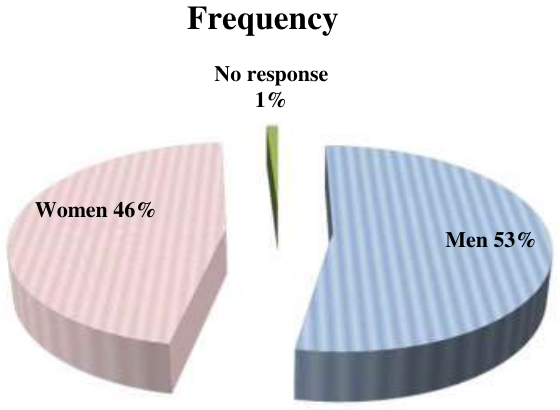
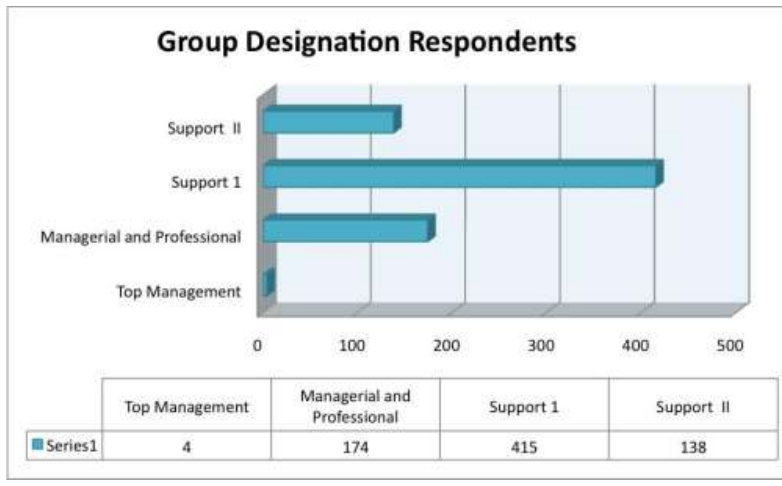
Generally, this research has an equal composition of men and women. The analysis also showed that the Support 1 group received the largest participation (57%), followed by 24% of the Management and Professional Group, 19% of the Support Group II, and 1% of the Group’s top management. 5.0
Shared Values
Shared Values, also known as the “superordinate goals” is the core values of the company that are evidenced in the corporate culture and general work ethics. Hence, employees are required to answer questions related to the values that they feel to already exist in the MALA department (Figure 3).
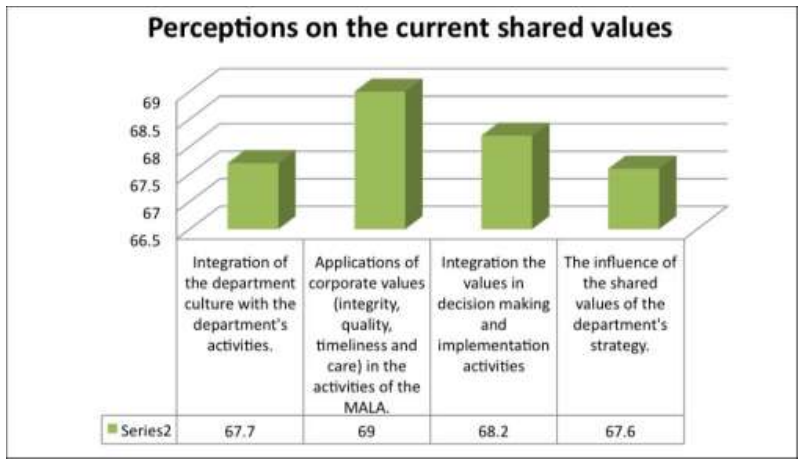
Although the shared values are considered as prerequisite to shape organisational culture, the share values implementation is still considered low in MALA where the respondents rated them with an averaged mean score of 68.1%. The highest score was related to the application of corporate value, namely the level of integrity, quality, timeliness, and sensitivity in the activities of MALA. Meanwhile, the lower mean scores were obtained for two aspects of shared values, which are the integration of the department culture with the department activities (67.7%) and the influence of the shared values in the MALA strategy (67.6%). Nevertheless, the score generally showed that the shared values for inculcating the transformational culture in MALA to be still considered below expected or satisfactory performance. The MALA staff may not be able to integrate the values and culture with the department’s strategy and activities effectively. Without coordination and integration, different functions and units in the department cannot work together to achieve the common goal. This result implies that improvement is needed to cultivate a unified set of values which would enhance the quality of collaboration among individuals, units and functions in the MALA department. According to Porter and Kramer (2011), shared values refer to the policies and operating practices that enhance the competitiveness of an organisation. With regard to competitiveness, the role of human resource activities cannot be denied in aligning the staff with the organisation goal. 6.0
Human Resoure Activities
Since the 1980s, human resource management (HRM) strategy has become an increasingly important topic for research. HRM strategy achieved its prominence because it provides a means by which business firms can enhance their competitiveness and promote managerial efficiency (Wright et al., 1998). By effectively managing their human resource, firms nurture the type of employee behaviour that is essential to the success of their competitive strategy. For the case of MALA human resource activities, questions were asked regarding the competency reengineering, level of the department’s initiatives in enhancing the efforts to improve high working spirit, level of department’s initiatives to provide training opportunities among staff, the skills effects toward staff performance, the effectiveness of mentor-mentee programme, the level of implementation on the counselling programme, and finally the balance between workload and staffing requirements, as shown in Figure 4.
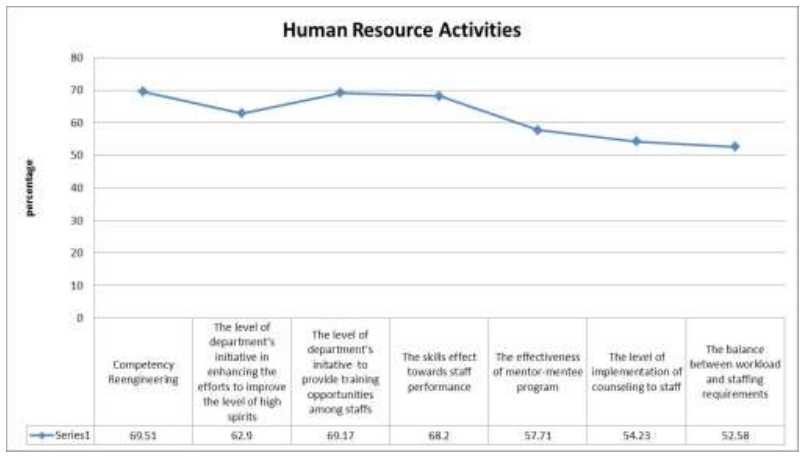
Generally, the mean score of the human resource activities is quite moderate that is 61.8%. The highest score was for the competency reengineering (69.5%). This reflects that the elements of reengineering took place whereby the respondents perceived the ways of doing tasks had been improved and supported by the IT systems. On the other hand, “the balance between workload and staff requirements” seems to be a concern among the staff, which is reflected in the lowest score of 52.6%.
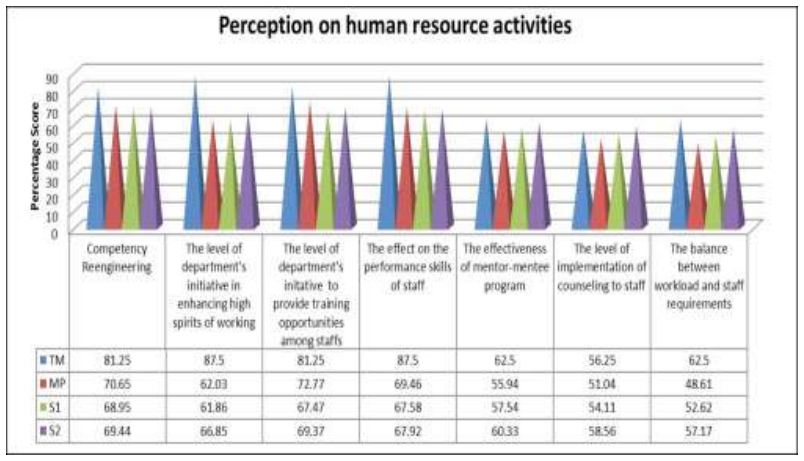
With regard to the group designation, the top management (TM) has given generally high scores compared to other groups. This group gave the highest scores (87.5%) for both “the level of initiative to enhance high spirit of working” and “the level on the skills towards staff performance”. This shows that the top management pays serious attention in developing staff competency. However, “the balance between workload and staff requirements” scored the lowest (55.3%) mainly from the managerial and professional group. This indicates that the intermediate level of management requires more staff to reduce the workload. 7.0
Discussion
An effective organisational culture exhibits the professionalism of its human resource to work as a team for achievement of the transformational objectives. Hence, the shared values cultivated through HR activities should be acknowledged as being a fundamental factor in accepting any changes (Adolvand et al., 2008).
The results demonstrated the perception on the existing practices. It can be perceived that the shared values are still not obvious among staff. According to the focus groups, the reason could be that some of the employees still do not have the sense of belonging, ownership toward their work, and have no interest to understand the department’s strategic mission and vision. Hence, more initiatives are needed by MALA in order to encourage integration, teamwork, cooperation, coordination, and empowerment of employees in the work environment. HR activities are the best medium to instil the above values especially in developing employee’s empowerment. Empowerment gives a chance for employees to contribute positively to the organisation by making decisions without referring to their supervisor, and at the same time, perform at their utmost effort to achieve the organisational objectives. By having this, the employees will have more involvement in the department’s decision process. Human involvement is a powerful instrument for organisational culture that encourages employee’s motivation and loyalty to the organisation. Some initiatives that have been proposed in order to link with the transformation plan are as follows: • enhancing integrity through implementing MALA department’s action plans, increasing allocation of funds, using outcome based budget (OBB), implementing a policy called “No Wrong Door Policy”, and establishing a monitoring committee;
implementing productive teamwork by integrating the 3E concept, i.e., engage, ex-plain, and execute, uphold the slogan of CTI PCI (“Cepat Tepat Integriti, Produk-tiviti, Kreativiti, Inovasi”, which is roughly translated as Fast, Accurate, Integrity, Productivity, Creativity, Innovation);
developing effective leadership by encouraging leaders and managers to go down to the problem and act as the fire fighters; and upgrading competencies such as by conducting programmes, particularly competencies training and certification by MALA training unit, mentor-mentees, and evaluation programme from peer groups.
It is hoped that the initiatives above are able to create effective organisational culture and stimulate the receptivity to change among employees.
Conclusion
Shared values include the values, vision, norms, working languages, systems, symbols, confidence, and character shared by all employees in the organisation. Shared values affect the way workers’ organisations and a collection of interaction among each other, with customers and with interested parties. On the other hand, human resources activities are responsible for processes such as attraction, selection, training, assessment, and reward of employees, in addition to overseeing leadership and organisational culture, and ensuring compliance with the employment and labour law. From the findings of this MALA research, even though the scores for shared values and human resource activities are considered moderate to low, it does provide some insight for the MALA top management on critical issues that they should give more attention before the transformation plan can take place successfully. The results showed what are the values and human resource activities that support the attitude needed within the organisation to enable the successful implementation of organisational strategy and action plan. This paper explored the perception of employees in one government department. Presently, all government departments have come out with their own transformation plan in order to ensure the successful implementation of the economic transformation plan set by the government. It is believed that it is important to understand the internal perspectives on their current practice. From there, the organisation can have some guidelines to develop its own measures and configure the department action plans toward the achievement of the country’s economic transformation plan.
References
- Amah, E, and Ahiauzu, A., (2014). Shared values and organisational effectiveness: A study of a Nigerian Banking Industry, Journal of Management Development, 33(7), 694–708.
- Ayuso. S., Rodriguez, M. A., and Ricart, J. E., (2006). Using stakeholder dialogue as a source for new ideas: A dynamic capability underlying sustainable innovation. Corporate Governance: The International Journal of Business in Society, 6(4), 475-490.
- Bondarouk, T. V., (2004). Using group learning to enhance the implementation of information technology: The results of discourse analysis, unpublished doctoral thesis, University of Twente, Enschede.
- Chesbrough, H., (2003). Open Innovation: The new imperative for creating and profiting from technology. Boston, MA. Harvard Business School Press.
- Cooke, F. L, (2000). Modelling an HR shared service centre: Experience of a MNC in the United Kingdom, Human Resource Management, 45(2), 211-27.
- Farndale, E., Paauwe, J, and Hoeksema, L., (2009). In sourcing HR: Shared service centres in the Netherlands, in Martin, G., Reddington, M. and Alexander, H. (Eds.), Technology Outsourcing and Transforming HR, pp 105-35.
- Florin, J. and Schmidt, E., (2011). Creating shared value in the hybrid venture arena: A business model innovation perspective, Journal of Social Entrepreneurship, 2(2), 165-97.
- Freeman, R. E., (1984). Strategic Management: A Stakeholder Approach, Pitman, Boston, MA.
- Freeman, R. E., Wicks, A. C. and Parmar, B., (2004). Stakeholder and the corporate objective revisited, Organisation Science, 15(3), 364-9.
- Hansen, E. G., Große-Dunker, F. and Reichwald, R., (2009). Sustainability Innovation Cube– a framework to evaluate sustainability-oriented innovations, International Journal of Innovation Management, 13(4), 683-713.
- Hart, S, and Milstein, M., (2003). Creating sustainable value, Academy of Management Executive, 17(2), 56-67.
- Nelson, J., (2001). Building Partnerships: Cooperation between the United Nations and the Private Sector, Department of Public Information, United Nations, New York, NY.
- Nelson, J., (2006). Leveraging the development impact of business in the fight against global poverty, Corporate Social Responsibility Initiative Working Paper No. 22, John F. Kennedy School of Government, Harvard University, Cambridge, MA.
- Palatkova, M., (2011). The 7-S-McKinsey Model: An implementation tool of a destination marketing strategy in the Czech Republic. Letter from the editor Peter Odrakiewicz.
- Peters, T. J., and Waterman, R. H., (2004). In search of excellence: Lessons from America’s best-run companies. Harper Business.
- Porter, M. and Kramer, M. R., (2011). The big idea: creating shared value, Harvard Business Review, 89(1/2), 62-77.
- Porter, M. E., (1980). Competitive Strategy: Techniques for analysing industries and competitors, The Free Press, New York, NY.
- Porter, M. E. and Kramer, M. R., (2002). The competitive advantage of corporate philanthropy, Harvard Business Review, December, 3-14.
- Porter, M. E. and Kramer, M. R., (2006). Strategy and society: the link between competitive advantage and corporate social responsibility, Harvard Business Review, 85(12), 78-92.
- Prahalad, C. K., (2005). The fortune at the bottom of the Pyramid, Wharton School Publishing, Philadelphia, PA.
- Prahalad, C. K., and Hart, S., (2002). The fortune at the bottom of the pyramid, strategy + business, 26, 2-14.
- Sink, D. W., (1991). Transorganisational development in urban policy coalitions, Human Relations, 44(11), 79-95.
- Spitzeck, H., (2009). Organisational moral learning: what, if anything, do corporations learn from NGO critique?, Journal of Business Ethics, 88(1), 157-73.
- Spitzeck, H. and Hansen, E., (2010). Stakeholder governance – how do stakeholders influence corporate decision-making?, Corporate Governance, 10(4), 378-91. https://hbr.org/2011/01/the-big-idea-creating-shared-value