A Study on Workforce Requirements at Besgrade Products Sdn. Bhd.
- Centre for Testing, Measurement and Appraisal (CeTMA)
- School of Economics, Finance and Banking, College of Business
- School of Business Management, College of Business, Universiti Utara Malaysia, Sintok, Kedah
Journal of Business Management and Accounting 5(1) (2015) · https://doi.org/10.32890/jbma2015.5.0.8863
Abstract
The Malaysian timber industry is a competitive industry that has the potential to grow. Since most of the production in this industry is for the export market, the global economic conditions and competition from other producing countries will nevertheless affect the performance of the industry. Therefore, in order for this market to expand, the quality of timber production should be further enhanced and offered at a more competitive price. Generally, issues related to high dependency on foreign workers and low level of automation are believed to seriously affect the viability and sustainability of the Malaysian timber industry. Following these issues, a case study was carried out on Besgrade Products Sdn. Bhd., which is one of the largest plywood manufacturers in Malaysia. The findings revealed that, in general, the percentage of foreign workers in the company is far higher than the percentage of local workers. It was also found that the majority of foreign workers occupied the operator position. Probing further into the problem facing by the firm in hiring local workers revealed that long working hours and unpleasant work environment are the major factors that contribute toward low participation of local workers. With regard to foreign workers, communication problems and “red tape†in permit approval are among the major issues. Based on the findings, various suggestions related to labour issues have been put forth. These include the rebranding of the timber industry to be more dynamic, providing a more conducive work environment, introducing competitive wages for local workers, intensifying efforts toward automation through the use of technology thereby promoting the training of skilled workers who can handle high technology machines, and finally establishing policies to gradually reduce the dependency on foreign labour while at the same time training local workers with the necessary skills.
Keywords: Foreign labour, timber industry, rebranding, wages, automation and policy
Introduction
The timber industry in Malaysia is one of the industries which contribute significantly toward the country’s revenue. On average, this industry contributes around 3.4% toward the gross domestic product (GDP). In general, the industry provides employment opportunities to more than 200,000 people. By and large, the timber industry in Malaysia has undergone several developmental phases based on the Industrial Master Plan. In the initial phase (First Industrial Master Plan, 1986-1995), the activities in the industry were more focused on the production of logs, sawmilling, and plywood. During the second phase of development of the timber industry (Second Industrial Master Plan, 1996-2005), the emphasis continued to be placed on value added processes involving the export of timber and timber products. In the third phase (Third Industrial Master Plan, 2006-2020), the government projected that growth in the timber industry will be geared toward higher value added processes, e.g., through the export of furniture.
In order to strengthen the growth of the timber industry, the Malaysian Timber Industry Board (MTIB) was established under the Act of Parliament on 1 June 1973 as a statutory body under the Ministry of Primary Industries. The Ministry later became known as the Ministry of Plantation Industries and Commodities. In line with the mission that have been assigned to the MTIB through the Malaysian Timber Industry Board Act 1973 (No. 105 of 1973), the Board identified several important objectives to be achieved, namely the need to develop further the timber industry and increase its significance through value added processes; to promote and improve the marketing strategy of wood products; to support and strengthen the development of small and medium scale industries; to establish and heighten the application of standards in the development of timber products; and to inculcate the spirit of discipline in the timber industry. In order to ensure the development of a conducive work environment and continuous quality service, the National Timber Industry Policy (NATIP 2009-2020) was introduced. This timely policy provides guidelines for the development and progress of the timber industry in general, and furniture industry in particular, until 2020. The MTIB, based on one of the strategic thrusts of the NATIP (Thrust 5: Human Capital Development), considers the development of human capital as one of the most important and critical elements that should be given emphasis, so as to ensure that productivity, efficiency, quality of service, and the competitiveness of the timber industry are enhanced. In this regard, MTIB is now taking the initiative to provide a platform to match the local workers, especially the skilled ones, with the demand of employers in the timber industry. It is hoped that with this new platform, the employers/firms will use it as a window of opportunity to upgrade the skills of the existing workers, and to select potential graduates with the necessary knowledge and skills related to the timber industry to be recruited, as these human resources are capable of boosting the growth of the industry through an increase in value added processes.
Problem Statement
The timber industry can be classified into the upstream and downstream activities. The upstream activities include timber harvesting and planting, while the downstream activities involve three stages from the processing of raw materials (timber) to the manufacturing of semi-finished wood products, and finished products. At present, about 60% of export value of timber industry is derived from the first stage of activities, including timber harvesting, and processing of sawn timber, plywood, veneer, and particleboard. Meanwhile, the remaining 40% of export value comes from the second and third stages of the activities related to the manufacture and export of wood mouldings; product builders, joinery and carpentry; furniture and furniture components, and wooden build-ing components and structures (NATIP Report, 2009). In ensuring the competitiveness and sustainability of the Malaysian timber industry, the government is determined in its efforts to achieve the target of 60% value added for the downstream activities. The move toward increasing value added outcomes is very much related to the development of human capital, which is one of the important ele-ments found in the NATIP’s strategic thrust, which is to ensure an increased local work-force and reduce the industry’s dependency on foreign labour. Data in 2012 showed that the hiring of foreign labour has increased by approximately 8.8% compared to that in 2011 (estimated figure based on MTIB-DOS, 2013). Production costs and lack of readiness among local workers to be involved in the timber industry are among the important factors that have contributed to heavy dependence on foreign workers. Cur-rently there is the view that the numbers and quality of graduates from existing training providers do not meet the needs for a skilled workforce required by the industry. There-fore, to overcome the shortfall in demand for skilled workforce, there is an urgent need to strengthen the capability and knowledge of local workforce, and equip them with the state-of-the-art technology so that they will contribute more toward developing the manufacturing activities with high value added products and services. By adopting cur-rent technologies and through effective training methods, the skilled workforce will be in a position to improve productivity in the timber industry. Realising that the timber industry is one of the industries that has high potential for growth, the government has decided that enhancing added value in the production of timber should be given serious attention through the implementation of a more strate-gic human capital development programme. At the same time, employers in the timber industry are encouraged to provide a more conducive working environment, willing and ready to invest in R&D, and move toward increasing the level of automation so as to reduce the high dependency on foreign workers. In light of these background is-sues, therefore there is an urgent need for a study to be conducted that will assist the management of MTIB to make informed decisions through a deeper understanding of the requirements and the demand for a skilled workforce in the industry. The study also evaluated related industry policies, especially in assessing the impact of the government’s policy in reducing dependency on foreign workers, the readiness of employers to invest in R&D, and their efforts to increase automation. For the purpose of identifying real problems that lead to high dependence on foreign workers as well as issues related to automation and skills of local graduates, therefore a case study has been carried out at Besgrade Products Sdn. Bhd., which is one firm actively involved in the timber industry. The objective, scope, and issues, as well as the findings are described in the following sections. In Malaysia, the minimum wage order was gazette on 16 July 2012 and implemented on 1 January 2013. The Minimum Wage Order requires employers with six employees and above to pay a minimum wage of RM900 a month in Peninsular Malaysia or RM800 a month in Sabah, Sarawak, and the Federal Territory of Labuan (National Wages Consultative Council, 2012). The policy is meant to ensure workers can meet their basic needs and to provide workers with a fair wage and protect them from being exploited. It is one of the government’s policy instruments under the New Economic Model (NEM) to ensure inclusiveness by transforming the economy from a middle-income to a highincome economy by the year 2020. However, the minimum wage policy has led to increased costs for employers as they have to absorb the resulting additional costs. In order to mitigate the impact of increased costs, some employers make adjustments by reducing the non-wage benefits (fringe benefits) (Senasi & Khalil, 2015) .
Objectives of the Study
Based on the problem statement, the current study was undertaken to achieve the following objectives: 1) to study the company profile, in particular, the current number of workers (either local or foreign) in each, 2) to identify the demand for workforce in Besgrade Products Sdn. Bhd., 3) to study the impact of minimum wage on Besgrade Products Sdn. Bhd., and 4) to investigate the readiness of Besgrade Products Sdn. Bhd. toward automation as well as the problems encountered. 4.0
Methodology
An interview with Besgrade Products Sdn. Bhd. representative was conducted on 18 June 2013 in Alor Setar, Kedah. Primarily, the interview was carried out with the intention to obtain the views of the top management related to labour issues in Besgrade Products Sdn. Bhd. Data of the employees, both local and foreign from 2010 to 2013, were also collected so as to get the overview of the workforce requirement at Besgrade Products Sdn. Bhd.
A Case Study at Besgrade Products Sdn. Bhd.
Company’s Profile
As one of the largest plywood manufacturer in Malaysia, Besgrade Products Sdn. Bhd., has strengthened its reputation since its establishment in 1997. The company is recog-nised as one of the 10 largest plywood manufacturers in Malaysia with recognition and validation from various certification bodies. Among them are ISO9001:2008, the Pro-gramme for the Endorsement of Forest Certification (PEFC)Chain of Custody Certifi-cation (PEFC-COC) Certification, The Forest Stewardship Council-Chain of Custody (FSC-COC) Certification, CE Certification (Export Standards), and Japan Agricultural Standard (JAS Standards). The products manufactured by Besgrade are exported to many European countries. Besides the main factory in Alor Setar, the company also has three other branches, namely in Hutan Melintang (Perak), Tanah Merah (Kelantan), and Gua Musang (Kelantan). For the purpose of this pilot study, only the main factory in Alor Setar was chosen.
Foreign Workers at Besgrade
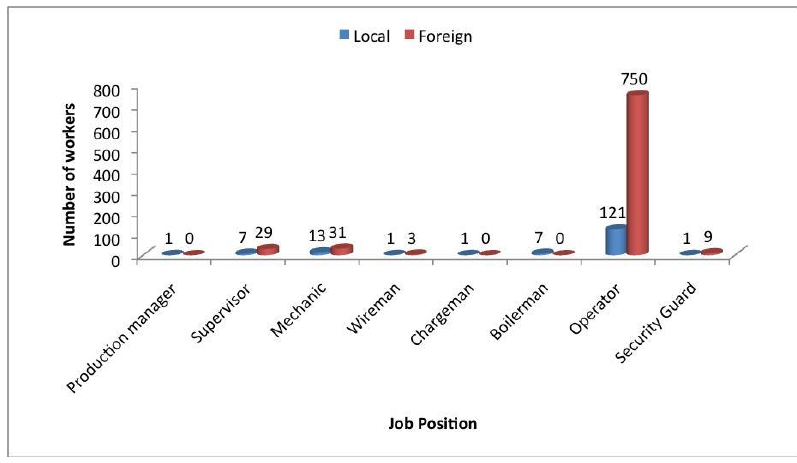
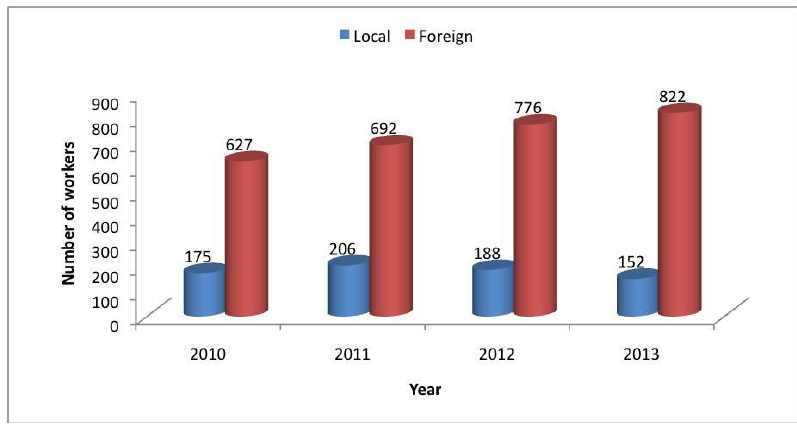
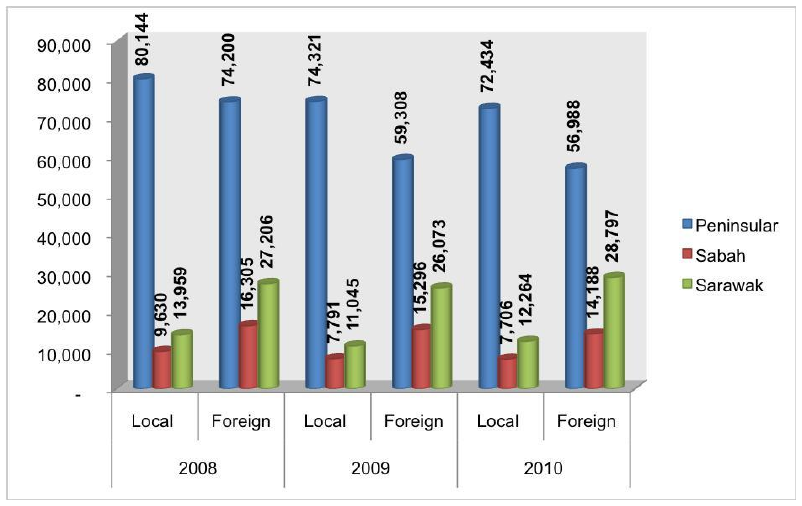
The involvement of foreign workers in the timber industry in Malaysia is a common phenomenon. Generally, a heavy reliance on foreign workers is due to several factors, particularly the willingness of foreign workers to accept lower wages and to work in unpleasant work conditions. The reverse is true for the local workers who prefer to work in a comfortable environment while demanding higher wages. Thus, despite the open policy for all to work at Besgrade, the company found that it was really difficult to attract local workers to work in this industry. This situation had left Besgrade with no choice but to hire foreign workers. Based on the data obtained, Besgrade is found to be more dependent on the use of foreign labour compared to local labour (Figure 1 and Figure 2). Apparently, the job of a general worker or operator is dominated by foreign labour, namely a total of 750 people compared to a total of 121 local workers, i.e., a ratio of approximately 6:1. In addition, the foreign workers are also found to dominate the others posts, such as supervisor and mechanic, wireman, and security guard. This statistic is consistent with the figure released by the Department of Statistics Malaysia on foreign workers’ employed in the timber industry in Malaysia from 2008 until 2010 (Figure 3). During that period, the recorded number of foreign labour in the timber industry was far greater than the local workers.
Based on an interview with the Human Resource Manager at Besgrade Products Sdn. Bhd., it was revealed that the main reason for recruitment of foreign labour by the company is due to the difficulty in getting local workers to work in the industry. Generally, lack of interest among local workers to join the company is related to two main reasons: 1) Long Working Hours The total working hours in Besgrade is 12 hours. A long period of working hours ultimately deters local workers from applying for the job. As opposed to foreign workers, the local workers have their families in the country, who they need to look after and thus time is a major constraint for them. 2) Unpleasant Working Environment The timber industry is associated with a “3D environment” which stands for “dirty, difficult, and dangerous”. Work such as this requires strong will and determination. Based on a response from Besgrade, working in the timber industry is considered as the last choice for local workers. Generally, local workers are keener to work in villages, such as being rubber tappers, paddy farmers, and some prefer to work in air-conditioned offices, although the salary offered is much lower. On the other hand, with regard to wages, the government has made it mandatory for employers to abide by the national minimum wage policy. The policy had come into effect on 1 January 2014 for the timber industry. In line with the government ruling, Besgrade had implemented the minimum wage policy. However, the implementation of this policy has put high pressure on cost for Besgrade. Eventually, the cost had increased by 45% and significantly affects the company’s annual turnover. In essence, the increased in labour costs was not only due to the increase in monthly salaries and wages, but also due to the increase in employer contributions to the Employees Provident Fund (EPF) involving local workers and the amount of overtime payment. Above all, the companies pointed out that the minimum wage offered does not commensurate with the qualification and skill levels of the workers, especially in the case of unskilled workers. Rising labour costs, according to Besgrade would affect the profitability of the company as well as posing some ramifications in terms of their collective agreement with trade unions. Unpredictable market conditions, as well as intense competition and the difficulty in ensuring price stability in the market result in companies being reluctant to implement the established minimum wage. These issues are very much part of the major challenges faced by most companies as it will have a negative impact on their revenue, more so when the portion of that revenue has to be used to cover the rising cost of labour. In the long run, poor market performance will lead to a decrease in production and productivity. To overcome this situation, a company may have to lay off workers, or if the situation continues, the company may have to shut down. In relation to skills requirement, Besgrade emphasises that the majority of workforce hired are for the operator position and thus no specific skills and qualifications are required. In essence, most workers acquire their skills through on job training. Besgrade, however is in the opinion that some of the training provided by the learning institutions are not relevant to the skills needed by the industry and therefore, companies are compelled to provide suitable in house training for their workers. 5.3
Issues with Foreign Workers
The majority of foreign workers at Besgrade Products Sdn. Bhd. are from Asian countries such as Bangladesh, Vietnam, Myanmar, and Indonesia. In general, most foreign workers involved in this industry do not have proper academic qualifications and skills, but normally benefit from free accommodation as an addition to their salary. In managing foreign workers, Besgrade cited that there are some problems that they have to deal with, particularly with regard to communication. Inability to communicate in Malay and English poses a very serious problem especially in relation to work instructions. As a solution, the use of sign language is well practised among employees. Another problem facing Besgrade when it comes to foreign workers is the duration of contract set by the government for them to work in a factory. As for Besgrade, the duration of contract imposed by the government is only for three years. Contract renewal or the recruitment of new foreign workers will take a very long time. Based on their statement, the approval by the Ministry of Home Affairs will take about 10 months, followed by a 4-month process through an agent. In order to overcome the shortage of workers, Besgrade has been using the overtime system. 5.4
Automation
As mentioned earlier, one way to enhance added value in timber production is through automation and the intensification of R&D efforts. In the case of Besgrade, the company does not rely fully on automation, in other words it operates using semi-automated processes using machine technology from Japan as shown in the following Table 1.
| No. | Type of machine | Purpose |
|---|---|---|
| 1 Yamamoto Fully | This machine is used to produce export grade phenolic film | |
| Automatic Phenolic Line, | faced plywood for international markets. It is fully automatic and | |
| Medium or High Density | computerised to minimise the risk of human errors in producing | |
| Overlay Overlaying Press | defective plywood as well as workplace accidents. | |
| Line | ||
| 2 Meinan S-BAL-DC-4N-E | The Meinan S-BAL is designed to peel veneer from logs that are difficult or impossible to process on a conventional lathe. It guarantees high veneer quality, optimum drying efficiency and ultimately high product yield per hectare of forest, which helps to preserve the forest and conserve energy. | |
| 3 Yamamoto 45 Openings | This hot-press machine is renowned for its reliability. Fully | |
| APT Hot-press | automatic and computerised, it produces high quality plywood and reduces risk of accidents of workers. This high capacity machine boasts a low running cost advantage. | |
| 4 EN-303 Smart In-line | This industrial computerised system enables the continuous and | |
| Dryer Veneer Moisture | automatic fine control of the net dryer speed to achieve accurate | |
| Contents Control System | desired veneer moisture content. This reduces rejects during production and defects on application. | |
| 5 Super Automatic | This machine adopts state-of-the-art grinding technology to | |
| Vertical Knife Grinder - | automatically maintain the razor sharpness of cutting knives. This | |
| Toyo KGV-SF22 | ensures consistent production of high quality veneer sheets. |
This machine is used to produce export grade phenolic film faced plywood for international markets. It is fully automatic and computerised to minimise the risk of human errors in producing defective plywood as well as workplace accidents.
Meinan S-BAL-DC-4N-E
The Meinan S-BAL is designed to peel veneer from logs that are difficult or impossible to process on a conventional lathe. It guarantees high veneer quality, optimum drying efficiency and ultimately high product yield per hectare of forest, which helps to preserve the forest and conserve energy.
Yamamoto 45 Openings APT Hot-press
This hot-press machine is renowned for its reliability. Fully automatic and computerised, it produces high quality plywood and reduces risk of accidents of workers. This high capacity machine boasts a low running cost advantage.
EN-303 Smart In-line Dryer Veneer Moisture Contents Control System
This industrial computerised system enables the continuous and automatic fine control of the net dryer speed to achieve accurate desired veneer moisture content. This reduces rejects during production and defects on application.
Super Automatic Vertical Knife Grinder Toyo KGV-SF22
This machine adopts state-of-the-art grinding technology to
automatically maintain the razor sharpness of cutting knives. This ensures consistent production of high quality veneer sheets.
Although there are high technology machines available at Besgrade, the management is in the opinion that the level of automation in this company may not reach 100% within the next 10 years, since any automation needs to be supported by at least 50% of manpower. In certain sections, the company still relies 100% on manual processes who consists of operators. As cited, among other constraints for Besgrade to move toward automation is particularly related to the high cost of purchasing machinery and the difficulty of obtaining spare parts. Most of the machines used are imported from foreign countries such as Japan and Germany. In the event of damage or malfunction, the process of getting new spare parts will take time and be costly. 5.5
Suggestion on Reducing Foreign Worker Dependency
Learning from the experience of Besgrade, a focus group discussion comprising industry experts, policy makers, and other stakeholders was conducted with the objective of drawing specific solutions related to the issue of foreign workers and ways of attracting local labour to work in the timber industry. Based on the data gathered, the following are some of the suggestions that had been put forth; 1) Rebranding the Timber Industry The timber industry has always been associated with unpleasant working environments. Apart from that, many have the impression that the timber industry is a sunset industry, which does not promise a bright future. In light of these prevalent negative perceptions, the relevant government agencies, associations, and companies must initiate actions and ways to transform the timber industry. In order to attract local workers to join the industry, there is an urgent need to vigorously pursue the rebranding of the timber industry. More efforts should be taken by employers to create a new conducive environment and to engage in campaigns that highlight promising future which will encourage people to join the industry. 2) Competitive Wage Rate The introduction of a national minimum wage policy from 1 January 2014 is a good start for improving the welfare of the workforce, especially in the tim-ber industry. However, feedback from the industry players suggest that a more competitive wage rate should be established for various job positions in various sectors of the industry, and importantly the wage must reflect productivity. In addition, as suggested by the Human Resource Manager at Besgrade Products Sdn. Bhd., the minimum wage policy should only be applied among local workers.
This is because, apart from salary, foreign workers enjoy other facilities such as accommodation and health insurance. Raising the basic salary of local workers to more than the minimum wage set by the government is seen as an incentive for local workers. Increased cost of employing local workers with higher wages should be seen by the companies as the long term return, when they no longer need to rely on foreign labour. 3) Efforts Towards Automation In general, the timber industry has not yet achieved high levels of automation. In order to enhance the competitiveness of the Malaysian timber industry, greater efforts toward automation and mechanisation need to be considered. The willingness among firms to move toward automation and mechanisation will thus increase productivity and reduce dependency on labour, and in particular, foreign workers. Principally, Malaysia’s aspiration to increase its value added outputs in production related to timber to up to 60% by 2020 requires readiness among firms to go for automation. In light of this, government’s incentives, such as tax exemption on purchases and leases of machines will help to encourage firms to move toward automation. 4) Strengthening Policies to Reduce Dependency on Foreign Labour Heavy dependence on foreign labour will cause instability in the timber industry in the long run given the volatility of global economic conditions. Shortage of supply of foreign labour will certainly have a significant negative impact on the industry. Reducing industry dependence on foreign labour, however, cannot be done overnight, since this will certainly put pressure on the employers. Simultaneously, a gradual reduction of foreign workers and training of the local workforce can be carried out. Moreover, better incentives should be provided so that the process toward mechanisation could be further enhanced.
5) Emphasis on Skills In general, readiness among firms to adopt the latest technology will also affect the kind of skills that should be acquired by labour and the training programmes that should be designed. Up to now, the government is committed in training a capable workforce through the establishment of various skill training centres. Parallel to this, companies should also provide the opportunity for their workers to go for appropriate training for up-skilling. Technical and vocational training sessions with particular emphasis on the timber related industry should be further developed.
Conclusion
All in all, the solution to the issue of employment in the timber industry requires commitment and cooperation between employers, training providers, the respective associations, and government agencies. Gradually, the timber industry will thrive if the employers work to promote automation and provide a more conducive work environment in addition to a more competitive wage for the long term benefit. At the same time, policies related to the timber industry and labour should be reinforced with clear and consistent guiding principles. If Malaysia wants to emulate other successful countries such as Japan, Korea, the United States of America, and China that use the latest technology in production as a way to replace foreign labour, the necessary impact study should however be conducted. Some critical issues and questions that need to be seriously considered are: What is the extra cost for firms to go for automation? Is the government willing to offer any incentives to encourage employers in the industry towards automation? What type of incentives will be offered? Is the training carried out by the existing skills training centres able to produce suitable graduates needed by the timber industry? To what extent do these graduates produced by these training centres have interest to be involved in the timber industry? Clearly, the above mentioned issues need to be appropriately addressed in order to ensure a sustainable growth of the timber industry in Malaysia. If these issues are not properly addressed, the continued reliance on unskilled foreign labour, as well as the absence of new technology will nevertheless seriously lead toward a bleak future of the timber industry in Malaysia.
References
- Annual Report, (2011). Malaysian Timber Council (MTC).
- Garis Panduan Bagi Definisi Baharu PKS, (2013). Sekretariat bagi Majlis Pembangunan PKS Kebangsaan. SME Corp. Malaysia.
- Malaysia, Jabatan Perangkaan Malaysia, (2008-2010). Employment, salaries, and wages in the manufacturing industries by category by local and foreign for wood industry. Putrajaya: Jabatan Perangkaan Malaysia.
- National Timber Industry Policy, (2009-2010). Ministry of Plantation Industries and Commodities Malaysia (2009). Malaysia.
- Occupational Analysis Wood Based Industry, (2013). Jabatan Pembangunan Kemahiran. Kementerian Sumber Manusia.
- RMA-Perunding Bersatu Sdn. Bhd., (1993). Manpower development needs of the furniture processing industry (The c1ase of export-oriented factories). Lembaga Perindustrian Kayu Malaysia.
- Senasi, V., and Khalil, S., (2015). Implementation of minimum wage policy in Malaysia: Manufacturing employers. International Journal of Humanities and Social Science, 87-94.