Government Transformation Programme (GTP): Effects of 4S Approach in Malaysian Government Departments
- School of Technology Management and Logistics, College of Business, Universiti Utara Malaysia, Sintok, Kedah
Journal of Business Management and Accounting 5(1) (2015) · https://doi.org/10.32890/jbma2015.5.0.8858
Abstract
The Government Transformation Programme has become the central issue among the public. For any government to retain its popularity, changes are needed to provide more vibrant, dynamic, and progressive services to its client, customer, and stakeholders. Therefore, implementing McKinsey approach is one mechanism to realise the transformation programme. Implementing McKinsey approach has long been practised by various organisations in adding value to delivery and improving performance. This article demonstrates findings of the four out of seven McKinsey approach elements implemented in two government departments in Malaysia. The survey method was conducted in this study on respondents comprising all the stakeholders dealing in the everyday transactions with the government departments, including suppliers, vendors, and many more. All the questionnaires were analysed and findings explained in greater detail. The four McKinsey elements included strategy, structure, system, and shared values (4S).A comparison was made between the results of the 4S from both agencies. Interestingly, the results illustrated how the government departments transformed their operational services by getting the whole organisation to put great efforts to undergo the overall process. The results also indicated that for a government department to undergo transformation, staff’s attitude toward changes, behaviour, and knowledge are crucial in making the process a successful one. Further elaboration on outcomes of each McKinsey elements is discussed in detail. The findings would become a guideline for future research dealing with elements of McKinsey approach, as well as serve as a reference for the betterment of any organisation that wants to apply the transformation agenda.
Keywords: Government transformation programme (GTP), McKinsey approach, government department
Introduction
In facilitating the delivery services of government departments, a transformation is needed to rejuvenate and introduce new approaches for the betterment of not only the government staff but also to the organisation, customer, and public in particular, and to the nation in general. What makes the situation complicated is due to the attitude, behaviour, and perception of government staff toward the transformational processes. They are already comfortable their current practice and are reluctant to accommodate the new radical changes since this would give rise to problems in their daily routine. Also, it was discussed in some literature work that long-term relationships seem not to play a role in the development of radical changes and innovations. Moreover in the case of the industry, clock speed has no significant bearing on the success or failure of any strategy in introducing radically new changes and technologies (Perrons, Richards, & Platts, 2005). Meanwhile, Perrons et al. (2005) argued that people have the tendency to work better and develop ideas faster within a single organisation than among different ones. Preferring a “make” strategy in these circumstances, he pointed out to managers that product development requires frequent, often in-person interaction between different units with the knowledge that underpins each of the components of a system. Interaction challenge is among the critical issues raised by the management especially between team and various parties in an organisation (Martini, Pareto, & Bosch, 2014). Thus, organisations often lose competitive advantage when a disruptive change or technology renders their own capabilities obsolete, but the survival or failure of firm’s outside stakeholders is also critically important insofar as the firm’s future success may hinge on the wellbeing of these other groups (Abernathy & Clark, 1985; Afuah, 2000; Utterback, 1994). Therefore, in the case of government departments, introducing radical and perhaps disruptive transformation could help in improving the quality of services being offered by them. In a similar vein, Collins and Porras (1996) examined more than 18 firms, including GE, IBM, 3M, and Walt Disney to name a few, that have led their respective industries over decades. Their findings indicated that each firm went through dramatic evolution processes since their early days. The study also found that each of these firms puts a tremendous amount of emphasis on its corporate culture, and regards its people as being the company’s most important resource. Relationships and long-term goodwill were therefore perceived by managers in these firms as being pivotal ingredients to their success. According to Martins and Terblanche, (2003), there are three elements affecting employee performance including ability, working environment, and motivation. This is supported by Chandrasekar (2011) who mentioned that workplace factors that affect employee performance include performance feedback, role congruity, defined processes, workplace incentives, supervisor support, mentoring/ coaching, opportunity to apply, job aids, and goal setting. To conclude, the organisation needs appropriate structure, strategy, and system. According to the 7s McKinsey approach, the structure, strategy, and system are the hard elements of any organisation. However, element of shared value is also important because it is the core of the McKinsey 7s model and directly serves as a core element to the organisation (Hanafizadeh & Ravasan, 2011). Therefore, this study demonstrated findings of the four elements (structure, strategy, system, and shared value) in 7s McKinsey approach implemented in two government departments in Malaysia.
Literature Review
The need for transformation done by government agencies is crucial in ensuring the delivery and services carried out are at par with the tax being paid by the public. Therefore, government agencies should initiate action to improve its delivery services, products offered, and quality provided. Huge efforts had been done since 2009 by the Honourable Prime Minister YAB Dato’ Seri Mohd Najib bin Tun Abdul Razak to create a foundation for transforming the country into a developed and high income nation by 2020. The Government Transformation Programme (GTP), a bold plan of initiatives designed to achieve fast and sustainable results, was subsequently launched.
In ensuring that the government is relevant and can gain trust from the public, problems surrounding the needs and wants of the public should be tackled accordingly with proper and real solutions. There is a dire need to propel the nation to the next level. The GTP focuses on areas that needed the most attention from the government and it is grouped under seven National Key Result Areas (NKRAs), which are subsequently assigned targets and a clear reporting framework. The GTP is aligned with the New Economic Model (NEM) and the 10th Malaysia Plan, and is a cohesive effort by the government to transform Malaysia into a progressive and harmonious high-income nation. The GTP is anchored on two main pillars, namely 1) “People First” – its main priority is addressing issues that matter most to the people, and 2) “Performance Now” – focusing on the fundamental changes nationwide to deliver big and fast results (GTP, 2015). Meanwhile, the McKinsey 7S framework is among the top management models established since the 1980s. This model is unique due to its strategic vision for groups, business units, and teams in the business. It is considered comprehensive because its covers the whole spectrum of business elements such as structure, strategy, systems, skills, style, staff, and shared values (Table 1). Any organisation can fully utilise this model because this model performs as an organisational tool to assess and monitor changes in the internal aspects of an organisation (Hanafizadeh & Ravasan, 2011).
| Dimension | Definition |
|---|---|
| Strategy | Actions a company plans in response to changes in its external environment. |
| Structure | Basis of specialisation and coordination influenced primarily by strategy, size, and diversity of organisation. |
| Systems | Formal and informal procedures that support strategy and structure. |
| Shared value | Norms and standards that guide the behaviour and actions of employees of the company. Source: Hanafizadeh and Ravasan (2011) |
Definition
Actions a company plans in response to changes in its external environment. Basis of specialisation and coordination influenced primarily by strategy, size, and diversity of organisation.
Systems Shared value
Formal and informal procedures that support strategy and structure. Norms and standards that guide the behaviour and actions of employees of the company.
Source: Hanafizadeh and Ravasan (2011)
It was noted that for an organisation to perform its best, proper coordination between the 7S should be aligned and mutually reinforced. It helps the organisation to improve performance, or to maintain alignment (and performance) during other types of change. When the organisation faces challenges such as restructuring, new processes, organisational merger, new systems, change of leadership, and so on, the ability to manoeuvre with the functions of the 7S elements would help the organisation to sustain and maintain in the turbulent seas of the business arena. By implementing the McKinsey framework, it gives better understanding on how organisational elements are interrelated that later on could yield in a wider positive impact when changes are done. Summarily, successful a business model can be done when the management understands the unique positioning strategy. Aligning products and services logic, providing value added logic, logic sales, and marketing, and logic revenue—all these have the potential to produce substantial amount of profits. The difficulties to imitate are the secret for successful business models (Matzler, Bailom, Eichen, & Kohler, 2013). When a company attempts to remain unique, it is compulsory for them to do so, as this could improve their business innovation model. According to Matzler et al. (2013), for a successful business model innovation, the model should comprise five components, namely 1) innovative and unique positioning; 2) a consistent product and service logic; 3) an appropriate value creation architecture; 4) an effective sales and marketing logic; and 5) a profit formula that works.
Methodology
This study was conducted on two public agencies namely Department X and Department Y, both of which are government departments that serve delivery functions for the government of Malaysia. Respondents involved in this study were participants from both Department X and Department Y. Department X was established with the aim to manage and develop the safety measures on biosafety issues in Malaysia while at the same time optimise their contributions to national socioeconomic development. The objective of Department X is to act as a one-stop-centre for all activities relating to biosafety. This department has several functions including to implement and enforce the Biosafety Act; to be the secretariat and the operational arm of the National Biosafety Board (NBB); to be the secretariat of the Genetic Modification Advisory Committee (GMAC), and committees/sub-committees established under the NBB and GMAC; to monitor all activities relating to living modified organism (LMO) and products of such organism; and to provide a platform for consultation with various parties in order to formulate and update policies, laws and guidelines related to biosafety.
It also plays a vital role in coordinating and integrating the efforts taken by federal government agencies, and state and non-government organisations, and the modern biotechnology industries that relate to biosafety issues; building strategic partnerships with relevant agencies within and outside the country in the field of biosafety; establishing mechanisms to facilitate the collection, storage and dissemination of data related to biosafety; assisting the government to formulate the country’s stand on the issues of biosafety at international forums; and finally to increase public awareness on biosafety. Even though this department is still at its infancy stage, its existence has contributed much to the development and progression of biosafety measures and issues in Malaysia. Meanwhile, Department Y’s prime concerned is aimed at making the Malaysian natural environment comfortable, thus ensuring better living conditions. Other than that, this department also offers a wide range of services including soothing the beauty of marine life, provide marine environment that may be used for research purposes, provide natural courses that can become as a learning place, create a safe environment for recreation and exercise, produce kits for marine knowledge, organise facilitators for meaningful training programme, provide facilities to conduct activities related to natural prominence, and also get involved actively in recruiting of marine resources. Due to high demand from the public, this department also offers in creating programmes of marine environmental awareness, providing public facilities for visitors to the Marine Park Centre (excluding accommodation), providing facilities for learning in the form of galleries and exhibitions, providing technical advisory services in matters pertaining to the marine environment, exercising enforcement of regulations in the waters of Service Marine Park, carrying out conservation programmes, participating in the construction of reef for the purpose of improvement of marine resources, assisting the research activities in Marine Parks, and finally controlling the research activities through the issuance of controlled permits. 4.0
Analysis
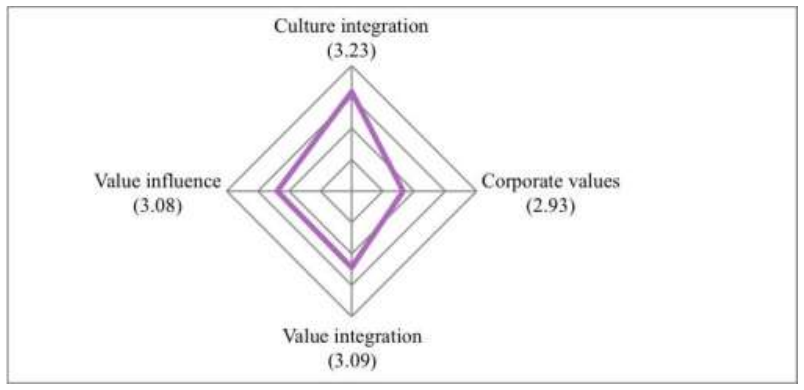
For Department X, the shared value items included culture integration, corporate values, value integration, and value influence. The mean score results were obtained for culture integration (3.23), corporate values (2.93), value integration (3.09) and value influence (3.08), and presented in a web-like illustration, as in Figure 1.
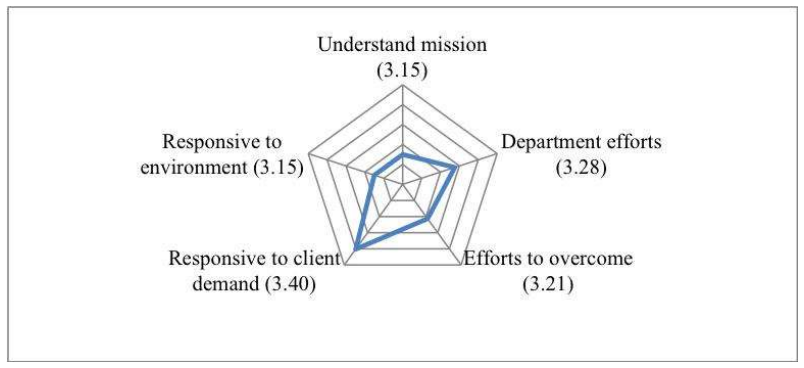
For the strategy dimension, the items measured included understanding mission, department efforts, efforts to overcome, responsiveness to client demand, and responsiveness to the environment. The mean score results were obtained for understanding mission (3.15), department efforts (3.28), efforts to overcome (3.21), responsive to client demand (3.40) and responsive to the environment (3.15), and these are illustrated in Figure 2.
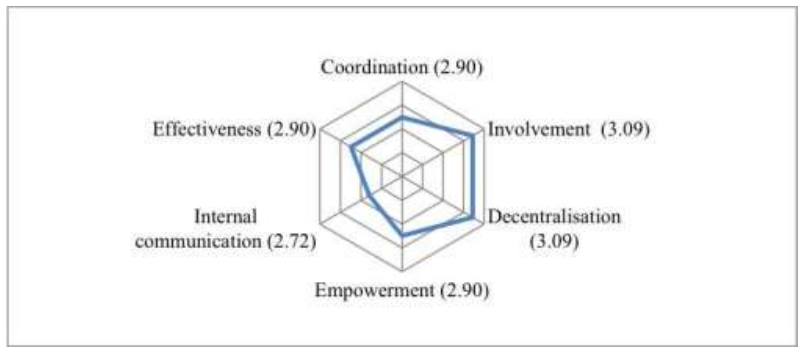
For the structure dimension (Figure 3), items measured were coordination, involvement, decentralisation, empowerment, internal communication, and effectiveness. The mean score results were obtained as follows, coordination (2.90), involvement (3.09), decentralisation (3.09), empowerment (2.90), internal communication (2.72), and effectiveness (2.90).
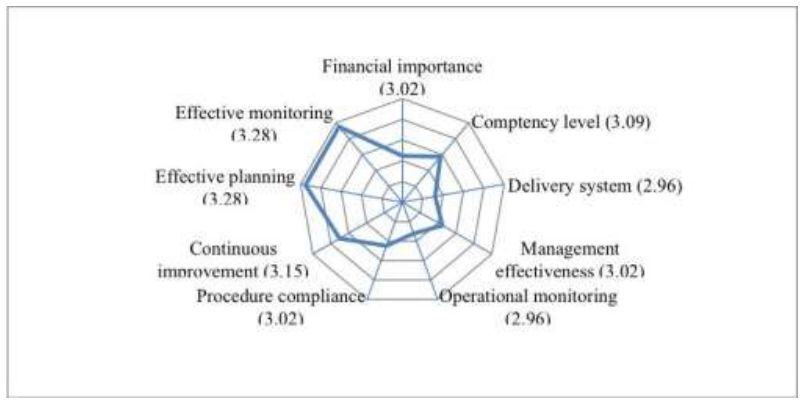
While for the system dimension (Figure 4), items measured included financial importance, competency level, delivery system, management effectiveness, operational monitoring, procedure compliance, continuous improvement, effective planning, and effective monitoring. The mean scores obtained were as follows, financial importance (2.88), competency level (2.94), delivery system (2.82), management effectiveness (2.88), operational monitoring (2.82), procedure compliance (2.88), continuous improvement (3.00), effective planning (3.12), and effective monitoring (3.12).
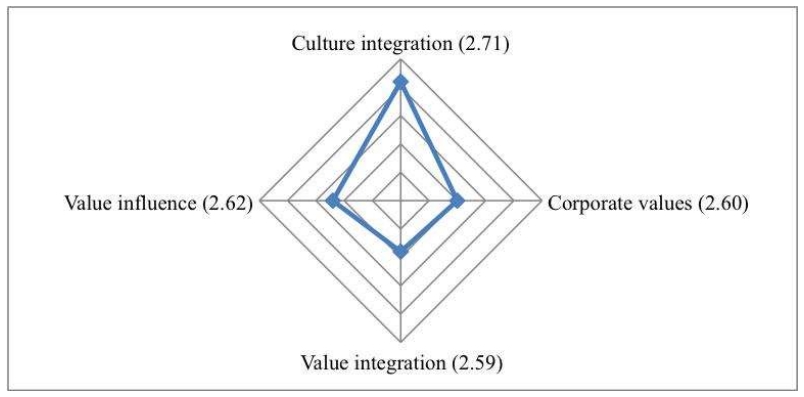
Meanwhile, for the other department under study, the data obtained from Department Y on shared values (Figure 5) were items on culture integration, corporate values, value integration and value influence. The mean score results obtained were as follows, culture integration (2.71), corporate values (2.60), value integration (2.59) and value influence (2.62).
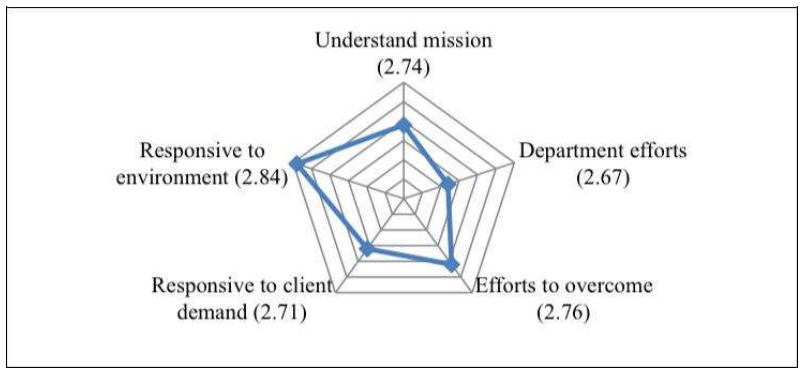
Next, for the strategy dimension (Figure 6), items measured were understanding mission, department efforts, efforts to overcome, responsiveness to client demand, and responsiveness to the environment. The mean score results obtained were understanding mission (2.74), department efforts (2.67), efforts to overcome (2.76), responsiveness to client demand (2.71), and responsiveness to the environment (2.84).
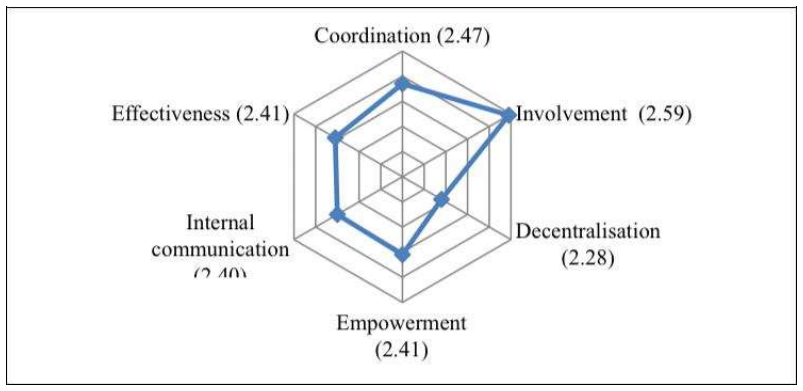
For the structure dimension (Figure 7), items measured were coordination, involvement, decentralisation, empowerment, internal communication, and effectiveness. The mean score results obtained were coordination (2.47), involvement (2.59), decentralisation (2.28), empowerment (2.41), internal communication (2.40), and effectiveness (2.41).
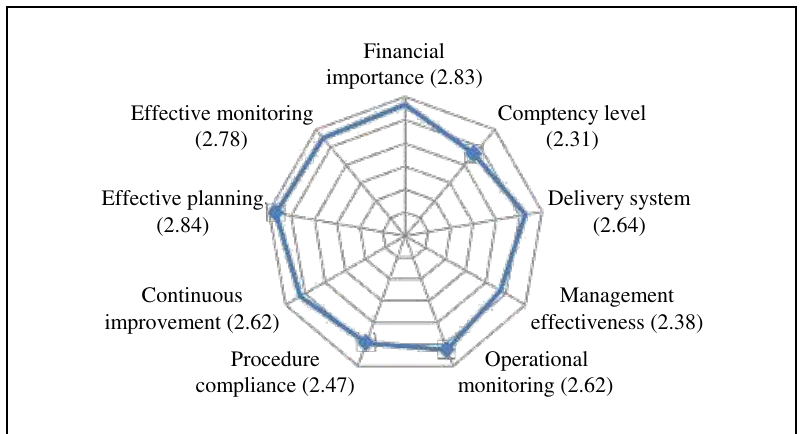
Meanwhile for the system dimension (Figure 8), the items measured included financial importance, competency level, delivery system, management effectiveness, operational monitoring, procedure compliance, continuous improvement, effective planning, and effective monitoring. The mean scores obtained were financial importance (2.83), competency level (2.31), delivery system (2.64), management effectiveness (2.38), operational monitoring (2.62), procedure compliance (2.47), continuous improvement (2.62), effective planning (2.84), and effective monitoring (2.78).
Financial importance (2.83) Effective monitoring (2.78) Effective planning (2.84) Continuous improvement (2.62) Procedure compliance (2.47)
Comptency level (2.31) Delivery system (2.64) Management effectiveness (2.38) Operational monitoring (2.62)
Findings
The comparison between the four variables from Department X and Department Y indicates slight difference which may by contributed to by the difference in nature of the operating government departments. Although the main functions for both departments focus on the biodiversity aspect of the whole nation, nevertheless, the outcome speaks differently. There are some new insights that could be learned from this study. One of the reasons for these differences to occur is through the number of staff in Department X. This department can be considered to be still young, which indicates their fewer numbers of staff. With the less number of employees, it would reflect the workload that each staff member needs to maintain. There are situations when they simply cannot fulfil the job demands, not to put the blame on them because they are not efficient, but because they just cannot cope with too many tasks to be done at a time. When comparing with Department Y, this department is well established with talented and multi-skilled staff. The staff had undergone various training and are equipped with necessary skills required in performing their duties. Therefore, they can serve and perform better in their daily job routine. Looking back at the scores for items under system for both departments, it was clearly shown that Department Y, with its long term reputation, managed to score a better mean score as compared to Department X. Established departments would score better as compared to new departments. This study provided an overall picture about the practices being implemented for both departments. Even though both departments’ working nature is closely related to biodiversity for the whole nation, there are some differences in their daily routine operations. It should be noted that both departments work hard to fulfil the responsibility in providing the best possible services to the clients but somehow, there are some improvements that could be made from time to time. 6.0
Conclusion
Based on the findings, the systems, structure, shared value, and strategy can clearly give another point of view on how both government departments perform their duties. Not to undermine their efforts and functions, clearly they tried their very best in providing the best services to their client. However, some of the constraints become a challenge for them and they have to bear it. Both government departments’ ability in facing these challenges should be rewarded. They have to face all obstacles and constraints despite their own workload. Apart from their internal challenges, the innovation that they did is also key which helps them to transform the way they do their ordinary routine business operations. Although only four out of the seven McKinsey 7S elements were studied, much knowledge was gained in terms of understanding the differences in style, strategy, system, and shared values of both departments in the same cluster. The same cluster does not mean they scored the same results, but only that they have something in common. The nature of biodiversity has its own uniqueness that can be seen by their functions, but not the mean score for every 4S. In the near future, the elaboration of findings that integrate all the 7S elements would yield a better understanding on what are the core functions that would be able to be improved further. Better mechanisms can be applied in order to increase the mean score for every 7S. A whole integrated system should be applied that needs more staffing, tools, value added skills, and many more in making sure both government departments can provide better services to their clients.
References
- Abernathy, W. J., and Clark, K. B., (1985). Innovation: Mapping the winds of creative destruction. Research Policy, 14(1), 3-22.
- Afuah, A., (2000). How much do your competitors’ capabilities matter in the face of change? Strategic Management Journal, 21(3), 387-404.
- Chandrasekar, K., (2011). Workplace environment and its impact on organisational performance in public sector organisations. International Journal of Enterprise Computing and Business Systems, 1(1), 1-19.
- Collins, J. C., and Porras, J. I., (1996). Built to last: Successful habits of visionary companies. London: Century. http://www.pemandu. gov. my/gtp/upload/GTP2_ENG_Cp1.pdf
- Hanafizadeh, P., and Ravasan, A. Z., (2011). A McKinsey 7S model-based framework for ERP readiness assessment. International Journal of Enterprise Information Systems, 7(4), 23-63.
- Martini, A., Pareto, L., and Bosch, J., (2014). Teams interactions hindering short-term and long-term business goals, Continuous Software Engineering, Springer International Publishing, 51-65, DOI: 10.1007/978-3-319-11283-1_
- Martins, E. C., and Terblanche, F., (2003). Building organisational culture that stimulates creativity and innovation. European Journal of Innovation Management, 6(1), 64-74.
- Matzler, K., Bailom, F., von den Eichen, S. F., and Kohler, T., (2013). Business model innovation: Coffee triumphs for Nespresso. Journal of Business Strategy, 34(2), 30-37.
- Perrons, R. K., Richards, M. G., and Platts, K., (2005). What the hare can teach the tortoise about make-buy strategies for radical innovations. Management Decision, 43(5), 670-690.
- Utterback, J. M., (1994). Mastering the dynamics of innovation. Boston, MA: Harvard Business School Press