A Review on the Selection of Granular Fertiliser Distribution Methods for Malaysia's Paddy Field on a Large Scale
- Faculty Mechanical and Manufacturing, Universiti Tun Hussein Onn Malaysia, Johor
- Pusat Penyelidikan Kejuruteraan Mardi, Serdang, Selangor
Journal of Business Management and Accounting 6(1) (2016) · https://doi.org/10.32890/jbma2016.6.1.8854
Abstract
High efficiency distribution applicators, such as boom sprayer (air blower concept), Kuhn Axis fertiliser spreaders (rotating disc concept), and pendulum spreader (magnetic concept) were the response to the call to distribute granular fertiliser to a paddy field on a large scale. Each of these distribution applicators had their own characteristics which are optimised for different purposes. This paper shows the review results after studying journal papers to select the most suitable applicators for Malaysia’s paddy field on a large scale. The analyses included the compliments of these applicators toward the type of granular fertiliser used in Malaysia’s paddy field, the maintenance cost of these applicators, the suitability of machine to be used in the landscape of Malaysia’s paddy, the distribution areas covered by these applicators, and the accuracy of distribution. The review concluded that Kuhn Axis fertiliser spreader was found to be the most suitable applicator compared to other applicators.
Keywords: Granular fertiliser, distribution applicators, paddy field, large scale, spreaders
1.0Introduction
Australia’s Commonwealth Scientific and Industrial Research Organisation (CSIRO) Report states that the world’s demand for food over the next 50 years will be greater than over the last 500 years, placing huge pressure on global food systems. According to the World Bank, Malaysia’s population itself had grown from 25.37 million in 2004 to 29.72 million in 2013. Due to the high demand for food, both locally and internationally, increasing crop yield is the main agenda of most crop growers. Rice is the staple food both locally and in Asia. Based on the statistics of Food and Agriculture Organisation of the United Nations 2004, in Malaysia there are 6700 km2 of paddy rice fields. Paddy fields are typically found in Peninsular Malaysia. The most scenic paddy fields are located in northern Malaysia, i.e., in Kedah, Perlis, and Penang; almost covering these states. Paddy fields also can be found on Malaysia’s eastern
128 Journal of Business Management and Accounting, 6(1) 2016: 127-140 coastal region, mainly in Kelantan and Terengganu, and also in Selangor, especially in the districts of Kuala Selangor and Sabak Bernam. These places have different composition of soil that requires different nutrition types to grow paddy plants.
One of the measures to grow the paddy plant is through reviewing existing planting practices such as fertilising, type, and amount of fertiliser. The advancement in technology resulted in fertiliser distribution applicators being developed in order to increase the efficiency of distributing these fertilisers into the field. This means that the distribution applicators will directly affect the yield rate of the paddy, because it controls the amount of fertiliser that the paddy field will receive to give nutrition to the crops. There are many research institutes in Malaysia that execute research to increase the growth of paddy such as the Ministry of Agriculture, the National Paddy and Rice Authority, the Malaysian Agricultural Research and Development Institute (MARDI), Research Station, Agriculture Institute, Department of Agriculture, Agricultural Development, and Universiti Putra Malaysia (formerly known as Universiti Pertanian Malaysia). MARDI is one the main agricultural institutes that has been carrying out research to improve the distribution of applicators.
Currently, available fertiliser boom spreaders were found to have certain limitations to be used with domestically-produced granular fertilisers because of the different environment user. Therefore, this has opened up more possibilities for improvement, such as the designing of a new type of distribution applicators by studying the available concept in the market. Therefore, this paper contributes by reviewing the selection of granular distribution methods for Malaysia’s paddy field on a large scale. There are basically three types of commonly used granular applicators with three types of concept of distribution, such as boom sprayer (air blower concept), Kuhn Axis fertiliser spreaders (rotating disc concept), and pendulum spreader (magnetic concept). These distribution concepts often start with small models and are not effective for large paddy fields. The study and development of research in this area continue using the same concept, but with modification to enable bigger scale dispersal; and with the addition of tractors that can carry fertilisers around the paddy field within a short period of time, and also by enlarging the size of equipment to enable it to contain more fertilisers.
2.0Granular Fertiliser Distribution Applicator
According to Table 1, Malaysia Agribusiness Directory 2013 to 2014 stated that the import of fertiliser distribution applicator is the lowest compared to the other machineries. This means that the popularity of using granular fertiliser distribution applicator in Malaysia’s paddy fields is low, which is not proportional to the development of agriculture in Malaysia. Many farmers are still using the traditional method to distribute fertiliser into the fields. Table 1 also shows that the import of fertiliser distributor had been decreasing from 439 units in 2011 to 378 units in 2012, as compared to 1045 A Review on the Selection of Granular Fertiliser Distribution Methods for Malaysia’s Paddy Field on a Large Scale: 127-140 129 units in 2009. Therefore, there is the need for investigating the popularity of fertiliser distributor in large scale operations in other nations, and the need to gain understanding of the structure and application of the fertiliser distributor in order to find out the reasons that cause the small number of users in Malaysia.
| Machinery | Year (units) | |||
|---|---|---|---|---|
| 2009 | 2010 | 2011 | 2012 | |
| Pedestrian Tractors | 5093 | 4075 | 3929 | 2368 |
| Tractors | 5085 | 6121 | 4199 | 6216 |
| Seeder and Planter | 242 | 315 | 108 | 2826 |
| Harrow (disc and non-disc) | 1849 | 1270 | 2587 | 2577 |
| Fertiliser Distributors | 1045 | 181 | 439 | 378 |
| Plow, soil preparation/cultivators | 1289 | 1463 | 1970 | 1612 |
| Mowers | 3691 | 5874 | 14922 | 10299 |
| Threshing machines | 126 | 220 | 30 | 1402 |
| (not combined) | ||||
| Source: Malaysia Agribusiness Directory, 2013 to 2014. | ||||
3.0Boom Sprayer
The boom sprayer was developed in the 1880s in France and in the United States of America, and was first used in Australia in the early 1900s (Combellack, 1981). Later developments saw the pump motorised, the units drawn by tractors, larger hoppers, larger booms and, in the l940s, the introduction of the fan nozzle. Based on Tucheng Hengshing Machinery Co. Ltd., there were 90.3% of buyers who contacted them received a response within 72 hours, which included responses sent in Alibaba Trade Centre and Trade Manager. A boom sprayer, which is commonly used with liquid fertiliser, is now being developed to meet the need in distributing granular fertiliser. Boom sprayers are used for broadcast applications of pesticides and fertilisers to large areas. Boom sprayers can be precisely calibrated to apply products uniformly at a recommended rate. It comes with different models, but the main structure of the applicator consists of hoppers, metering, air blower, and boom pipe with blow heads in each side. The hopper does not have compartments but the number of hoppers can be manipulated. The metering controls the amount of fertiliser from the hopper to the boom pipes. The IHB-181LA and IHB-181SA models consist of only one centrifugal air blower which has two functions. One is to blow the 130 Journal of Business Management and Accounting, 6(1) 2016: 127-140 fertiliser out of the hopper and another function is to distribute the fertiliser into the boom sprayer. The length of the boom pipes is 5m on each side and the spread width is 10m. Table 2 shows the specification of the boom sprayer that is currently used in one of the paddy fields in Malaysia. It is a product from Japan with one larger than the other. Research is trying to improve the current design by adding an extra blower because the current design is only designed for singular density fertiliser, whereas fertilisers used in Malaysia’s paddy fields vary in density. However, this will make the machine very bulky and still give limited support to the distribution of various density fertilisers.
| Specification | Model | |
|---|---|---|
| lHB-181LA | lHB-191SA | |
| Spreading width (m) 15 | 10 | |
| Capacity (l) | ||
| 180 | 180 | |
| Spreading (kg/min) | ||
| 0,4-16 | 0,4-16 | |
| Spreading capacity (kg/10ares) | ||
| 1-60 | 1-60 | |
| Source: Operation Manual, 2014. | ||
4.0Kuhn Axis Fertiliser Spreaders
Rotating disc is a very common concept used to distribute fertiliser and pesticide. There are applicators with single disc and dual-purpose discs. Single disc applicator is the simplest tin design and is only used in small scales, whereby, dual-purpose disc applicator concept can be used in large scale operations which is used in Kuhn Axis fertiliser spreaders. It consists of a hopper, orifices, discs, and variable speed electric motor. These applicators employ the use of two discs rotating in an opposite direction driven by electric motors. Fertilisers inside the hopper fall freely by gravity through the orifices and drop directly onto the rotating discs (impeller) and are subsequently applied to the field. It also consists of metering that controls the amount and speed of the fall of fertilisers from the hopper to the rotating disc.
This concept of distribution is assumed to be the mainstream trend, but Kuhn has introduced a new model that has been dubbed as a precision broadcast fertiliser spreader. The Kuhn AXIS 50.1 H-EMC is hydraulically driven, with enough force to sprinkle an accurate, uniform swath of granular fertiliser for up to 50m. The electronic mass control takes a reading once every second, allowing the distribution disc on each side to adjust independently for fertiliser density, slope, prescription map instructions, and GPS location signals. A Review on the Selection of Granular Fertiliser Distribution Methods for Malaysia’s Paddy Field on a Large Scale: 127-140 131
The hydraulic drive technology allows the spread of urea (fertiliser) in a uniform pattern 37m wide at 24km/h. The machine can spread up to 500kg of granular fertiliser per minute at 24km/h. Kuhn has conducted 40,000 calibration and uniformity tests on virtually every granular fertiliser on the market, so the company knows how each distinct product will react in the disc, and what adjustments are needed for the best performance. Approximately 80 per cent of products fall in the main target area, while the other 20 per cent falls out toward the far tips of the triangle. Then on the return trip, the tips of the triangle are filled-in with the remaining 80 per cent. The result is close to perfect uniformity in any situation because there is no sharp edge at the extremity of the spread. Other than that, Kuhn also developed many other models that are smaller in scale as compared to the Kuhn Axis 50.1 H-EMC. Table 3 shows certain models that were developed by Kuhn.
| Specification | Model | ||
|---|---|---|---|
| UKS80 | UKS100 | UKS120 | |
| Working width (m) | 0.8 | 1.0 | 1.2 |
| Capacity (min).(l) | 165 | 200 | 240 |
| Weight approx. (kg) | 105 | 120 | 130 |
| Drive | Hydraulic or PTO | Hydraulic | Hydraulic |
| Source: Kuhn, 2014. |
5.0Pendulum Spreader
The pendulum spreader had a magnetically damped inclinometer. It has a shaft with attached pendulum that rotates. The rotation causes an index member to rotate past one or a set of magnets or electromagnets that are connected to the load. The magnet or electromagnet may be mounted directly on the load or it may be in the form of an off-centre ring. Another embodiment uses a spring to bias two magnets apart. A cam is attached to the shaft such that, as the pendulum and shaft rotate, a roller connected with the load or spreader bar allows the spring to push the magnets farther apart. The damped inclinometers are used to determine and provide information to respond to the initial way of a load prior to bringing the load to a stop.
One of the models is Kubota pendulum spreader. The Kubota pendulum spreader is for maximum spreading quality and ease of operation. With hopper capacities of 600, 132 Journal of Business Management and Accounting, 6(1) 2016: 127-140
800, and 1000 with the 600 hopper as the basic hopper, and 750, 950, 1150, 1350, and 1650 litres with the 750 as a basic hopper. The advantages are the SuperFlow spreading system, easy setting of the application rate, a wide range of spreading spouts, and optional PS-ED II on-board computer. Table 4 shows the technical specifications of the available model for Kubota.
| Specification | Model | ||
|---|---|---|---|
| VS1150 | VS1350 | VS1650 | |
| Hopper capacity (l) | 1150 | 1350 | 1650 |
| Hopper width (cm) | 175 | 175 | 175 |
| Filling height (cm) | 116 | 125 | 141 |
| Weight 3-point types (kg) | 171 | 178 | 184 |
| PTO speed (rpm/min) | 540 | 540 | 540 |
| Three-point linkage category | 2 | 2 | 2 |
| Source: Kubota, 2014. |
6.0Methodology
Most journal articles analyse based on individual type of distribution applicators, for example the spread width, the structure of the distribution applicators, and the accuracy. The selection of the suitability of the distribution applicator is based on both qualitative with the support of quantitative methods. In order to make the best selection, the qualitative method provides what, where, when, why, and how decision making is done and must have a strong links to the field of agriculture, the types of fertiliser used, and the characteristics of the granular distribution applicator. Figure 1 shows the level of gathering and elimination of journal articles, websites, and operation manuals related to paddy, paddy fertiliser, and distribution applicators. Categorising the data is helpful to link all the data for achieving the research objectives. It involves open coding, axial coding, and selective coding which help to have deeper understanding of the available data.
The conclusion is made after comparing all the quantitative analysis of the specification of granular distribution applicators and analysing the external factors influencing the suitability of applicators. Quantitative analysis cannot stand alone in this investigation in order to achieve the research objectives. The reason is that external factors cause the suitability of the distribution applicators to decrease. The way of measuring the accuracy of distribution by each journal paper regarding the distribution applicators A Review on the Selection of Granular Fertiliser Distribution Methods for Malaysia’s Paddy Field on a Large Scale: 127-140 133 differ due to various concepts. Therefore, qualitative investigation is very important in this paper. The purpose of this study was to help improve the design of distribution applicator or in developing the new design of distribution applicator. The introduction of this paper is open coding. 2.1 until 2.2 is the axial coding. Results and discussion are based on selective coding. Only after that, the data is processed into conclusion.
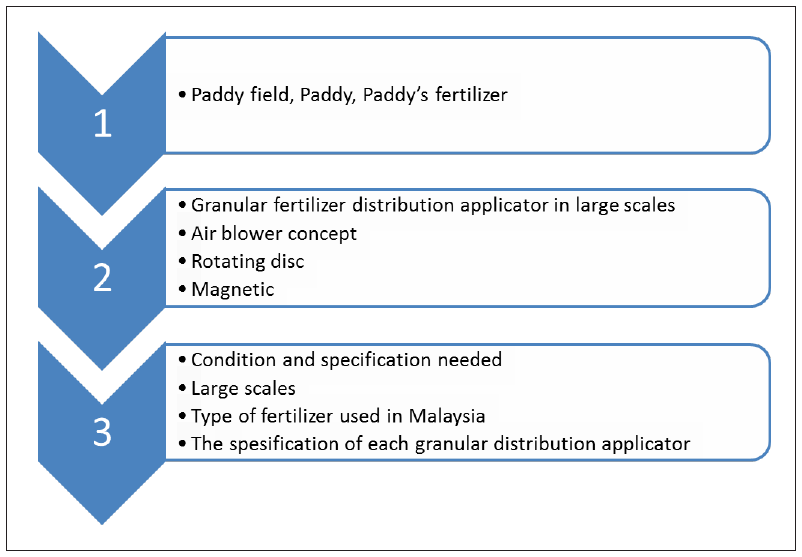
related to paddy, paddy fertiliser, and distribution applicator.
7.0The Use of Fertilisers
The NPK fertiliser, which is in granular form, is a chemical component use in growing paddy by regular agronomic practice. It comes in different forms, sizes, and densities. However, since the soil in Malaysia varies, different formulae ratio of each type of fertiliser vary according to places and soil type. From NPK, N is more for promoting leaf growth, P contributes to root, flower, and fruit development, and K contributes to stem and root growth. However, the negative impact of this type of fertiliser is that excessive usage will cause residue toxicity and environmental pollution, because about 40 to 70% of nitrogen, 80 to 90% of phosphorus, and 50 to 70% of potassium of the applied normal fertilisers is lost to the environment and cannot be absorbed by plants 134 Journal of Business Management and Accounting, 6(1) 2016: 127-140
(Corradini, de Moura, & Mattoso, 2010). The fertilisers will dilute into a sticky liquid due to the chemical reaction of mixing them together. Table 5 shows the fertiliser amount recommended according to a given area.
| Location of Paddy Field | Type of Paddy | Amount (ingredient, kg ha-1) | ||
|---|---|---|---|---|
| Field | ||||
| N | P | K | ||
| Plain field below 250m above | Normal | 110 | 45 | 57 |
| sea level | ||||
| Plain field below 250m above | Sandy | 130 | 51 | 71 |
| sea level | ||||
| Field from 250 to 400m above | Salty | 110 | 64 | 78 |
| sea level | ||||
| Field over 400m above sea level | 110 | 77 | 93 | |
| Reclaimed field from the sea | 200 | 51 | 57 | |
| Source: (Kim et al., 2008). | ||||
8.0The Structure of the Distribution Applicators
The Table 6 and Figures 2a-c below show the structure of the three distribution applicators. Comparing the different structures and functions of the distribution applicators would help in understanding the advantages and the disadvantages of each applicator. Each applicator has one hopper and one metering. Every metering functions to control the amount of fertiliser drop from hopper to the parts for distributing.
| Parts | Boom sprayer | Kuhn Axis fertiliser | Pendulum spreader |
|---|---|---|---|
| spreaders | |||
| Hopper | 1 | 1 | 1 |
| Concepts | Air blower | Rotary (disc) | magnetically damped inclinometer |
| Part of distribution | Boom | Disc | Spreader bar |
| Metering | 1 | 1 A Review on the Selection of Granular Fertiliser Distribution Methods for Malaysia’s Paddy Field on a Large Scale: 127-140 | 1 135 |
| a) | |||
| Hopper | Boom | Boom The granular fertiliser flows from left to right inside the boom and comes out from the blow head in a specific path shape Side view | |
| b) | Hopper Spreader bar | Spreader bar Hopper Top view | |
| c) | Hopper | ||
Rotating disc Hopper Rotating disc
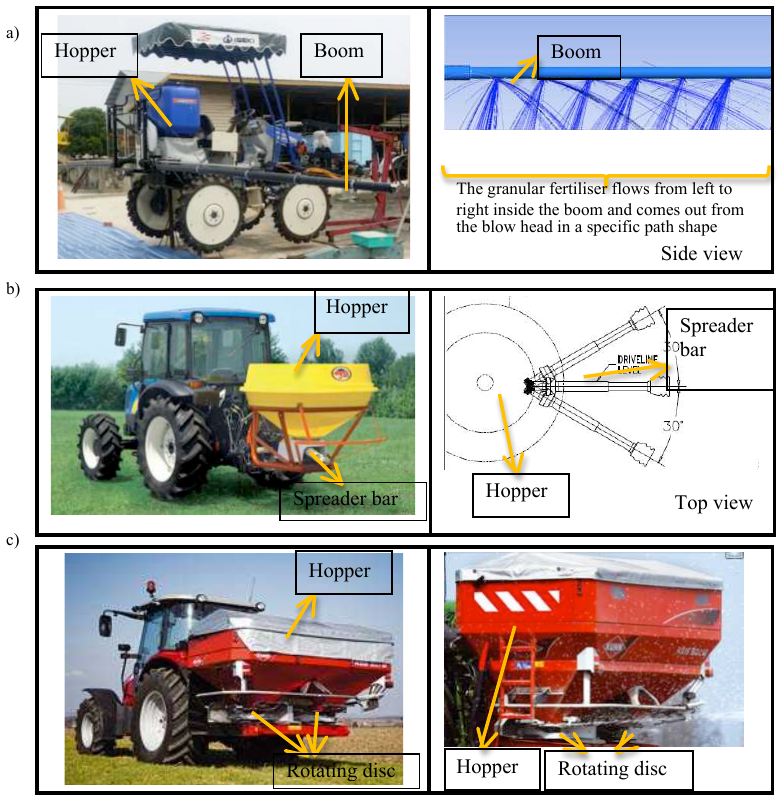
and right booms. The right side of the boom, the granular fertiliser will go through the boom from left to right and then flow from the blow heads. Every blow head consists of a reflector that channels the granular fertiliser out of the boom. When the granular fertiliser exits the blow head, it will not drop vertically onto the ground, but it will be deflected as shown in the figure. It is pneumatic system because a blower is used to blow the fertiliser out of the boom.
9.0Results and Discussion
Table 1 shows the decrease of import of the distribution applicator compared to the rest of the machines. Comparing local and international usage, other countries have already widely improved in designing the granular distribution applicator. The market is actually very large according to the description of each type of granular applicator. These phenomena might be due to the application that has not been widely promoted to local farmers.
According to Table 2, Table 3, and Table 4, all applicators have a large hopper to hold the fertiliser and have a wide-spread width. They have tractors to move around the field in a short time based on Figure 2. Even though the hopper of the pendulum method seems to be much larger than the other two, each distribution concept has many models which come with different hopper sizes. In other words, the hopper size can be manipulated according to the needs.
Further selection is based on the accuracy of the distribution applicator and this depends on both external and internal factors. For internal factors, the accuracy of the three applicators is high according to all the journal papers and operation manuals, but it will vary according to the place and the effect of the external factors. However, external factors are harder to predict. For example, all three applicators are affected by wind factor, the gravity force, and the condition of landscape. So, carrying out a review of all three applicators was based on Malaysia’s paddy field conditions.
The compliment factor of the applicator with the fertiliser is one important factor to be considered in order to achieve the objective of this paper. When the fertilisers N, P, and K are mixed together, they will be a chemical reaction. Among the three applicators, the applicator that is affected the most by the chemical reaction of NPK fertiliser is the boom sprayer. The fertiliser dissolves in the boom sprayer and not only affects the hopper but also the boom. After a certain period of time, the fertiliser will be stuck in the boom, resulting in difficulties to clean up. The boom might need to be discharged in order to be cleaned. This takes time because there is a need to wash and dry it. The maintenance cost becomes very high due to the time consumed and there is a possibility that new parts are needed to replace damaged components in the more extreme conditions. The fertiliser usually gets stuck in the boom because the blower has not enough power to support the three types of fertilisers in the boom. Due to the different density of each fertiliser, it is impossible to produce an even distribution by using one blower. Figure 3 portrays a scaled-down model of the boom sprayer with particles of different densities stuck in the pipe when using a blower. A Review on the Selection of Granular Fertiliser Distribution Methods for Malaysia’s Paddy Field on a Large Scale: 127-140 137
Stuck
Source: Fatin, 2015.
The figure itself is in the PDF version.
As for the pendulum spreader, the fertiliser dissolves into a sticky liquid mainly in the hopper, but lesser in the spreader bar because the spreader is rotating at a high speed, so the fertiliser will just stay in the spreader bar for a short period of time. However, due to the fast speed motion of the spreader bar, the fertilisers will be crushed into powder form before it is distributed into the field (Pendulum Spreaders, 2015). The reason that the fertiliser must remain in granular form when it is distributed into the field is to lengthen the time for the fertiliser to dissolve. If the fertiliser dissolve time is shortened, the soil will become acidic and poison to the paddy plants (Corradini et al., 2010).
| Parameter | Boom sprayer | Kuhn Axis | Pendulum |
|---|---|---|---|
| fertiliser spreaders | spreader | ||
| Fertilisers | Dissolve into | Dissolve into | Dissolve into |
| sticky liquid | sticky liquid after | sticky liquid | |
| after sometime | sometime in the | in the hopper. | |
| in the boom | hopper | The fertiliser | |
| is crushed into | |||
| powder form | |||
| before distributed | |||
| into the field | |||
| (continued) | |||
| 138 | Journal of Business Management and Accounting, 6(1) 2016: 127-140 | ||
| Parameter | Boom sprayer | Kuhn Axis | Pendulum |
| fertiliser spreaders | spreader | ||
| Maintenance cost | High because | Low because less | Moderate |
| more parts to | parts involved in | ||
| clean up | clean up | ||
| Accuracy | High | High | High |
| Accuracy | |||
| Accuracy | High | ||
| High | High | ||
| High | High | ||
| High | |||
| Accuracy | High | High | High |
| Spreading | |||
| Spreading | |||
| Spreading | shape | ||
| shape | |||
| shape | |||
| Spreading | shape | ||
| Part used to spread the | Blower | Rotating disc | Magnetically |
| fertiliser | damped | ||
| inclinometer | |||
| References | (Sun & Miao, | (Abubakar et al., | (Parish, n.d.) |
| 2011) | 2011) (Pendulum | ||
| (Woodward et | (Sima et al., 2013) Spreaders, 2015) | ||
| al., 2008) | |||
10.0Conclusion
The fact is, according to the technical specifications, all three applicators actually had high efficiency levels. Therefore, granular distribution applicator needs to be promoted well to the locals. It is made for large-scale operations and highly promotes the growth of crops. From this study, it was revealed that the most suitable applicator that can be used to distribute NPK fertiliser into the paddy field in Malaysia is the Kuhn Axis fertiliser spreader. This is in accordance with all the discussion and analysed results above.
In this paper, both quantitative and qualitative investigations were employed. In engineering, most of the analysis was interpreted through graphs and tables. The objective of this paper was to compare all three distribution applicators, and to eliminate two distribution applicators such that a suitable distribution applicator for Malaysia’s large paddy fields can be identified. Therefore, after studying the advantages and disadvantages of each distribution applicator, as well as the accuracy of the distribution and the type of fertilisers, the qualitative investigation helps to make the final conclusion. The qualitative analysis covered both external and internal factors, and the results were presented in numerical tables. A Review on the Selection of Granular Fertiliser Distribution Methods for Malaysia’s Paddy Field on a Large Scale: 127-140 139
For further study, a comparison through controlled experiment conditions can be performed involving the spreaders by fabricating the spreader parts. More concrete results can be uncovered to verify the conclusion of this paper. Both quantitative and qualitative approaches are important in the engineering field. If qualitative investigation is executed without the quantitative approach, it will be very subjective with high possibilities of human error. In addition, external factors will also be neglected. The results can be further used for improving the design of the spreader applicators and for simulation validation in the actual large-scale operations.
Acknowledgements
The authors of this paper would like to acknowledge Universiti Tun Hussein Onn Malaysia for providing the facilities to write this paper. This research was supported financially by the Ministry of Higher Education Malaysia (FRGS/2/2013/STWN03/ UTHM/03/1), which was also known as Grant FRGS 1420.
References
- Abubakar, M. S. A., Ahmad, D., Jamarei, O., Samsuddin, S., & Norhisam, M. (2011). Evaluation of a dual-purpose chemical applicator for paddy fields. American Journal of Applied Sciences, 8(May), 362-367. doi:10.1109/ ICOM.2011.5937188.
- Combellack, J. H. (1981). History and trends in the design of ground boom sprayers for Australian conditions. Proceedings of the Sixth Australian Weeds Conference, 1, 87-91.
- Corradini, E., de Moura, M. R., & Mattoso, L. H. C. (2010). A preliminary study of the incorporation of NPK fertiliser into chitosan nanoparticles. Express Polymer Letters, 4(8), 509-515. doi:10.3144/expresspolymlett.2010.64.
- Kim, Y. J., Kim, H. J., Ryu, K. H., & Rhee, J. Y. (2008). Fertiliser application performance of a variable-rate pneumatic granular applicator for rice production. Biosystems Engineering, 100, 498-510. doi:10.1016/j.biosystemseng.2008.05.007.
- Kubota. (2014). Kubota Report, 2014. Business and CSR Activities. http://www.kubota-global.net/report/pdf/pdf/digest2014.pdf
- Kuhn. (2014). Linkage fertiliser spreader review - Kuhn Axis 50.1 H-EMC-W https://www.tradefarmmachinery.com.au/.../kuhn-axis-501-h-emc-w-fertiliser-spreade 140 Journal of Business Management and Accounting, 6(1) 2016: 127-
- Maire, J., Coyer, A., & Fatin, N. (2015). Surfactant Foam Technology for in Situ Removal 2of Heavy Chlorinated Compound - DNAPLs., Journal of Hazardous Materials, Elsevier. http://www.sciencedirect.com/science/article/ pii/S0304389415006081
- Malaysia Agribusiness Directory. (2013-2014). Publisher, Agribusiness Publishing Sdn Bhd, 2013. Length, 489 pages. Export Citation, BiBTeX EndNote. https://books.google.com/books/.../Malaysia_Agribusiness_Directory_2013_201. html
- Operational Manual. (2014). 493593 Booms Operators Manual 2014.pdf. http://hagie.com/Virtual/Manuals/Spray%20Boom%20Manuals/2014/493593%20 BOOMS%20OPERATORS%20MANUAL%202014.pdf?x=
- Parish, R. L. (1999). Granular spreaders: Selection, calibration, testing, and use, pp.1-68.
- Sima, T., Nozdrovicky, L., Dubenova, M., Kristof, K., & Krupicka, J. (2013). Effect of manual navigation on quality of work of Kuhn Axera 1102 h-emc fertiliser spreader, Engineering for Rural Development, 185-189.
- Sun, J., and Miao, Y. (2011). Simulation & controller design for an agricultural sprayer boom levelling system. Proceedings of the 3rd International Conference on Measuring Technology and Mechatronics Automation, ICMTMA 2011, 3, 245-248. doi:10.1109/ICMTMA.2011.632.
- Viet, L. D. & Park, Y. (2015). A Cable-Passive Damper System for Sway and Skew Motion Control of a Crane Spreader. Hindawi.com.http://dx.doi. org/10.1155/2015/507549
- Woodward, S. J. R., Connell, R. J., Zabkiewicz, J. A., Steele, K. D., & Praat, J. P. (2008). Evaluation of the AGDISP ground boom spray drift model. New Zealand Plant Protection, 61, 164-168.