Attitude toward Conflict and Family Business Succession
- Universitas Ciputra, Surabaya
- School of Business Management, College of Business, Universiti Utara Malaysia
Journal of Business Management and Accounting 6(1) (2016) · https://doi.org/10.32890/jbma2016.6.1.8851
Abstract
Conflict is central in family business. Family business consists of family members working together, using family and business logics. Efforts are done to mitigate the impact of role conflicts. Nevertheless, conflict remains the top reason for discontinuity. Findings suggested that participants with positive attitude toward conflict take more relaxed approach toward succession, with larger next generation talent pool. This group is egalitarian in strategic decision making and characteristically optimistic. Participants with negative attitude have a smaller talent pool for succession, since they reserve leadership for the select few. They are more cautious, requiring successors to implement their visions beforehand, and are less optimistic. This study contributes to the body of knowledge and family business practitioners. Firstly, this paper introduces the use of attitude toward conflict to predict behaviour during succession. Secondly, this paper inspires leaders to assess their attitudes, and if required to change their attitudes, so that they can plan their succession accordingly.
Keywords: Family business, conflict, family business succession, attitude, attitude toward conflict
1.0Introduction
In the history of family business, Colli (2003) pointed out that family business is the oldest form of business institutions. While Les Henokiens boasted a membership of 33 of the oldest family firms that have been around for over 200 years, the Hay Group (2012) published that the life expectancy of family firms in 10 Asian countries has shortened to 24 years; roughly 1.5 generations, from 50-60 years, 2-3 generations, in 1990. Credit Suisse (2011) reported similar findings, which is alarming because family firms make up the vast majority of business institutions, even in capitalist countries (Caspersz & Thomas, 2013; Nordqvist & Melin, 2010).
In the past, scholars assumed that the family business is a temporary business model that will grow into a professional firm when it becomes too large to handle (Fukuyama, 1995; Halls, 1988; Chandler, 1980). Les Henokiens’ global presence proves that their
76 Journal of Business Management and Accounting, 6(1) 2016: 75-89 members are not always small operations. Giant companies such as Tata Group, LVMH, and Walmart are family firms. Looking at how large companies manage to stay family- controlled and family-owned, statistics showed failure of some 70% family firms going into the second generation, thus it is important to investigate how family firms manage their succession (Credit Suisse, 2011).
This study addressed the following research questions: (a) How does predecessor’s attitude toward conflict influence the succession? and (b) What is the impact of family business leaders’ attitude toward conflict on sustainability? While there are many elements in family business succession, the literature maintained that succession does not happen until family business leaders relinquish their power to successors (Michael- Tsabari & Weiss, 2013). In fact, Hatak and Roessl (2013) added that many family business leaders, driven by fears and uncertainty, linger past their tenure and refuse to leave their position. This study does not aim to put the blame on leaders when succession does not occur. Nevertheless, the literature showed that until the succession process is completed and successors rise to power, leaders are the ones who must follow through (Blumentritt, Matthews, & Marchisio, 2013).
On top of contributing to the body of knowledge, this study is also useful for family business owners and operators. Firstly, this paper is the first to illustrate the use of attitude toward conflict in family business studies. While the study of attitude is the heart of social psychology, it has never been used in studying conflict in the family business setting (Fazio & Olson, 2003). Attitudes toward conflict are divided into two extremes, participants with positive attitude toward conflict who treat conflict as a natural part of life, and participants with negative attitude toward conflict who keep conflict at bay as much as they can. Secondly, through identification of attitude toward conflict, this research contributes to the practitioners, specifically family business leaders, who can assess their own attitudes toward conflict to be able to make a succession plan that works with their styles, and, if necessary, make an attitude change.
This article is structured as follows; after the introduction, a literature review of family business succession and related aspects such as conflict and communication is summarised. The research methodology is laid out in detail afterward, followed by findings, as well as a discussion and recommendations.
2.0Family Business
Putting family business into one category is misleading because of the variety of business models. While it shares the quality of putting family members in the workplace and intention to be passed down through the generations, a family business is very vibrant and diverse as it includes firms of many shapes and sizes in every industry (Stewart & Hitt, 2012; Chrisman, Chua, Pearson, & Barnett, 2010).
2.1Family Business Sustainability
In the beginning of family business studies, succession has been under the spotlight of this field. While succession issues have recently been overshadowed by many other topics, it remains one of the main research interests. Similar to the difficulty of defining family business, succession is hard to unwrap because of definitional discrepancy. In family business, the leaders may hold different functions in the firms (Stewart & Hitt, 2012; Chrisman et al., 2010). However, most family business leaders are also patriarchs and matriarchs with strong influences in the family (Cicellin, Mussolino, Martinez, & Iacono, 2013). Therefore, in family business, it is important to understand the family before the business (James, Jennings, & Breitkreuz, 2012; Chrisman, Kellermanns, Chan, & Liano, 2010).
In the past, the dissolution of family businesses is often blamed on management incompetence that could only survive through professionalization Levinson, 1971. In fact, as recently as 1995, world-renown economist Francis Fukuyama, in his book “Trust”, wrote that low-trust cultures such as in Asian and Latin American countries do business through personal references, resulting in economies dominated by family businesses that develop at a slower speed in comparison to high-trust, Western cultures. This, as according to Fukuyama, is a drawback for the economy caused by a limited talent pool when hiring for family businesses. Stewart and Hitt (2012), however, disagreed with Fukuyama and suggested that the hiring process in family firms are much simpler because the employers know the skills and qualifications of the family employees beforehand. As a result, decision making is faster because family members have done it in the family setting. They do not have to adjust to one another’s style anymore.
Early allegations that family businesses are not capable of running effective management also went unproven when Lam (2011) discovered that family members often disagree during the succession process because of conflicting roles at home and at work, and not because of their management incompetence. Lam (2011) added that skilled non-family employees should be able to manage operational issues while the family deals with succession. Stewart and Hitt (2012) suggested an alternative, where professionalisation is done by leveraging the skills of family employees, instead of hiring non-family professionals.
2.2Reciprocal Nepotism
A family business without nepotism is a business staffed with related employees, similar to an entrepreneurial start-up utilising family capital to staff the operation when it cannot afford to hire proper employees. Nevertheless, scepticisms surrounding family business as a viable business model often revolve around the narrow talent pool from which successors are nominated from, such that Family Business Review only had four articles with the word “nepotism” on their titles, since its first issue in 1988. This finding showed that even in the family business field, this word is preferably avoided. 78 Journal of Business Management and Accounting, 6(1) 2016: 75-89
From the four articles, one was a book review while the oldest article was not available during search, so this paper only relied on the latter two. This study adopted the notion of reciprocal nepotism, as proposed by Jaskiewicz, Uhlenbruck, Balkin, and Reay (2013). While this notion was not empirically tested, the idea was proven in this study that privileges such as primogeniture do not prevail in succession.
Reciprocal nepotism adheres to the stewardship theory in which the successor reciprocates the parents’ guidance and becomes the guardian of family legacy. Comparing family firm CEOs to their non-family counterparts, Salvato, Minichilli, and Piccaretta (2012) supported reciprocal nepotism, reporting that CEO of family firms take as much time rising in rank as non-family CEOs, indicating that they are appointed because they are qualified.
On the opposite side of reciprocal nepotism is entitlement nepotism, in which successors begin their careers entitled to the position, usually ignoring obligations to perform. Primogeniture is an example of entitlement nepotism where a successor is chosen because he is the oldest. Entitlement nepotism is usually rooted from parental asymmetric altruism, resulting in the successor exploiting resources for personal benefits at the expense of firm survival.
2.3Conflict
Conflict is not a new issue in family firms. Literature suggested that family business succession is conflict-laden because it involves intense emotions (Lam, 2011). A search of Family Business Review articles with the word “conflict” in their titles resulted in a total of 13 articles, but none of which talk about attitude toward conflict. Literature on conflict is divided into two streams, one being internal conflicts within self, which is usually referred to as role conflicts, and interpersonal conflict. Consistent to the focus of this study, this paper shall review literature on role conflicts.
De Massis, Kotlar, Mazzola, Minola and Sciascia (2016), proposed that the lack of self-control in family owners who are also operators of their own family businesses result in agency problems, unlike agency problems found between principal and agent. The study reported that family owners do not have to respond to the board of directors, causing them to be able to make decisions that do not benefit the firms. Similarly, Memili, Chang, Kellermanns, and Welsh (2012), posited that managing role conflict is crucial in family business.
3.0Method
Family business is a complicated subject involving multiple actors in different settings, at home and at work, and thus, succession is best studied qualitatively (Dawson & Hjorth, 2012). Because of the research objectives, this study is a collective case study, in which participants provide data through qualitative interviews that are processed through multiple layers of manual coding.
3.1Research Setting
Participants were taken from the second largest city in Indonesia, which is also the industrial hub for eastern Indonesia, Surabaya. The place was chosen because the researchers are natives to Surabaya, thus minimising cultural gap and maximising the understanding of local culture. The two largest groups inhabiting Surabaya are Javanese and ethnic Chinese. In Surabaya, it is common for middle and upper class families to run businesses intended to be passed through generations. Taking over parents’ businesses is so common that it is a disgrace to the family when a child applies for a job. The participants ranged from parents to grownup children between the ages of 18 and 53.
3.2Research Method
A collective case study is the method of choice to allow robust cross-case analysis based on theme identification (Creswell, 2011). The two research questions are interconnected to one another. Conflict is a sensitive issue in Asia where the collective culture upholds agreement and age hierarchy. To obtain the data, qualitative interviews were conducted where participants are asked to tell their stories on succession and changes that occurred when the children enter the firms.
3.3Data Collection
Participants were selected based on certain criteria, namely family business leaders in the midst of succession, and more than next generation family employees in the family business. Participants were chosen purposively from the first author’s professional network. Careful considerations were taken into account to make sure personal opinions and biasness do not interfere with data collection. Several qualified participants were omitted from the list because of the authors’ presumptions. Prevailing sampling methods were purposive and partial snowballing. Snowballed participants underwent vetting to maximise demographic variety.
Data collection produced seven robust interviews from seven participants ranging from the ages of 53 to 71. Participants’ children’s age ranged from 18 to 53. Participants are owners of family firms in various industries, with annual revenue of RM15,150 or more. The threshold follows “Undang-Undang Nomor 20 Tahun 2008 tentang UMKM”, which is Indonesian government regulation regarding the size of SMEs. Businesses with annual revenue under RM15,150 are considered micro, small, or medium enterprise, which would skew the result because owners of small and medium businesses in Surabaya prefer to provide financial and human capital for their children to form start-ups in similar industries. In reality, participants’ annual company revenues are upward of RM 600,000. 80 Journal of Business Management and Accounting, 6(1) 2016: 75-89
3.4Data Analysis
Recordings from the interviews were mind-mapped to reveal keywords and connections among keywords. The same protocol was done with the transcripts to increase validity, which was compiled into a list of keywords. The final list of keywords was run against field notes containing observation notes of facial expressions, body languages, signs of discomfort, and unease of the direction taken in the conversation, and changes in the tone of voice to increase reliability of the data. The list was reduced until they revealed the main themes.
Transcripts from the interviews were run through the Attitude towards Conflict Scale to develop patterns of decision making (Bresnahan, Donohue, Shearman, & Guan, 2009). While the word “conflict” was included in the research protocol, qualitative analysis was needed to test the validity of the claim.
4.0Findings
Focusing on how predecessors’ attitude toward conflict influences their approach to succession and optimism on the future of the firms, the research divided the attitude toward conflict consistent to Bresnahan et al. (2009). One the one hand, the data revealed leaders with positive attitude toward conflict, while on the other, the data revealed those with negative attitude toward conflict.
| Positive Attitude Toward | Negative Attitude Toward | |
|---|---|---|
| Conflict | Conflict | |
| Intention for succession Plan A | Sole plan | |
| Talent pool | Unlimited, all next generation | Select few, others kept away from operations |
| Decision making | Egalitarian or consultative | Pre-drafted, predecessor-controlled |
| Attitude toward the | Relaxed, successor is well- | Nervous, hoping for the best |
| family firms’ future | equipped | |
| Anticipation for | Equally nervous of the word ‘retirement’, because of culture | |
| retirement |
4.1Predecessors with Positive Attitude Toward Conflict
Participants with positive attitude toward conflict believe that conflict will enhance their family capital. They believe that the family shall remain, regardless whether or not the business survives. Therefore, these participants are guardians of the families before they are guardians of the family business. The attitude toward conflicts also influences their talent pool. Not only do they allow all children to join the companies, many also hire family employees in strategic positions, although they usually are not nominated as successors.
“I always provide jobs to family members. Some misused my trust. Years ago, my son in law was cheated by his friend in Singapore. I had to absorb the loss, but what can I do? This is my business and they are my family. Now my son in law has passed away, so I am glad we did not end on a bad note. Two years ago, my grandson in law did the same thing. I forgave him, but I did remind him not to do that again. I had to pay for the loss. At the end of the day, I am debt free, so I think this is the right thing to do” (Participant E).
“I was not wanted in the business; my mother was my father’s third wife. Surprisingly, my father’s first wife asked me to run the family business and buy out my step siblings when my father passed away. I did it as a grant (hibah) to my stepsiblings. By law, they were still co-owners. My legal advisor warned me against future problems but I trust my family” (Participant G).
On top of putting family first, this group does not believe that conflict starts at home. They believe good communication to solve disagreements early are key to a harmonious workplace and family.
“We grew up together, so we adhere to the same culture. I do not believe conflict start at home. We have to keep things honest, even with my siblings who are not operationally involved. If they do not understand my decisions, especially regarding money, they will get suspicious. If it goes on for a long time, it will blow up into a divisive conflict. That was how my uncle and father split up. My uncle was very good at budgeting. He did not like that my father kept using the corporate fund and my father was not happy because he made significant contribution through his marketing efforts. I do not want that to happen to us, so I keep everything communicated” (Participant A).
Participants with a positive attitude toward conflict do not simply say that problems need to be tackled early, they take it seriously, as illustrated by one participant that makes it his business so that disagreements are verbally settled and all parties agree 82 Journal of Business Management and Accounting, 6(1) 2016: 75-89 that the case is closed. Many of them learn from past experience that nothing is worth splitting up the family. This is apparent with Participant G who started in the family firm as the underdog.
“I have never seen a large conflict, but when my sons have problems with each other or their cousins, I help them solve the problems openly. Last time, my son did something that offended my brother. I told him to apologize and admit he was wrong” (Participant G).
From the above data, it seemed that Participants A and G avoid conflicts as much as participants with negative attitude toward conflict. However, their willingness to discuss them before conflicts become dysfunctional shows them placing higher priority on guarding family unity. In the next sections, a discussed will ensue to illustrate where this group falls on their conflict management style, in comparison to participants with negative attitude toward conflict.
A similar claim was made by Participant F who hired his brother as director of operations. He added that the key to a successful, conflict-free operation is not to be too tight on money, both for family and employees.
“I never have argument with my brother. He has been my managing director for the past 20 years, we get along fine. His being with the company allows me to do social works related to my business. Most importantly, do not hold your money too tightly, everything should be fine” (Participant F).
While the ultimate goal of both groups is the same—to retain family control— predecessors in this group are well-aware that succession is a collective process.
“My children are informed that they are expected to support the company, but I know that I have to appoint one of my managers to replace me if no one is capable or interested” (Participant A).
Because of the agreement on the importance of family support and participation, this group tends to involve family members in strategic decision making. The behaviour is most obvious in mapping out strategic decisions and next generation involvement.
“My daughter likes fashion. When she was in high school, I tried to influence her decisions. Funeral services industry is much less competitive, and we already have the largest market share in the business. There is a buffer, she will start at a safe position. Life will be comfortable. She did not come to work for me for another 16 years after graduation. But, really, I had it comfortable since the beginning, so I genuinely wanted to give her something for her future, even if she never works for me. Funeral management is a pretty undesirable field. Anywhere, it is relatively easy competition” (Participant F).
Overall, observation on this group suggested that they have more flexibility toward how the business operates, including the shape of corporate goals. The ambition of keeping management control remains but realistically, as these participants agree that they cannot force their offspring to have the same aspirations. Their ability to admit visible conflict and willingness to tackle it early allows this group to maintain stable family relationships with members of the next generation.
4.2Predecessor with Negative Attitude Toward Conflict
Participants with negative attitude toward conflict are also passionate about maintaining family unity. It is upon this priority that they choose to separate one offspring from the others—to keep siblings from competition that they predict could lead to the dissolution of the firm. The difference between this group and the previous one is the level of trust they put on their offspring’s ability to maintain family unity.
“My oldest and youngest are pretty similar, they understand each other, and are equally skilful. If I put them together in the firm, they will have frequent conflicts, it is undesirable for the children to have disagreements, especially once we pass away” (Participant C).
The preference to avoid conflict is clearly shown when questioned what they would do, should family members other than their children intend to join the firms, such as children-in-law. One participant very sternly explained that his firm had enough leadership with his youngest son in place. He welcomes family members and relatives as resellers but the company is reserved for his son (Participant B).
Participants with negative attitude toward conflict noted that their children’s involvement in the business is by their own initiatives. However, this group is less flexible in strategic planning and goal setting, believing it is best for successors to do business according to the parents’ plans.
“I do the early negotiations. Once the deal is made, I delegate it to my son. Once he manages to achieve the goals, he can plan the future, but as long as I remain, I give instructions and he follows” (Participant C).
When asked about the future of the firms, however, participants of this group are not so sure. Participant B kept repeating his doubt by questioning whether or not he made the correct choice. Furthermore, there has been uncertainty when it comes to the other siblings. Participant C who has a son in the family firm and two daughters working professionally asked the interviewer what to do with the daughters:
“We have not think about shares for our daughters. Do other families give shares to daughters? Uhh ... we honestly have not thought about it. We do not know what to do” (Participant C). 84 Journal of Business Management and Accounting, 6(1) 2016: 75-89
As a whole, this group is firm in their goal setting and less tolerant to changes, but they tend to be nervous about the future of the family businesses and doubtful of their own decisions. At the same time, it is worth noting that reciprocal nepotism prevails here. Children chosen to succeed the parents are handpicked for their perceived ability, and they enter into generalised social exchange relationships with their parents, consistent to reciprocal nepotism (Jaskiewicz, Heinrichs, Rau, & Reay, 2015).
4.3Anticipation for Retirement
In the interview protocol, the interviewer directed participants to discuss both retirement and conflict using the two keywords. The authors anticipated participants to feel uneasy about the question, understanding the social stigma associated with it in the local culture. It was intentionally done to catch their reaction on both the question of their retirement and their feelings about the thought of leaving the firms with their successors.
The data, however, suggested that attitude toward conflict has less to do with anticipation for retirement. Instead, participants’ lifestyle is more relevant. For example, Participant A who is a self-admitting supporter of conflict in the workplace told the interviewer that he joined his friends in a shrimp start-up business to prepare for the time when the children can handle the business on their own. Participant C with negative attitude toward conflict shared his dream of operating a fishing boat for hire, leading groups of tourists on fishing and diving trips.
5.0Discussions and Recommendations
From the business standpoint, leaders with positive attitude toward conflict creates a competitive environment where each idea is challenged for the best to prevail. Nevertheless, this can backfire if discussions take too long to conclude, resulting in “too many cooks in the kitchen” (Spriggs, Yu, & Sorenson, 2012). This model is also dangerous should the predecessor perish before the leadership is handed over to the successor (Long & Chrisman, 2014). Without their parent as a referee, the leadership can head south if all potential successors think of themselves as the most capable.
Family business leaders with negative attitude toward conflict encounters negative emotional issues when other offspring feel left out of the talent pool, but this is a lesser problem compared to what may happen if the successor feels so indebted for the parents for putting him/her in the position of power and too afraid to voice personal opinion. In addition, the successor, while being the most capable, may not aspire to the same goals as the predecessor.
On the other hand, successor’s awareness of parental expectation creates a strong stewardship that will optimise successor’s effort in maintaining the survival of the firm.
Another strength of leaders with negative attitude toward conflict, due to less flexible goal setting strategy, is that the firm can focus on the agenda, taking less time to adjust to new goals (De Massis, Kotlar, Mazzola, Minola, & Sciascia, 2016).
The first contribution of this study was the introduction of attitude toward conflict to justify family business leaders’ behaviour during succession. De Massis, SIeger, Chua and Vismara (2016), suggested that family business leaders’ attitude toward intra- family succession is a critical individual determinant of the outcome of intra-family succession. It is the only study of attitude within the family business study setting, suggesting that emotional attachment has the strongest relationship with attitude toward succession. While this study made an incremental contribution in the study of attitude toward conflict, this discovery can be extended to the study of other family members and family employees’ attitude toward conflict, and eventually, future studies can look into family business attitude toward conflict as an organisational behaviour.
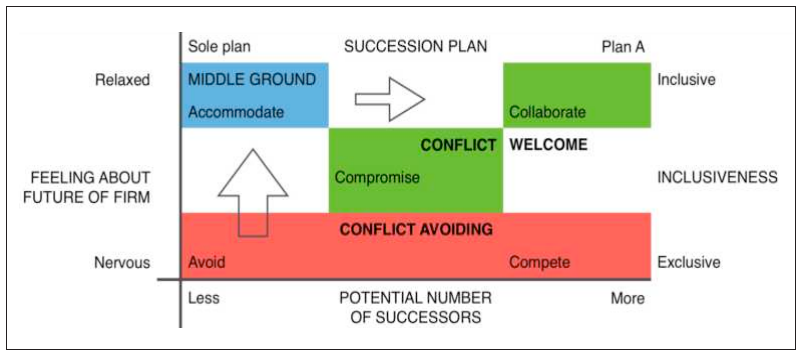
The second contribution of this study was directed toward practitioners, both family business leaders and consultants. The knowledge of how different attitudes toward conflict influence the succession process (as shown in Figure 1) can lead family business leaders to assess their own attitude, and change their attitude when it is believed to be necessary for sustainability of the family firm. After all, succession is under the control of the current leaders (De Massis, SIeger, Chua, & VIsmara, 2016; Long & Chrisman, 2014).
6.0Conclusions
This study is important in understanding the missing link that determines family business survival. Succession is the period where conflict is rampant, and inability 86 Journal of Business Management and Accounting, 6(1) 2016: 75-89 to deal with the intensity of conflicts and transition may lead to larger issues risking the survival of the family business. Succession is more emotional than strategic that many decisions are driven by fear of uncertainty (Shepherd, 2016; Lam, 2011). Ability to understand attitude toward conflict, in and of itself, can predict a lot of behaviours and open doors for future researchers in helping predecessors keep looking ahead and successors to focus on firm survival.
Family business field is driven by an understanding that putting family variables first complicates the outcome because of the emotional issue (Shepherd, 2016; Jennings, Breitkreuz, & James, 2013; Lam, 2011). Based on such understanding, future studies can benefit from larger samples, especially from other cultures, to see how cultural differences influence the attitude differently. It will also be interesting if future research is conducted longitudinally to see if there are temporal impacts, as well as test on the accuracy of the outcome. Family business issues deal with maturity and past experience, which may change the attitude of both predecessors and successors as they both get older. Being a qualitative study, this study lacks the ability to measure the intervals in between positive and negative attitudes. Future studies should also focus on measuring the studying behaviours of leaders with negative attitude toward conflict when they are forced to face conflict.
References
- Blumentritt, T., Mathews, T., & Marchisio, G. (2013). Game theory and family business succession: An introduction. Family Business Review, 26(1), 56-67.
- Bresnahan, M. J., Donohue, W. A., Shearman, S. M., & Guan, X. (2009). Research note: Two measures of conflict orientation. Conflict Resolution, 26(3), 365-379.
- Caspersz, D., & Thomas, J. (2013). Developing positivity in family business leaders. Family Business Review. Advance online publication. doi: 0894486513505641.
- Chandler, A. D. (1980). Managerial hierarchies. Cambridge, MA: Harvard University Press.
- Chrisman, J. J., Chua, J. H., Pearson, A. W., & Barnett, T. (2010). Family involvement, family-influence, and family-centred non-economic goals in small firms, Entrepreneurship Theory and Practice, 34(5), 1-27.
- Chrisman, J. J., Kellermanns, F. W., Chan, K. C., & Liano, K. (2010). Intellectual foundations of current research in family business: An identification and review of 25 influential articles. Family Business Review, 23(1), 9-26.
- Cicellin, M., Mussolino, D., Martinez, M., & Iacono, M. P. (2013). Towards the Construct of Paternalism to Investigate Control in Family Business Governance. Corporate Ownership and Control / 10(4), 2013, 317-328
- Colli, A. (2003). The history of family business, 1850-2000. (Vol. 47). Cambridge, England: Cambridge University Press.
- Credit Suisse, (2011). Asian family businesses report 2011. Switzerland: Credit Suisse.
- Creswell, J. C. (2011). Qualitative inquiry and research design: Choosing among five traditions. Thousand Oaks, CA: Sage.
- Dawson, A., & Hjorth, D. (2012). Advancing family business research through narrative analysis. Family Business Review, 25(3), 339-355.
- De Massis, A. V., Kotlar, J., Mazzola, P., Minola, T., & Sciascia, S. (2016). Conflicting Selves : Family Owners’ Multiple Goals and Self-control Agency Problems in Private Firms. Entrepreneurship Theory and Practice, 11.10.2016. http://www. research. lancs. ac.uk › Research › Publications and Outputs
- De Massis, A. V., Sieger, P., Chua, J. H. & Vismara, S. (2016). Incumbents’ Attitude toward Intrafamily Succession: an Investigation of its Antecedents., Family Business Review. 29, (3), 278-300 23.
- Fazio, R. H., & Olson, M. A. (2003). Implicit Measures in Social Cognition Research: Their Meaning and Use., Annual Reviews Psychology, 54,297–327 doi: 10.1146/ annurev.psych.54.101601.145225.http://www.psy.ohio-state.edu/faculty/ fazio/ reprints.../FazioOlsonAnnualReview2003.pdf
- Fukuyama, F. (1995). Trust: The social virtues and the creation of prosperity. New York, NY: Free Press.
- Halls, P. D. (1988). A historical overview of family firms in the United States. Family Business Review, 1(1), 51-68.
- Hatak, I. R., & Roessl, D. (2013). Relational competence-based knowledge transfer within intrafamily succession: An experimental study. Family Business Review, 0894486513480386.
- Hay Group, (2012). Family business in Asia: Breaking the third-generation curse. Singapore: Hay Group.
- James, A. E., Jennings, J. E., & Breitkreuz, R. S. (2012). Worlds apart? Rebridging the distance between family science and family business research. Family Business Review, 25(1), 87-108. 88 Journal of Business Management and Accounting, 6(1) 2016: 75-
- Jaskiewicz, P., Heinrichs, K., Rau, S. B., & Reay, T. (2015). To be or not to be: How family firms manage family and commercial logics in succession. Entrepreneurship Theory and Practice. Advance online publication. doi: 10.1111/etap.12146.
- Jaskiewicz, P., Uhlenbruck, K., Balkin, D. B., & Reay, T. (2013). Is nepotism good or bad? Types of nepotism and implications for knowledge management. Family Business Review, 26(2), 121-139.
- Jennings, J. E., Breitkreuz, R. S., & James, A. E. (2013). When family members are also business owners: Is entrepreneurship good for families? Family Relations, 62(3), 472-489.
- Lam, W. (2011). Dancing to two tunes: Multi-entity roles in the family business succession process. International Small Business Journal, 29(5), 508-533.
- Levinson, H. (1971). Conflicts that Plague Family Businesses. Harvard Business Review. 90-95. http://gsappweb.rutgers.edu/cstudents/readings/Summer/ Ballet_ FamilySystems/levinson_conflicts.pdf
- Long, R. G. & Crisman, J. J. (2014). Management Succession in Family Business. In S. Goel and P. Sharma (Eds.), The SAGE Handbook of Family Business (247-268)
- Memili, E., Chang, E. P. C., Kellermanns, F. W. & Welsh, D. (2015). Role Conflicts of family members in family firms. European Journal of Work and Organizational Psychology, 1(24), 143–151.
- Michael-Tsabari, N., & Weiss, D. (2013). Communication traps: Applying game theory to succession in family firms. Family Business Review. Advance online publication. doi: 089448651349506.
- Nordqvist, M. & Melin, L. (2010). The promise of the strategy as practice perspective for family business strategy research. Journal of Family Business Strategy, 1(1), 15-25.
- Salvato, C., Minichilli, A., & Piccaretta, R. (2012). Faster route to CEO suite: Nepotism or managerial proficiency? Family Business Review. Advance online publication. doi: 10.1177/0894486511427559.
- Shepherd, (2016). An Emotions Perspective for Advancing the Fields of Family Business and Entrepreneurship: Stocks, Flows, Reactions, and Responses., Family Business Review., 29(2) 151 –158. sagepub.com/journalsPermissions. navDOI: 10.1177/ 0894486516634943
- Spriggs, M., Yu A., Deeds D., & Sorenson, R. L. (2012). Too many cooks in the kitchen: Innovative capacity, collaborative network orientation, and performance in small family businesses. Family Business Review. Advance online publication. doi:10.1177/0894486512468600 Google Scholar Link
- Stewart, A. & Hitt, M. A. (2012). Why can’t a family business be more like non-family business? Modes of professionalization in family firms. Family Business Review, 25(1), 58-