Using Action Research in Business: Developing New Practical Framework of Financial Planning Process for a New Franchise System
- School of Economics, Finance and Banking, College of Business, Universiti Utara Malaysia, Sintok, Kedah
- Graduate College of Management, Southern Cross University, Coolangatta Qld
Journal of Business Management and Accounting 6(1) (2016) · https://doi.org/10.32890/jbma2016.6.1.8849
Abstract
Franchising is the fastest growing method of doing business these days, however, there is little academic research to guide or regulate industry practices. Thus, this research investigated the financial planning process in developing a new franchise system. This study used action research methodology to develop a new practical framework of financial planning for a new franchise system within the Malaysian government department franchise regulators. Three main action research cycles were conducted with three new franchise systems seeking to register with the Registrar of Franchise Malaysia (ROF). To triangulate the findings of the action research, the researcher also presented them at a National Franchise Workshop (NFW). These activities showed that the process of financial planning for a new franchise system should comprise 14elements with specific linkages. These practical frameworks for financial planning in a new franchise system were adopted by the ROF to be used as guideline in the process of developing a new franchise system and serve as evaluation tools for franchise registration.
Keywords: Franchising, action research, qualitative research
2.0A Preliminary Framework
A preliminary framework to guide this research was developed from the literature on the process of financial planning in developing a new franchise system in developed nations, and in Malaysia in particular. Entrepreneurs who want to develop and operate a franchise system in Malaysia must obtain approval from the Registrar of Franchise (Malaysia Franchise Act, 1998), as noted above. The new franchisor needs to prepare financial planning along with other documents (Franchise and Vendor Development
Using Action Research in Business: Developing New Practical Framework of Financial Planning Process for a New Franchise System : 29-45
Division, 1999), for submission with an application form for review by the Registrar of Franchise (Bustaman, 1995; Miranda, 1995).
3.0Financial Planning in Developing a New Franchise System
The financial planning process in developing a new franchise system requires prospective franchisors to calculate, explain, and summarise the reward and risks of the venture, which involves gross and operating margin, potential profitability and durability, fixed costs, variable costs, semi-variable costs, while identifying the framework to attain the break-even point, positive cash flow, key financial projections, and expected return on investments. The entrepreneur develops various documents in the process such as the income statement and balance sheet of an existing business (if available), proforma cash flow, pro-forma income statement, pro-forma balance sheet, break-even chart and calculation, and financial ratio analysis. Except for Justis and Judd (1998), Mat Hassan (1998), and Abdul (1995), there is a gap in the literature about how the elements should be developed in the financial planning of a new franchise system by the potential franchisor, and this research had to establish these new franchise system financial planning elements. As well, it had to identify linkages between these elements because that had not been previously done in the literature. This study had developed a preliminary, but very comprehensive list of financial planning elements of a new franchise system from various Western and Malaysian sources, as shown in Table 1. Meanwhile, Figure 1 emphasises the linkages and the flow of financial planning process that had to be made explicitly in this research: • in preparing the pro-forma annual balance sheet, it shall use the information from the existing balance sheet as an opening balance (line “a” in Figure 1), operating budget (line “b” in Figure 1), capital budget (line “c” in Figure 1), and cash flow projection (line “d” in Figure 1), the information from the operating budget will be used in preparing the proforma annual income statement (line “e” in figure 1), cash flow projection is also helpful to a franchisor in identifying whether the franchisor needs to source outside financing in developing and operating the franchise system (line “f” in Figure 1), the ratios are designed to compare the current business activity (before franchising) using the existing financial statements (line “i” in Figure 1) with the pro-forma financial statements (lines “g” and “h” in Figure 1), and the start-up or turnkey costs to open a franchisor’s outlet will be used in preparing the capital budget (line “j” in Figure 1).
Twelve financial planning elements and ten linkages within financial planning process could be included in the process of developing the new franchise system and they were used for this research.
The next step was to investigate if those 12 elements and 10 linkages were in fact necessary, feasible, or desirable in the real-world setting of Malaysia.
| No. | Elements of financial planning in developing | A | B | C | Total | This |
|---|---|---|---|---|---|---|
| franchise system | research | |||||
| 1 | Existing financial statements (statements from - the established business) | 2 | ||||
| 2 | Identify franchise development costs - | 2 | ||||
| 3 | Franchise start-up or turnkey cost for the franchisor and franchisee to begin the franchise system | - 2 | ||||
| 4 | Franchise fees (initial fee, continuing fee, and advertising levy) | 3 | ||||
| 5 | Operating budget (monthly) - - | 1 | ||||
| 6 | Capital budget (monthly) - | - 1 | ||||
| 7 | Cash flow budget (monthly basis) and cash flow projections statement (yearly basis) | 3 | ||||
| 8 | Pro-forma annual income statement | 3 | ||||
| 9 | Pro-forma annual balance sheet | 3 | ||||
| 10 | Break-even analysis - | 2 | ||||
| 11 | Financial ratio analysis - | 2 | ||||
| 12 | Financing Total 9 8 | 3 10 12 | ||||
| Legend: | A = Justis & Judd (1998) B = Abdul (1995) C = Mat Hassan (1998) Source: Developed for this research Using Action Research in Business: Developing New Practical Framework of Financial Planning Process for a New Franchise System : 29-45 1. The existing financial statements 2. Identify franchise development costs franchise process 3. Franchise start-up or turnkey cost | 33 |
Using Action Research in Business: Developing New Practical Framework of Financial Planning Process for a New Franchise System : 29-45 franchise process
1. The existing financial statements
2. Identify franchise development costs
3. Franchise start-up or turnkey cost
4Franchise fees
budgeting
5. Prepare operating budget (monthly)
10. Break-even analysis 11. Financial ratio analysis
6. Prepare capital budget (monthly)
statements
7. Prepare cash flow budget (monthly) and cash flow projection (yearly)
8. Prepare a pro-forma annual income statement capital plan
9. Prepare a pro-forma annual balance sheet
12. Financial position and financing(capital)
Legend:
a-i = direct linkages (the direct linkages are function as information provider to the related elements) Source: developed for this research from the literature cited in table 1
The figure itself is in the PDF version.
4.0Methodology
This research sought to explore a little-researched area, that is the theory-building research, rather than theory-testing. Thus, it was appropriate to use a qualitative methodology to obtain a “window’ on to the complex processes of financial planning in developing a new franchise system in Malaysia (Carson et al., 2001). Action research was the qualitative method used, mainly for access reasons. For example, case studies of franchisors, franchisees, or consultants could not be obtained because the financial matters in a franchise system in Malaysia are complex and deal with confidential elements. Nevertheless, access to three prospective franchisors and their financial plans was eventually obtained through a group of regulators within the Registrar of Franchise (ROF). This research involved the researcher in participative and collaborative research in the best site in Malaysia to investigate the planning processes of the many would-be franchisors who are required to apply for registration with the division. Several researchers have defined action research, some of whom include Altricther (1990), Bawden and Zuber-Skerritt (2000), Dick (1992), Lewin (1946), Perry and Zuber-Skerritt (1992), and Rapoport (1970), which lead to the synthesis of the action research definition employed for this research that has three core ideas: • • • a collaborative group of people work using a cyclical process methodology that incorporates the process of planning, acting, observing, and reflecting on results generated from a particular body of work; to increase the understanding of the participants in a workgroup (called the policy workgroup) and others within an organisation (at a National Franchise Workshop toward the end of the research project); and produce a public report of those experiences (the PhD thesis and guidelines for developing a new franchise system that were adopted by the government department).
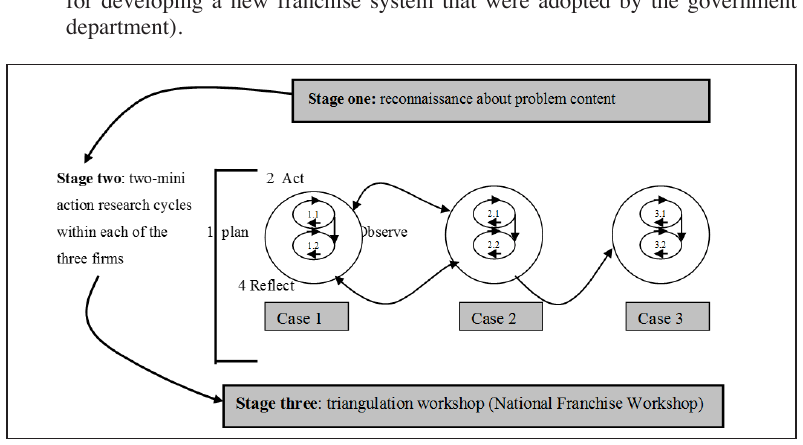
Using Action Research in Business: Developing New Practical Framework of Financial Planning Process for a New Franchise System : 29-45
Legend: 1.1 and 1.2: two mini-action research cycles in case 1 2.1 and 2.2: two mini-action research cycles in case 2 3.1 and 3.2: two mini-action research cycles in case 3 note: the cycle in each case was a combination of two mini-action research cycles Source: developed for this research
The Action Research Process for this research consisted of three stages: reconnaissance, two-mini action research cycles for each of the three firms (cases), and a triangulation workshop, as summarised in Figure 2. 4.1
Stage One: Reconnaissance
Stage one of reconnaissance consisted of an explanation and fact-finding progression to derive further information about the research topic, and gain a greater understanding of how the franchise system in Malaysia was established with particular reference to financial planning. This investigation was performed using the following steps: Step One: The Franchise Division, PNS was Selected for the Action Research Project The researcher approached the Ministry about the problem addressed in this action research project. The discussion started immediately after the researcher was awarded the research grant. The ROF agreed to implement the action research project as a tool to solve the problem of how to establish a new franchise system, especially from the financial planning aspect. Indeed, this action research project was expected to produce guidelines on how to develop a new franchise system in Malaysia that complied with the Malaysian Franchise Act 1998. Step Two: Literature Review The literature review was used to increase the understanding of the process of developing a franchise financial planning system. Articles, research journals, and books were used in this process, while at the same time the nature of franchisee and franchisor in Malaysia were considered. Finally, the preliminary theoretical framework of developing a new franchise system in Malaysia was produced. Step Three: Review of Internal and External Resources The researcher reviewed both internal and external sources (documents and personnel) to ascertain existing knowledge within the ROF, franchise consulting companies, and other relevant entities (“Perbadanan Nasional Berhad”, “Perbadanan Usahawan Nasional Berhad”, SME Bank, and “Bank Pembangunan”). This was to establish whether a similar project had been completed and whether experiences from other undertakings could be extrapolated toward the current project.
Step Four: Convergent Interviewing
Convergent interviewing was also used to obtain ideas from people who are experts in the franchise industry. This process of five convergent interviews in Malaysia was used to support the theoretical framework of this research before the second stage of action research project was commenced, which is discussed next. 4.2
Stage Two: Two-mini Action Research Cycles for Each of The Three Firms (Cases)
The action research process was used after the theoretical framework and research issues had been determined from the literature review and the convergent interviews. It involved working in a collaborative workgroup with the members in the division soliciting information, input, responses, and seeking assistance to implement the theoretical framework that had previously been defined. As noted, this action research took place at the ROF’s office. This department is the authority that handles all the franchising matters in Malaysia, such as monitoring the Franchise Development Programme (FDP) and evaluating franchisors’ applications for endorsement by the ROF. To begin the second stage of the action research project, the researcher discussed in depth with the head of the ROF, pertaining the planning of problem solving activities. Six officers were included in this action research project to work with the researcher, which was to be known as a policy workgroup. These officers were those who are in charge of the process of monitoring the development and evaluating a new franchise system for endorsement by the ROF. During the first introduction meeting of the action research project, all members of the policy workgroup were briefed by the researcher regarding the aim, mission, processes, and tasks that needed to be carried out in the action research project. During the first meeting, two firms were identified by the policy workgroup to be included in this action research project. These two firms were in the process of developing their business into a franchise system and their application endorsement by the ROF had been submitted. These two firms had achieved 50 per cent progress in developing their franchise system and they had established a pilot operation for more than two years. Indeed, the two firms had been registered under the Franchise Development Programme (FDP) in the initial stage of developing their franchise system. Two officers were appointed to be directly responsible for each of the firms. The policy workgroup selected the third firm after completing the second main action research cycle. Three main action research cycles were conducted for the three firms (Figure 3). The first and the second main action research cycles were conducted in four months and the third main action cycle was concluded after the third month, as shown in Table 2. Each of the main action research cycles comprised two mini-action cycles for each case, as shown in Figure 3.
Using Action Research in Business: Developing New Practical Framework of Financial Planning Process for a New Franchise System : 29-45
2 Act ! Visit business’ headquarters ! Evaluate the franchise prototype outlet ! Consult the franchise management team ! Explain the franchise development guideline 1 Plan ! Receive the documents ! Review the document ! Check completeness of documents ! Plan for field work visit
3 Observe * Discussion among policy workgroup mini-action research cycle 1
4 Reflect ! Require additional planning information of business and financial
2 Act ! Conduct an official discussion with the BOD ! Provide consultation session for the BOD 1 Plan ! Study the business and financial planning ! Check completeness of documents ! Prepare the official discussion procedure
3 Observe * Presentation by franchisor * Policy workgroup’s meeting mini-action research cycle 2
4 Reflect ! Decision was made endorsement by ROF by the policy workgroup for the
Source:Source: developed for thisfor research developed this research
FigureFigure 3. Outline of TwoofMini-Action Research Cycles in Each Case.case. 3: Outline two mini-action research cycles in each Mini-action research cycle 1. The first mini-action research cycle 1 consisted of four steps, namely the plan, act, observed, and reflect activities. During the “plan” step in the first mini-action research cycle, four tasks were carried out: receipt of documents from the firm, review of documents, check of the completeness of documents, and plan for the field work visit (the “plan” step of the mini-action research cycle 1 in Figure 3). The policy workgroup studied the documents and a checklist was produced by the officers’ in-charge to inform all the other members. That is, a preliminary guideline of franchise development was generated to increase the understanding of the process in developing a new franchise system, which was distributed during visits to the firms. The first mini-action research cycle then continued with the “act” step. Four tasks were carried out: visit the business headquarters, evaluate the prototype outlet, provide a consultation session to the franchise management team, and explain the usefulness of the franchise development’s guidelines (the “act” step of the mini-action research cycle 1 is shown in Figure 3). Representatives from the policy workgroup visited the headquarters of the firm and the franchise prototype outlet. As a result, a report of the visit was produced to inform the other members. Indeed, the performance of the franchise prototype outlet was analysed by using the past two years’ financial statements as agreed by the policy workgroup. For better understanding, a representative from the firm was invited to attend a consultation session and a full explanation pertaining to the usefulness of the guidelines to improve the process of developing their franchise system was given. An explanation emphasised the financial planning elements that needed to be considered by the firms to improve the business and financial process of developing the new franchise system.
| Mini-action research cycle 1 | Mini-action research cycle 2 | ||||||
|---|---|---|---|---|---|---|---|
| Fashion Goods | Food Products | Domestic | Fashion Goods | Food Products | Domestic Education | ||
| (main cycle 1) | (main cycle 2) | Education | (main cycle 1) | (main cycle 2) | (main cycle 3) | ||
| (main cycle 3) | |||||||
| Plan* | 8 Sept. 2010 | 20 Sept. 2011 | 30 Nov. 2010 | 27 Oct. 2010 | 7 Nov. 2010 | 11 Jan. 2011 | |
| Act | 4 Oct. 2010 | 9 Oct. 2011 | 7 Dec. 2010 | 8 Nov. 2010 | 13 Nov. 2010 | 15 Jan. 2011 | |
| Observing | 11 Oct. 2010 | 16 Oct. 2010 | 19 Dec. 2010 | 17 Nov. 2010 | 20 Nov. 2010 | 17 Jan. 2011 | |
| Reflecting* | 18 Oct. 2010 | 20 Oct. 2010 | 22 Dec. 2010 | 23 Nov. 2010 | 29 Nov. 2010 | 5 Feb. 2011 | |
Legend:
* = these meetings and discussions also considered the process of the two main cycles combined, and the “act” and “observe” parts of those combined cycles were done during the “act” and “observe” parts of each mini-cycles. Note: • the first discussion with the Head of Division was conducted on 22 August 2010.
the first introduction meeting with the policy workgroup was conducted on 3 September 2010.
the National Franchise Workshop was conducted on 18 January 2011 for the triangulation process of this research.
the final presentation and discussion with the Secretary General (also Registrar of Franchise Malaysia) to inform the conclusion of action research project and to handover the franchise development guidelines was conducted on 28 February 2011.
Source: developed for this research
Next, the third “observe” step took place with the members of policy workgroup having a discussion to review the progress of developing the new franchise system (the “observe” step of the mini-action research cycle 1 is shown in Figure 3). For this purpose, reports from earlier planning and acting steps were used to help the policy workgroup to make a conclusion. Indeed, the policy workgroup also discussed how
Using Action Research in Business: Developing New Practical Framework of Financial Planning Process for a New Franchise System : 29-45 to improve the guidelines of franchise development based on experience from the previous steps. The final step of the first mini-action research cycle reflected the conclusion of the “observe” step (the “reflection” step of the mini-action research cycle 1 is shown in
The figure itself is in the PDF version.
additional requirements that needed to be reviewed and submitted for further action. The additional requirements covered the full set of business and financial planning of the new franchise system. The firm was given a period of time to prepare and accomplish the documents required for further implementation of the action research project. This will be discussed next. Mini-action Research Cycle 2. This cycle also consisted of the same basic four activities as in cycle 1 above. However, the detail of each activities in this cycle differ with the first cycle. To begin the mini-action research cycle 2, the “plan” step was implemented. Three tasks were carried out: study the additional information of business and financial planning, check of the completeness of the documents, and prepare the official discussion procedure (the “plan” step of the mini-action research cycle 2 in Figure 3). Once the information required by the policy workgroup was received from the firm, a thorough analysis was conducted. A comparison with the guidelines of franchise development was made to ensure the process of business and financial planning in developing a new franchise system was on track. Based on the comparison, a report was produced to inform all the other members. For further investigation, the members of the policy workgroup agreed to conduct an official discussion with the firm. As a result, an official discussion procedure was prepared to be implemented in the “act” step. The mini-action research cycle 2 then continued with the “act” step. This step involved two tasks: conduct an official discussion with the Board of Directors (BOD), and provide a consultation session with them (the “act” step of the mini-action research cycle 2 in Figure 3). The policy workgroup made an appointment to meet all the BOD for official discussion at the firm’s office. Representatives from the policy workgroup with the Head of the ROF attended this session. In order to be flexible in the discussion procedure, the official discussion and consultation were conducted with a “win-win situation” in mind, as this could benefit both parties to find a better way in developing a new franchise system. At the end of the session, the BOD of the firm was asked to prepare a comprehensive presentation to the ROF and the members of the policy workgroup in a week’s time. Next, the “observe” step of mini-action research 2 performed two tasks: attend the presentation by the firm, and meeting among the policy workgroup (the “observe” step of the mini-action research cycle 2 in Figure 3). All the members of the policy workgroup were given a notice to attend the presentation by the firm. The ROF was also invited to attend this session. The presentation session was held at the ministry’s office and lasted an hour. The firm that was in the process of getting endorsed as a franchise business was asked to justify questions to ensure whether they were ready to implement the franchise system in Malaysia. Then a meeting among the policy workgroup was held to discuss the overall progress of the firm. All the reports from previous steps, including the mini-action cycle 1 were considered to make the decision whether the firm was recommended to be endorsed by the ROF. The policy workgroup also discussed in the meeting for the amendment of the guidelines of franchise development. Finally, in the “reflect” step of mini-action research 2, the policy workgroup produced a report that consisted of the whole progress of the firm in developing a new franchise system (the “reflect” step of the mini-action research cycle 2 in Figure 3). In addition, the policy workgroup helped the ROF by sharing advice and opinions in making the endorsement decision. The policy workgroup also produced new amended guidelines of franchise development to be used in the next main action research cycles. The process of this action research project was continued until the initiating problem was satisfactorily resolved and the exit point from the action research process was then reached. That is, three main action cycles were conducted in the second stage of action research methodology for this research. Then, to ensure the implementation of action research project was continued, a discussion and presentation were conducted with the ROF to inform the conclusion and findings of the study. Indeed, a complete set of franchise development guidelines was provided to the ROF, who responded positively, “I am very satisfied with this study and we will continue to use this process for the development and evaluation of a new franchise system. Thank you”. 4.3
Stage Three: National Franchise Workshop Used As a Triangulation Workshop
Triangulation uses different measures or data collection techniques to examine answers to a particular research question (Bryman & Burgess, 1994). The basic idea of the triangulation technique is that measurement improves when diverse indicators are used. Using multiple sources allows the researcher to fill the gaps or loopholes that would occur if the researcher relied on only one source (Berg, 1989). The triangulation can be used in both data collection and data analysis to check the validity and reliability, that is, clearing up any elementary misunderstandings and by verifying information (Burgess, 1984). Indeed, triangulation is a commonly used technique to improve the internal validity of research. That is, if the researcher exclusively relies on one method, it may be bias or distort the picture that the researcher is investigating (Burns, 1994). Moreover, triangulation contributes to the verification and validation of qualitative research by checking out the consistency of findings generated by different data collection methods and checking out the consistency of different data sources within the same method (Burns, 1994). For this action research project, four types of triangulation based on Denzin (1978) were used, which are the data, investigator, theory, and methodological triangulations. The data triangulation technique was chosen for this research (Burgess, 1984) to confirm
Using Action Research in Business: Developing New Practical Framework of Financial Planning Process for a New Franchise System : 29-45 the three main action research cycles conducted by the policy workgroup. The National Franchise Workshop was used by the policy workgroup as the platform to present the core findings of the three main action research cycles. The core findings were presented as a paper in the NFW with the title of “The effective business and financial planning process in developing a new franchise system”. Over 100 participants attended this workshop. These participants were people directly involved in the franchise industry such as franchisors, franchisees, bankers, franchise consultants, qualified accountants, lawyers, President of Malaysian Franchise Association (MFA), Chief Executive Officer of MFA, representatives ROF, from PNS, representative from PUNB, and representatives from higher education institutions. Thus, they represented the experienced experts, franchise business investors, and the financiers and consultants who resource or advise the current and potential franchisees and franchisors. The researcher moderated the workshop and the other members of the policy workgroup acted as observers. The purpose of this session was to allow all participants to collaborate and contribute feedback to the policy workgroup.
5.0Methodological Implications
This research has a few methodological implications, which showed that action research can be anchored in the literature and can also change practices in the workplace. Thus, the usefulness of the process running a core action research project within a particular workplace and then doing analytical generalisation from those workplace findings, first developed by Perry and Zuber-Skerritt (1992), has been further established as a way of combining the thematic concerns of a workgroup and theoretical concerns. The project also showed that action research can be conducted in non-Western cultures. Of course, the high-power distance structure of the ROF had to be carefully walked through, but that culture is not very different from that of similar ministries in the West. Moreover, the collectivist culture of Malaysia helped the project team to work together, and to overcome barriers of face or status. Perhaps one reason why this occurred is that the researcher (the first author) was a Malay of moderate to high status who had studied in western Australia for a year before the project started. This reason could be added to the six, western-based points of acculturation of action research in Marquardt, (2001). In brief, this research provides another example of the world-wide power of action research methodology.
6.0Findings
Findings from this action research project extended the preliminary framework that has been developed based on the literature, to provide two conclusions. To begin, the findings of this research added another two elements of financial planning to the original twelve elements of developing a new franchise system as shown in Table 1. Firstly, the payback period analysis of the new franchise system must be included in the process of financial planning in developing a new franchise system because it is an element of financial planning that could be used to monitor the financial plans of a new franchise system in Malaysia. In addition, it helps a franchisor to forecast the duration of getting back the total investment of a new franchise system. Secondly, the safety margin analysis must be included as well because it is an element of financial planning that could be used to monitor the financial plans of a new franchise system in Malaysia and it can help the franchisor to indicate the level of safety of the franchise operation to continue the business operation in the worst-case scenario. Using payback period and safety margin analysis for this purpose were discovered for the first time by this research because of the processes of the action research project. These two additional elements in financial planning in developing a new franchise system had not been considered before and so add to the contribution of this research. The second conclusion, the 10 linkages in the financial planning process of developing a new franchise system had not been discussed in the literature. This research had included the linkages in the conceptual framework. The findings of this research also confirmed for the first time the use of all the 10 linkages in the financial planning process of developing a new franchise system. This research discovered the linkages usage because of the collaboration between the new franchisors and the members of workgroup in the action research project, with the aim of producing a high standard of financial planning. In summary, 14 elements of financial planning and 10 linkages within the elements of financial planning are to be used in the process of developing a new franchise system in Malaysia. No other researches had previously examined the process of financial planning in developing a new franchise system as precisely or as broadly as in this research, especially in Malaysia where only minimal literature exist. 7.0
Conclusion
There is very limited research on the process of developing good financial planning for a new franchise system in Malaysia. This research has developed the practical framework concerning the elements of financial planning for a new franchise system based on the western and Malaysian literature. All elements of financial planning identified from the literatures were considered to be used in the financial planning for a new franchise system with two additional elements. This paper not only contributes to the body of knowledge by providing an effective financial planning framework for both new franchise systems and new venture businesses, but it also has implications for policy and practice. This paper also produced guidelines for franchise evaluation that has been successfully adopted by the Registrar
Using Action Research in Business: Developing New Practical Framework of Financial Planning Process for a New Franchise System : 29-45 of Franchise Malaysia (ROF). These guidelines could be used to build franchise guidelines in other developing countries and even in developed countries like Australia and New Zealand. The business consultant can also use these guidelines to strengthen the process of developing the franchise system. Furthermore, bankers could also use this framework to update their evaluation guideline of financial planning characteristics for business financing. Finally, these guidelines also provide a platform for comprehensive training for existing franchise systems on how to improve their financial planning system. In terms of the methodology used, this study provides another example of the advantages of action research methodology in developing a theoretical framework. Further research could consider how these findings could be employed in other country, culture, and regulatory contexts.
References
- Abdul, K. M. (1995). Financing your franchise. Paper from the proceedings The Second Malaysian International Franchise Conference and Exhibition, Kuala Lumpur.
- Adzmi, A. W. (1999). Malaysian-gateway to Asian franchising. Malaysia Franchise, (May-June), 6-7.
- Altricther, H. (1990). Do we need an alternative methodology for doing alternative research? In O. Zuber-Skeritt (Ed.), Action-research for change and development, Centre for the Advancement of Learning and Teaching.
- Baucus, D. A., & Baucus, M. S. (1997). Variations in base fees and royalties in franchising contracts. Franchising Research: An International Journal, 2(1), 15-31.
- Bawden, R., & Zuber-Skerritt, O. (2000). The concept of process management. Action learning, action research and process management: Theory, practice, and praxis. Brisbane, Australia: Action Research Unit, Faculty of Education, Griffith University.
- Berg B. L. (1989). Qualitative research methods for the social science research. Boston: Allyn and Bacon.
- Bryman, A., & Burgess, R. G. (1994). Reflection on qualitative data analysis. In A. Bryman and R. G. Burgess (Eds.), Analysing qualitative data, London: Routledge. 216-226.
- Burgess, R. G. (1984). In the field: An introduction to field research. London: George Allen and Unwin Ltd. 44 Journal of Business Management and Accounting, 6(1) 2016: 29-
- Burns, R. (1994). Introduction to research methods in education. Longman Cheshire, Melbourne.
- Bustaman, A. (1995). Legal issues on franchising in Malaysia. Paper from the proceedings of The Second Malaysia International Franchise Conference and Exhibition, Kuala Lumpur.
- Carson, D., Gilmore, A., Perry, C., & Gronhaug, K. (2001). Qualitative research in marketing. London: Sage.
- Denzin, N. K. (1978). Sociological methods: A sourcebook. New York: McGraw Hill.
- Dick, B. (1992). You want to do an action research thesis? Interchange Document, University of Queensland.
- Dyl, E. A. (1991). Financial issues in franchising in advances in small business finance, Netherlands: Kluwer Academic Press.
- Franchise and Vendor Development Division. (1999). Franchise business in Malaysia: A handbook. Kuala Lumpur: The Ministry of Entrepreneur Development.
- Frazer, L. (1998). Motivations for franchisors to use flat continuing franchise fees. Journal of Consumer Marketing, 15(6), 587-597.
- Justis, R. T. (1995). What, why, and when franchising? Global trends in franchising: USA and Europe. Paper from the proceedings of The Second Malaysian International Franchise Conference and Exhibition, Kuala Lumpur.
- Justis, R. T., & Judd, R. (1998). Franchising. United States of America: Cincinnati South Western Publishing Company.
- Katz, B. G., & Owen, J. (1992). On the existence of franchise contracts and some of their implications. International Journal of Industrial Organization, 10, 567-593.
- Lewin, K. (1946). Action research and minority problems. Journal of Social Issues, 2(4), 34-46.
- Malaysia Franchise Act. (1998). Franchise Act 1998, Malaysia: PNMB.
- Marquardt, M. J. (2001). Action learning and leadership: The learning organization. 7 (5), 233-241
- Mat Hassan, E. (1998). PNS role in financing your franchise business. Paper from the proceedings of The Malaysia Franchise Exhibition and Conference, Kuala Lumpur.
- Mendelsohn, M. (1995). New bank franchise finance scheme introduced in U.K. Franchising World, 27(1), 69-70.
- Mendelsohn, M. (1999). The guide to franchising (6th ed.). London: Casell.
- Miranda, G. (1995). Franchising an overview. Kuala Lumpur: Malaysian Franchise Association.
- Mohd Ali, A. (1995). The franchise development program in Malaysia: A public/ private sectors synergy to promote Bumiputera participation in franchising. Paper from the proceedings of The Second Malaysian International Franchise Conference and Exhibition, Kuala Lumpur.
- Perry, C. & Zuber-Skerritt, O. (1992). Action research in graduate management research programs. Higher Education, Netherlands: Kluwer Academic Publishers.
- Rapoport, R. N. (1970). Three dilemmas of action research. Human Relations, 23, 499-513.
- Sherman, A. J. (1995). International franchising: Strategies for building bridges between Asia and North America. Paper from the proceedings of The Second Malaysia International Franchise Conference and Exhibition, Kuala Lumpur.
- Swartz, L. N. (1995). Worldwide franchising statistics: A study of worldwide franchise association, Arthur Anderson (in co-operation with the World Franchising Council).
- Welsh, D. H. B. (1996). Editorial. Franchising research: An International Journal, 1(1), 3.