The Adoption of Lean Principles to Reduce Resistance to Change in Transforming a Shipyard
- Boustead Naval Shipyard, c/o Royal Malaysian Navy Base, Lumut, Perak
- Universiti Teknologi Malaysia International Campus, Jalan Semarak, Kuala Lumpur
Journal of Business Management and Accounting 6(2) (2016) · https://doi.org/10.32890/jbma2016.6.1.8840
Abstract
A Shipyard is trying to change, but facing employee Resistance to Change (RTC). Resistance is attributed to the dysfunctional organisational context in the form of technical and political/structural issues giving rise to non-conformance behaviour. An action research was conducted with the author as a participant researcher to understand and identify the underlying behaviour of the employees. Lean production was used as an intervention to re-couple tasks to behavioural elements. Resistance is due to incoherency of a person’s belief in established standards, giving rise to cognitive dissonance. Lean principles reduces dissonance, creating psychological flow in the workforce and the momentum for change. As a result, the shipyard managed to recovered the delay of a ship and delivered it on-time, with cost avoidance of RM63 million in liquidated damage. The Shipyard also managed to reduce the average delay for ships undergoing repair to 6 months, compared to previous average delay of 17 months. This research was a collaboration between the employees and the researcher to identify the source of RTC. The outcome is both, insightful in creating change and contribution to knowledge. The significance of this study is the realisation of how individuals and groups’ past behaviour can subconsciously challenge the existence of the organisation and better methods. The study provides an exploratory model on the workings of human behavioural elements in Lean production. The knowledge of how the researcher gained utility from resistance and mediate through the application of these techniques would be of considerable benefit to leaders of change management.
Keywords: Lean, action research, resistance to change, theory of cognitive dissonance
Introduction
Many previous research stress that reasons for failure of many change initiatives can be found in employees RTC (Hinz, 1998; Bovey, 2001a; Manuela et al., 2003; Vakil, E-mail: shamaun.yushak@bnsy.com.my
2006; Oreg, 2003; Pardo et al., 2003; Kotter, 2007; Ford et al., 2008; Keller et al., 2008; Pieterse et al., 2012; Beal et al., 2013; Burnes, 2015). Organisational realities as a source of RTC is described by researchers as socially constructed realities (Ford et al., 2002), culture (Zabid, 2004; Nordin, 2010; Zairi, 2005; Lawson, 2003), shadow organisation (Hinz, 1998), and subjective change (Vakil, 2006). Heracleous (2001) argues that effective change management is not just about the ‘hard’ structural aspects of organisations; but, an in-depth appreciation of the human aspects of organisations, and taking actions based on this understanding. Researchers argued that, to understand the subjective experience of change, there is a need to focus on the context of the organisation (Mabin, 2001; Oreg, 2003; Vakil, 2006; Skrudupaite & Jucevicius, 2011), or management systems (Ohno, 1988). Kotter (2002) argues that trying to shift culture, norms and values before creating the new way of operating does not work. Braganza (2009) posits that organisations need to put in place programs that are meant to realign the culture to be more receptive to the changes being proposed. Researchers has also conceptualise the source of RTC as contextual discourse, which should be utilised to understand and influence change (Pieterse et al., 2012, Vakil, 2006; Heracleous, 2001). Mabin (2001) argued that change management literature highlights vision, mission, culture, communication, strong leadership and participation as prerequisites for successful change, but not how there are achieved. Mabin suggested that, without any of these prerequisites, change will fail due to resistance. Therefore, there is need to identify resistance, define strategies and create action plans for a complete and successful implementation. An Action Research on a Shipyard in Malaysia was conducted to: 1) identify the source of RTC by focusing on the context of the organisation (objective) and its subjective change by using Meyer and Allen (1991) Behavioural Perspective on Organisational Commitment model as the framework, 2) explore the relationship between contextual change and and its impact on behaviour and attitude using principles from Theory of Cognitive Dissonance and 3) investigate how Lean principles were used as interventions to identify and resolve conflict, thereby creating a new way of operating for a successful change. The research method includes review of secondary data, semistructured interviews using open-ended questions, participants observations, field analyis and survey to reveal hidden assumptions. The Shipyard conducted series of iterative AR projects in two cycles on three repair projects and one new shipbuilding project. The iterative cycle was aimed at proselytizing democratic-participatory values into normative and attitudinal belief, towards Lean. Lean behaviour when repeated will develop into habits and eventually a new organisational culture. There are several contributions from this research; 1) contextual discourse is embedded as institutionalised habits creating cognitive dissonance, 2) dissonance was only realised through in-depth intervention using Lean and Lewin’s field theory to establish a state of psychological disconfirmation, 3) implementing action research to gain indepth knowledge on how repair projects were successfully delivered through change,
4) importance of focusing on the context that provoked or shaped RTC rather than individual’s reaction, and 5) findings supports Meyer and Allen (1991) behavioural perspective model in identifying conditions under which a behaviour, once exhibited tends to be repeated, as well as effects of new behaviour on attitude change. Findings shows that, when people believe in its overall purpose, they will be happy to change their individual behaviour to serve that purpose, if they don’t, they will suffer from cognitive dissonance and subconciously slip into organisational deterioration (Karube et al., 2009; Robbins et al., 2011; Burnes & James, 1995). The purpose of this research is to; 1) identify the source of RTC, 2) examine the effectiveness of the change initiatives implemented and 3) understand how the interventions influence behaviour. AR was adopted to apply a constant and iterative reflection as part of the change process and to create new knowledge. An exploratory model that conceptualise change as part of an ongoing organisational discourse based on theory of cognitive dissonance was used as a communication strategy to understand the conditions required for organisational change. In the same model, Lean was demonstrated as a control intervention responsible for creating the conditon for contextual and behavioural change. 2.0
Literature Review
An Overview of Employee RTC
Change is critical for an organisation’s survival when current norms and basic assumptions, can lead to organisational deterioration (Karube et al., 2009). Organisational change is defined as the application of strategies based on behavioural sciences to make changes at work to improve performance by modifying employee behaviour (Beal et al., 2013). Piderit (2000) put forward Lewin’s definitions of resistance as ‘a restraining force moving in the direction of maintaining the status quo’, giving rise to the force-field theory (Lewin, 1947). Literature on RTC is mainly discussed within three perpectives; 1) constructed reality or organisational culture (Zabid, 2004; Nordin, 2010; Zairi, 2005; Lawson, 2003; Hinz, 1998; Lawson, 2003; Blanford, 2002; Burnes & James, 1995; Heracleous, 2001; Barnard et al., 2001; Goffee & Jones, 2003; Yahyagil, 2004; Oreg, 2006; Graafland, 2006), 2) organisational context (Kotter, 2002; Oreg, 2003; Mabin, 2001), management systems (Ohno, 1988) or techniques (Skrudupaite & Jucevicius, 2011) and 3) both, culture and context (Vakil, 2006; Bhasin & Burcher, 2006; Bovey et al., 2001a; Mdletye, 2014; Burnes & James, 1995).
2.1.1RTC in Constructed Reality or Organisational Culture
There are many arguments as to the causality of RTC. Ford et al. (2002) argued that RTC is not to be found “in the individual”, but in the constructed reality in which the individual operates. Skrudupaite and Jucevicius (2011) posit that many authors focus on organisational culture as an obstacle or needed behaviour critical for successful implementation. Waddel and Sohal (1998) submit that, people do not resist change; rather they resist the uncertainties and the potential outcome that is caused by change. Vakil (2006) stated that, RTC develop when the organisation is divided between antecedent and subsequent organisation. Mdletye et al. (2014) suggested that RTC arises from the disequilibrium between forces that support and forces that oppose change. Hinz (1998) argued that RTC evolve from the gap between legitimate and shadow system of the organisation. Karube et al. (2009) argued that, conflict arising from difference in beliefs and standards gives rise to organisational deadweight. However, researchers agrees that the realities resides in the culture, values, norms and basic assumptions (Goffee & Jones, 2003; Chapell et al., 2003; Zabid, 2004; Karube et al., 2009) and its effect on performance can only be inferred, thus the need to adopt a new perspective towards change by focusing on individual attitude and behaviour (Festinger, 1957; Meyer & Allen, 1991; Piderit, 2000; Burnes & James, 1995; Heracleous, 2001; Burnes, 2015; Zabid, 2004; Yahyagil, 2004; Jones, 2007).
2.1.2RTC in Organisational Context
Researchers argued that to understand the subjective experience of change, there is a need to focus on the context of the organisation in terms of its history and prevailing discourse (Ohno, 1998; Dent, 1999; Graves & Crute, 2000; Nelson, 2003; BrydonMiller et al., 2003; Oreg, 2003; Pieterse et al., 2012; Heracleous, 2001; Kotter, 2002; Mabin, 2001; Skrudupaite & Jucevicius, 2011; Beale, 2009; Ajzen, 2009; Ogbonna, 2003; McKay & Marshall, 2001). Mabin (2001) emphasised the importance of understanding organisational context by quoting Pascale: “to transform itself an organisation need to tackle its very core - its context - the underlying assumptions and invisible premises on which its decisions and actions are based’’. Stone (2010) quoted Swanson and Holton, “Deming estimated 90 percent of the problems that might be blamed on individuals in the workplace were a result of having them working in bad processes or systems”. The predilection of choosing between focusing on organisational culture and context is further argued by Skrudupaite and Jucevicius (2011) by quoting Edgar E. Schein; ‘Never start with the idea of changing culture. Always start with the issue of organisation culture, only when those business issues are clear should you ask yourself where the culture aids or hinders resolving the issues. Always think of the culture as your source of strength’. Kotter (2002) reiterated that, trying to shift the norms and values before you have created the new way of operating does not work. He further suggested that a culture truly change when a new way of operating has been shown to suceed over some minimum period of time. Graves and Crute (2000) argued that those traditional companies which recognised the gap between current and a later culture which promotes Lean thinking and continuous improvement may still choose to focus on culture change rather than the context. In other words, change drivers tend to focus on individual’s reaction to change rather than how context provoked or shaped that reaction (Mabin, 2001; McKay et al. 2013; Mdletye et al., 2014). Bhasin (2012) suggested that, it is imperative to anchor the appropriate behaviour to create a favourable culture before focussing on change techniques such as Lean.
2.1.3RTC in Both Culture and Context
The third perspective of RTC argues that, resistance occurs at two levels simultaneously, Vakil (2006) concrete (objective) and socially constructed (subjective) level, Braganza (2009) context and culture, Bhasin and Burcher (2006) organisational and technological aspects of quality management, and Bovey et al. (2001) organisational and human needs to be balanced. Mdletye et al. (2014) surmised that 1) systemic resistance emanates from the lack of relevant knowledge, information, skills, competencies and managerial capacity, while 2) behavioural resistance originates from perceptions, reactions and assumptions of individuals or groups of people within the organisation. It is critical for change drivers to understand, how human elements influence change (Bovey, 2001a), how employees feels about change Vakil (2006) and how employees are evaluated as the prime source of RTC (Mdletye et al., 2014). There is a need to discuss link between culture, attitude and behaviour within the dynamic process of organisational context. Burnes and James (1995) suggested that, this is done by evaluating the context of the cultural disruption and cognitive dissonance generated. 2.2
The Theory of Cognitive Dissonance
The relationship between organisational culture and individual attitudes and behaviour is clearly linked, and it is important to understand what this link is and how it affects the change process (Burnes & James, 1995). When individuals demonstrate symptoms of resistance, it is important to distinguish the symptoms of resistance and the causes behind it (Bovey, 2001b), attributed either by cultural or contextual discourse. Canning and Found (2015) provided an example of dissonance, where a survey shows respondents support change, however, in reality there exist a weak relationship between involvement and support. Thereby, an intention to engage in a particular behaviour may not be sufficient for the behaviour to occur and intentions may turn out to be poor predictors of behaviour (Ajzen, 2002), thus giving rise to cognitive dissonance. Dissonance also occurs when organisation talks about process change but has difficulties changing norms, examples are as follows: 1) focus on results-only biased type of model rather than process (Karube et al., 2009), thereby promoting a maverick type culture where, ‘if it works use it’, or ‘ends justify the means’ as standard behaviour (Robbins et al., 2011) and 2) existence of a shadow organisation (Hinz, 1998) that promotes resultoriented culture (Hinz, 1998) at the expense of compromising processes, resulting in organisation deterioration (Karube et al., 2009), giving rise to complacency, resignation and cynicism which are actually realities to which people are blind (Ford et al., 2002).
For managers who want to manage and support employees who are affected by the change (Mdletye et al., 2014), contention should not be mistaken as an indicator of mismanagement and the theory of cognitive dissonance proves very influential to understand the largely invisible patterns of thinking and behaviour (Mabin 2001). It is important to explore how psychologists attempted to understand and explain human behaviour, thereby the need to understand the Theory of Cognitive Dissonance (Burnes & James, 1995; Heracleous, 2001; Harmon-Jones et al., 2007; Beal, 2009; Smollan, 2009; Robbins et al., 2011; Burnes, 2015). 2.3
Self-Awareness of the Organisational Realities
Kotter et al. (2002) argued that the core problems in implementing change is “changing people’s behaviour”. What people do are surface manifestation of the deep level values they hold and much of it is tacit reflection of general habits and strategic orientation coming from the firm’s past (Duhigg, 2014). To understand how actions can be improved, we need to tap our deep tacit knowledge and raise it to an explicit level of awareness (McNiff & Whitehead, 2000).
Organisational Change
Resistance to Change
Lean as Change Intervention
New Behaviour Psychological state
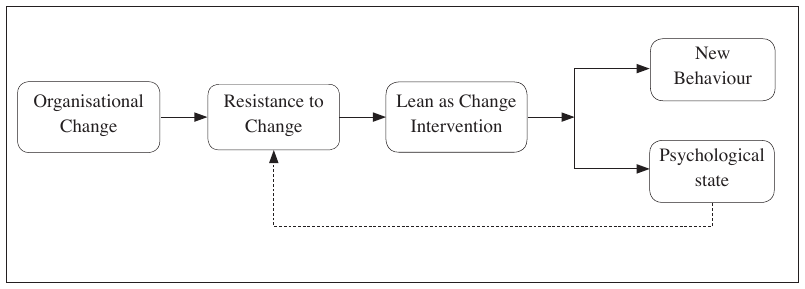
An exploratory model adopting Lean principles as an intervention to solicit change is provided at Figure 1. The model was adapted from Meyer and Allen (1991) and used to; 1) understand the tacit nature and governing assumptions of RTC, 2) conceptualise intervention strategies to reduce the level of dissonance caused by the change, 3) understand the effects of the intervention on behaviour, 4) ensure that the new behaviours, values, and beliefs are not in conflict with the final process (Heracleous, 2001) and, 5) the critical success factor of any change initiatives depends on the ability to change the psychological state to change behaviours.The behavioural perspective model towards change provides a deeper level of understanding of the effects of the intervention and identifying conditions under which a behaviour, once exhibited tends to be repeated (Meyer & Allen, 1991; Ajzen, 2002).
Identifying the Source of Resistance
The relationship between external stimulation and internal psychological experience of individuals is known as psychophysics. It is a fundamental psychological approach, whereby the external world is represented in the mind as a process (Hunt, 1975). In order to identify the source of RTC hidden beneath the norm, organisations need to learn to disagree without being disagreeable and channel contentions as a self-questioning organisation (Mabin, 2001), giving rise to the term ‘let’s celebrate the problem’. For successful behaviour change (Burnes, 1995; Kotter, 1997), management need to implement intervention strategies and techniques that firstly create self-awareness and secondly develop process to eliminate irrational thoughts (Bovey, 2001a), or “fat behaviour”. ”Fat” behaviour (the opposite of Lean) is behaviour that adds no value or ‘waste’ (Emiliani, 1998). These self-defeating behaviours impedes flow between people because its primary operating mechanisms include deception, gossip, innuendo, halftruths, lying, revenge, and destructive political behaviours driven by high ego (Emiliani, 2004). Fat behaviours are recognisable as lots of talk where nothing has actually been said, or indirect words whose meanings are subject to interpretations (Emiliani, 1998). He further suggests that companies generally tolerate disruptive personalities found in the workplace due to their technical, historical or functional knowledge, disregarding the enormous negative impact that such behaviours have on organisations. These dysfunctional and non-conformance practices consumes psychological (Emiliani, 1998) and management resources (Karube et al., 2009). It is nearly impossible for most people to see the destructiveness of fat behaviours because their mindset constitutes the form and substance of this mental model (Emiliani, 1998), thus, businesses that fail to realise and change their behaviour will risk the future existence of their entire enterprise (Karube et al., 2009). Jimmieson et al. (2008) suggested that, strategies should focus on changing the more personal factors underlying behavioural decision-making. These are underlying assumptions and invisible premises on which decisions and actions are based (Mabin, 2001). There is little empirical attention given to the cognitive processes underlying habitual behaviours (Aarts et al., 1998). A well developed study is required to empirically explore past behaviour, in order to identify underlying factors and nonconscious habits giving rise to RTC. 3.0
Research Method
The identification of the underlying factors attributing to RTC will be guided by Festinger’s Theory of Cognitive Dissonance and presented using Lewin’s Field Theory as restraining factors towards performance. Participatory Action Research is employed to solicit change and create knowledge with regards to change. Lean is used as interventions to rationalise what constitute valid knowledge about behaviour and its social world, thus contributing to the epistemology of the research.
Participatory Action Research
The research was built around a project team that was formed to address the issues confronting the organisation and work in an action learning mode (Coghlan & Shani, 2013). A Dual Imperative Action Research (McKay et al., 2001) with the Shipyard as the source of data was commissioned to study and fill skills or knowledge gap on the issues preventing change (Costley et al., 2010). A single longitudinal study (Styhre, 2002) of the Shipyard was undertaken from November 2013 to September 2016, involving two cycles, three shiprepair and one shipbuilding projects, to enable a thorough and in-depth understanding of the change processes and events that unfold over time. The researcher who is also the participant member of the system was involved in the inquiry process itself (Coghlan & Shani, 2013; Coghlan & Brannick, 2014; Brydon-Miller et al., 2003; Dent, 1999; Zuber-Skeritt & Perry, 2002; Avison et al., 2001; Styhre 2002), contributing to organisational change by taking an active role in the operation and studying the process (Avison et al. 2001; Styhre, 2002). The search for alternative change methods, documenting techniques applied and how managers gained utility from resistance through in depth action research was invaluable (Waddel & Sohal, 1998). The distinct feature of action research is that, it generates insight not only to explain but also to change (Coghlan & Brannick, 2014). 3.2
Data Collection and Analysis
Primary data was collected from observations, interviews and outcome of twenty-one recursive AR projects. The interpretation and findings were triangulated, challenged, supported or disconfirmed based on findings from survey, interviews, secondary data and core AR projects. A survey using Oreg (2003) RTC Scale, was conducted for the entire population of the Shipyard (900 employees) to gauge their disposition with regards to RTC. This data was invaluable in identifying target segment and outlook towards change. Secondary data based on documentation review was conducted to position the research in its historical and cultural context. Archaive analysis of documents such as progress and audit reports, minute of meetings, notes of discussions, schedules, reviews and surveys were conducted. In-depth face-to-face interviews with selected key personnel comprising of middle managers and supervisors (Daymon & Holloway, 2002; Yin, 2009) using open-ended questions were conducted for in-depth qualitative study. Middle managers was identified as individuals who can purposefully inform and understand the research problem and central phenomenon in the study. The managers’ experiences and responses (Costley, 2010; Cassel & Symon, 2004; Drew et al., 1996) on planned cultural changed was critical for the study (Ogbonna et. al 2003). Data collected from archaives, analysis of documents, interviews, survey, observations and AR (Coghlan & Brannick, 2014) were analysed using ATLAS.ti 7. Validation was done through the learning-action process itself and, through co-interpretation of outcomes with the participants (Cassel & Symon, 2004) in meetings, trainings and continuous improvement projects.
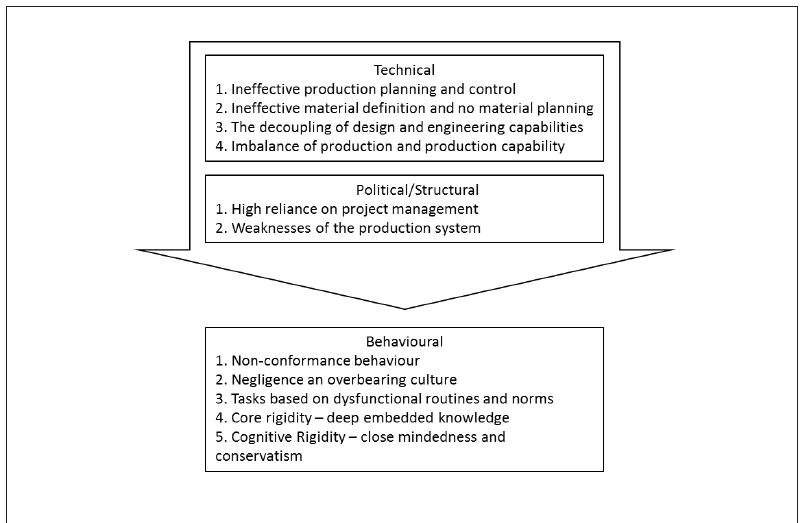
Findings
Source of RTC
An analysis of the root cause and symptoms for the eleven restraining factors in Figure 2, shows that, by measurement, the number of problems or issues identified under technical and political resistance is more than behavioural resistance, thereby influencing it. This supports the theory that people are generally not the root of the problem (Burnes, 2015; Heath & Heath, 2010; Lewin, 1947b; Ford et al., 2002). The source of RTC was found in the constructed reality in which the individual operates (Ford et al., 2002) or organisational context (Kotter and Cohen, 2002; Oreg, 2003; Mabin 2001). Based on the findings, it is suggested that the dysfunctional behaviour is institutionalised in the Shipyard’s values and norms creating bad habits through thoughtlessness and neglect, caused by the decoupling of tasks from its technical and structural core due to rationalised myths. Some of the rationalised myths identified through the findings of this research were: 1) urgent or unplanned work, cannot be planned due to its urgency, 2) it is a crisis thus requiring emergency action, 3) acceleration or ramification of plan required by the customer or management, 4) delay does not affect the Shipyard (profit/ loss), 5) the importance of result rather than process, 6) the problem is with the people, and their personality, 7) failure of a project, put blame on the project management, a failure attribution error.
Lean Principles
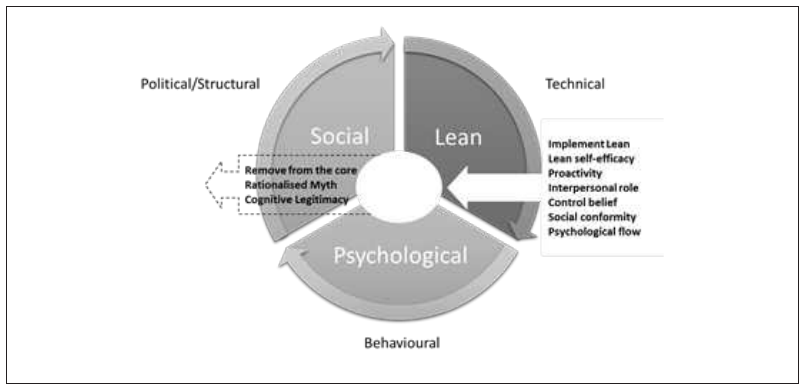
The researcher and the organisation developed action plan (Cassel & Symon, 2004) based on best practices to address the source of RTC. They evaluate the outcomes of the actions, both intended and the unintended through review meetings. This evaluation lead to further cycles of examining issues, planning action, taking action and evaluation through active participation. Lean and Kaizen through work-out groups was used as indepth intervention to help establish a state of psychological disconfirmation to generate dissonance. AR investigates and document how, as an example, Lean Production Planning and Control was successfully implemented in Shiprepair with opportunity for improvement. Figure 3 illustrates how Lean principles facilitate the tasks and behaviour elements, by reducing the psychological discomfort when one embraces a cognition and behave in a conflicting manner with his or other people’s cognition or behaviour. The psychological discomfort found in this research was in the form of cognitive legitimacy to rationalised myth. Lean self-efficacy reduces the distressing mental state when people’s beliefs are inconsistent with their action causing dissonance. When people believe that, they have control over a positive outcome or ‘psychological flow’, they will be happy to change their individual behaviour to serve that purpose. The individual ‘psychological flow’ will in turn create a belief, changing the psychological state and creating a new social norm. !
This research was a collaboration between the employees and the researcher to identify the source of RTC. The outcome is both, insights to create change and knowledge. The respect the researcher has for the complexity of the Shipyard and the knowledge gained through the process was an impetus to understand how the person thinks, creating praxis of relational participation; a quality unique to AR (Coughlan & Coghlan, 2002). The research draws power from the promise of pragmatism, i.e., beliefs we can know only through doing (Brydon-Miller et al., 2003), and from the knowledge of individuals and group behaviours (Emiliani, 1998). Employees will most likely be more supportive with change projects that are aligned with individual and organisational beliefs and behaviour. Therefore, meaningful context driven actions such as Lean and AR, is useful to encourage the more reticent employees to embrace change, and happily change their individual behaviour. The struggle for congruency between espoused and enacted values can only be achieved when dissonance are clearly identified and mitigated. Otherwise the organisation will suffer the effects from its non-conscious habits and subconciously slip into organisational deterioration. The significance of this study is the realisation of how individuals and groups’ past behaviour can subconciously challenge the existence of the organisation and that better methods live within the study of subject such as Psychology, Lean, Action Research and Resistance to Change. The knowledge on how the researcher gained utility from resistance and mediate through the application of these techniques would be of considerable benefit to leaders of change management. Acknowledgement This research was financially supported by the Ministry of Higher Education under the Industrial PhD program MyBrain15 with collaboration from a leading Shipyard in Malaysia and Razak School of Engineering and Advanced Technology, Universiti Teknologi Malaysia.
References
- Aarts’, H., Verplanken, B., & Knippenberg, A. V. (1998). Predicting behaviour from actions in the past: Repeated decision making or a matter of habit? Journal of Applied Social Psychology, 28(15), 1355-1374.
- Ajzen, I. (1986). Prediction of Goal-Directed Behaviour: Attitudes, intentions, and perceived behavioural control. Journal of Experimental Social Psychology, 22(5), 453-474.
- Ajzen, I. (1991). The theory of planned behaviour. Organisational Behaviour and Human Decision Processes, 50(179-211).
- Ajzen, I. (2002). Residual effects of past on later behaviour: Habituation and reasoned action perspectives. Personality and Social Psychology Review, 6(2), 107-122.
- Ajzen, I., & Fishbein, M. (2005). The influence of attitudes on behaviour. in D. Albarracı´n, B. T. Johnson, & M. P. Zanna (Eds.), Handbook of Attitudes and Attitude Change (pp. 173–221). Hillsdale, NJ: Erlbaum.
- Ajzen, I., Joyce, N., Sheikh, S., & Cote, N. G. (2011). Knowledge and the prediction of behaviour: The role of information accuracy in the theory of planned behaviour. Basic and Applied Social Psychology, 33. 101–117.
- Avison, D., Baskerville, R., & Myers, M. (2001). Controlling action research projects. Information Technology & People, 14(1), 28-45.
- Beale, J. (2009). Understanding the influences on employee motivation for lean: An individual-level analysis. Thesis Submitted in Fulfillment of the Requirements for the Degree of Doctor of Philosophy of Cardiff University, pp. 1-346.
- Bhasin, S. & Burcher, P. (2006).”Lean viewed as a philosophy”. Journal of Manufacturing Technology Management, 17(1), 56–72.
- Bhasin, S. (2012). An appropriate change strategy for lean success. Management Decision, 50(3), 439–458.
- Bovey, W. H., & Hede, A. (2001a). Resistance to organizational change: The role of cognitive and affective processes. Leadership & Organization Development Journal, 22(8), 372–382.
- Bovey, W. H., & Hede, A. (2001b). Resistance to organisational change: The role of defence mechanisms. Journal of Managerial Psychology, 16(7), 534–548.
- Braganza, A. (2009). Changing behaviours: An activities-based approach. Strategic HR Review, 8(5),32-37. Emerald Group Publishing Limited.
- Brydon-Miller, M., Greenwood, D., & Maguire, P. (2003). Why action research? Action Research, 1(1): 9-28, SAGE Publication.
- Burnes, B., & James, H. (1995). Culture, cognitive dissonance and the management of change. International Journal of Operations & Production Management, 15(8), 14–33.
- Burnes, B. (2015). Understanding resistance to change – Building on Coch and French. Journal of Change Management, 15(2), 92-116.
- Cassel, C., & Symon, G. (2004). Essential guide to qualitative methods in organisational research. Sage Publications, London, pp. 1-372.
- Canning, J., & Found, P. A., (2015). The effect of resistance in organizational change programmes. International Journal of Quality and Service Sciences, 7(2/3), 274–295.
- Cappellatti, L. G., & Baker, C. R. (2010). Developing human capital through a pragmatic action research project: A French case study. Action Research, 8(2), 211-232.
- Chandler, D., & Torbert, B. (2003). Transforming inquiry and action: Interweaving 27 flavors of action research. Action Research, 1(2), 133–152.
- Chapell, C., Rhodes, C., Solomon, N., Tennant, M., & Yates, L. (2003). Reconstructing the Lifelong Learner: Pedagogy and identity in individual, organisational and social change. RoutledgeFalmer, New York, pp. 104.
- Coghlan, D., & Brannick, T. (2014). Doing action research in your own organisation. Sage Publications, pp. 1-177.
- Coghlan, D., & Shani, A. B. (2013). Creating action research quality in organisation development: Rigorous, Reflective and Relevant. Springer Science and Business Media New York, pp. 1-64.
- Coughlan, P., & Coghlan, D. (2002). Action Research for Operations Management. International Journal of Operations & Production Management, 22(2), 220–240.
- Costley, C., Elliot, G., & Gibbs, P. (2010). Doing work based research: Approaches to enquiry for insider-researchers. Sage Publication, pp. 1-194.
- Creswell, J. W. (2007). Qualitative inquiry & research design: Choosing among five approaches. 2nd Edition. Sage Publication, pp. 1-269.
- Daymon, C., & Holloway, I. (2002). Qualitative research methods in public relations and marketing communications. Routledge, London, pp. 1-369.
- Dent, E. B., & Goldberg, S. G. (1999). Challenging resistance to change. Journal of Behavioural Science, 35(1), 25-41.
- Drew, C. J., Hardman, M. L., & Hart, W. (1996). Designing and conducting research, inquiry in education and social science. Simon and Schuster. USA, pp. 1-370.
- Duhigg, C. (2012). The Power of Habit - Why we do what we do in Life and Business. Random House Trade Paperbacks. New York, 1-400.
- Emiliani, M. L. (1998). “Lean Behaviours”. Management Decision, 36(9), 615–631.
- Emiliani, M. L. (2003). ‘Linking leaders’ beliefs to their behaviours and competencies. Management Decision, 41(9), 893–910.
- Emiliani, M. L., & Stec, D. J. (2004). Using value-stream maps to improve leadership. Leadership & Organization Development Journal, 25(8), 622–645.
- Emblemsvag, J. (2014). Lean project planning in shipbuilding. Journal of Ship Production and Design, 30(2), 79-88.
- Festinger, L. (1957). A theory of cognitive dissonance. Standford CA, Standford University Press, pp. 1-291.
- Fishbein, M., & Ajzen, I. (2005). Theory-based behaviour change interventions: Comments on Hobbis and Sutton. Journal of Health Psychology, 10(1), 27–31.
- Ford, J. D., Ford L. W., McNamara, R. T. (2002). Resistance and the background conversations to change. Journal of Organizational Change Management, 15(2), 105-121. https://doi.org/10.1108/09534810210422991
- Goffee, R., & Jones, G. (2003). The character of a corporation. How your company’s culture can make or break your business. Harper Collins Business, London 2nd Edition, pp. 1-272.
- Graves, A., & Crute V., (2000). A lean approach to change management. International Journal of Aerospace Management, 1(2), 167-177.
- Graafland, J., Kaptein, M., & Schouten, C. M. (2006). Business dilemmas and religious belief: An explorative study among Dutch executives. Journal of Business Ethics, 66, 53-70.
- Harmon-Jones, E. & Harmon-Jones, C. (2007). Cognitive dissonance theory after 50 years of development. Zeitschriftfür Sozialpsychologie, 38(1), 7–16.
- Heracleous, L. (2001). An ethnographic study of culture in the context of organisational change. The journal of Applied Behavioural Science, 37(4), Appendix 1.
- Heracleous, L., & Barrett, M. (2001). Organizational change as discourse: Communicative actions and deep structures in the context of information technology implementation. Academy of Management Journal, 44(4), 755-778.
- Hinz, O. (1998). The stumbling stone method, The Learning Organisation, 5(3), 138-143. MCB University Press. ISSN 0969-6474.
- Jimmieson, N. L., Peach, M. W., & Katherine, M. (2008). Utilizing the theory of planned behaviour to inform change management: An investigation of employee intentions to support organizational change. Journal of Applied Behavioural Science, 44(2), 237-262.
- Jimmieson, N. L., White, K. M., & Zajdlewicz, L. (2009). Psychosocial predictors of intentions to engage in change supportive behaviours in an organisational context. Journal of Change Management, 9(3), 233-250.
- Karube, M., Numugami, T., & Kato, T. (2009). Exploring organisational deterioration:’Organisational Deadweight’ as a cause of malfunction of strategic initiatives in Japanese firms. Long Range Planning, 42(4), 518-544.
- Keller, S. & Aiken, C. (2008). The inconvenient truth about change management. McKinsey & Company. Business Review Press, USA, pp. 1-20.
- Kotter, J. P. (2007). Leading change: Why transformation efforts fail. Harvard Business Review. HBR.ORG the Test of Leader. Reprint 95204, 57-68.
- Kotter, J. P., & Schlesinger, L. A. (2008). Choosing Strategies for Change. Harvard Business Review Press, USA, 21-23.
- Kotter, J. P. (2012). Leading change. Why transformation fail. Harvard Business Review Press. Boston, Massachusetts, USA. 1-12.
- Lewin, K. (1947). Frontiers in group dynamics: Concept, method and reality in social sciences; Social Equilibria and Social Change. Human Relations, Sagepub. 21-23.
- Mabin, V. J., Forgeson, S., & Green, L. (2001). Harnessing resistance: Using the theory of constraints to assist change management. Journal of European Industrial Training, 25(2/3/4), 168–191.
- McKay, J., & Marshall, P. (2001). The dual imperatives of action research. Information Technology and People, 14(1), 45-59.
- McKay, K., Kuntz, J. R. C., & Näswall, K. (2013). The effect of affective commitment, communication and participation on resistance to change: The role of change readiness. New Zealand Journal of Psychology, 42(2), 29-40.
- McNiff, J., & Whitehead, J. (2000). Action research in organisations. Routledge, London. Pp. 1-331.
- Mdletye, M. A., Coetzee, J., & Ukpere, W. I. (2014). The reality of resistance to change behaviour at the department of correctional services of South Africa. Mediterranean Journal of Social Sciences MCSER Publishing, 5(3), 548-560.
- Meyer, J. P., & Allen, N. J. (1991). A three-component conceptualisation of organisation commitment. Human Resource Management Review, 1(1), 61-89.
- Nelson, L. (2003). A case study in organisational change: Implications for theory. The Learning Organization, 10(1), 18-30.
- Nordin, N., Md. Deros, B., & Abdul Wahab, D. (2010). Relationship between organisational change and LEAN manufacturing implementation in Malaysian automotive industry. The 14th Asia Pacific Industrial Engineering and Management System Conference and The 14th Asia Pacific Regional Meeting of International Foundation for Production Research, pp. 22-24. http://www. apiems.net/archive/apiems2010/paper.php.
- Ogbonna, E., & Wilkinson B. (2003). The false promise of organisational culture change: A case study of middle managers in grocery retailing. Journal of Management Studies, 40(5), 1151-1178.
- Ohno, T. (1988). Toyota production system. Beyond large-scale production. Taylor & Francis Group. Florida. USA, pp. 1-163.
- Oreg, S. (2003). Resistance to change: Developing an individual differences measure. Journal of Applied Psychology, 88(4), 680-683.
- Oreg, S., & Gerro, K. T. (2006). Predicting proenvironmental behaviour cross-nationality. Values the theory of planned behaviour and value-belief-norm theory. Environment and Behaviour, 38(4), 462-483.
- Oreg, S., Bayazıt, M., Vakola, M., Arciniega, L., Armenakis A., Barkauskiene, R., Bozionelos, N., Fujimoto, Y., Gonza´lez, L., Han J., Hrˇebı´cˇkova´, M., Jimmieson, N., Kordacˇova´, J., Mitsuhashi, H., Mlacˇic´, B., Feric I., Topic´ M. K., Ohly S., Saksvik P. O., Hetland H., Saksvik, I., van Dam K. (2008). Dispositional resistance to change: Measurement equivalence and the link to personal values across 17 Nations. Journal of Applied Psychology, 93(4), 935–944.
- Pardo, D. V., Manuela, Martinez Fuentes, & Clara. (2003). Resistance to change: a literature review and empirical study, Management Decision, Universitat de Valencia Spain. Management Decision, 41(2), 149-155.
- Peach, Megan, Jimmieson, Nerina, L., & White, Katherine M. (2005). Beliefs underlying employee readiness to support a building relocation: A theory of planned behaviour perspective. Organization Development Journal, 23(3), 9-22.
- Piderit, S. K. (2000). Rethinking resistance and recognising ambivalence: A multidimensional view of attitudes toward an organisational change. Case Western Reserve University. Academy of Management Review, 25(4), 783-794.
- Pieterse, J. H., Caniëls M. C. J., & Homan T. (2012). Professional discourses and resistance to change. Journal of Organizational Change Management, 25(6), 798–818.
- Skrudupaite, A. & Jucevicius R. (2011). Critical success factors for the implementation of the synchronized production system. Socialoniai Mokslai, 2(72), 16-23.
- Stone, K. B. (2010). Kaizen Teams: Integrated HRD practices for successful team building. Advances in Developing Human Resources, 12(1), 61–77.
- Smollan, R. K. (2009). The emotional rollercoaster of organisational change: Affective responses to organisational change, their cognitive antecedents and behavioural consequences. A thesis presented in partial fulfilment of the requirements for the degree of Doctor of Philosophy in Management at Massey University, Auckland, New Zealand.
- Styhre, A. (2002). Non-Linear change in organisations: Organisation change management informed by complex theory. Leadership and Organisational Development Journal, 23(6), 343-351.
- Tasie, G. O. (2009). Can Japanese management styles be applied to Africa? African Journal of Business Management, 3(4), 233-240.
- Vakil, T. (2006). An exploratory model for studying rhetorical strategies during organizational change. University of Victoria, Victoria, Canada, pp. 1-267.
- Yahyagil, M. Y. (2004). The interdependence between the concepts of organisational culture and organisational climate: An empirical investigation Instanbul University. Journal of Business Administration, 33(1), 69-98.
- Yin, R. K. (2009). Case Study Research, Design and Methods. The Canadian Journal of Action Research, 4th Edition. Sage Inc., U.S.A. 14(1), 69-71.
- Zabid, M. A. R., Sambasivam M., & Rahman A. A. (2004). The influence of organisational culture on attitudes toward organisational change. Leadership & Organisational Development Journal, 25(2), 161-179.
- Zairi, M. (2005). TQM sustainability: How to maintain its gain through transformational change. Bradford University School of Management. 175-188.
- Zuber-Skeritt, O., & Perry C. (2002). Action research within organisations and university thesis writing. The Learning Organisation, 9(4), 171-179.