Halal Governance in Malaysia
- Malaysia Institute of Transport (MITRANS), UiTM Shah Alam, Selangor
Journal of Business Management and Accounting 6(2) (2016) · https://doi.org/10.32890/jbma2016.6.1.8838
Abstract
Malaysia is in a strategic location in the South East Asia for the halal Industry, with a predominant Muslim population. The halal certificate by the Department of Islamic Development (JAKIM) is recognized globally. The halal hub is confined within the parameters of governance support and cooperation, such as political will to improve in terms of public service, governance structure, policy and all related to systematic governance. This study discusses the halal governance issue and the halal governance in Malaysia. Data was collected through series of focus groups interviews which makes this study exploratory in nature. The study applies purposive sampling, as information is conveniently available from specific target groups. The paper shall serve a reference for the government halal authority, higher institutions and researchers toward development of halal industry in Malaysia and focussing on halal supply chain activities which involves ministry, department and agency roles.
Keywords: Halal governance, halal industry, systematic governance, governance structure
1.0Introduction of Halal
Halal is derived from the Arabic word, which means lawful. From the perspective of English language, the word ‘halal’ is interpreted as “allowed” or “permissible (Muhammad et al., 2009). The word ‘haram’ is the opposite of halal, which means prohibited or unlawful. In other words, products that contain pork and related items are forbidden or ‘haram’. Food ingredients of animal origin, alcohol and products that do not consider cleanliness during its preparation are also forbidden (Ramezani & Hanzaee, 2011). The consumption of halal food is advocated in the Quran. In protecting
Islamic life, it is compulsory to consume halal products and avoid haram products by following sharia principles (IHI alliance, 2009).
Nowadays, the halal market has become the most influential industry in the world and becoming important not only in Muslim countries but also in non-Muslim countries of the world (Muhammad et al., 2009). Halal awareness among Muslim consumers is growing, as they are very particular on the ingredients in their foods and products. In the context of halal, the word “awareness” means being well informed of what is happening currently on halal foods, drinks and services (Raufu & Bakar, 2014). Furthermore, the origin of imported products is crucial because the understanding, practice and implementation vary from country to country. Thus compliance to halal standards becomes an important issue.
In term of food preparation, the halal foods or products must be hygienic and safe for Muslims to consume. This is clearly highlighted in the Holy Quran where Allah (SWT) says:
“He hath forbidden you only carrion, and blood, and swine flesh, and that which hath been immolated to (the name of) any other than Allah. But he who is driven by necessity, neither craving nor transgressing, it is no sin for him. Lo! Allah is Forgiving, Merciful” (Qur’an 2:173).
The Holy Quran clearly states what is permissible for Muslims to consume. The prohibition is to protect humans from any harmful elements. For example, carrion and dead animals are forbidden because of the decaying process that leads to the formation of chemicals that are harmful to human. Human wellbeing will be affected because the blood that is drained from those animals contains bacteria and toxins. This may also be harmful to human metabolism and development.
2.0Malaysia and the Halal Industry
In Malaysia, halal certification for food and products is applied through the Malaysian Department of Islamic Development (JAKIM). Halal certificate is normally issued after the applicant follows all the procedures and fulfils the requirements stipulated in the guidelines. The certification is valid for two years. Compared to other countries, halal certification in Malaysia is issued by the Government, whereas for other countries, halal certifications are endorsed by their Islamic Institutions (Nasaruddin, et al., 2009). In 2004, Malaysian Halal Standard introduced MS1500: 2004. This has proven the commitment of the Malaysian Government in their effort to enhance the halal procedures and halal compliance. This new standard strengthened the halal industry in Malaysia because the halal certification creates confidence in the world (Muhammad Halal Governance in Malaysia: 73-89 75 et al., 2009). In Malaysia, much effort has been devoted to achieving the aspiration to become the halal hub and role model in halal industry to other Islamic countries. Furthermore, the halal logo in Malaysia is the only one in the world that is supported by its Government, and it is an international standardized logo to be used by all the Muslim nations (Rahman, et al., 2014). The Halal logo by JAKIM is globally recognized as halal compliant (Salam, and Othman, 2014). The Malaysian halal certification increases the demand for manufacturing products which results in positive impact on the Malaysian economy. The halal logo provides assurance of a product, as it is more meaningful and important than other similar certifications (Shafie & Othman, 2006).
Nowadays, Muslim consumers are more aware in purchasing their daily food (Zulfakar, Jie, & Chan, 2012). They are more concerned with food ingredients and that all the activities involved along the supply chain must be truly halal and tayyib. Manufacturers, who do not reveal true ingredients from various sources, constitute serious problem for Muslim consumers (Riaz & Chaudry, 2003). Thus, managing of halal food supply chain process for the sake of satisfying the needs and requirements of both halal and tayyib is highly important (Ab Talib et al., 2012).
According to the Shariah law, Halal food must fulfil the following conditions:
1) The food must not contain any non-halal parts or products of haram animals or animals that are not slaughtered in the name of Allah and Shariah principle
2) The food should not contain any ingredients or sources that are considered un- clean
3) The food must be safe and do not affect the consumers negatively.
4) In terms of preparing the food, there should be no contamination with non-Halal ingredients in preparing, processing or manufacturing and the use of tools or equipment.
5) To ensure it does not contain any human parts in terms of the products and source of ingredients
6) To ensure the halal process of supply chain including manufacturing, prepara- tion, packaging, storage or distribution are separated between halal and haram products.
7) To ensure the food products have a wholesome halal process. It must involve the whole aspects of supply chain from the source of materials right until the end of process to the consumers to ensure the tayyib and sharia guidelines are fulfilled.
The whole process of supply chain should be monitored at each stage until end of con- sumption. According to Jaafar et al. (2011), the halal integrity of products is intact as long as the product is in the producer’s custody. The product process through stages along the halal supply chain should have similar understanding and standards of opera- tional practice of handling halal products to avoid contamination.
3.0Halal Integrity
As mentioned earlier, food and products including halal food involve different parties and stages. It involves a lot of handling before the products reaches the final point of consumption. According to Zulfakar, et al. (2014), it is challenging in the halal supply chain when all parties must be involved in order to ensure that integrity of the halal product is intact throughout the whole halal supply chain. Consumers are concerned about the halal status, especially the integrity part that involves movement along the supply chain. Tieman (2011) agrees that halal integrity is the key factor in developing a trusted halal food supply chain. Manufacturers are required to understand the halal food supply chain process that fulfills the Shariah principle. All the parties involved must undertake responsibilities and able to use every possible action to protect the integrity of the halal supply chain. This is further supported by Talib (2010), who pointed out that adequate and appropriate equipment for handling halal food products will help in protecting the integrity of the food products as the foods are separated from other potential non-halal elements that might cross contaminate it. In the halal supply chain activities, it is also important to understand the product characteristics, the customer requirements, and the market itself.
3.1Halal Governance
In Malaysia, there are three main roles for the Halal Industry in terms of formulating, implementing and regulating policies. JAKIM is one of the current leading institutions on halal matters (Ismaeel & Blaim, 2012). JAKIM is responsible for Halal certification from the establishment of the Halal logo, monitoring and enforcement as well as ensuring that Halal guidelines and shariah principles are followed. Rezai, Mohamed and Shamsudin (2012a) reported that the consumers are more confident with the Halal logo provided by JAKIM. Before a company is granted with a Halal certification, JAKIM will supervise the halal chain especially relating to adherence to halal standards when acquiring the ingredients. Promoting halal industry is also important and should also be considered by the government. The role of promoting the halal industry includes halal training and promoting halal agenda to the whole country which is now actively led by MITI (Ministry of Trade and Industry). The promotion for international level is led by MATRADE (Ministry of External Trade Development Corporation).
The government’s role in ensuring Halal food supply chain integrity is very significant. A research by Melatu, Samsi, Tasnim and Ibrahim (2011) identified that the government’s roles are to ensure that Halal supply chain integrity and this includes planning, developing, implementing, regulating, promoting and educating Halal Governance in Malaysia: 73-89 77 the halal industrial players and Halal consumers. Furthermore, the government’s part covers setting up agencies and monitoring bodies to authorize and regulate any aspect that relate to halal certification, auditing and guidelines. In Malaysia, there are more than 20 different ministries and agencies that contribute towards Halal regulation for halal industry (Syed & Nazura, 2011).
Governance in Halal Industry
Micro Supervision Macro Supervision
Sharia Compliance
3.2Halal Certification and Supervision
It remains unclear whether all Islamic requirements, from breeding to retailing, are inspected and monitored in the certification process. Since several principles of halal have yet to be formalized, the authority responsible for ensuring halal status of food items and products, especially those imported from outside, remains unclear. In Malaysia, JAKIM claims to be working on the supervision of the halal chain, especially in adhering to halal standards on acquiring ingredients before a company can be given halal certification. However, one of the main problems faced by halal certification is the lack of proper policy and monitoring, which makes it very difficult to prove if a food producer adheres to halal requirements, especially during the production. Syed Ali Tawfik Al-Attas (2006), the Director-General of Institut Kefahaman Islam Malaysia (IKIM) stated that, “It’s only when we send representatives to those companies that all of a sudden, everything is in place, but as soon as the representatives leave, it’s back to business as usual”.
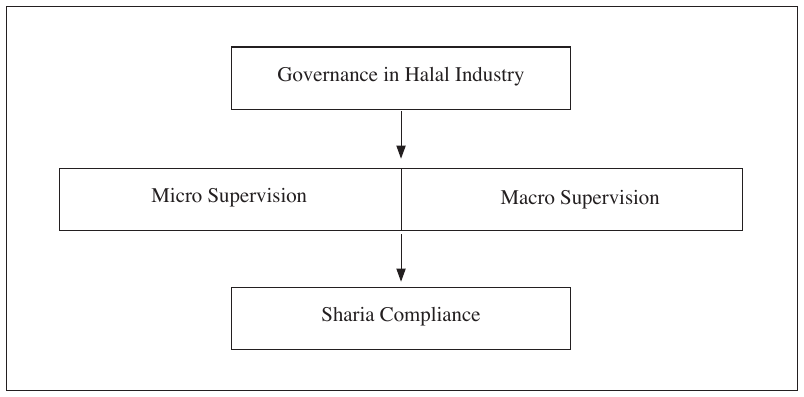
Figure 1 showed the halal governance and supervision in halal industry in Malaysia. The framework shows the involvement of halal agencies for monitoring and supervision in micro and macro level supervision. Micro supervision will be monitored by the halal department in the organization itself as suggested by the halal agency that producers should have one unit or department that controls and monitors the halal process. The supervisor of the halal unit will ensure that all the requirements as stated by the government are fulfilled. Usually, this unit will monitor activities in the organization after they are well trained by the trainers from the halal government agencies such as JAKIM and HDC (Halal Industry Development Corporation). Macro supervision is about the whole involvement of halal supply chain activities. This includes the involvement of halal agencies in every stage from the beginning of production to consumers.
The stages of the framework in Figure 2 are generated to show the halal value chain process and category for animal in beef and poultry. The involvement of halal agency in each stages show the halal supply chain process in halal industry in Malaysia for beef and poultry categories. The beginning of the stages starts at the farm and it involves the Ministry of Agriculture (MOA) and JAKIM. At this stage MOA will guide the procedure and requirement especially the animal condition and health. Under MOA there is an agency to check and monitor the animals which is (Department of Veterinary Services) or DVS. Whereas JAKIM will ensure that the process of rearing the animals in terms of feeding to the animal itself must follow the sharia compliance.
Halal Value Chain Proses and Category
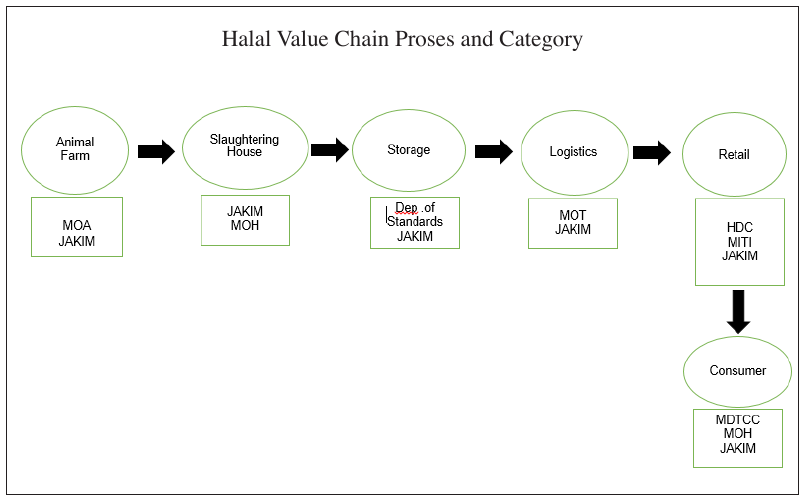
by JAKIM. Before the slaughtering, MOH will check the condition of the animal and provide confirmation that the animal is free from diseases or viruses that will affect the consumers. After the two stages are passed, the next stage is relating to storage or warehouse. This stage is to ensure that the stock is kept in good condition and ensuring that the storage of the halal and non halal products must be kept in different places to avoid contamination. JAKIM’s standard department will guide the flow of storage according to the halal standards for storage. In terms of logistics, the storage will be sent through halal logistics guidance, JAKIM will ensure that the goods must be separated with non halal goods. Currently the Ministry of Transportation (MOT) is responsible for logistics and safety requirements. After the logistics passed the halal requirement, the retailing stages will be monitored and checked by the HDC (Halal Development Corporation) and MITI (Ministry of Trade and Industry). Retail stage includes promoting and training for halal foods standards for logos and certificate for local and international level. The main agencies in charge of promoting the goods and products are HDC and MITI whereas training is put under HDC. After the approval of products is obtained, it means that it has successfully fulfilled the standards. Hence, the final stage is the consumer. The products are safe to consume after being supervised and monitored by the Ministry of Domestic Trade, Co-operatives and Consumerism (MDTCC). For commercial purpose, the JAKIM logos and certificates indicate that products are safe to use and consume under Ministry of Health (MOH) approval.
3.3Monitoring and Inspecting
Many questions arise during daily inspections of business on the use of halal products. One of such is the issue of agencies not attending the production house to monitor and inspect. Secondly, lack of expertise and lack of adequate number of staff are the reasons the monitoring and inspecting activities are not regular. Monitoring is a potential issue in halal certification especially after the issuance of the halal certificate. Many companies no longer worry about complying with halal requirements as stated in the certification. Undoubtedly, certification and quality reassurance alone will not provide satisfactory solution to determine the consumers’ need for foods and products.
Issues pertaining to quality, safety and hygiene are generic to halal, inclusive of the slaughter, storage, display, and preparation. They are to ensure that hygiene and sanitation are adhered to based on guidelines stated by JAKIM (Shafie & Osman, 2006). However, not all of these guidelines are observed, for example, clear principles have yet to be formalized and properly controlled. There are allegations against companies that they do not adhere to the halal procedures despite being certified halal; this allegation misleads the community.
However, application for halal certification is increasing due to the rising demand of consumers. This entails rising income in primary markets for halal food; increasing demand for safe, high quality and variety of halal foods (Omar & Jaafar,et al., 2011).
Hence, some policy actions are required in governance of halal in Malaysia (Syed & Nazura, 2011). Although the legislation made by the government would eliminate the problem of fake halal certificates from unreliable sources, yet policy mechanisms are needed to secure the confidence of Muslims in certifying products with several legislation for the protection of consumers in terms of halal foods and products. Nowadays, the presence of Muslims is noticeable socially and politically, thus, there is increasing need for halal-certified food products (Riaz & Chaudry, 2004).
However, it remains unclear whether the processing of foods and products care are based on the monitoring elements. For example, it is doubtful whether slaughter of meat and poultry at abattoirs adhere to the Islamic law (Mian, 2010). Production house that manufactures food consumed by Muslims must also follow the relevant Shariah guidelines. Halal food is not only for Muslim consumption, the guidelines of halal standards are hygienic to the non-Muslims as well for consumption. Furthermore, relevant agencies practice different policies although aligned to the same ministry and policy. Policies and rules are made from different ministries such as MOH (Ministry of Health), MOA (Ministry of Agriculture) and more ministries and the agencies enforce and implement the policy as stated. The policies are unclear and non-standardized. Another issue is that the implementation activities, which include inspection and monitoring, are usually limited to only ports of entry. Majority of the imported goods are checked at the Port of Entry, and checked for the presence of pork, pork products or alcohol and halal certificates. Halal regulation is difficult to implement and it mainly covers imports, exports, inspection and enforcement (Mustafa Afifi, 2012).
3.4Halal and Regulatory Activities
Standards and Acts are tools for agencies to enforce and implement all of their activities. There is no mother law that can be a supreme law of halal related matters in Malaysia. As far as halal governance in the halal industry is concerned, it is essential to formulate halal act or halal regulation that could be under a single roof and be a paramount law for the halal industry. The issue of different entities with different rights, duties and powers as well as conflict of jurisdictions causes disunity within both implementation and prosecution jurisdictions. For example, JAKIM and MAIN (Majlis Agama Islam Negeri) need to provide courses and training in relation to the investigation and prosecution duties. The MDTCC (Ministry of Domestic Trade, Co- operatives and Consumerism) has appointed JAKIM officers and state Islamic officers as enforcement officers known as assistant trade description controllers under the Trade Descriptions Act 2011, in other words, JAKIM uses the Act (TDA 2011) from MDTCC. JAKIM as the enforcer of halal supply chain activities, however, has no veto power. So far, the ministry has appointed 240 personnel from JAKIM, JAIN (Jabatan Agama Islam Negeri) and MAIN. Courses relevant to investigation and prosecution must be conducted often to further enhance and create dedicated law enforcement officers. Relevant knowledge and exposure pertaining to raids, prosecutions, inspections and knowledge of acts such as the Evidence Act, the Criminal Procedure Code and others (Roslan, 2012) must be enhanced. However, constraints arise in the context of training Halal Governance in Malaysia: 73-89 81 since there are no strict selection sessions to elect JAIS officers, as there are officers who do not perform the assigned task (Ahmad Solihin, 2013). Some officers are not ready to face the challenges of enforcement duties (Zawawi, 2013). Apart from the issues of affordability, efficiency and competency of the officers, JAIS also has to deal with the transfer of staff or officers in the department (Zawawi, 2013). Thus, many officers are not capable of these duties (Zawawi, 2013).
4.0Research Methodology
De Ruyter (1996), Sekaran (2007), and Walden (2006) highlight that focus groups are effective instruments for qualitative study in order to obtain inclusiveness of understanding especially for new phenomena and issues, such as halal supply chain Industry. In qualitative study, the data are collected through a series of interviews and focus groups (Sekaran & Bougie, 2009).
Qualitative research is the primary basis for organizing and reporting after obtaining the results. Focus group can be used for preliminary studies (Kreuger 1988). In this study which is to evaluate a particular programme (Race et al 1994); focus group was used to assess its impact and generate further avenues of research. Purposive sampling is used to select the participants from a population of stakeholders. The sample frame consists of halal governance agencies and the participants or users. The researcher adopted purposive sampling technique in selection of informants for the study (Ary, Jacobs & Razavieh, 1996). There are three processes of discussions blended throughout the study, which consists of collection, coding, and analysis. This approach encourages flexibility as more information and a better understanding of relevant data is acquired (Blumer, 1999). Table 1 indicates the representation of different group as listed:
| Category of group | Total |
|---|---|
| Logistics and Operation | 6 |
| Information and Technology (ICT) | 7 |
| Retail | 8 |
| Syariah | 7 |
| Institutional & Governance | 12 |
| Inter-organizational Relationships and Awareness | 12 |
| Human Capital | 8 |
| Food Science | 16 |
| Total | 76 |
In this study, the data was collected from primary source through interviews of focus groups. The moderator in the focus group play a crucial role in introducing the topic to the participants and the moderator for this focus group is the researcher (Sekaran & Bougie, 2009). During the discussion, the researcher will need to promote debate, perhaps by asking open questions, observe, take notes and record all the discussions. Table 2 summarizes halal governance agencies and their roles.
| Government Agencies | Description Role |
|---|---|
| Agency W,X, | Formulation |
| Agency Y,Z,K | Implementation |
| No. of | Role of | Years in |
|---|---|---|
| Company | Position | |
| Participants | Agency | Industry |
| Formulate of | ||
| Agency W,X, 3 Assistant Director | > 7 Years | |
| Halal Policies | ||
| Councilor | > 8 Years | |
| Head Ass. Director | > 15 Years | |
| Agency Y,Z,K 3 Formulate of Asisstant Manager | > 9 Years | |
| Halal Policies Head Asisstant Manager | > 10 Years | |
| Asisstant Director | > 20 Years |
and the tapes were played back as well. This was done so that researcher could recall and reflect on the interview sessions with the participants. The data was recorded and the researcher transcribed the conversations. Currently, the studies on halal governance are scarce. However, the questions for the interviews were designed from information in the literature related to the halal industry.
Cooper and Schindler (1998) suggested that focus group should consist of six to ten respondents. There are six experts in formulation and implementation of halal governance among the participants in these focus groups. Table 3 summarizes the respondents’ details in terms of roles, positions and years of service. The conversation was recorded using voice recorder devices with the consent of the respondents.
Focus group discussion focuses on critical issues, current problems, and challenges in halal supply chain industry. The discussion included the importance of halal governance and related agencies in the ministries, departments and units. The topic of the discussion covered general to specific questions to avoid bias (Grudens-Schuck et al., 2004). Referring to Miles and Huberman (1994), the discussion was concluded and drawn after the data has been analyzed.
5.0Preliminary Findings and Discussion
During the discussion, the issues were listed and highlighted for further actions. Table 4 shows the listing of issues and current challenges in halal supply chain industry and halal governance. The issues are categorized as below: The first category labelled ISSUE 1 consists of number 1, 2, and 3, and is about laws for halal industry. ISSUE 2 consists of number 4, 5, 6 and 7 and they are on the checks and balances for all related halal agencies. ISSUE 3 consists of number 8, 9, 10 and 11 and is about agencies and implementation. Lastly, ISSUE 4 consists of number 12, 13, 14 and 15 and is about Authorities and agencies.
| No. Topic encountered |
1No mother of law for halal industry
2 Different practices for states and federal
3Law scattered
(continued)
No. Topic encountered
4Lack of expertise and knowledge
 5               Lack of effectiveness and comprehensiveness for halal laws
 6               Lack of cooperation between agencies in implementing halal
                 activities
 7               Differences in standards of practice among agencies
 8               Abundance of work for certain agencies
 9               Miscommunication among agencies
 10              Conflicting roles: Y, Z and K in terms of implementation
11Poor job performance
 12              Misaligned goals of the halal industry: W and X
 13              Ambiguity of authority
 14              Overlapping of functions: W and X
 15              Unclear functions and roles of agencies
ISSUE 1: Law for Halal Industry
Several issues have been highlighted in the institutional and governance group. The first issue indicates that governance for halal bodies needs to be in a unified system. Currently, halal governance has to go through many processes, the difference of the states and federal government and differences on decision making. Every decision that relates to halal, which is religious, takes a long time because the process is different for every state, and is not unified. Each of the states is different in terms of culture, practice, thought and leadership. Respondents of the focus group gave an example of best practice for Shariah finance, which is Bank Negara Malaysia (BNM). Each activity and decision is made collectively by the state and federal government and under one entity lead by the BNM. The discussion stressed on the governance and structure of halal industry that should be placed under PM Department (Economic) as suggested. In Malaysia, as there are more than 20 different ministries and agencies that continue to have input in halal regulations (Syed & Nazura, 2011), governance of halal is unsystematic. The confidence in halal reassurance is mainly based on personal conviction, rather than on institutional confidence. Some policy actions are required as governance of halal is disorderly in Malaysia (Syed & Nazura, 2011).
ISSUE 2: Checks and Balances for All Related Halal Agencies
On the issue of checks and balances, the participants of the discussion highlighted the lack of knowledge in halal and Shariah principles leading to weak compliance. Halal Governance in Malaysia: 73-89 85
The agency related did not perform well due to insufficient expertise that is not only lacking in terms of training, but also results to poor job performance. Therefore, the needs for a body to ensure checks and balances in terms of practice and activities are strongly required. The participants also emphasized on SWOT analysis as a part of yearly activities to look into the weaknesses of each agency in ensuring the objective mission and vision of halal industry will be smoothly achieved. Furthermore, to increase cooperation among agencies especially in terms of implementation and enforcement of the halal policy by looking at implementation issues in Malaysia. The current conflicting outcomes among different agencies especially in carrying out enforcement matters should be highlighted. JAKIM and Ministry of Trade, Co-Operatives and Consumerism (MDTCC) should collectively conduct enforcement activities; as JAKIM is not authorised to carry out prosecution of halal matters by itself. MDTCC needs to work together with JAKIM, which has absolute power under MDTCC to implement these activities. Many problems will occur if one of the agencies is not represented in matters of enforcement. It is advisable for all halal related agencies to sit together and find solution to these issues.
ISSUE 3: Agencies and Implementation
The next issue discussed pertains to the agencies and weak implementation. Agency X was given a lot of work in terms of checking the halal certification. Moreover, abundance of work such as monitoring and about religious matter was referred to this agency. It remains unclear whether the processing of foods and products care is based on the monitoring elements. For example, slaughter of meat and poultry to be conducted at abattoirs that adhere to the Islamic law (Mian, 2010). The actual role of X agencies in the halal industry is questionable and unclear. Sometimes, these agencies ‘assume’ that as a leader to the halal industry, however there is no black and white. The lack of implementation in monitoring and the usage of certified halal logo have caused the public to question the integrity of the products that are claiming halal certified. According to (Shahidan, Shafie & Md Nor Othman, 2006), JAKIM itself lack “enforcement” in the halal industry. As we know, halal certified is the symbol for the consumer to buy, if the integrity of halal supply chain itself is confusing what about the rest, which is lack of proper monitoring after being halal certified. Halal regulation is difficult to implement and it mainly covers imports, exports, inspection and enforcement (Mustafa Afifi, 2012).
ISSUE 4: Authority and Agencies
The next issue is the authority. There is no body vested with authority to lead the halal industry. JAKIM and Jabatan Agama Islam Negeri (JAIN) function in the halal certification and administer the halal certification operations by using the halal standard, which is referred to the Standard Malaysia (MS) and Malaysia Halal Certification for enforcement purposes. JAKIM and JAIN are dependent on the laws, which differ with other agencies. This causes the activities of enforcement to be less effective. The other agency such as MDTCC is under Trade Description Act (TDA) 2011 act that clearly stated the roles and function of the agencies. Ministry of Health (MOH) with the Food Act 1983 and Food Regulations 1985 regarding labeling, hygienic practice and food safety; The Animals Act regarding animals rearing and diseases control by the Department of Veterinary Services (DVS); The Customs Act, regarding the import of halal meat enforce by the Royal Malaysian Customs. The Halal Development Corporation (HDC) focuses on promoting halal industry to the global market. Until now, Malaysia is unsure of halal leader in the halal industry. The body that supposed to be a leader as a whole for the halal industry in Malaysia still unresolved. Courses relevant to investigation and prosecution must be conducted often to further enhance and create dedicated law enforcement officers. Relevant knowledge and exposure pertaining raids, prosecutions, inspections and knowledge of acts such as the Evidence Act, the Criminal Procedure Code and others (Roslan, 2012) must be enhanced.
6.0Discussion and Conclusion
This study can be concluded based on the four issues encountered in halal governance. The first issue is the law for halal industry. This issue is all about power and limitation. The agencies are limited by the function since the states and federal are different. The state has its own authority and no decision could be implemented if there is no agreement by the state itself. Secondly is the issue of halal and implementation. Halal logo of products indicates that the products are halal and tayyib, and act as guidance to the consumers in buying. However, the agency should monitor even after the halal logo is given to the manufacturer. This issue also concerns the manufacturers as they use halal logo to market their products and only focus on profit and not the halal per se. As the demand for halal food products is expected to grow, there is need for halal integrity and to ensure that the needs and well-being of the halal food consumers can be met and well protected. Thirdly, the issue of checks and balances for halal industry, the professionalism of halal training community is needed where this community will educate and train regulators of the industry. Although this study managed to encounter issues related to halal governance for halal industry in Malaysia, however there are more categories and sectors in the halal industry and should be included. This study covered halal supply chain processes in beef and poultry categories and the processes of giving halal governance which involve halal agencies from the government. Therefore future studies should include more sectors in the halal industry in Malaysia and also more views from government agencies. To conclude, the halal industry plays a bigger role as it increases the economy of the country. Thus, the integrity of halal products would then obviously influence consumer purchasing behavior. In conclusion, the growth of halal economy can be a stepping stone to economic prosperity. The government, regulators and the entire halal agencies must be involved in halal related matters in this country and agree on the concept of strategic management system of the halal industry and its legal regime. Halal Governance in Malaysia: 73-89 87
Acknowledgements
The authors would like to thank and acknowledge Malaysia Institute of Transports (MITRANS), UiTM for the Halal Supply Chain (HSC) research grants under Ministry of Higher Education (MoHE) Malaysia to conduct this research program for useful data and support.
References
- Al-Bukhari. (1984). Summarized Sahih Al-Bukhari: Arabic-English. Translated by M. M. Khan, Riyadh. Saudi Arabia: Dar-us-Salam Publications.
- Cooper, D. R., & Schindler, P. S. (1998). Business research methods. McGraw-Hill, Singapore.
- Grudens-Schuck, N. (2004). Focus group fundamentals. Iowa State University, University Extension.
- Hambali, A. R., & Bakar, A. N. (2014). People’s awareness on Halal foods and products: Potential issues for policy-makers. International Halal Conference, PWTC, Kuala Lumpur, Malaysia, 4-5 September 2012.
- IHI Alliance. (2009). Halal lead auditor’s training, international Halal integrity alliance, Kuala Lumpur.
- Ismaeel, M., & Blaim, K. (2012). Toward applied Islamic business ethics: Responsible Halal business. Journal of Management Development, 31(10), 1090-1100.
- Jaafar, H. S., Endut, I. R., Faisol, N., & Omar, E. N. (2011). Innovation in logistics services: Halal logistics, paper presented to 16th International Symposium on Logistics (ISL), Berlin, Germany, 10-13 July.
- Marzuki, S. Z. S., Hall, C. M., & Ballantine, P. W. (2012). Restaurant managers’ perspectives on Halal certification. Journal of Islamic Marketing, 3(1), 47-58.
- Melatu Samsi, S. Z., Tasnim, R., & Ibrahim, O. (2011). Stakeholders’ role for an efficient traceability system in Halal industry supply chain, paper presented to Annual International Conference on Enterprise Resource Planning Supply Chain Management (Penang, Malaysia, 14th -15th March 2011).
- Miles, M. B., & Huberman, A. M. (1994). Qualitative data analysis: An expanded sourcebook. Sage Publications, Incorporated.
- Muhammad, N. M. N., Isa, F. M., & Kifli, B. C. (2009). Positioning Malaysia as Halal-hub: Integration role of supply chain strategy and Halal assurance system. Asian Social Science, 5(7), 44-52. Mustafa ‘Afifi A. H., & Mohd Mahyeddin, M. S. (2012). The Possibility of Uniformity on Halal Standards in Organization of Islamic Countries (OIC) Country, World Applied Science Journal 17 (Towards the Traceability of Halal and Thoyyiban Application)):06-10,2012. IDOSI Publication.
- Nasaruddin, R. R., Fuad, F., Mel, M., & Jaswir, I. (2009). The importance of a standardized Islamic manufacturing practice (IMP) for food and pharmaceutical productions. Advances in Natural and Applied Sciences, 6(5), 588-595.
- Noordin, N., Noor, N. L. M., Hashim, M., & Samicho, Z. (2009). Value chain of Halal certification system: A case of the Malaysia Halal industry. In the proceedings of the 2009 European and Mediterranean Conference on Information System, pp. 1-14.
- Omar, E. N., & Jaafar, H. S. (2011). Halal supply chain in the food industry-A conceptual model, In 2011 IEEE Symposium on Business, Engineering and Industrial Applications (ISBEIA), Langkawi, Malaysia, 25-28 September 2011, IEEE, Langkawi, 384-389.
- Rahman, R. A., Mohamed, Z., Rezai, G., Shamsudin M. N., & Sharifuddin, J. (2014). Exploring the OIC food manufacturer intention towards adopting Malaysian Halal certification, 9(5), 266-274.
- Ramezani, M. R., & Hanzaee, K. H. (2011). Intention to Halal products in the world markets. Interdisciplinary Journal of Research in Business, 5(1), 1-7.
- Rezai, G., Mohamed, Z., & Shamsudin, M. N. (2012). Assessment of consumers’ confidence on Halal labelled manufactured food in Malaysia, 20(1), 33-42.
- Riaz, M. N., & Chaudry, M. M. (2003). Halal food production. CRC Press. USA. pp. 1-24.
- Riaz, M. N., & Chaudry, M. M. (2004). Halal food production. Florida. CRC Press LLC.
- Salam, S. S. A., & Othman, M. (2014). Consumer disconfirmation of expectation and satisfaction with SMEs products in Klang Valley, Malaysia: A theoretical framework. In the Proceedings of the 2014 International Postgraduate Research Colloquium, pp. 13-19.
- Sekaran, U., & Bougie, R. (2009). Research method for business, a skill building approach. Wiley, Singapore
- Shafie, S., & Othman, M. N. (2006). Halal certification: An international marketing issues and challenges. In the Proceedings of the 2006 International IFSAM VIIIth World Congress, pp. 28-30.
- Syed, S. A., & Nazura, M. S. (2011). Applying the theory of planned behaviour (TPB) in Halal food purchasing. International Journal of Commerce and Management, 21(1), 8-20.
- Syed Ali T. A. (2006). In Heikal Abdul Mutadir. The great Halal debate Malaysian business, 16, 44.
- Talib, Z., Zailani, S., & Zanuddin, Y. (2010). Conceptualizations on the dimensions for Halal orientation for food manufacturers: A study in the context of Malaysia. Pakistan Journal of Social Sciences. 7(2), 56-61.
- Talib, M. S. A., & Johan, M. R. M. (2012). Issues in Halal packaging: A conceptual paper. International Business and Management, 5(2), 94-98.
- Tieman, M. (2011). The application of Halal in supply chain management: In-depth interviews. Journal of Islamic Marketing, 2(2), 186-195.
- Tieman, M. (2012). Principles in Halal supply chain management. Journal of Islamic Marketing. http://doi.org/10.1108/17590831211259727
- Tieman, M., & Ghazali, M. C. (2014). Halal control activities and assurance activities in Halal food logistics. Procedia - Social and Behavioral Sciences, 121, 44–57. http://doi.org/10.1016/j.sbspro.2014.01.1107
- Walden, G. R. (2006). Focus group interviewing in the library literature: A selective annotated bibliography 1996-2005. Reference Services Review, 34(2), 222-241.
- Zulfakar, M. H., Jie, F., & Chan, C. (2012). Halal food supply chain integrity: From a literature review to a conceptual framework. Conference: 10th ANZAM Operations, Supply Chain and Services Management Symposium 1(614).
- Zulfakar, M. H., Anuar, M. M., & Ab Talib, M. S. (2014). Conceptual framework on Halal food supply chain integrity enhancement. Procedia - Social and Behavioral Sciences, 121, 58–67. http://doi.org/10.1016/j.sbspro.2014.01.1108