Order Fulfillment in Supply Chain Management: Does the Dimension of Inventory Management Matter in the Aerospace Industry in Malaysia?
- School of Business Management, College of Business, Universiti Utara Malaysia, Sintok, Kedah
Journal of Business Management and Accounting 6(2) (2016) · https://doi.org/10.32890/jbma2016.6.1.8835
Abstract
Inventory management is important in meeting customers’ requirements. Similarly, the effectiveness of supply chain management in the order fulfillment process is critical for the organization to stay in business. Inventory determines the service level of any organization as the adequate and timely flow of inventory across the supply chain and manufacturing processes is imperative for the success of the organization. This ensures high rating on order fulfillment and ensures profitability. In the supply chain, inventory management is a critical part of the process as inventory is an asset and any shortage of inventory impact performance negatively. To keep the right level of inventory is a challenge for all companies and the challenge is becoming more complex with the drastic and frequent changes in demand. This also makes the forecasting process more tedious and difficult. The constant changes in customer preferences with the increases in demand have affected order fulfillment as most manufacturing facilities do not have the additional capacity to cope with sudden increase in orders. They require huge investment and with the shortening of product life cycle, the period to apportion return on investment has to be relatively short compared to the past experience. This affects working capital and increasing working capital is not an easy task unless the organization is wealthy. As Malaysia embarks on the aerospace industry, the dilemma for the manufacturers are similar. The high cost of raw materials in inventory and inventory holding significantly affects order fulfillment. The findings of this study differs from the normal business inventory management practices, thus offering new knowledge and learning curve in the inventory management context of the high technology industry, in particular, the aerospace. The findings indicate that inventory management or the inventory conversion period has an inverse relationship with organization’s profitability.
Keywords: Supply chain management, inventory management, aerospace industry, order fulfillment, performance
Introduction
The importance of inventory management in all organizations and at every level, whether small or large is an undeniable fact (Dooley, 2015). The complexity of consumer choices has made the inventory management system a bigger challenge. According to Slack et al. (1995), inventory is maintained to cater for customers’ orders and competition and also to mitigate the effect of production and delivery lead-time. This leads to the concept of ‘make to stock’ instead of ‘make to order’ in anticipation of orders. The concept ‘make to stock’ requires an effective forecasting process, particularly the accuracy between the forecast and actual orders. Moreover, the consumers’ knowledge and choices have changed over the years and the current emphasis is more than ‘fulfilling the needs’ but rather ‘satisfying their needs’. Thus, for many manufacturers, having the product range with high consumer demand are preferable with a wider range of options. They become more competitive, particularly for technology related products. Inventory is part of the assets of an organization and therefore, it is part of working capital. For some industries, for example, the high technology industry, the working capital required to finance operations is high. Mistakes have serious consequences. Many have difficulties coping with the continuous investment required to stay in business. In the aerospace industry, delays from the suppliers can result in the companies compensating customers for late delivery of the airplane. The amount involved in paying the penalty due to late delivery can easily wipe out profit for the year and will definitely affect the company working capital in the near future. Thus, it is not surprising that most large organizations recognize the importance of supply chain management and include it as a key activity to improve the organization performance. Traditionally, organizational performance is linked to profitability. This can be achieved through order fulfillment. Such measurement is still very much valid, for instance, the return to shareholder fund is an important measurement to convince the shareholder for future re-investment, for additional capacity or new equipment or technologies as the industry dictate from time to time. Apart from profitability, another important measurement is the volume of sales either by pieces sold or the amount invoiced. Purchases in bulk or higher quantity reduces the fixed cost and to some degree, it is able to share out the variable cost. The greater the volume of purchases, the more likelihood that per item price will be reduced, either through effective negotiation or bulk purchase discount offered by the suppliers. Moreover, with the intense global competition, many companies have started working closely with their suppliers to improve their product quality, and at the same time, reduce the cost of the products. This can be observed in the electronics sector where the big players are pushing the inventory management responsibility to their suppliers via a program known as vendor managed inventory. In such initiative, the suppliers manage the total inventory requirements and they are taking risks in the process of managing the inventory level and replenish when necessary. Within the context of information technology, this is where information sharing is viewed as very important and crucial. The suppliers are made aware of any stock movements. The information is in real time thus ensuring accuracy in decision making. It is often argued that organizations with weak inventory management are not competitive and may fail to survive. According to Lewis (2003), continuous down time in the manufacturing can lead to higher cost of operation. In the absence of inventory management, order fulfillment is affected. Thus, the success or failure of the business totally depends on the inventory management as high order fulfillment generates better customer service level and higher profitability. Moreover, many items today have a shelf life and strict requirements to ensure the product functions optimally during usage and throughout the total product life cycle. In the aerospace industry, the firms impose shelf life for most of the items used, especially for items termed ‘flyaway’ products, where records must show that these items are still valid and as described in the requirements. Apart from the shelf life, keeping the items in the recommended storage condition is equally important where the composite materials are required to be stored for instance,in an environment below 20oC. Otherwise their properties need to be retested before further product applications. This reveals the importance of inventory management in the airline industry. 2.0
Inventory and Supply Chain Management in the Aerospace Industry
This paper examines the relationship between inventory management and order fulfillment performance. It reviews the literature examining the supply chain management and its effect on company profitability in the aerospace (high technology) industry. With the rapid rate of globalization and intense competition in the business arena, major changes are expected in inventory management and the entire supply chain management dealing with the planning and control of total material flow from end to end, that is from suppliers to end users. One of the very important parts of the supply chain is to determine the location of inventory and at what level to efficiently provide efficient service to customers at the most competitive cost. Effective inventory management will result in the right level of customer service. The right service level ensures that customers are satisfied and having the right policies in the inventory management is part of the total supply chain management concept. Inventory optimization can reduce the working capital or capital outlay, but the level required to balance with the level of customer service required is of utmost concern as many suggest that this could be different between firms in different industries The necessary inventory level to be maintained to ensure that manufacturing processes are not affected is the primary goal for most manufacturers and the losses incurred for down time are always too expensive. Moreover, there is possibility that the manufacturer’s capacity loss due to delays cannot be recovered. This damages the firm’s reputation and customer’s expectation. In such occurrences, there is a likelihood of losing customers. For the aerospace industry, any delays including non-performance in delivery result in heavy penalty imposed by the industry players. Therefore the relationship between inventory and order fulfillment in the context of supply chain management is important and expected to apply more stringently in the aerospace industry. Inventory management does not receive much attention from the top and senior management unless there are issues of production stoppage or customer’s claim due to delivery delays. In most cases, top management only gets involved when the situation is really bad and some use the fire-fighting strategy to combat the problems. During such correction time, apportioning blame and finger pointing is usual in organizations. However, the root cause of the problem is never resolved, neither are plans made for improvements nor corrections carried out.
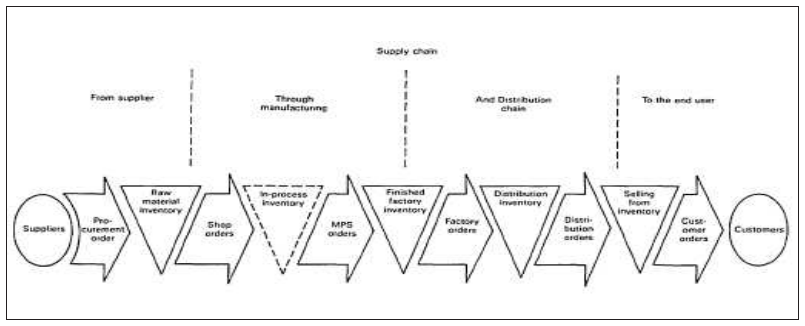
Based on findings from previous studies, the inventory management issue must be given serious attention by all, industry pratictioner and the academics. Inventory management must be included in the core subject due to its importance in meeting the customer’s requirements and a primary factor in determining service level. The industry must have individuals who are well versed in inventory management in order to minimize the problems arising from the supply chain process and activities. Figure 1 indicates the supply chain process in the aerospace industry and it can be observed that it is not much different from the supply chain process for most manufacturers as given by most textbooks.
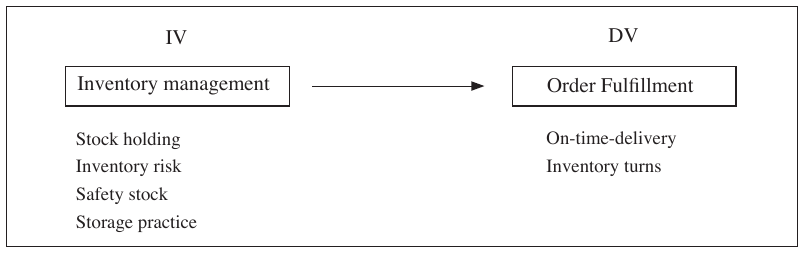
In supply chain management, information sharing is an important element (Paulraj, 2004; Devaraj, Krajewski & Wei 2007). Information on lead-time and quantity are important for the success of the supply chain management. According to Zhang et al. (2002) and Chopra (2001), it also ensures improvement in the supply chain cycle. Lee et al. (1997) suggests that the supplier’s demand difference is drastically reduced due to the sharing of information among them. The fact that supplier management has become an important part of supply chain management is evident in our study. However, there are studies that stated otherwise. For example, the study by Cachon and Fisher (2000) found the insignificant benefits of information sharing. Their finding is not unexpected, as the possible reasons could be the limited data size. With regard to the number of sources in supplying products and materials to the manufacturers, the source of inventory from one source and two sources makes a substantial difference when there is an imbalance in demand and supply (Tang, 2006). When there is an alternative, it means there is no restriction (Gavirneni et al. 1999) and the information becomes valuable when it is flexible in responding to the system. In our study, the leading edge organizations are moving their quality focus from inspection to designing quality into products coupled with process control and process improvement efforts. They have appointed suppliers and the number is very small, only one or two suppliers for most materials. Thus, the service level is expected to be efficient as it affects the success in managing the supply chain and the organization performance. Due to the high carrying cost in the aerospace industry, the amount of inventory is kept at a minimum level most of the time. To minimize the inventory, the aerospace organizations work with the suppliers and the small number of suppliers allows for better relationship with them. In theory, assuming the volume remains constant, a decrease in supplier base means an increase in volume to the strategic suppliers and possible reduction in price due to increase in quantity. This is something that is disputable in our study. The research framework for our study is provided as in depicted in figure 2. IV
DV
Inventory management
Order Fulfillment
Stock holding Inventory risk Safety stock Storage practice
On-time-delivery Inventory turns
Research Methodology
The methodology adopted in our research is the quantitative approach. The data collection was done using questionnaires distributed to identified suppliers to the aerospace manufacturers in Malaysia. As the quantitative cum deductive approach requires a clear understanding of the type, collection and analysis of evidence within a well-defined theoretical framework, the research methodology section here covers the mentioned aspects. The target population is the companies that have business deals with the two main aerospace companies in Malaysia. A total of 20 companies were identified from the list provided by both Boeing and Airbus companies. For each company, 5 sets of questionnaires were distributed to the managers. In total, 85 sets of questionnaires were returned. The main reason the total population is low is that the aerospace industry is relatively new in Malaysia. With the required technology and considerable huge investment, not many are able to become suppliers. The study thus becomes like a census. However, they were not compelled to respond to the questionnaire and only those who were willing to participate were counted as the sample. The data collection process was difficult as most of the respondents practice very strict rules on matters pertaining to sharing information with outsiders. The dependent variables are on-time-delivery and inventory turns, which represent order fulfillment. The independent variables as provided in figure 2 are the (i) safety stock, (ii) storage practice, (iii) inventory risk and (iv) stock holding. Each is examined separately, thus, eight hypotheses were tested. Validity and reliability tests were performed prior to the regression analysis. 4.0
Findings
The data collected for this study was analyzed using the Statistical Package for Social Sciences (SPSS) software. Missing data and outliers were removed during the analysis. Reliability tests, using Cronbach’s alpha, were performed on the measures of “inventory management” and “order fulfillment”. For the measure of “inventory management” which has four dimensions: stock holding, inventory risk, safety stock, and storage practice, the reliability scores range from 0.610 (safety stock) to 0.859 (stock holding). The scores indicate that the measure of “inventory management” has acceptable reliability levels for its dimensions. Reliability scores for the “order fulfillment”, which has two dimensions: on-time delivery and inventory turns, are 0.763 and 0.765 respectively. The scores indicate that both dimensions of “order fulfillment” possess acceptable levels of reliability. The results of the reliability tests are shown in the following table, Table 1. Regression analyses were conducted to examine the effects of the inventory management dimensions on order fulfillment. The first analysis was to examine the effects of those dimensions on the first dimension of order fulfillment, i.e. on-time delivery. The second analysis was to examine the effects of the inventory management dimensions on the second dimension of order fulfillment, i.e. inventory turns.
| Latent variables | Dimensions | Cronbach’s Alpha | Means | Standard deviation |
|---|---|---|---|---|
| Stock holding | 0.859 | 4.16 | 0.836 | |
| Inventory | Inventory risk | 0.736 | 4.21 | 0.787 |
| Management | Safety stock Storage practice | 0.610 0.719 0.763 | 3.99 4.14 3.98 | 0.848 0.949 0.787 |
| Order fulfillment | On-time-delivery Inventory turns | 0.765 | 4.04 | 0.747 |
Means
Standard deviation
From the results shown in Table 2, it can be seen that the inventory management dimensions account for about 11.3% of the variance in on-time delivery (R2 = 0.113, F= 1.573, p < 0.167). Only one out of four dimensions is significantly related with on-time delivery: safety stock (β = 0.276, p ≤ 0.05). For inventory turns, two of the inventory management dimensions are significantly related to it: safety stock (β = 0.209, p ≤ 0.10) and storage practices (β = 0.296, p ≤ 0.01). These two dimensions of inventory management account for about 29.6% of variance in inventory turns (R2 = 0.296, F= 5.176, p < 0.000).
| Independent variables | DV | β | Sig. | R2 |
|---|---|---|---|---|
| Stock holding | 0.011 | 0.929 0.113 | ||
| Inventory risk On-time-delivery | 0.027 | 0.843 | ||
| Safety stock | 0.276 | 0.034 | ||
| Storage practice | 0.096 0.096 | 0.445 0.407 0.296 | ||
| Stock holding Inventory turns | 0.020 | 0.869 | ||
| Inventory risk | 0.209 | 0.069 | ||
| Safety stock | 0.296 | 0.010 | ||
| Storage practice |
Conclusions
The finding indicating the insignificant effect of stock holding on the supply chain management shows that it is not in line with previous studies such as Sheffi (2002) and Wanke (2011). This opposite finding could be explained by the fact that this study was conducted in a high technology industry where the cost of stock holding is very expensive. Moreover, the items are specialized and relatively in fewer in number. Its supply is regulated by the manufacturers of the raw material and it is more toward a ‘just-in-time’ practices. Similarly, the results for inventory risk also show different findings from the previous literature, for example by Harland et al. (2003) and Kleindorfer and Saad (2005). Similar arguments can be used to justify the insignificant effect of inventory risk on order fulfillment, further justification could be that the high technology players are cash rich which represents a relatively low percentage of the total working capital. Results for the test on safety stock indicate a significant effect on both dimensions of order fulfillment. This is in line with many findings of previous studies such as (Hult et al., 2004), Wanke (2011) and Sheffi and Rice (2005). In the aerospace industry, the importance of safety stock can not be denied. If the components are not available justin-time, ultimately the cost of processing will increase drastically due to the expensive nature of operations. The results of the tests on storage practices show a significant relationship only with inventory turn. This is explained by the fact that inventory turns influences the storage practices and policy (Levy, 1997), thus having the right storage practices affects the inventory turns, as proven in the finding. Moreover, the storage practices appear to be cost significant to both of the dimensions of order fulfillment. Thus, it is suggested here that in the aerospace industry, due to the high value of components, more inventory turns are required. This requires better and appropriate storage practices and policies. The findings of this study are actually similar to various research findings such as Levy (1997) and Pujawan N (2008). This proves the importance of inventory management in order fulfillment for all industries inclusive of the high technology aerospace industry. Although only two dimensions of inventory management: safety stock and storage practices, were found to be significant, it is justified by the nature and the environment of the industry. This paper provides a fresh perspective on inventory management affecting the order fulfillment. It shows that it is important to take the necessary steps to support the order fulfillment in a supply chain environment. Within the context of high technology firms, particularly the aerospace industry, safety stock and storage practices are the two important factors in inventory management to improve order fulfillment. Many organizations have been paying the penalty for non-conforming to delivery without realizing the importance of managing their supply chain management. It is suggested that future studies should look into different contexts such as in the solar industry, which also has a high carrying cost and high value of raw materials. It is hoped that this research can be of use to the industry in understanding the importance of inventory management in the supply chain perspective.
References
- Cachon, G., & Fisher, M. (2000). Supply Chain Inventory Management and the Value of Shared Information. Journal from Management Sci. 46(8), 1032-1048.
- Chopra, S., & Meindl, P. (2001). Supply chain management: strategy, planning, and operation, Prentice-Hall, Upper Saddle River, N.J,
- Devaraj, S., Krajewski, L., & Wei, J. C. (2007). Impact of eBusiness technologies on operational performance: The role of production information integration in the supply chain. Journal of Operations Management, 25(6), 1199–1216.
- Dooley, F. (2015). Logistic, inventory control and supply chain management, The American Agricultural Economics Association, Choices. 20,(4), 287-291 Retrieved from : http://www.choicesmagazine.org/2005-4/supplychain/2005-4-14.htm
- Gavirneni, S., Kapuscinski, R., & Tayur, S. (1999). Value of information in capacitated supply chains. Management Sci. 45(1),16-24.
- Harland, C., Brenchley, R., & Walker, H. (2003). Risk in supply networks, Journal of Purchasing and Supply management, 9(2), 51-62.
- Hult, G. T. M., Ketchen J. D. J., & Slater, S. F. (2004). Information processing, knowledge development, and strategic supply chain performance. The Academy of Management Journal, 47(2), 241–253.
- Kleindorfer, P. R., & Saad, G. H. (2005). Managing disruption risks in supply chains. Production and Operations Management 14(1), 53–68.
- Lee, H. L., Padmanabhan, V., & Wang, S. (1997). Information distortion in a supply chain. The bullwhip effect. Management Sci. 43(4), 546-558.
- Levy, D. L. (1997). Lean production in an international supply chain, Sloan management Review, Winter, 94-102.
- Lewis, M. (2003). Cause, consequence and control: towards a theoretical and practical model of operational risk, Journal of Operational Management, 21(2), 205-224.
- Pujawan, N. (2008). Augmenting the lot sizing order quantity when demand is probabilistic. European Journal of Operational Research. 188(3) 705–722.
- Paulraj, A., & Chen, I. J. (2007). Strategic buyer–supplier relationships, information technology and external logistics integration. Journal of Supply Chain Management, 43(2), 2–14.
- Sheffi, Y. (2002). Supply chain management under threat of international terrorism, International Journal of Logistics Management, 12(2), 1-12.
- Sheffi, Y., & Rice, J. B. (2005). A supply chain view of the resilient enterprise. MIT Sloan Management Review, 47(1), 41-48.
- Slack, N., Chambers, S., Harland, C., Harrisons, A., & Johnston, R. (1995), Operations Management, International Journal of Service Industry Management, 7(3). 63-64.
- Tang, C. (2006). Perspectives in supply chain risk management. International Journal of Production Economics. 103(2), 451-488.
- Wanke, P. (2011). The impact of different demand allocation rules on total stock levels. Pesquisa Operacional 30(1), 33-52.
- Zhang, Q., Vonderembse, M. A., & Lim, J. (2002). Value chain flexibility: A dichotomy of capability, International Journal of Production, 40(3), 561-583.