University-Industry Collaboration in Research and Development in Malaysian Universities
- Kolej Professional MARA Ayer Molek, Melaka
Journal of Business Management and Accounting 6(2) (2016) · https://doi.org/10.32890/jbma2016.6.1.8834
Abstract
The focus of this study is on types of university-industry collaboration in R&D projects in Malaysian universities. The study identified the benefits derived from University-Industry collaborations as it relates to performance of R&D project and the characteristics of R&D projects that encourage industry to collaborate with universities. It also makes recommendations towards increasing performance of R&D projects based on the data collected and analysed. Exploratory approach was used in this study. This approach explored the collaboration types and how it contributed to R&D performance. Quantitative analysis was used by analysing questionnaire data. The reliability of the questionnaire items was tested. The respondents were people with experience in U-I collaborations. Data was analysed based on the five major elements in the theoretical framework. These are: benefits, performance, characters, practice and barrier. Based on the findings from the study, all of these five elements should be combined to ensure better R&D performance. The contribution of this study is the suggestions to universities in Malaysia and the Ministry of Higher Education (MOHE) to encourage increasing numbers of U-I collaborations.
Keywords: University-industry (U-I), collaboration, research and development (R&D), R&D benefits, R&D performance
1.0Introduction
Collaboration is the linkage and relationship between university and industry involving knowledge and technology transfer (Mike, Brat and Andy, 2008). Academics engage in several broad categories of technology transfer activities. These are the creation and diffusion of knowledge through publications, transmission of knowledge through teaching, and engaging in spinoffs formation and consulting services (Rejean, Malek and Nabil, 2010). Benyamin, Dudi and Siti (2012) argued that even though R&D collaboration creates benefits in term of benefits funding, it is not easy to clearly define collaboration. It depends on purpose of forming the collaborations. But most of the time, collaboration leads to improved productivity and produces better quality outputs.
A Study by Chandran (2010) showed that funding is an important contributor to R&D project success. He stressed that the weakness of funding channels includes lack of pre-seed and seed funding, and lack of collaboration and linkages for demand-driven innovation. He added that in Malaysia context, collaborative R&D activities between universities and industries are still low. Chandran (2010) again indicates that research benefits such as funding should support partnership approaches to new and emerging research areas. In this aspect, institutions should eventually develop programs that integrate industries’ need for new products with public universities to develop concepts, ideas and products to meet those needs. The major concerns include:
i.     Overlapping roles of agencies with less focussed effort
ii.    Lack of institutional support to manage the risk of ineffective allocation and
       usage of fund because of overlapping roles of agencies,
iii.   Inadequate centres to encourage and to promote industry sponsored research,
       and
iv.    Lack of agencies in managing and assessment of the impact of R&D funds and
       management of various government funds.
Kurtulus and Kadir (2011) identified eight factors that constitute a barrier to U-I collaboration: lack of interest from industrialists and academicians, bureaucracy, remoteness of field studies, insufficient publicity, lack of communication, ineffective regulations, ineffective U-I collaboration centres, and previous bad experience. Although U-I collaboration has made important contribution, universities need to embrace ‘entrepreneurship’ as part of their missions (Kurtulus and Kadir, 2011). Collaborating in R&D projects will increase performance. Giovanni, Ciriaco and Flavia (2009) stated that researches involving U-I collaborations have better performance than researches that are not involved in U-I collaboration. Banji and Boladale (2012) agreed with this statement and concluded that incentives, especially funding, is the most critical factor that affects university research performance.
Due to the problems faced by universities in finding funding from collaboration with industry, this study explored various types of U-I collaborations and the relationship between benefits and R&D performance. The study also identified the characteristics of R&D projects that could encourage industries to collaborate. This study offers suggestions and recommendations to universities in order to increase their research collaboration.
2.0Literature Review
Carnwell (2009) defines collaboration in terms of ‘two or more individuals must be involved in a joint venture, typically one of an intellectual nature in which participants willingly participate in planning and decision making’. Individuals consider themselves to be members of a team working towards a common goal, sharing their expertise and responsibility for the outcome. Fundamentally, the relationship between collaborators is non-hierarchical, and shared power is based on knowledge and expertise, rather than role or title. Not to forgot that, collaborations has always happened in R&D environment.
There is abundant evidence that research collaboration has become the norm in every field of scientific and technical research. Bozeman, Fay and Slade (2013) consider collaborations aimed chiefly at expanding the base of knowledge (knowledge-focused collaborations) as well as ones focused on production of economic value and wealth (property-focused collaborations). They conclude with some suggestions for possible improvement in research on collaboration including: more attention to multiple levels of analysis and the interactions among them; careful measurement of impacts as opposed to outputs; more studies on ‘malpractice’ in collaboration, including exploitation; and increased attention to collaborators’ motives and the social psychology of collaborative teams.
Grimpe & Hussinger (2013) has identified formal and informal channels in university knowledge and technology transfer (KTT). While formal KTT typically involves a legal contract on a patent or on collaborative research activities, informal transfer channels refer to personal contacts and hence to the tacit dimension of knowledge transfer. They analysed whether these activities are mutually reinforcing, i.e., complementary. The management of the firm should therefore strive to maintain close informal relationships with universities to realize the full potential of formal KTT.
The purpose of universities and industries collaboration is not just funding, it is also pressures universities to perform their functions of teaching and research. Collaboration between universities and industries give benefit to both parties when both partners need to remain competitive in the market. It will be difficult for industries to survive if they do not carry out R&D on their products. Kurtulus and Kadir (2011) highlighted in their research that universities and industries need to be in contact via collaboration with the aim of developing new data, method and technology. They added that the ‘collaboration’ between universities and industries has different meanings for both parties. When collaboration is performed, universities translate the knowledge into practice, integrate the information into the higher education system as ‘research data’ and obtain fund for research or find sponsors.
According to Muscio (2012), the existence of a form of complementarily between universities and government, and external funding to universities would imply that universities need government funding to increase collaboration channel with industry. Strong connection between universities and industries is seen as necessary, and this requires a structural change in the role of the universities within the national innovation system and modernization of their managerial and organizational skills (Muscio 2012).
Benyamin et al. (2012) argued that even though R&D collaboration creates benefits, especially funding, it is not easy to clearly define collaboration. It depends on purpose of forming the collaborations. But most of the time, collaboration enhances productivity and produces better quality outputs.
3.0Types of U-I Collaborations
According to Markus, Zella and Stephen (2011), there are five types of U-I relation. There are spinoffs or licensing, academic entrepreneurship, collaborative research, contract research and consulting. Collaborative research, contract research and consulting are purposely looking for funding from industries. Donald (2007) in his research highlighted five types of U-I collaboration namely spinoffs, contract research, sponsored research, joint ventures and invention. A Different view from Mike, Andy and Brat (2006), stated that types of collaboration consists of spinoffs (licensing and patent), contract research, consultancy and reach-out, and graduate and researchers mobility.
Mike, Andy and Brat (2006) suggest that different types of universities may create different types of spin-offs. Similarly, some universities may create different types of spin-offs with different objectives and growth prospects that have different financial requirements in the process of matching the appropriate type of external finance provider with particularly types of spin-offs at different phases in their development. It is not easy to clearly define collaboration. It depends on purpose of forming the collaborations. But most of the time, collaboration produces better quality outputs (Benyamin, Dudi and Siti 2012). Table 1 shows four types of U-I collaborations and the definitions provided by several researchers.
Based on studies by previous researchers, this study picked only four types of collaboration based on the importance and the function of each type. Moreover, the four types are widely practiced. They four types selected for this study are spinoffs or licensing, contract research, consultancy and joint venture. The types of collaborations will become independent variables in this study. U-I collaboration is a win-win situation where universities try to use industries to help them in doing R&D while industries also have their own reasons to collaborate. There are varieties of reasons industries choose to collaborate. According to Banji and Boladale (2012), industries collaborate because of external knowledge derived from growing complexity of production, and because of the interactive nature of learning. Other than that, industries use universities as consulting and technology transfer unit.
| No | Types of Collaboration | Definitions |
|---|---|---|
| 1. | Spinoffs and Licensing Donald (2007), Mike & Brat (2008), Karl, Johan & Mike (2011), and Markus & Kathryn (2011) | - A university based researcher launches a new venture to commercialize research perfected in the university’s lab. - Contractual assignment of university generated intellectual property (IP) to industry. - Enhances resources of public and private funding and helps participation in technology transfer and human training activities. It also helps enhance focus on secondary research of immediate industrial relevance. |
| 2. | Contract Research Donald (2007), Mike & Brat (2008), and Markus & Kathryn (2011) | - Application-oriented R&D activities carried out by university – funded by industry. - Serves to refine the technology into a commercially viable form. |
| 3. | Consultancy Mike & Brat (2008), and Markus & Kathryn (2011) | - Application-oriented R&D activities or advice provided individually by academics – funded by industry - Interaction between academic and industry in order to find the best and most appropriate solution to a problem. - The return can be the creation and diffusion of knowledge. It is often enhanced by combination of different skills, cross-pollination of ideas and pooling of resources. These returns help to generate economies of scale in research activities and may help avoid duplication of research effort. |
| 4. | Joint Venture Donald (2007) | - Industry has a product that needs R&D to develop the product. They develop the solution together and share intellectual property (IP). - looking for external knowledge derived from growing complexity of production, and because of the interactive nature of learning |
U-I collaboration is beneficial in terms of increasing quality and quantity of research output, to access expertise, to access resources and funding of R&D projects (Diego and Allesandro, 2011). They added that returns to collaboration are potentially huge. The returns can be the creation and diffusion of knowledge. It is often enhanced by combination of different skills, cross-pollination of ideas and pooling of resources. These returns help to generate economies of scale in research activities and may help to avoid duplication of research effort. Most common reasons for collaboration include accessing expertise, accessing equipment and resources, encouraging cross-fertilization across disciplines, improving access to funds, obtaining prestige or visibility, learning tacit knowledge about research techniques, pooling knowledge for tackling large and complex problems, enhancing productivity, educating students, increasing the specialization of science, and for fun and pleasure or social reason (Benyamin, Dudi and Siti 2012).
Markus, Zella and Stephen (2011), stated that high degree of U-I interactions are associated with high R&D performance. Working with industry also will enhance scientists’ resources as researchers are able to attract industry funding for contract research and consulting. They added that industry will want to have university partners that are prepared to accept industry funding. Giovanni, Ciriaco and Flavia (2009) agreed that R&D projects resulting from collaboration (U-I) demonstrates superior performance compared with R&D projects are not involved in such collaborations. Rejean, Malek and Nabil (2010) concluded their research by convincingly arguing that the existence of collaboration activities enhance performance.
Johan, Pablo and Amon (2010) added that ‘orientation-related barriers’ always happened because academics often have to engage in ‘status competition’ such as publication records, institutional affiliation and prizes while ‘transaction-related barriers’ occur because, in some cases, universities attempt to capture the commercial benefit from research and leads to significant distributional conflicts between U-I. The method that Johan, Pablo and Amon (2010) used was by listing all the barriers to university-industry interaction. Then, they suggested that breadth of interaction is likely to be associated with lower orientation-related barriers. The finding casts light on how broader U-I ties can have both a positive and negative effects on the barriers to collaboration. They also found that inter-organizational trust is one of the strongest mechanisms for lowering the barriers against interactions between universities and industries. They suggest that that the traditional system of informal reciprocity and exchange, which dominated U-I exchanges, should be an important part of attempts to support and build U-I collaborations.
Markus, Zella and Stephan (2011) stressed that the decisions of academic researchers to work with industries derived from two factors which are, firstly, to gain benefit from the complementarities between their academic work and industry engagement, and secondly, the additional resources for research. But on the part of industry, they work with universities in order to access academic expertise which benefits their R&D and/ or product development activities. University-Industry Collaboration in Research and Development in Malaysian Universities : 27-42 33
There are several guides to be followed by universities and industries in order to make the collaboration smooth and successful. In the real situation there are many professional guidance for U-I to avoid conflict and ensure the success of the collaboration. For example, some studies advised on legal agreement, framework to follow and others. But, for this study, the researcher only chooses the most important practice to follow which is coordination or trust and managing mutual objectives
Based on all the factors discussed in past research, this study explored the various collaborations between university-industry in Malaysia and the benefits from the collaboration in R&D projects. This study also identified the required characteristics that encourage industries to collaborate with universities and also other factors that may increase R&D performance and number of R&D projects in Malaysian higher education sector especially among the selected higher education samples.
4.0Theoretical Framework
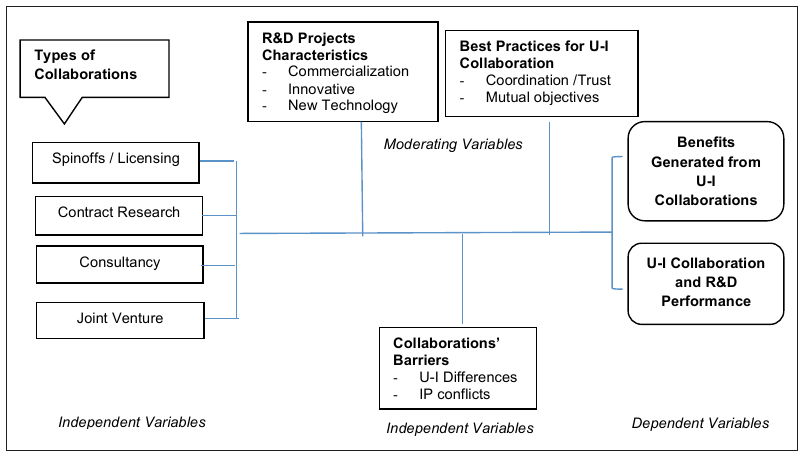
The research identified the benefits gained from the collaboration of university and industry. The benefits are funding, resources sharing, knowledge sharing, enhance productivity and enhance university and industry images. The study contributed in terms of the type of collaboration (spin-offs / licensing or contract research or consultancy or joint venture) and how it affects R&D performance. In figure 1, the theoretical framework is a summary of the relationship among dependent variables, moderating variables, intervening variables and independent variables.
R&D Projects Best Practices for U-I Types of Characteristics Collaboration Collaborations - Commercialization - Coordination /Trust - Innovative - Mutual objectives - New Technology - Incentive/ Rewards Moderating Variables Benefits Spinoffs / Licensing Generated from U-I Collaborations Contract Research
Consultancy U-I Collaboration and R&D Performance Joint Venture Collaborations’ Barriers - U-I Differences - IP conflicts Independent Variables Independent Variables Dependent Variables
4.1Data Collection Method
The two types of data sources used in this study are primary data and secondary data sources. Primary data source includes data that needed to be interpreted such as empirical data, interviews, questionnaire data and observation data. Primary data was collected using questionnaire and analyzed to obtain the result for this study. It was also used to get more views and perceptions from researchers/lecturers in universities in Malaysia. This group of people will give good data since they are knowledgeable about their jobs in their own situation.
A full set of questionnaires were distributed to researchers in universities in Malaysia. They provided information based on their experiences and opinion regarding collaborations. The questionnaires were distributed by two different methods. Firstly, it was distributed to them directly. Second, it was distributed by email to their offices’ voucher were given out to those who responded the questionnaire.
The secondary data used in this study, came from various sources. Among these sources are the published online journals, research papers, thesis etc. Secondary data sources are based on primary sources, which are usually studies, which support, analyse, evaluate, interpret, or criticize.
4.2Data Analysis
Raw data from the questionnaire was analyzed using descriptive statistical analysis, reliability analysis, and hypothesis testing. Each scale was examined for the convergent validity of the final result. The statistical data also was analyzed from different aspects to enable comparison.
After the descriptive statistics the Pearson correlation matrix was produced to see the relationship between variables in this study. The variables are university-industry collaboration, funding, resource sharing, knowledge sharing, enhance productivity and enhance university and industry images. From the result, the researcher can identify whether there are positive or negative correlations between the variables.
Another statistical tool used to analyse data in this study is multiple regressions. Using this tool, the researcher can determine how the independent variables explain the variance in the dependent variables. This type of analysis is to determine the relationship between the independent and dependent variables.
4.3Results and Discussions
4.3.1Reliability and Validity of Constructs
There are a number of different reliability coefficients. One of the most commonly used is Cronbach’s Alpha, which is based on the average correlation of items within a test if the items are standardised. If the items are not standardised, it is based on the average covariance among the items. Because Cronbach’s Alpha can be interpreted as a correlation coefficient, it ranges in value from 0 to 1.
This measure indicates the consistency of multiple items scale. Cronbach alpha is typically used when there are several Likert-type items that are summed to make a composite score or summated scale. Alpha is based on the mean or average correlation of each item in the scale with every other item. In the social science literature, alpha is widely used, because it provides a measure of reliability that can be obtained from just one testing session or one administration of a questionnaire.
Reliability of items can be measured by calculating the Cronbach’s α value where a value larger than 0.70 is acceptable according to Kline (1999). However, this guideline should be used with caution. This is because the value of α depends on the number of items in the scale where the larger number of items will increase α value. The reliability coefficient was computed statistically by using the coefficient alpha formula. Obtaining coefficient alpha can be done by calculating the average of the coefficients from all combination of split halves.
Using the Cronbach’s Alpha as a tool of testing the reliability statistics, Using the Cronbach’s Alpha as a tool of testing the the result is presented in the table 2. The reliability obtained from 11 questions in two groups which can be defined as the awareness of collaborations’ benefits and R&D performance. This reliability value was obtained from responses by 85 respondents that are involved in University-Industry Collaborations.
| Variables | Cronbach’s alpha | Number of items |
|---|---|---|
| Awareness of Collaboration’ Benefits | 0.795 | 6 |
| R&D Performance | 0.833 | 5 |
| TOTAL | 11 |
4.3.2Sample Characteristics
A questionnaire was distributed to a random sample of 100 researchers that are involved in University-Industry Collaboration. The questionnaires were distributed throughout universities in Malaysia. 100 completed surveys were returned but only 85 surveys were completed properly, yielding 85% response rate Contract research and joint venture have the highest contribution in collaborations’ benefit. This is because the nature of collaboration is clear. Contract research is an application-oriented R&D activities carried out by university but funded by industry and serves to refine the technology into a commercially viable form while joint venture happens when industry has a product that needs R&D by the university in order to develop the product. They develop the solution together and shared the IP. Compared to consultancy, it is more beneficial to the collaborators.
4.3.3Crosstab Summary
Table 3 shows the summarisation of all the crosstab done. The crosstab that are involved in the analysis are between five types of benefits generated from U-I collaborations with R&D performance and increasing numbers of R&D Projects. It shows that the most important types of collaborations influence the R&D performance and lead to increasing numbers of R&D projects.
| R&D | Increasing numbers | |
|---|---|---|
| Performance | of R&D Project | |
| Benefits of U-I Collaborations -Funding | Contract Research | Contract Research |
| Benefits of U-I Collaborations –Knowledge | Joint Venture | Joint Venture |
| Sharing | ||
| Benefits of U-I Collaborations –Resource | Joint Venture | Joint Venture |
| Sharing | ||
| Benefits of U-I Collaborations –Productivity | Joint Venture | Contract Research |
| Benefits of U-I Collaborations -Images | Joint Venture | Joint Venture |
4.3.4Regression Analysis
The linear regression analysis used to determine whether there is significant linear relationship between moderating variable and intervening variable (x) with dependent variable (y). Moderating variables presents R&D project characteristics, and good practices in U-I collaboration, intervening variables presents collaboration barriers and dependent variables presents benefit generated from U-I collaboration and U-I collaborations and R&D performance.
Where Β0 is a constant, Β1 is the slope (also called the regression coefficient), X is the value of the moderating and intervening variable which is R&D project characteristics, good practices in U-I collaboration, and collaborations barriers, while Y is the value of the dependent variable which is benefit generated from U-I collaboration and U-I collaborations and R&D performance.
4.3.5Summary of the Hypotheses Analysis
Based on the crosstab measure between University-Industry benefit and R&D performance and Increasing numbers of R&D projects, the relationship between the independent variables which is types of U-I collaboration (spin-off/licensing, contract research, consultancy and joint venture) and the dependent variable (U-I collaboration benefits and R&D projects performance) were analysed and the table 6 below summarized the results of all hypotheses developed. From the analysis, the most effective types of collaboration are joint venture and contract research. Hypotheses were used and discussed in this study to find out the relationship between independent variable and whether they increase R&D performance and increase numbers of R&D projects.
The hypotheses are:
H1: If the spinoffs/licensing type of U-I is used, the benefits of collaboration between university-industry will increase, and performance of R&D projects will increase. H2: If the contract research type of U-I is used, the benefits of collaboration between university-industry will be increase, and performance of R&D projects will increase. H3: If the consultancy type of U-I is used, the benefits of collaboration between university-industry will increase and performance of R&D projects will increase. H4: If the joint venture type of U-I is used, the benefits of collaboration between university-industry will increase and performance of R&D projects will increase.
Hypothesis 1, 2, 3, and 4 refer to the impact of the benefits from collaboration and R&D performance if the spinoff/licensing or contract research or consultancy or joint ventures types of collaborations are used. The benefits involved are funding, resources sharing, knowledge sharing, enhance productivity and enhance university and industry images.
Table 4 shows the result of hypothesis 5 and 6 based on regression and correlation analysis. Hypotheses were used and discussed in this study to find out the relationship between moderating variable and intervening variable and the dependent variables, whether they increase R&D performance and increase numbers of R&D projects.
The hypotheses are:
H5: If the R&D projects characteristics and good practices are increased, the benefits of collaboration university-industry will increase, and performance of R&D projects will increased.
Hypothesis 5 is referring to the impact of the benefits from collaboration and R&D performance if the moderating variables are increased. Moderating variables are R&D projects characteristic and good practices. The characteristics are commercialization, innovative, new technology, incentive/rewards, and expert researchers while the good practices consists of coordination/trust and mutual objectives elements.
H6: If the collaborations’ barriers decreased, the benefits of collaboration university- industry will increase and performance of R&D projects will be increased.
Hypothesis 6 is referring to the impact of the benefits from collaboration and R&D performance if the intervening variables are decreased. Intervening variable is the Collaboration barriers which consists of U-I differences and IP conflict barriers.
| Hypothesis | Variables | Method Analysed | Results |
|---|---|---|---|
| Hypothesis 1 | Spin-off / Licensing | Regression | H1 is rejected |
| Hypothesis 2 | Contract Research | Regression | H2 is accepted |
| Hypothesis 3 | Consultancy | Regression | H3 is rejected |
| Hypothesis 4 | Joint Venture | Regression | H4 is accepted |
| Hypothesis 5 | R&D Characteristics and Good Practices | Regression and Pearson Correlation | H5 is accepted |
| Hypothesis 6 | Barriers in Collaboration | Regression and Pearson Correlation | H6 is accepted |
According to the Table 4, among all the six hypothesises tested; four hypotheses were accepted while the other two were rejected. The accepted hypotheses are hypothesis 2, hypothesis 4, hypothesis 5, and hypothesis 6. Hypothesis 2 provides support for the statement that if contract research is used, the benefits of collaboration between university-industry will increase, and performance of R&D projects will also increase. The hypothesis 4 provided support for the statement that if joint venture is used, the benefits of collaboration between university-industry will increase and performance of R&D projects also increase.
The hypothesis 5 provided support to the statement that if the R&D projects characteristics and good practices are increased, the benefits of collaboration between university-industry will increase, and performance of R&D projects will increase. The hypothesis 6 provided support for the statement that if the collaborations’ barriers decreased, the benefits of collaboration university-industry will increase and performance of R&D projects will be increased. Table 4 also showed that the rejected hypotheses are hypothesis 1 and hypothesis 3. Hypothesis 1 supports the fact that if the spinoffs/licensing are used, the benefits of collaboration university-industry will not increase, and performance of R&D projects also will not increase. Lastly, hypothesis 3 provided support for the fact that if the consultancy is used, the benefits of collaboration university-industry will not increase, and performance of R&D projects also will not increase.
5.0Conclusion and Recommendation
The objective of this study was to find the most influential type of University-Industry collaboration, which gives better performance and benefit. Thus, the objective of this study was attained. Among five types of U-I collaborations presented in this research, the types of collaborations which leads to positive relationship with the R&D performance and at the same time increase number of R&D projects in universities are contract research and joint venture. The respondents think that any industries should have sufficient fund and good R&D characters to collaborate with them. Thus the right collaborated industry should offer R&D projects needed by universities. On the management side, the administration of the universities must help to find qualified and experienced industries to collaborate and achieve higher R&D performance. Other than that, the universities itself must increase the number of Professors, PhD holders as their academic’s staff and also take action to encourage academics to do more research and publications so that the reputation of their academics staff can increase and they can become more famous and well-known in the country. This directly can promote the universities and attract many more potential industries into the universities.
Based on the result of hypotheses developed, contract research and joint venture are two types of collaborations that seem to be the best type in collaborating with industries. It is because both universities and industries need each other in those types of collaboration. Compared to the other two types of collaborations; spin-off or licensing and consultancy seems to give only one-sided benefits.
From the industries’ point of view, collaborations with universities or individual academics often spill out into teaching and work placements, which fill their workplace with energetic researchers who are able to get into the industries. These collaborations also help offer access to networks of talented students who may become potential employees. Industry also wants the technical and innovation skills that universities can offer. Industries are aware that researchers from universities normally know what is coming next, and that by mixing researchers into their teams they get this subcultural ingredient which helps give them a commercial edge.
Based on the findings above, all of these elements should be combined or any of the important elements found from this study should be noted during the R&D activities. Universities and industries should emphasize more on these elements when collaborating.
6.0Recommendation
Based on this study, universities in Malaysia must improve in areas discovered by this study in order to attract more industry enrolment into their R&D projects. Universities should practise all elements discussed and should have good R&D projects characteristics to encourage industries to collaborate with them. From this study, it was found that the industries will look into this element before choosing the right R&D project for them to collaborate. From the feedback received from the respondents and university researchers, there are suggestions for top management, universities’ personnel, procedures, government and others. They suggested that top management of the universities and industries must get involved directly to improve the quality of the U-I collaboration, and management also have to improve their labs. Universities also should establish collaboration with the industries in order to increase the chances of employment for its graduates. Universities might as well hire experienced researchers from industries as a network expansion in all fields not only science and technology, or allow researchers from the universities to join industries to gain experience and more knowledge. Industrial training for undergraduate students also helps in ensuring smooth the collaboration process.
On the government role, they suggested that they should ensure fair distribution of funding to every university whether public or private, reduce procedure and bureaucracy. For the researchers’, they should also involve themselves in the commercial R&D projects. To make U-I collaboration successful and achieved its objectives, they should follow and consider all the factors discussed and avoid all barriers that could affect the performance.
References
- Banji Oyelaran-Oyeyinka, & Boladale Abiola Adebowale. (2012). University-industry collaboration as a determinant of innovation in Nigeria. Institution and Economics. 4(1), 21-46.
- Benyamin Lakitan, Dudi Hidayat, & Siti Herlinda. (2012). Scientific productivity and the collaboration intensity of Indonesian universities and public R&D institution. Technology in Society. 34(2012), 227-238. DOI: 10.1016/j.techsoc.2012.06.001
- Bozeman, B., Fay, D., & Slade, C. P. (2013). Research collaboration in universities and academic entrepreneurship: the-state-of-the-art. Journal of Technology Transfer. 38(1). doi:10.1007/s10961-012-9281-8
- Chandran Govidaraju, V. G. R. (2010). R&D commercialization challenges for developing countries: The case of Malaysia. Technology Monitor. 25-30. http://www.techmonitor.net/tm/images/d/dd/10nov_dec_sf3.pdf
- Cristoph Grimpe, & Katrin Hussinger. (2013). Formal and informal knowledge and technology transfer from academia to industry: complementarity effects and innovation. performance. 20(8), pp. 683-700. http://www.tandfonline.com/doi/ pdf/10.1080/13662716.2013.856620
- Donald Rumball. (2007). Case study of collaborative innovation in Canadian small firms. Pp. 1-19. www.strategis.ic.gc.ca/epic/site/sbrp-rppe.nsf/en/rd02182e.html Giovanni Abramo, Ciriaco Andrea D’Angelo, Flavia Di Costa, & Marco Sozzali. (2009). University-industry collaboration in Italy: A bibliometric examination, technovation. Elsevier Science. 29(6) 498-507. http://dx.doi.org/10.1016%2Fj. technovation.2008.11.003
- Johan Bruneel, Pablo D’Este, & Ammon Salter. (2010). Investigating the factors that diminish the barriers to university-industry collaboration. Research Policy, 39(7), 858-868.
- Karl Wennberg, Johan Wiklund, & Mike Wright. (2011). The effectiveness of university knowledge spillovers: performance differences between university spinoffs and corporate spinoffs. Research Policy, 40(8), 1128-1143.
- Kurtulus Kaymaz, & Kadir Yasin Eryigit. (2011). Determining factors hindering 185-213.
- Markus Perkmann, & Kathryn Walsh. (2008). Engaging the scholar: Three types of academic consulting and their impact on universities and industry. Research Policy. 37, 1884-1891.
- Markus Perkmann, Zella King, & Stephen Pavelin. (2011). Engaging excellent? Effect of faculty quality on university engagement with industry. Research Policy. 40(4), 539-552.
- Mike Wright, Andy Lockett, Brat Clarysse, & Martin Binks. (2006). University spin-out companies and venture capital. Research Policy, 35(4), 481-501.
- Mike Wright, Brat Clarysse, Andy Lockett, & Mirjam Knockaert. (2008). Mid-ramge universities’ linkages with industry: Knowledge types and the role of intermediaries. Research Policy. 37, 1205-1223.
- Muscio, A, et al. (2013). Does government funding complement or substitute private research funding to universities?. Research Policy. 42(2013), 63–75.
- Rejean Landry, Malek Saihi, Nabil Amara, & Mathieu Ouimet. (2010). Evidence on how academics manage their portfolio of knowledge transfer activities. Research Policy. 39(10), 1387-1403.