Addressing Social Innovation in the Malaysian University-Industry-Community Knowledge Transfer Partnership: A Preliminary Empirical Insight
- Othman Yeop Abdullah Graduate School of Business, Universiti Utara Malaysia, Sintok, Kedah Malaysia
- Tunku Puteri Intan Safinaz School of Accountancy, College of Business, Universiti Utara Malaysia, Sintok, Kedah
- School of Technology Management and Logistic, College of Business, Universiti Utara Malaysia, Sintok, Kedah Malaysia
Journal of Business Management and Accounting 6(2) (2016) · https://doi.org/10.32890/jbma2016.6.1.8833
Abstract
The aim of this paper is to give a preliminary empirical insight on the potential impact of strategic knowledge management processes, i.e. knowledge creation, knowledge transfer and knowledge application, on social innovation as a new innovation outcome strategy within the Malaysian university-industry-community knowledge transfer partnership. Based on survey of relevant literatures and the gaps discovered, a research framework is then proposed. The processes of knowledge creation, knowledge transfer and knowledge application is proposed as independent variables. Social innovation is the dependent variable of the study. The preliminary empirical data was generated through structured questionnaires. The project leaders of the selected samples of Malaysian university-industry-community knowledge transfer partnership projects were chosen to answer the questionnaires distributed. The findings of this study show that all variables items are well above the acceptable level of construct reliability which is determined by the Cronbach’s Alpha value. Furthermore, the descriptive analysis also shows that respondents were consistent in their responses to the measurement items used as the independent and dependent variables in the framework of this study.
Keywords: Social innovation, strategic knowledge management processes, knowledge resource
1.0Introduction
Only recently, social innovation emerged as the new paradigm of innovation outcome strategy and it is receiving an overwhelming interest from governments, public and private institutions worldwide (Pue, Vandergeest & Breznitz, 2015). Within the developed countries such as the United States of America (USA), United Kingdom
(UK) and some wealthy European Union (EU) countries, social innovation has been widely adopted as their new innovation outcome strategy (Altuna et.al., 2015).
This is due to the fact that, the contribution of social innovation is said to be much greater and portrayed significant benefits compared to technological innovation per se (Benneworth & Cunha, 2015). Social innovation has concurrent benefits in the social, economic and technological aspects, whereas technological innovation limitedly contributes merely to fulfilling private needs (Lizuka, 2013). In tandem with the above statements, Malaysian government has taken initiatives in relation to social innovation as a new innovation outcome strategy like other countries of the world. Social innovation as a new innovation outcome strategy has been addressed in the two Malaysian Plans (RMK), the 10th Malaysian Plan (RMK-10) from 2011-2015 and also the 11th Malaysian Plan (RMK-11) from 2016-2020, respectively. The two aforementioned plans are regarded as the major strategy in helping Malaysian government to achieve its aspiration of attaining a high income country status by the year 2020.
The inclusion of social innovation as an outcome of new innovation strategy in the above mentioned plans with hope of propelling Malaysia to achieve real GDP growth of 6 % per annum, gross national income per capita of USD 15,690.00 which is the threshold of high income country, average monthly household income of USD 2,763.00 and also to increase the quality of life index by 1.7 % per annum. Like many developed countries, Malaysia also embarks on social innovation as their new innovation outcome strategy through university-industry-community knowledge transfer partnership between private, academic and community institutions. This is due to the facts that, university is seen as a potential source of new knowledge resource for innovation, economic growth and competitiveness and direct relationships between university-industry-community can bring massive contribution to the nation as a whole (Breznitz & Ram, 2013).
To elaborate further, the new superior knowledge resource that is created within the partnership system through the independent processes of knowledge creation, knowledge transfer and knowledge application is then embedded into products, processes and services. This in turn produced highly innovative products, processes and services that contribute towards social, economic and technological payoffs (Kanter, 2015). In addition, this in turn provides significant returns in terms of better living condition, better environmental condition, better education, better human development, economic growth, increase employment opportunity and also contributes towards profitability of the private sector (Altuna et.al., 2015). Hence, social innovation and its association with strategic knowledge management processes i.e. knowledge creation, knowledge transfer and knowledge application, should be fully explored. This paper is set out in four sections. Firstly, the paper highlighted the problem, presented an overview and framework of the study. Secondly, this paper offers the proposed conceptual framework. Next, the paper presents the methodology of the study followed by the results and discussion section. Finally, the paper presented some concluding comments and implications of the study.
2.0Problem Overview and Theoretical Foundation of the Study
Various researchers asserted that social innovation as a new innovation outcome strategy is very much under-developed, limited and inconsistent in terms of empirical evidence offered within the social innovation literature (Cajaiba-Santana, 2014; Krlev, et.al., 2014; Makimattila et.al., 2015). This situation perhaps offers all stakeholders limited alternatives in searching for best practices regarding the adoption of social innovation as a new innovation outcome strategy. To elaborate further, within the literature, social innovation is very much central and exclusively connected to the social aspects and social purposes and it is distinct from other innovation outcomes for example technological driven innovation (Dawson & Daniel, 2010). This situation leaves social innovation isolated within the scope of social and creates under-value and under-investment in social innovation (Pol & Ville, 2009; Altuna et.al., 2015). Social innovation is not necessarily tied up to address specific social purposes but its value encompasses a wide range of benefits that includes social, economic and technological aspects (Dunphy et.al., 2007; Unceta et.al., 2016). Recent studies (Krlev et.al., 2014; Bitzer & Hamann 2015) show evidence that social innovation has integrated the economic and technological aspects within the outcome of social innovation only recently. However, it predominantly focuses on the conceptual part of social innovation rather than gives a useful empirical insight on how social innovation as an outcome contributes towards social, economic and technological aspects (Lizuka, 2013; Krlev et.al., 2014).
From the above paragraph, in the new era of the knowledge-led economy, the concept of innovation considers knowledge resource as the new basis for innovation and replacing old tangible resource that refers to raw materials, financial resources and machinery (Alegre & Chiva, 2008; Sammara & Biggiero, 2008). Knowledge resource is created through the integrated and independent processes of knowledge creation, knowledge transfer and knowledge application and it involved the interplay of tacit and explicit knowledge (Meier, 2011). Furthermore, it is embedded into products, processes and services to make them highly innovative and in turn contribute not only to technological but also to social and economic benefits (Lichtenthaler & Lichtenthaler, 2009; Chiva et.al., 2014). This modern concept of innovation creates a new paradigm of innovation that is beneficial in the aspects of social, economy and technology. This subsequently provides an outstanding solution to all stakeholders in order to help them overcome crucial and long-standing social and economic problems faced by many nations worldwide (Moore et.al., 2012). Krlev et.al., (2014) asserts that knowledge resource is more effective and efficient compared to tangible resource i.e. raw materials, finance and machinery.
A recent study by Unceta et.al., (2016) found that a linkage between superior knowledge resource and social innovation is the best solution in producing superior products, processes and services towards overcoming social, economic and technological problems.
Within this context, very little research has examined social innovation with strategic knowledge management processes, particularly in the context of university-industry- community partnership in creating superior knowledge resource (Benneworth & Cunha 2015). Westley, et.al.(2014) stated that there is an urgent need for studies and analysis of empirical evidence linking social innovation and strategic knowledge management processes. In addition, a complete and extensive understanding of how social innovation and strategic knowledge management processes is connected across organizations should be investigated (Battisti, 2012).
3.0Proposed Conceptual Framework
Based on the concept of Resource Based View (RBV) and Knowledge Based View (KBV) theory, knowledge resource has emerged as the valuable, rare, and non- substitutable resources that can lead to unique solution and value creation of innovation and sustainable competitive advantage (Nonaka & Takeuchi, 1995; Miller, 2012). This assumption is based on changes in business environment, technological change, competition and globalization which compel organization to be dynamic and adapt to the rapid changes of new economic environment (Abou-Zeid, 2005; Hamel & Prahalad, 2013). Strategic knowledge management processes represented by knowledge creation, knowledge transfer and knowledge application were used as the independent variables to test their impact on social innovation, which is the dependent variable, in the context of Malaysian university-industry partnership.
Knowledge creation is one of the processes in strategic knowledge management (Meier, 2011). It is associated with the development of new tacit and explicit knowledge. In the process of knowledge creation, various actors exchanges tacit and explicit knowledge with one another through social and formal activities in order to create new knowledge resource (Nonaka & Takeuchi, 1995). The process of knowledge transfer involves specific actions of transmission and absorption between senders and receivers (Kumar & Ganesh, 2009). The two actions in the knowledge transfer process generate new knowledge resources among the actors involves (Liyanage et.al., 2009). Knowledge application process developed new knowledge resource through the aspect of application. The new tacit and explicit knowledge is absorbed and applied into products, processes and services in order to create value and highly innovative products, processes and services which in turn contribute towards social, economic and technological development (Jiang & Li, 2009; Meier, 2011).
Social innovation helps to solve societal, economic and technological related problems by creating new knowledge resource. This new knowledge resource acts as solution in form of products, processes and services which makes them highly innovative and in turn, works to meet pressing social, economic and technological needs and to improve quality of people’s life (Kanter, 2015). Empirical findings by Surikova et. al., (2015) and Kanter (2015) show that in the aspect of poor public education system, social innovation offers new solutions i.e. superior knowledge resource that contributes to a better educated people. Scheuerle et al., (2015) also stated that the deployment of superior knowledge resource within social innovation outcome on the issues of massive unemployment, contributes towards increase in employment among people and also increase in economic benefits. Moreover, Cajaiba-Santana (2014) and Spiess-Knafl et. al., (2015) maintained that social innovation with the presence of superior knowledge resource created within the strategic knowledge management processes leads to the creation of superior products, processes and services. Furthermore, they assert that, these superior products, processes and services have multiplier effects on the economic value in terms of profit maximization, market share monopoly and enhance private performance.
El Arifeen et. al., (2013) also showed the positive effect of social innovation and knowledge resource on the issue of social health. Knowledge resource leads to the establishment of superior medical products that can improve people’s health. A study by Pratt and Loff (2012) highlighted the positive association between social innovation and knowledge resource in the healthcare industry. Their study shows that new knowledge resource created from university-industry partnership contributes towards improving quality of life and enhance people’s health. The application of new knowledge resource has reduced the cost of healthcare which means that society can enjoy affordable medicine. Furthermore, their study shows that the application of knowledge resource and social innovation as a new innovation outcome strategy leads to accessibility of healthcare for all people in the society. In addition, both elements act as a driver of change in healthcare practice which leads to greater public awareness of health risks and benefits. Apart from that, the establishment of advance medical products, processes and services have also contributed massively to the industry partners in terms of commercial and private returns that stimulates economic growth (El Arifeen et.al., 2013). Therefore, social innovation is regarded as an important outcome of innovation strategy that provide novel solution i.e. knowledge resource; in dealing with social, economic and technological issues that are crucial and requires innovative solutions to deal with (Krlev, et al., 2014).
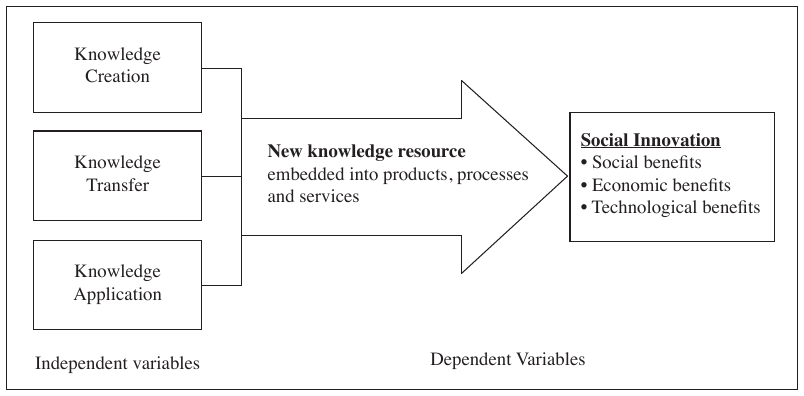
From the above paragraph, empirical evidence clearly shows that social innovation as a new innovation outcome strategy is linked positively to knowledge resource in producing highly innovative products, processes and services that in turn provide significant socioeconomic benefits to the wider society. (Miller et.al., 2016). Thus, after a review of the relevant literature about social innovation and strategic knowledge management processes i.e. knowledge creation, knowledge transfer and knowledge application, the proposed conceptual framework for this study is shown in figure 1.0 below:
Knowledge Creation
Social Innovation New knowledge resource Knowledge • Social benefits embedded into products, processes Transfer • Economic benefits and services • Technological benefits
Knowledge Application
Independent variables Dependent Variables
4.0Methodology
4.1Research Design
Research design is described as the detailed plan for a study which includes data collection method, sampling and data analysis and the results (Kumar et.al., 2013). According to Saunders et.al. (2007), research design is a master plan of how the researcher will go about answering the questions under investigation. This paper used quantitative analysis in order to provide a preliminary empirical insight on the potential impact of strategic knowledge management processes on social innovation as a new innovation outcome strategy within the Malaysian university-industry-community knowledge transfer partnership project. This paper analyzed construct reliability and descriptive test. Quantitative approach is often regarded as a systematic empirical research that utilizes statistical and mathematical technique of analysis (Bryman & Bell, 2015) and helps researchers to have a preliminary indicators of scientific relationships between two or more variables under study (Kumar et.al., 2013). The units of analysis of this study are the projects in the Malaysian university-industry-community knowledge transfer partnership. Thus, the actors involve in the Malaysian university-industry- community knowledge transfer partnership projects are the respondents of this study. This study used structured questionnaires as the medium of collecting data to enable a meaningful empirical insight from the respondents (Creswell, 2003).
4.2Data Collection
This study involves collection of primary data which was collected through structured questionnaires from the respondents involves in the Malaysian university-industrycommunity knowledge transfer partnership projects in order to provide the preliminary empirical insight over the potential impact of strategic knowledge management processes on social innovation as a new innovation outcome strategy. This study used personal and internet survey approaches in distributing the structured questionnaires to the target respondents. Moreover, personal approach in distributing structured questionnaires has the advantage of getting questionnaires completed within a short period of time and research assistants can clarify doubts that arises immediately (Kumar et.al., 2013). Furthermore, this study used internet survey approach in order to reach respondents that live far away area as this is less expensive and faster (Hair, et.al., 2007). According to Sekaran and Bougie (2011) and Hair et.al. (2010), A minimum of 30 respondents are required to constitute adequate sample in a quantitative study. This study aims to give a preliminary empirical insight on the impact of strategic knowledge management processes on social innovation. A sample of 50 respondents participated in the survey and this is considered adequate.
4.3Knowledge Transfer Partnership (KTP) Projects Samples
The study chooses the actors involves in the Malaysian university-industry-community knowledge transfer partnership projects. The actors of each project consist of academicians, industry owners/ staffs and community members. The entire population (N) is 350 projects, and the study used samples sample size (n) of 50 projects for the preliminary empirical analysis in this paper. In this study, the academician which is the project leader of each project represented other actors in answering the distributed questionnaires. The total number of respondents is 50 which comes from the partnership projects of Universiti Malaya (UM), Universiti Sains Malaysia (USM), Universiti Utara Malaysia (UUM), Universiti Malaysia Perlis (UniMAP) and Universiti Institute Teknologi MARA (UiTM).
5.0Data Analysis and Results
The aims of this paper is to give a preliminary empirical insight over the potential impact of strategic knowledge management processes on social innovation as a new innovation outcome strategy within the Malaysian university-industry-community knowledge transfer partnership. This paper examines social innovation as the dependent variable and the processes of knowledge creation, knowledge transfer and knowledge application were proposed as independent variables. A set of questions were developed for both variables namely social innovation, knowledge creation, knowledge transfer and knowledge application. Construct reliability and descriptive analysis tests were then performed. The reliability of a measure indicates the extent to which it is without bias (error free) and, hence ensures consistent measurement across time and across the various items in the instrument (Sekaran & Bougie, 2011). In other words, the reliability of a measure is an indication of the stability and consistency with which the instrument measures the concept and helps to assess the “goodness” of a measure (Sekaran & Bougie, 2011).
Cronbach’s alpha is commonly used as the statistical indicator of reliability analysis. Nunnaly and Bernstein (1994) suggested that Cronbach’s alpha must be greater than 0.6 or 60% for the instruments to be deemed acceptable. However, Hair et. al., (2010) suggested that the rule of thumb for acceptance level of Cronbach’s alpha value must be higher than 0.70. Furthermore, descriptive analysis provide simple quantitative summaries about the samples choosen through the questions answered by the respondents in this study (Dimaggio, 2013). Data collected through descriptive analysis could provide valuable insights about the study units along with relevant characteristics and in addition it provide simple summaries about the sample and the measures. The reliability and descriptive analysis test for each variable is explained and shown below.
5.1Reliability Analysis
The purpose of the reliability analysis is to ensure internal consistency of measurements of the items used. The internal consistency determines whether the items that make up the scale hang together or not. The most common indicator of internal consistency is Cronbach’s Alpha coefficient. Ideally, the Cronbach’s Alpha value should be 0.7 and above. Table 1 below shows the reliability result of each variable understudy.
| Type of variable | Dimension | No.of Items | Cronbach’s Alpha value |
|---|---|---|---|
| Dependent variable | Social Innovation | 17 | 0.765 |
| Independent Variable | Knowledge Creation Knowledge Transfer Knowledge Application As revealed in Table 1.0 above, coefficient alphas for all study variables were above the acceptable level of 0.70 (Cavana et. al., 2001; Hair et.al., 2010) ranging from a minimum of 0.726 to 0.770. Accordingly, no items were deleted from the present scales. All the variables in this study have values above 0.70. Overall, the analysis indicated that each instrument was meaningfully measured and represented by reliable items. The above Cronbach’s alpha value shows that the index had high reliability. The data were collected between May 2016 to August 2016. The questionnaires were delivered | 16 10 11 Addressing Social Innovation in the Malaysian University-Industry-Community Knowledge Transfer Partnership: | 0.770 0.736 0.726 19 |
to the project leaders in the Malaysian university-industry-community partnership projects through personally administered and emails. In order to measure the potential impact of knowledge creation, knowledge transfer and knowledge application on social innovation, 54 questions were used to measure respondents perspectives on all variables: Social innovation i.e. dependent variable, comprises of 17 questions, 5 point likert-scale ranked from 1 = strongly disagree, 2 = disagree, 3 = neutral, 4 = agree to 5 = strongly agree were used. Knowledge creation, knowledge transfer and knowledge application i.e. independent variable, comprises of 37 questions in total, with the dimension of knowledge creation consisting of 16 items measured. Dimension of knowledge transfer consist of 10 items measured and knowledge application have the total items measured of 11. 5 point likert-scale had been ranked from 1 = strongly disagree, 2 = disagree, 3 = neutral, 4 = agree to 5 = strongly agree.
5.2Descriptive Analysis
The main objective of descriptive analysis is to find the level of agreement and acceptance on the perception of characteristics of a population or phenomenon such as objects, people, groups, organizations or environments (Dimaggio, 2013). Data collected through descriptive analysis could provide valuable insights on the study units along with their relevant characteristics. Descriptive analysis provides simple summaries about the sample and the measures. Table 2 below shows the descriptive analysis i.e. mean and standard deviation value, of each variable under study.
| Type of variables | Dimension | Mean value | Standard Deviation |
|---|---|---|---|
| Dependent variable | Social Innovation | 4.40 | 0.33 |
| Independent variable | Knowledge Creation Knowledge Transfer Knowledge Application | 4.00 4.59 4.38 | 0.50 0.33 0.41 |
As described in Table 2.0, respondents scores indicate high agreement and acceptance towards both measurement items in the dependent and independent variables. Social innovation score the mean value of (Mean=4.40, SD=0.33). For the independent variables, knowledge transfer dimension score the highest mean value of (Mean=4.59, SD=0.33), followed by knowledge application (Mean=4.38, SD=0.41) and the mean and SD value for knowledge creation is (Mean=4.00, SD=0.50).
To elaborate further, 17 items were tested within the dimension of social innovation towards the respondents under study. The 17 items that were tested comprises aspects of 1) Developing new and novel innovation solutions which refers to knowledge resource that can be embedded into products, processes and services; 2) Social integration and social value through wider collaborative networks; and 3) Contribution towards social, economic and technological benefits. The mean score of 4.40 in overall measurement items of social innovation dimension indicates that the respondents are in high agreement that social innovation developes new and novel solutions that comes from intangible resource i.e. knowledge resource. This can be embedded into products, processes and services which lead to contribution towards improving the quality and quantity of people’s life, enhance economic growth and improves technological advances. For independent variable, 16 items were tested in the dimension of knowledge creation. The respondents were asked to indicate their agreement and disagreement in the aspects of creation of new knowledge that involve the dynamic interplay of tacit and explicit knowledge within the scope of socialization, externalization, combination and internalization.
The result shows that respondents have a relatively high agreement i.e. mean score 4.00, towards the perception that new knowledge is created through the combination and dynamic interplay of tacit and explicit knowledge. However, there is a slightly lower agreement value among respondents towards measurement items within the scope of Information and Communication technology (ICT). To elaborate further, majority of the respondents disagreed with the statement that knowledge creation dimension creates new explicit knowledge resource based on a good ICT facilities and actors literacy of ICT practices. Moreover, knowledge transfer dimension has 10 measurement items. Knowledge transfer dimension has a very high mean score of 4.59 compared with the other two dimensions of independent variable.
The result shows that all respondents agreed that new knowledge resource is generated within the dimension of knowledge transfer through an efficient and effective formal and informal communication process between source and recipient of knowledge resource. Furthermore, all respondents are also in high agreement that new knowledge resource is established through individual’s absorption capabilities within the dimension of knowledge transfer. Finally, there are 11 measurement items developed to measure the dimension of knowledge application. The respondents were asked to indicate their agreement and disagreement regarding whether their particular project delivers new knowledge resource that in turn produce completely new highly innovative products, processes and services or adding significant value to the existing products, processes and services. With the mean score of 4.38 in overall measurement items of knowledge application dimension, this indicates the respondents high agreement and acceptance that their project deliver a new knowledge resource that can be embedded into products, processes and services which subsequently invents and introduce highly innovative products, processes and services or improves and refine the existing products, processes and services to make them highly innovative such that can be offered to the market.
6.0Conclusion
The study is expected to provide much needed empirical insight by presenting preliminary quantitative findings on addressing the association of social innovation as a new innovation outcome strategy with knowledge resource within the Malaysian university-industry-community knowledge transfer partnership system. The scope of the study is the Malaysian university-industry-community knowledge transfer partnership ecosystem. The reliability analysis and descriptive analysis was performed by getting feedback through structured questionnaires from actors involves in the Malaysian university-industry-community knowledge transfer partnership. The reliability analysis was determined by the Cronbach Alpha value. The Cronbach Alpha value obtained was above acceptable level of 0.7, hence, it is satisfactory. Moreover, the descriptive analysis through the mean score and standard deviation revealed a relatively high agreement on both measurement items of the dependent and independent variables.
A preliminary conceptual framework of this study is then advocated in relations to the gaps and reviews of relevant literature. From the above statements, this paper suggests that more empirical investigation should be carried out on the relationship between social innovation and knowledge resource particularly within the university-industry- community knowledge transfer partnership. This will be beneficial towards fulfilling the Malaysian government aspiration highlighted in the Eleventh Malaysian Plan (2016- 2020) of becoming a high income country status by the year 2020. The Malaysian university-industry-community knowledge transfer partnership is seen as an essential platform to link new knowledge resource with the new paradigm of innovation that refers to social innovation. The linkage of both is paramount considering the massive contribution of social innovation as a new innovation outcome strategy in the aspects of social, economic and technological benefits and knowledge resource as a new basis for innovation (Benneworth & Cunha, 2015). Therefore, this paper identified and provides some promising avenues for future research and offers some interesting preliminary empirical evidences of the relationship between social innovation and strategic knowledge management processes i.e. knowledge resource, within the context of university-industry-community knowledge transfer partnership.
Acknowledgement
The authors would like to thank the anonymous reviewers. The authors would also like to give special thanks to the Knowledge Transfer Program (KTP) secretariat for the funding received under the KTP special research program titled KTP Problem
Statements of Industry/ Community Problems in Malaysia and ASEAN Region, SO code 13319.
References
- Abou-Zeid, E. S. (2005). A culturally aware model of inter-organizational knowledge transfer. Knowledge Management Research & Practice, 3(3), 146-155.
- Alegre, J., & Chiva, R. (2008). Assessing the impact of organizational learning capability on product innovation performance: An empirical test. Technovation, 28(6), 315-326.
- Altuna, N., Contri, A. M., Dell Era, C., Frattini, F., & Maccarrone, P. (2015). Managing social innovation in for-profit organizations: the case of Intesa Sanpaolo. European Journal of Innovation Management, 18(2), 258-280.
- Barney, J. B. (1991). Firm resources and sustained competitive advantage. Journal of Management, 17(1), 99–120.
- Battisti, S. (2012). Social innovation: the process development of knowledge-intensive companies. International Journal of Services Technology and Management, 18(3-4), 224-244.
- Benneworth, P., & Cunha, J. (2015). Universities contributions to social innovation: reflections in theory & practice. European Journal of Innovation Management, 18(4), 508-527.
- Bitzer, V., & Hamann, R. (2015). The business of social and environmental innovation. In The Business of Social and Environmental Innovation (pp. 3-24). Springer International Publishing.
- Breznitz, S. M., & Ram, N. (2013). Enhancing economic growth? University technology commercialization. Creating competitiveness: Entrepreneurship and innovation policies for growth: Edward Elgar Publishing, pp. 88-115.
- Bryman, A., & Bell, E. (2015). Business research methods. Oxford University Press, USA, pp. 1-816.
- Cajaiba-Santana, G. (2014). Social innovation: Moving the field forward. A conceptual framework. Technological Forecasting and Social Change, 82(2014), 42-51.
- Cavana, R. Y., Delahaye, B. L., & Sekaran, U. (2001). Applied business research: Qualitative and quantitative methods. John Wiley & Sons Australia. A Preliminary Empirical Insight: 11-
- Chiva, R., Ghauri, P., & Alegre, J. (2014). Organizational learning, innovation and internationalization: A complex system model. British Journal of Management, 25(4), 687-705.
- Creswell, J. W. (2003). Research design: Qualitative. quantitative and mixed methods approaches, 2nd Edition. London, UK: Sage Publications, pp. 1-304.
- Dawson, P., & Daniel, L. (2010). Understanding social innovation: A provisional framework. International Journal of Technology Management, 51(1), 9-21.
- Dimaggio, C. (2013). Introduction. in SAS for epidemiologists. Springer New York, pp. 1-5
- Dunphy, D., Griffiths, A., & Benn, S. (2007). Organizational change for corporate sustainability, 2nd ed., Routeledge, London, pp. 1-368.
- El Arifeen, S., Christou, A., Reichenbach, L., Osman, F. A., Azad, K., Islam, K. S., & Peters, D. H. (2013). Community-based approaches and partnerships: Innovations in health-service delivery in Bangladesh. The Lancet, 382(9909), 2012-2026.
- Hair, J. F., Money, A. H., Samouel, P., & Page, M. (2007). Research methods for business (1st ed.). Sussex, England: John Wiley & Son Ltd, pp. 1-496.
- Hair, J. F., Black, W. C., Babin, B. J., & Anderson, R. E. (2010). Multivariate data analysis: A global perspective. Upper Saddle River.
- Hamel, G., & Prahalad, C. K. (2013). Competing for the Future. Harvard Business Press.
- James, P. (2004). Strategic management meets knowledge management: A literature review and theoretical framework, 5th actKM Conference Canberra, ACT, Australia, pp. 1-20.
- Jiang, X., & Li, Y. (2009). An empirical investigation of knowledge management and innovative performance: The case of alliances. Research Policy, 38(2), 358-368.
- Kanter, R. M. (2015). From spare change to real change: The social sector as beta site for business innovation. Harvard Business Review, 77(3), 122-132.
- Krlev, G., Bund, E., & Mildenberger, G. (2014). Measuring what matters—Indicators of social innovativeness on the national level. Information Systems Management, 31(3), 200-224.
- Kumar, A. J., & Ganesh, L. S. (2009). Research on knowledge transfer in organizations: A morphology. Journal of Knowledge Management, 13(4), 161-174.
- Kumar, M., Talib, S. A., & Ramayah, T. (2013). Business research methods. Oxford Fajar/Oxford University Press, Selangor.
- Lichtenthaler, U., & Lichtenthaler, E. (2009). A capability-based framework for open innovation: Complementing absorptive capacity. Journal of Management Studies, 46(8), 1315-1338.
- Liyanage, C., Elhag, T., Ballal, T., & Li, Q. (2009). Knowledge communication and translation-a knowledge transfer model. Journal of Knowledge Management, 13(3), 118-131.
- Lizuka, M. (2013). Innovation systems framework: Still useful in the new global context?. UNU-MERIT. Working paper series United Nations. Maastricht, The Netherlands Innovation, 005. Pp. 1-14.
- Makimattila, M., Junell, T., & Rantala, T. (2015). Developing collaboration structures for university-industry interaction and innovations. European Journal of Innovation Management, 18(4), 451-470.
- Meier, M. (2011). Knowledge management in strategic alliances: A review of empirical evidence. International Journal of Management Reviews, 13(1), 1-23.
- Miller, K. (2012). Exploring the knowledge processes within university technology transfer : Through and absorptive capacity lens. Unpublished Phd thesis. Ulster University. Northern Ireland. UK.
- Miller, K., McAdam, R., Moffett, S., Alexander, A., & Puthusserry, P. (2016). Knowledge transfer in university quadruple helix ecosystems: an absorptive capacity perspective. R&D Management. 44(3) 265-287.
- Moore, M. L., Westley, F. R., & Brodhead, T. (2012). Social finance intermediaries and social innovation. Journal of Social Entrepreneurship, 3(2), 184-205.
- Nonaka, I., & Takeuchi, H. (1995). The knowledge creating company: how Japanese companies create the dynamics of innovation, New York: Oxford University Press, pp. 284, ISBN 978-0-19-509269-1.
- Nunnally, J. C., & Bernstein, I. H. (1994). The assessment of reliability. Psychometric Theory, 3(1), 248-292.
- Pol, E., & Ville, S. (2009). Social innovation: Buzz word or enduring term?. The Journal of Socio-Economics, 38(6), 878-885. A Preliminary Empirical Insight: 11-
- Pratt, B., & Loff, B. (2012). Health research systems: promoting health equity or economic competitiveness?. Bulletin of the World Health Organization, 90(1), 55-62.
- Pue, K., Vandergeest, C., & Breznitz, D. (2015). Toward a theory of social innovation. Innovation Policy Lab White Paper, (2016-01). 1-56.
- Unceta, A., Castro-Spila, J., & Garcia Fronti, J. (2016). Social innovation indicators. Innovation: The European Journal of Social Science Research, 29(2), 192-204.
- Sammarra, A., & Biggiero, L. (2008). Heterogeneity and specificity of Inter-Firm knowledge flows in innovation networks. Journal of Management Studies, 45(4), 800-829.
- Saunders, M., Lewis, P., & Thornhill, A. (2007). Research methods for business students, 5th edition. Harlow: Prentice Hall, pp. 1-560.
- Scheuerle, T., Schmitz, B., Spiess-Knafl, W., Schues, R., & Richter, S. (2015). Mapping social entrepreneurship in Germany - A quantitative analysis. International Journal of Social Entrepreneurship and Innovation, 3(6), 484-511.
- Sekaran, U., & Bougie, R. (2011). Research method for business: A skill building approach. Pp. 1-436. ISBN: 978-1-119-94225-2.
- Spiess-Knafl, W., Mast, C., & Jansen, S. A. (2015). On the nature of social business model innovation. Social Business, 5(2), 113-130.
- Surikova, S., Oganisjana, K., & Grinberga-Zalite, G. (2015, May). The Role of Education in Promoting Social Innovation Processes in the Society. In SOCIETY, INTEGRATION, EDUCATION. Proceedings of the International Scientific Conference, 4, 233-243.
- Westley, F., Antadze, N., Riddell, D. J., Robinson, K., & Geobey, S. (2014). Five configurations for scaling up social innovation case examples of nonprofit organizations from Canada. The Journal of Applied Behavioral Science, 50(3), 234-260.