The Influence of Institutional and Contingency Factors on the Adoption of Forensic Accounting by Anti-Corruption Agencies: A Proposed Framework
- Department of Accountancy, Yobe State University
- Tunku Puteri Intan Safinaz School of Accountancy, College of Business, Universiti Utara Malaysia, Sintok, Kedah
Journal of Business Management and Accounting 6(2) (2016) · https://doi.org/10.32890/jbma2016.6.2.8832
Abstract
The increasing concern over corruption in developing countries has been associated with the inability of Anti-Corruption Agencies (ACAs) to tackle corruption. The ineffectiveness of these ACAs is said to be influenced by several factors including the underutilization of forensic accounting in fraud investigation process. This article focuses on the identification of these factors and their influences on the adoption of forensic accounting by ACAs. This was done through the review of literature and proposing a framework for further in-depth research work. The conceptual framework highlights the antecedent influence of political will on these factors and their influences on the adoption of forensic accounting. The implication is that identifying these factors through further in-depth studies will contribute to the insufficient research work on the adoption of forensic accounting and help policy makers to enhance the performance of these agencies.
Keywords: ACAs, corruption, forensic accounting, political will
1.0Introduction
Corruption is a fundamental obstacle to economic development. Extant research efforts have sought to understand the causes, and consequences of corruption (Gould & Mukendi, 1989; Treisman, 2000) and anti-corruption measures (Quah, 2013b), thereby leading to multiple approaches to curbing corrupt practices (Hanna, Bishop, Nadel, Scheffler, & Durlacher, 2011). However, attention has been directed towards the establishment of Anti-Corruption Agencies (ACAs) (Meagher, 2005) due to the successes recorded in Asia (Quah, 2009, 2015a) and their failure in Sub-Saharan Africa (Doig, Watt, & Williams, 2007; Heeks & Mathisen, 2012). The successes and failures of these specialized organizations have been associated with institutional and contingency factors (Quah, 2015b). Previous research efforts have identified the influences of political will, operational autonomy, comprehensive legislation and sufficient resourcing (Meagher, 2005; Persson, Rothstein, & Teorell, 2013; Quah, 2013a). Despite these extant studies on corruption and anti-corruption, little is known about the influences of these factors on the adoption of forensic accounting by ACAs. (Bierstaker, Brody, & Pacini, 2006). What are the institutional and contingency factors that influence the adoption of forensic accounting? This article addresses this question by reviewing the literature to identify existing gap and to propose a framework for further studies.
The article is divided into five sections. The next section reviews the literature to identify possible contextual factors influencing the adoption of forensic accounting by ACAs. The third section identifies contingency factors and their influences on the adoption of forensic accounting. The proposed framework for understanding the influences of these factors on the adoption of forensic accounting by ACAs is presented in the fourth section. The implication of the proposed framework is explained in section five. The paper concludes by suggesting the need to conduct further in-depth study on the influences of these factors on the adoption of forensic accounting to minimize the level of corruption globally, and specifically in developing countries.
2.0Review of Related Literature
One of the reasons for the creation of ACAs by most developing countries is a response to donor requirements and domestic reform policies (Heilbrunn, 2004; Persson et al., 2013). Accordingly, Heilbrunn (2004) argued that the creation of ACAs might be a genuine concern about the adverse developmental impact of corruption. In line with this, Quah (2009) defined ACAs as specialized organizations established by governments for the purpose of minimizing corruption in their respective countries. These organizations are distinct from other anti-corruption strategies because of the degree of specialization, expertise, autonomy and freedom from corruption (Quah, 2009). However, these features exist in the presence of significant government commitment in the form of sufficient legal powers, adequate human and financial resources and operational autonomy (Doig et al., 2007; Gregory, 2015; Quah, 2015b). Most of these preconditions for effective ACAs appear to be absent in most of the developing countries of Sub-Saharan Africa (Doig et al., 2007; Persson et al., 2013). This affects their performance by influencing the strategy and structural form (DiMaggio & Powell, 1983; Okogbule, 2006). Additionally, the performance, strategy and structure of these organizations are influenced by institutional factors (DiMaggio & Powell, 1983) and organizational contingencies (Donaldson, 2006).
2.1Institutional Factors Affecting Structural form of ACAs
The preceding section pointed out that the effectiveness of ACAs depends on three fundamental factors. These are sufficient legislative powers, adequate resourcing The Influence of Institutional and Contingency Factors on the Adoption of Forensic Accounting by Anti-Corruption Agencies: 3 and operational autonomy (Quah, 2009). Accordingly, Heilbrunn (2004) argued that establishment of ACAs require enabling legislation, competent staff and adequate budgetary allocation. The existence of these conditions signifies the presence of political will (Brinkerhoff, 2010).
Political will refers to the commitment of political leaders to minimize the level of corruption in their countries. Accordingly, Quah (2009) argued that the commitment of political leaders is demonstrated in the existence of comprehensive anti-corruption legislation; the independence of ACAs, provision of sufficient personnel and resources; and the impartial enforcement of anti-corruption laws. In other words, the commitment of political leaders to initiating and sustaining anti-corruption fight is paramount in ensuring effective ACAs (Brinkerhoff, 2010). This, signals that political will has a strong effect on ACAs’ resources, operational autonomy and efficient judicial system.
A fundamental success factor for an effective ACA is the sufficiency of financial resource. The adequacy of budgetary allocation to ACAs is linked to the effectiveness of ACAs in fighting corruption (Quah, 2009). In addition, Quah (2015b) attributed the success of Singapore’s Corrupt Practices Investigation Bureau (CPIB) to the adequacy of funding from the government. Sufficient budgetary allocation is a precondition for the recruitment of adequate and competent personnel and the adoption of innovation (Hameed, Counsell, & Swift, 2012; Meagher, 2005). Therefore, political will is a key factor in funding and the recruitment of competent workforce to enable the adoption of forensic accounting by ACAs.
The powers of ACAs to adopt measures that ensure successful investigation and prosecution of corrupt practices is usually contained in the laws establishing these agencies (Ogbu, 2010). As such, ensuring the operational autonomy of ACAs leads to the adoption of modern approach in evidence gathering. Furthermore, the existence of a comprehensive law that guarantees the autonomy of ACAs and having knowledge of forensic accounting was found to enhance the effectiveness of CPIB in collecting relevant evidence and tracing ill-gotten assets (Quah, 2015b). Thus, comprehensive anti-corruption legislation may have a positive influence on the adoption of forensic accounting in fraud investigation process.
Furthermore, Meagher (2005) argued that the effectiveness of ACAs depends on the efficient functioning of the country’s legal system. The argument is that corrupt elite hinders the efficiency of the judicial system by manipulating resource allocation to the judiciary and the appointment of key judicial officers. This weakens the judicial system and affects the smooth prosecution of corruption cases. Moreover, this causes unnecessary delays in the court process allowing corruption to spread. In order to overcome this, an effective evidence gathering technique needs to be adopted to prosecute the corruption cases beyond reasonable doubt. This might call for a scientific approach to evidence gathering using forensic experts including forensic accountants whose analytical knowledge and communication will convince the jurists on the charges brought against defendants.
In this regards, the relevance of forensic accounting to successful anti-corruption fight is highlighted by Quah (2015b) and its effectiveness was reported in fraud investigation process in private sector (Bierstaker et al., 2006; Muthusamy, 2011). Despite the reported effectiveness, previous studies have reported the underutilization of forensic accounting in fraud investigation process (Bierstaker et al., 2006), attributing it to inadequate organizational resources and behavioral factors (Muthusamy, 2011). This highlights the importance of organizational resources on the adoption of forensic accounting in fraud investigation process.
2.2Influence of Organizational Factors on Structural Form ACAs
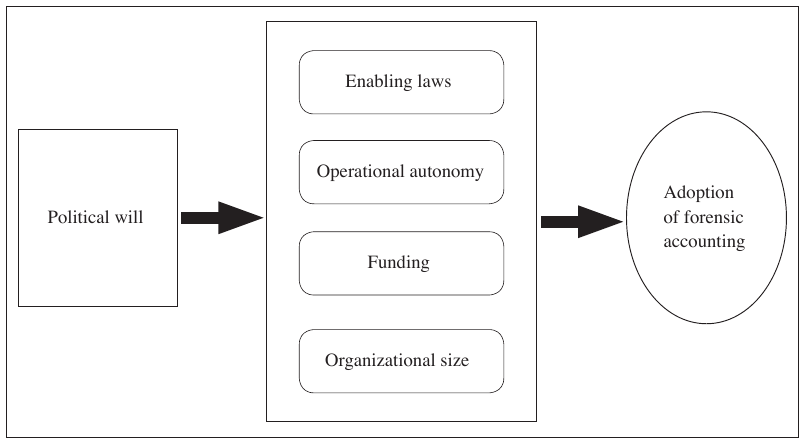
In the preceding section, the influence of contextual factors were highlighted by identifying the antecedent effect of political will on the sufficiency of funding, efficiency of the judicial system, and operational autonomy of ACAs. These factors are believed to be critical in the adoption of forensic accounting by ACAs. Equally, political will was found to affect the resourcing of ACAs especially financial and human resource that are essential for a successful anti-corruption fight.
In line with this proposition, Meagher (2005) and Persson et al. (2013) have variously argued that the effectiveness of ACAs was dependent on the sufficiency of resources. Specifically, Meagher (2005) posits that the success or failure of ACAs is dependent on adequate number of personnel that are highly specialized. Therefore, having sufficient number of qualified staff is a precondition for the adoption of modern fraud detection tool for an enhanced anti-corruption fight. Previous studies have associated the adoption of innovation to organizational size (Chor, Wisdom, Olin, Hoagwood, & Horwitz, 2015; Kimberly & Evanisko, 1981). Organizational size, measured in terms of number of employees, is directly associated with specialization, professionalism, differentiation and slack resources (Damanpour, 1991; Vanacker, Collewaert, & Zahra, 2016). Larger and complex organizations were found to adopt new ideas faster than smaller organizations (Kapoor, Dwivedi, & Williams, 2014; Rogers, 2003). Thus, there is apparent indication that sufficient number of personnel in an ACA leads to the adoption of forensic accounting in fraud investigation process.
Size is also associated with managerial attitude (Vaccaro, Jansen, van den Bosch, & Volberda, 2012). The role played by top management, in any organization, is to provide direction in achieving organizational objectives (Vaccaro et al., 2012). In line with this, Hambrick and Mason (1984) proposed that organizational choices and performance are influenced by managerial background characteristics. Previous studies have reported the influence of top managerial background characteristic on the adoption of new ideas in public sector organizations (Damanpour & Schneider, 2006; Kimberly & Evanisko, The Influence of Institutional and Contingency Factors on the Adoption of Forensic Accounting by Anti-Corruption Agencies: 5
1981). Specifically, top management educational background, age and tenure of office have been used in predicting strategic decisions including the adoption of innovation (Hameed et al., 2012). Therefore, top management background characteristics are said to influence the strategic decision to adopt forensic accounting by an ACA. It is believed that political will influences the adoption of forensic accounting by ACAs, by affecting the sufficiency of funding, enabling laws, organizational resources and managerial background characteristics. However, there appears to be inadequate studies that have examined the influence of these factors on the adoption of forensic accounting to explain the nature of their influences. This suggests the need for further in-depth studies to identify and describe these institutional and contingency factors affecting the adoption of forensic accounting by ACAs.
3.0Proposed Framework
Various theories have been used to explain organizational forms, structures and the adoption of innovation in enhancing organizational performance (Ahmadi, Nilashi, & Ibrahim, 2015; Ciganek, Haseman, & Ramamurthy, 2014; DiMaggio & Powell, 1983; Donaldson, 2006; Rogers, 2003). A majority of these theories are concerned with how new ideas are created, accepted, diffused and legitimized (DiMaggio & Powell, 1983; Rogers, 2003). Some are concerned with internal capability to meet organizational objectives (Donaldson, 2006). Accordingly, two prominent theories have been used to explain organizational form, structure and performance. A rational organization structure is formed by adjusting its internal capability to external dynamics (Donaldson, 2006).
According to the institutional perspective, organizational structure is influenced by external pressures exerted by the government, donor agencies and/or the need to replicate successful firms (Daddi, Testa, Frey, & Iraldo, 2016). According to DiMaggio and Powell (1983), coercive pressures from the government or regulatory agencies, normative forces exerted by external integration and the need to imitate successful ACA may influence the adoption of advanced fraud investigation tool for survival and legitimacy (Volberda, van der Weerdt, Verwaal, Stienstra, & Verdu, 2012). In line with this postulation, political will, resource dependence, donor requirements, and external communication among ACAs may have strong influence on the adoption of forensic accounting by ACAs.
Although external influences do encourage the adoption of novel ideas (Rogers, 2003), organizational factors may pose a challenge to the adoption of forensic accounting. The adoption of forensic accounting in fraud detection may partially be influenced by organizational size, professionalism, differentiation or top management background characteristics. Accordingly, organizations are conscious entities aiming to enhance performance by fitting their structure to their operational contexts (Donaldson, 2006)
thus, suggesting that both external and internal factors may contribute to the adoption of forensic accounting by ACAs.
Enabling laws
Operational autonomy Adoption Political will of forensic accounting Funding
Organizational size
4.0Research Implication
The increasing incidences of corrupt practices and the inability of ACAs to minimize the level of corruption have been associated with external influences and organizational contingencies. Although past studies have argued that the effectiveness of anti- corruption fight depends on the degree of commitment exhibited by political leaders, little empirical efforts have been conducted to assess the existence of these factors and their influences on the structure of these ACAs in Sub-Saharan Africa.
Theoretically, integrating institutional and contingency factors in identifying and explaining the influence of environmental and organizational factors on the adoption of forensic accounting by ACAs will contribute to the literature. In identifying these factors alone, this study adds to the insufficient literature on the adoption of forensic accounting, particularly by ACAs. Investigating the influences of these factors on the adoption of forensic accounting will further create an avenue for academic discussion thereby coming up with specific factors leading to the underutilization of forensic accounting in fraud investigation process.
However, considering the insufficiency of research works on the adoption of forensic accounting in fraud investigation process, in-depth research using multiple sources of data becomes essential so as to identify and describe these influential factors. The The Influence of Institutional and Contingency Factors on the Adoption of Forensic Accounting by Anti-Corruption Agencies: 7 current study, therefore, proposes the case study approach to inquiry, purposively selecting research subjects with appropriate knowledge of the relevance of forensic accounting and decision-making factors in ACAs. This will provide diverse views of probable factors responsible for the adoption of forensic accounting by ACAs in developing countries.
Public policies, especially anti-corruption, need to be dynamic. Therefore, identifying these factors will provide a guide to formulating anti-corruption policies and modifying existing policies to meet the modern need for effective anti-corruption strategies. Practically, identifying the relevance of political will and its influence on ACAs’ performance will minimize the level of corruption by ensuring adequate legal support, sufficient funding and operational autonomy to aid in the adoption of modern fraud investigation tools such as forensic accounting.
5.0Conclusion
Without doubt, an effective ACA is a necessity for economic development. Ensuring the effectiveness of these ACAs depends on the level of commitment, comprehensive anti-corruption policies and sufficient financial and human resources. Providing adequate funding has a strong impact on ACAs’ workforce and the adoption of forensic accounting in fraud investigation. Despite this proposition, little is known about the influences of these factors on the adoption of forensic accounting by ACAs. Therefore, addressing these limitations will enhance our understanding of the influences of these factors theoretically, and practically help in minimizing corruption in developing countries.
References
- Ahmadi, H., Nilashi, M., & Ibrahim, O. (2015). Organizational decision to adopt hospital information system: An empirical investigation in the case of Malaysian public hospitals. International Journal of Medical Informatics, 84(3), 166–188.
- Bierstaker, J. L., Brody, R., & Pacini, C. (2006). Accountants’ perceptions regarding fraud detection and prevention methods. Managerial Auditing Journal, 21(5), 520–535.
- Brinkerhoff, D. W. (2010). Unpacking the concept of political will to confront corruption. U4 Brief, 2010:1, 1-4.
- Chor, K. H. B., Wisdom, J. P., Olin, S. C. S., Hoagwood, K. E., & Horwitz, S. M. (2015). Measures for predictors of innovation adoption. administration and policy in mental health and mental health services research, 42(5), 545–573.
- Ciganek, A. P., Haseman, W. (Dave), & Ramamurthy, K. (2014). Time to decision: The drivers of innovation adoption decisions. Enterprise Information Systems, 8(2), 279–308.
- Daddi, T., Testa, F., Frey, M., & Iraldo, F. (2016). Exploring the link between institutional pressures and environmental management systems effectiveness: An empirical study. Journal of Environmental Management. 183(3) 647-656. doi: 10.1016/j. jenvman.2016.09.025. Epub 2016 Sep 13.
- Damanpour, F. (1991). Organizational innovation: A meta-analysis of effects of determinants and moderators. The Academy of Management Journal, 34(3), 555–590.
- Damanpour, F., & Schneider, M. (2006). Phases of the adoption of innovation in organizations: Effects of environment, organization and top managers. British Journal of Management, 17(3), 215–236.
- DiMaggio, P. J., & Powell, W. W. (1983). The iron cage revisited: institutional isomorphism and collective rationality in organizational fields. American Sociological Review, 48(2), 147–160.
- Doig, A., Watt, D., & Williams, R. (2007). Why do developing country anti-corruption commissions fail to deal with corruption? Understanding the three dilemmas of organisational development, performance expectation, and donor and government cycles. Public Administration and Development, 27(3), 251–259.
- Donaldson, L. (2006). The contingency theory of organizational design: challenges and opportunities. Organization Design, 6(4), 19–40. New York: Springer.
- Gould, D. J., & Mukendi, T. B. (1989). Bureaucratic corruption in Africa: Causes, consequences and remedies. International Journal of Public Administration, 12(3), 427–457.
- Gregory, R. (2015). Political independence, operational impartiality, and the effectiveness of anti-corruption agencies. Asian Education and Development Studies, 4(1), 125–142.
- Hambrick, D. C., & Mason, P. A. (1984). Upper Echelons: The organization as a reflection of its top managers. Academy of Management Review, 9(2), 193–206.
- Hameed, M. A., Counsell, S., & Swift, S. (2012). A meta-analysis of relationships between organizational characteristics and IT innovation adoption in organizations. Information and Management, 49(5), 218–232. The Influence of Institutional and Contingency Factors on the Adoption of Forensic Accounting by Anti-Corruption Agencies: 9 A Proposed Framework : 1-
- Hanna, R., Bishop, S., Nadel, S., Scheffler, G., & Durlacher, K. (2011). The effectiveness of anti-corruption policy: What has worked, what hasn"t, and what we don"t know–a systematic review. Technical Report. London: EPPI-Centre, Social Science Research Unit, Institute of Education, University of London, pp. 1-121.
- Heeks, R., & Mathisen, H. (2012). Understanding success and failure of anti-corruption initiatives. Crime, Law and Social Change, 58(5), 533–549.
- Heilbrunn, J. R. (2004). Anti-Corruption Commissions Panacea or Real Medicine to Fight Corruption ? (37234). The World Bank Institute. Washington DC, pp.1-18.
- Kapoor, K. K., Dwivedi, Y. K., & Williams, M. D. (2014). Rogers’ innovation adoption attributes: A systematic review and synthesis of existing research. Information Systems Management, 31(1), 74–91.
- Kimberly, J. R., & Evanisko, M. J. (1981). Organizational innovation: The influence of individual, organizational and contextual factors on hospital adoption of technological and andministrative innovations. The Academy of Management Journal, 24(4), 689–713.
- Meagher, P. (2005). Anti-corruption agencies: Rhetoric versus reality. The Journal of Policy Reform, 8(1), 69–103.
- Meyer, J. W., & Rowan, B. (1977). Institutionalized organizations: Formal structure as myth and ceremony. American Journal of Sociology, 83(2), 340.
- Muthusamy, G. (2011). Behavioral Intention to Use Forensic Accounting Services for the detection and prevention of fraud by large malaysian companies. Ph.D Thesis. Curtin University of Technology January.
- Ogbu, O. (2010). Combating corruption in Nigeria: A critical appraisal of the laws, institutions, and the political will. Annual Survey of International & Comparative Law, 14(1), 1-52.
- Okogbule, N. S. (2006). An appraisal of the legal and institutional framework for combating corruption in Nigeria. Journal of Financial Crime, 13(1), 92–106.
- Persson, A., Rothstein, B., & Teorell, J. (2013). Why anticorruption reforms fail-systemic corruption as a collective action problem. Governance, 26(3), 449–471.
- Quah, J. S. T. (2009). Benchmarking for excellence: A comparative analysis of seven asian anti-corruption agencies. Asia Pacific Journal of Public Administration, 31(2), 171–195.
- Quah, J. S. T. (2013a). Different paths to curbing corruption: A comparative analysis. Different Paths to Curbing Corruption. pp. 219–255.
- Quah, J. S. T. (2013b). Introduction: Different paths to curbing corruption. In J. S. T. Quah (Ed.), Different Paths to Curbing Corruption. Emerald Group Publishing Limited, pp. 1–22.
- Quah, J. S. T. (2015a). Evaluating the effectiveness of anti-corruption agencies in five Asian countries. Asian Education and Development Studies, 4(1), 143–159.
- Quah, J. S. T. (2015b). Singapore’s Corrupt Practices Investigation Bureau: Four suggestions for enhancing its effcetiveness. Asian Education and Development Studies, 4(1), 76–100.
- Rogers, E. M. (2003). Diffusion of innovation. New York: Free Press, pp. 1-576.
- Treisman, D. (2000). The causes of corruption: A cross-national study. Journal of Public Economics, 76(3), 399–457.
- Vaccaro, I. G., Jansen, J. J. P., Van Den Bosch, F. A. J., & Volberda, H. W. (2012). Management innovation and leadership: The moderating role of organizational size. Journal of Management Studies, 49(1), 28–51.
- Vanacker, T., Collewaert, V., & Zahra, S. A. (2016). Slack resources, firm performance and the institutional context: Evidence from privately held European firms. Strategic Management Journal. 38 (6), 1305-1326.
- Volberda, H. W., Van Der Weerdt, N., Verwaal, E., Stienstra, M., & Verdu, A. J. (2012). Contingency fit, institutional fit, and firm performance: A metafit approach to organization-environment relationships. Organization Science, 23(4), 1040–1054.