The Moderating Role of Access to Finance on the Impact of Entrepreneurial Awareness on Nigerian SMEs’ Performance
- Shehu Shagari College of Education, Sokoto
- School of Business Management, College of Business, Universiti Utara Malaysia, Sintok, Kedah
Journal of Business Management and Accounting 7(1) (2017) · https://doi.org/10.32890/jbma2017.7.1.8827
Abstract
This study aims at examining the moderating role of access to finance on the relationship between entrepreneurial awareness and SMEs performance in north-western Nigeria. Literature suggested many factors as determinants of SMEs performance. But, few studies have been attempted to consider the influence of entrepreneurial awareness on SME performance in Nigeria. These few studies came up with mixed findings. Hence, this study aims to fill up the gap that exists in the extant literature by employing quantitative survey method. Using 354 owner/managers of SMEs in Kano, Kaduna and Sokoto State in north-western Nigeria. PLS-SEM was used for data analysis. It was found that entrepreneurial awareness is positively related to SME performance and access to finance is negatively and significantly related to SME performance. Additionally, access to finance moderates the relationship between entrepreneurial awareness and SME performance. Implication of the finding and suggestion for future research were also discussed
Keywords: Entrepreneurial awareness, access to finance, PLS, SMEs performance, Nigeria
Introduction
Small and Medium Enterprises (SMEs) are considered as the essence of economic survival of any nation (Tadesse, 2014). Fundamentally, SMEs serve as a mechanism for job creation across the globe (Mahmood & Hanafi, 2013; Oduyoye, Adebola, & Binuyo, 2013). Thus, they attracts global attention and encourage supporting of SMEs development (Oduyoye et al., 2013). Mostly, many countries utilize SMEs to fight their socio-economic problems such as unemployment, poverty and low Gross Domestic Product (GDP) growth. Despite the important role played by SMEs in the economy of a country, Nigerian SMEs are weak and only few of them are able to survive due to the problems of finance (Aminu & Shariff, 2014). Furthermore, the poor performance of SMEs in Nigeria is an issue of serious concern to all stakeholders (Gbandi &
Amissah, 2014). For example, in Nigeria, SMEs contribute less than 10% to the GDP. Consequently, SME performance is highlighted on the number of issues. Variables like entrepreneurial awareness, access to finance, infrastructure and many more are established in the literatures to have influential implications on the SMEs positively or otherwise (NBS & SMEDAN, 2012). SMEs in Nigeria are motivated by the government with various entrepreneurial opportunities (both financial and non-financial) but the level of awareness is still lacking (NBS & SMEDAN, 2012; Thong, Chye, & Fong, 2013). For example, among every 10 SMEs operators, more than 9, which is equivalent to 95.2 percent, are not aware of the entrepreneurial opportunities available for entrepreneurial activities in Nigeria (NBS & SMEDAN, 2012). A broad review of the literature indicates that several factors influence SME performance. Though previous studies have provided empirical understanding of the determining factors of SMEs performance, only few studies have investigated the influence of entrepreneurial awareness on the performance of Nigerian SMEs and they came up with mixed results (inconsistency in their findings). Therefore, this motivates the design of this study by employing the moderating variable of access to finance. According to Baron and Kenny (1986) whenever there is inconsistency in previous findings, a moderating variable is suggested. The specific grounds for the moderating relationship are informed by the significance of AF in several studies, stressing its unique role as a catalyst in enhancing SMEs’ performance (Beck & Demirguc-Kunt, 2006; Demir & Caglayan, 2012; Fonseka, Yang, & Tian, 2013; Krishnan, Nandy, & Puri, 2014; Kuzilwa, 2005; Rahaman, 2011; Rogerson, 2008; Xavier, Kelly, Kew, Herrington, & Vorderwülbecke, 2013; Zou, Chen, & Ghauri, 2010). However, not only does this study use AF as a moderator, but others (e.g. Frank, Kessler, & Fink, 2010; Wiklund & Shepherd, 2005) also employed it in investigating the relationship between entrepreneurial orientation and business performance. These studies emphasize the need for replication. This motivates the present study in examining the moderating role of AF on the relationship between EAW and SMEs’ performance in Nigeria. Likewise, reports on the role of financial intermediaries in enhancing SME development in developing countries have suggested the need for an empirical investigation into the effect of AF on the development of SMEs in developing countries like Nigeria (Bouri et al., 2011). From the related literature reviewed, there are few studies on EAW as major drivers of SMEs’ performance. Similarly, there are few studies on the moderating effect of AF on the relationship between EAW and SMEs’ performance. In short, most of the previous studies also concentrated on individual performance rather than organisational performance. Generally, few empirical studies have been conducted on EAW and SME performance, particularly in developing countries like Nigeria; most of the literature
The Moderating Role of Access to Finance on the Impact of Entrepreneurial Awareness on Nigerian SMEs' Performance: 89-103 on EAW and performance describes research conducted in developed economies (Gruber, 2007; Hmieleski & Baron, 2008; Hmieleski & Corbett, 2008; Homburg, Klarmann, & Schmitt, 2010; Pan, Sun, & Chow, 2011; Panian & Spremić, 2004) and mostly used first-generation analysis techniques (SPSS), neglecting second-generation techniques such as Partial Least Square-Structural Equation Modelling (PLS-SEM). This indicates an important gap in the literature. Therefore, in an effort to fill this important gap, this study will extend the existing literature by empirically examining the moderating role of access to finance on the influence of entrepreneurial awareness on performance of SMEs in Nigeria. 2.0
Literature Review
SME Performance
Performance is the actual outcome measured against organizational input. Through performance measurement, organizations would be able to focus on units that need upgrading by appraising the level of work progress in terms of time, quality and cost as well as amalgamating areas with higher output (Hansen & Wernerfelt, 1989; Ringim, 2012; Tomlinson, 2011). To a certain extent, a number of criteria are used in assessing SME performance. The key indicators used in measuring organizational performance include both the subjective and objectives (i.e. profitability, management performance, liquidity and leverage market share, quality of goods and services, human resource management) (Dess & Robinson, 1984). However, Kamyabi and Devi (2011) viewed performance as the measurement of financial ability of the firm such as the investment level, growth in sales and profit. Performance in optimal utilization of resources is related to productivity, effectiveness and efficiency (Berry, Sweeting, & Goto, 2006). In contrast, Man (2009) asserted that performance is the outcome of adapting effective management process. He posited that organizational performance can be measured using a number of criteria such as growth, productivity effectiveness and efficiency. Therefore, in line with the above argument, performance is conceptualized in this study as a measure of organizational success that comprises both financial and nonfinancial indices. 2.2
Entrepreneurial Awareness and SME Performance
Awareness is the “state of acknowledging the existence of something and its importance” (Oxford Dictionary, 2010). Clare, Marková, Roth, and Morris (2011) and Ardichvili, Cardozo, and Ray (2003) pointed out that opportunity awareness serves as the major component of opportunity recognition.
Numerous studies have been conducted by different researchers in different disciplines to examine the concept of awareness. For instance, a study by Thong, Chye, and Fong ( 2013 ) was conducted to examine the level and influence of finance awareness of microfinance programmes within the central region of Malaysia among microenterprises. Findings of the study indicated that educational level, marketing and promotional activities are positively related to the level of awareness. Meanwhile, age, monthly income, social culture and gender have negative relationship with level of finance awareness. Hence, the creation of finance awareness is imperative for launching of any programmes and schemes to promote entrepreneurship by the government and other stakeholders (Singh & Belwal, 2008). Ajemunigbohun, Ademola, and Iyun (2014) measure the level of accessibility of micro-insurance products in Nigeria through the creation of finance awareness and discovered that finance awareness among the Nigerian insurance companies is not encouraging and it is not significantly reflected in the life of many insuring populace. Similarly, it was found that there is no significant relationship between brand awareness and brand/ consumer loyalty (Subhani & Osman, 2011). In contrast, a study by Panian and Spremić (2004) showed a significant relationship between the degree of finance awareness and managers’ perception of e-business. Likewise, Shamsudeen, Keat, and Hassan (2015, 2016) reported a significant relationships between entrepreneurial awareness and SME performance in Nigeria. It has been revealed from the literature that there are still limited studies that relate entrepreneurial awareness and SMEs performance, in particular, in Nigeria. Therefore, based on the literatures, this study hypothesized that: H1: Entrepreneurial awareness positively and significantly influence SME performance in Nigeria. 2.3
Access to Finance as Moderator
Financial resources are very vital factors to the survival and operation of any business organization. The performance of SMEs depend mostly on firms’ ability to generate financial resources (internal and external finance) (Demir & Caglayan, 2012; Wiklund & Shepherd, 2005). Consequently, poor access to financial resources will be harmful to the growth of any business enterprise (Rahaman, 2011). Inadequate financial resources is one among the factors contributing to weakening SME performance (Xavier, Kelley, Kew, Herrington, & Vorderwülbecke, 2013). According to Giannetti and Ongena (2009), enterprises with no or poor access to financial capital are constrained in achieving their objectives of high performance. Likewise, in Nigeria access to finance is among the major problems that lead to poor SME performance (SMEDAN, 2012). Thus, when SMEs has limited access to financial resources, their contribution to economic growth will be very small. Financial structures and policies of the country toward SMEs determined its access to financial resources (Berger & Udell, 2006). It was discovered by several studies that, access to finance positively influence SMEs performance. For example, Akingunola (2011) reported that, SMEs financing
The Moderating Role of Access to Finance on the Impact of Entrepreneurial Awareness on Nigerian SMEs' Performance: 89-103 is positively related with their growth. Also, Mazanai and Fatoki (2012) opined that access to finance has direct relationship with the SME’s performance. Similarly, firm performance depends on the firms’ access to finance, market and information (Ribeiro Soriano, Fornoni, Arribas, & Vila, 2012). In the field of finance the relationship between firm financing and firm performance is an indispensable and unresolved issue (Aminu & Shariff, 2014). AF was used as moderator in a study of Frank et al. (2010), while Wiklund and Shepherd (2005) reported no moderating effect on the entrepreneurial orientation-performance relationship in their configuration model. Likewise, Shamsudeen et al. (2015, 2016) also used access to finance as a mediator in different studies. Frank et al. (2010) and Wiklund and Shepherd (2005) call for the replication of the moderating relationship of access to finance. Access to finance is an entrepreneurial opportunity that require high entrepreneurial awareness to discover and exploit which in turn leads to an increase in performance (Ardichvili et al., 2003; Ardichvili & Cardozo, 2000; Mot, 2011). Therefore, this proves the moderating influence of access to finance on the relationship between entrepreneurial awareness and SMEs performance. In line with the above, this study came up with the following hypothesis: H2: Access to finance positively and significantly influence SME performance in Nigeria. H3: Access to finance moderates the relationship between entrepreneurial awareness and SME performance in Nigeria.
Methodology
It is a cross-sectional research design where the data were collected only at a given point in time (Kumar, Talib, & Ramayah, 2013; Zikmund, Babin, Carr, & Griffin, 2012). A total of 559 questionnaires were distributed using face to face contact with SME owner/managers in Kano, Kaduna and Sokoto states in north-western Nigeria, 354 questionnaires were retuned and useable for the purpose of this study. Variables under study were measured using the adapted items from prior literature. Six items on SMEs performance were adapted from Suliyanto and Rahab (2012), five questions on entrepreneurial awareness were adapted from Nambisan, Agarwal, and Tanniru (1999) and eight items for access to finance are from Martin, Cullen, Johnson, and Parboteeah (2007). All questions were on a 7-point Likert scale where ‘1’ denotes ‘strongly disagree’ and ‘7’ denotes ‘strongly agree’. Finally, the data were analyzed using Smart-PLS 2.0 statistical package.
Analysis and Result
Smart PLS 2.0 was used to test the validity and reliability measures of the constructs. The mod 4.0
Analysis and Result
finance awareness and SME performance was examined, which employed a two-ste Smart PLS 2.0 was used to test the validity and reliability measures of the constructs.
measurement structural measure by Chin The modeland involving finance awareness and (1998). SME performance was examined, which employed a two-step approach measurement and structural measure by Chin (1998).
IV
DV SMEs Performance
Entrepreneurial awareness
Access to Finance
MV
The figure itself is in the PDF version.
The figure itself is in the PDF version.
The Measurement Model
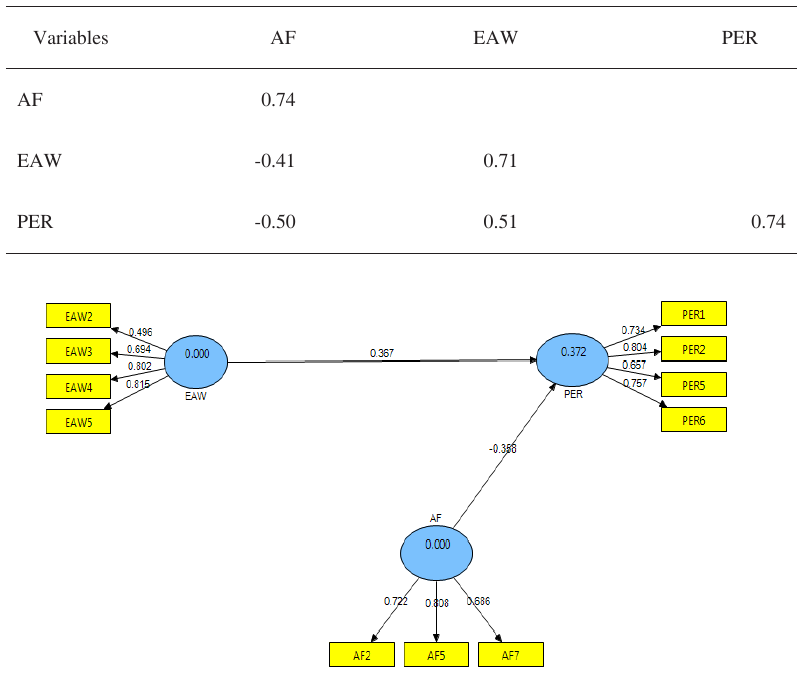
The main objective of measurement model is to filter the data, which is to assess The Measurement Model and confirm the constructs’ validity and reliability before establishing the goodness of measures. The data were examined for indicator reliability, with 0.4 as acceptable While for consistency, composite 0.7 iswhich considered The threshold. main objective ofinternal measurement model is to reliability filter the ofdata, is toanassess and acceptable level. For convergent validity using average variance extracted (AVE), it must be 0.5 and above (Chin, 1998). For discriminant validity using cross loading, any item constructs’ validity and reliability before establishing the goodness of measures. The data we loading on the other construct higher than their loadings should be deleted (Chin, 1998; Hair, 2010). Hence, in order to satisfy the measurement model, some items were deleted: for indicator reliability, withAF3, 0.4 AF4, as acceptable threshold. PER3, PER4, EAW1, AF1, AF6, AF8 because they While did not for meetinternal with the consistency minimum benchmark (Chin, 1998; Hair, 2010). Hence, it is resolved that the instrument reliability of in 0.7this is considered an acceptable level.ofFor validity average varian adapted study were reliable, since none the convergent items load with less using than 0.4.
All it items loaded on and their above respective construct from 0.496 to validity 0.814, which (AVE), must be 0.5 (Chin, 1998).ranges For discriminant usingis cross loadin deemed acceptable since all values range above the cut-off point of 0.4 (see Chin, 1998; Hair, & Sarstedt, 2011). Equally, the composite ranges from loading onRingle, the other construct higher than their loadings reliability, should be value deleted (Chin, 1998; Hair, 20 0.783 to 0.828 which are also greater than the recommended value of 0.7 (Hair et al, 2011). To determine the convergence validity, used. The AVE ranges fromEAW1, AF1 in order to satisfy the measurement model, someAVE itemswas were deleted: PER3, PER4, 0.508 to 0.548, which are above the minimum cut-off point of 0.5 (Hair et al, 2011). Lastly, to determine discriminant validity, the AVE is compared to correlation squared AF6,ofAF8 theyvariables did not of meet the minimum (Chin,adequate 1998; Hair, 2010). the because interrelated the with concerned constructsbenchmark which indicates
The Moderating Role of Access to Finance on the Impact of Entrepreneurial Awareness on Nigerian SMEs' Performance: 89-103 discriminant validity. Table 1 presents factor loading, Table 2 presents the discriminant validity and Figure 2 shows the measurement of the model.
| Items | Factor Loading | Composite Reliability | AVE |
|---|---|---|---|
| EAW2 | 0.496 | 0.800 | 0.508 |
| EAW3 | 0.694 | ||
| EAW4 | 0.801 | ||
| EAW5 | 0.814 | ||
| AF2 | 0.721 | ||
| AF5 | 0.808 | 0.783 | 0.548 |
| AF7 | 0.685 | ||
| PER1 | 0.734 | ||
| PER2 | 0.804 | 0.828 | 0.547 |
| PER5 | 0.657 | ||
| PER6 | 0.756 | ||
| 96 | Journal of Business Management and Accounting, 7 (1) 2017: 89-103 | ||
| e2 |
| Discriminant Validity | |||
|---|---|---|---|
| ables | AF | EAW | P |
| 0.74 | |||
| Variables | AF -0.41 -0.50 | EAW | PER 0.71 0.51 |
| AF | 0.74 | ||
| EAW | -0.41 | 0.71 | |
| PER | -0.50 | 0.51 | 0.74 |
4.2Structural Model
After Model
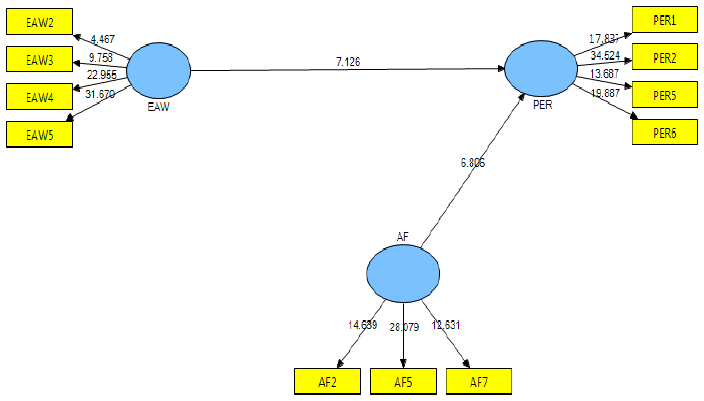
attaining the requirement of the measurement model (construct validity and Structural reliability), the next step was to test the proposed hypotheses of the study by running PLS Algorithm and Bootstrapping in Smart PLS 2.0. Table 3 and Figure 3 present the hypothesis testing results. r attaining the requirement of the measurement model (construct validity and reliability), the nex to test the proposed hypotheses of the study by running PLS Algorithm and Bootstrapping in
2.0Table 3 and Figure 3 present the hypothesis testing results.
Hypotheses
Relationship
Beta (β)
EAW -> PER
AF -> PER
SE
T Statistics
Decision
The Moderating Role of Access to Finance on the Impact of Entrepreneurial Awareness on Nigerian SMEs' Performance: 89-103
Supported NS
Note: **Significant at 0.01 (1-tailed), *significant at 0.05 (1-tailed), NS= Not-Supported
| Hypothesis Testing Results | |||||
|---|---|---|---|---|---|
| EAW is significantly and positively related to SMEs performance (β=0.367; t=7.12 p<0.01). In co | |||||
| Hypotheses | Relationship | Beta (β) | SE | T Statistics | Decision |
| s not supported as indicated by statistical result which implies that access to finance or AF is n | |||||
| H1 | EAW -> PER elated to SMEs performance (β= -0.358; t=6.80 p>0.05). (see Figure 3). | 0.367 | 0.051 | 7.12** | Supported |
| H2 | AF -> PER Note: **Significant at 0.01 (1-tailed), *significant at 0.05 (1-tailed), NS= Not-Supported | -0.358 | 0.052 | 6.80 | NS |
the statistical analysis proved that H1 is supported where entrepreneurial awa Hypothesis Testing Results
EAW is significantly and positively related to SMEs performance (β=0.367; t=7.12 p<0.01). In co Hypotheses
Relationship
Beta (β)
SE
T Statistics
Decision
EAW -> PER
Supported
AF -> PER
NS s not supported as indicated by statistical result which implies that access to finance or AF is n elated to SMEs performance (β= -0.358; t=6.80 p>0.05). (see Figure 3).
Note: **Significant at 0.01 (1-tailed), *significant at 0.05 (1-tailed), NS= Not-Supported
| Hypothesis Testing Results | |||||
|---|---|---|---|---|---|
| EAW is significantly and positively related to SMEs performance (β=0.367; t=7.12 p<0.01). In co | |||||
| Hypotheses | Relationship | Beta (β) | SE | T Statistics | Decision |
| s not supported as indicated by statistical result which implies that access to finance or AF is n | |||||
| H1 | EAW -> PER elated to SMEs performance (β= -0.358; t=6.80 p>0.05). (see Figure 3). | 0.367 | 0.051 | 7.12** | Supported |
| H2 | AF -> PER Note: **Significant at 0.01 (1-tailed), *significant at 0.05 (1-tailed), NS= Not-Supported | -0.358 | 0.052 | 6.80 | NS |
entrepreneurial awareness or EAW is significantly and positively related to SMEs performance (β=0.367; t=7.12 p<0.01). In contrast, H2 is not supported as indicated by statistical result which implies that access to finance or AF is negatively related to SMEs performance (β= -0.358; t=6.80 p>0.05). (see Figure 3).
Testing the Moderating Effects of Access to Finance
In testing the moderating effects of access to finance on the relationship between entrepreneurial awareness and SME performance, this study used PLS in estimating the indirect effects among the variables at 0.05 11 level of significance. (see Table 4 and

| Hypotheses |
| Relationship |
| Beta (β) |
| SE |
| H3 |
| EAW * AF -> PER |
| 0.117 |
| 0.065 |
| T Statistics |
| 1.95* |
| Decision |
| Supported |
Note: **Significant at 0.01 (1-tailed), *significant at 0.05 (1-tailed)
It is indicated from Table 4 that access to finance or AF moderates the relationship between EAW and SMEs Performance (β=0.117; t=1.95 p<0.05). Hence, H3 is supported.
Discussion and Conclusion
The primary aim of this study is to examine the moderating role of access to finance on the relationship between entrepreneurial awareness (EAW) and SME performance in Nigeria. The statistical finding of the study shows that hypothesis one is supported, where EAW – SMEs performance relationship is positive and significant (β=0.367; t=7.12 p<0.01). Therefore, the result of this study is in line with the finding of Panian iscussion and Conclusion and Spremić (2004); Mansor, Shariff, and Manap (2012); Ugwu and Ezeani (2012) that shows EAW is significantly and positively related to SME performance. This implies that high level of EAW increase SMEs’ performance in the context of Nigeria.
mary aim of this study is to examine the moderating role of access to finance on the relationship n entrepreneurial awareness (EAW) and SME performance in Nigeria. The statistical finding of the hows that hypothesis one is supported, where EAW – SMEs performance relationship is positive and
The Moderating Role of Access to Finance on the Impact of Entrepreneurial Awareness on Nigerian SMEs' Performance: 89-103
Access to finance (AF) as a moderating variable is also hypothesized to have direct positive relationship with the endogenous variable (SMEs performance). The hypothesis (H2) stated that, AF is positively related to SME performance, and it was tested empirically in the present study. Based on the empirical finding in this study, AF is found to be negatively and significantly related to SMEs performance; thus, H4 is not supported; because the statistical result show that access to finance has negative relationship with SMEs performance (β= -0.358; t=6.80 p>0.01) which is contrary to the hypothesized statement. Therefore, H4 is rejected by this study. Additionally, this result is not surprising even though most of the earlier studies reported that access to finance positively influence SMEs performance, because the literature in the context of this study signify that successful business activities will positively affect the firms’ financial access in the future, although it might not be the case in the short-term (Aktan & Bulut, 2008). It could be recalled that hypothesis H3 stated that access to finance moderates the relationship, positively, between EAW and SMEs performance. Specifically, this relationship is stronger for SMEs with high access to finance than it is for SMEs with low access to finance. The finding of this study shows that access to finance moderate the relationship between EAW and SMEs performance (β=0.117; t=1.95 p<0.05). Hence, H3 is supported. This result tends to suggest that SMEs, in the Nigerian context, with high level of EAW need to have high access to finance as it can help them to exploit identified entrepreneurial opportunities which will lead to achieving higher performance. Theoretically, this study contributes to existing literature by introducing the moderating variable of AF on the relationship between EAW and SME performance thus extending the literature. In terms of practical contribution, the results of this study will help stakeholders (i.e. agencies, both governmental and non-governmental organisations) in taking appropriate decisions as regards to awareness campaigns on the existence and benefits of financial facilities as well as how the entrepreneurs use the financial resource accessed in effective and efficient way. Consequently, the present study is also useful for the government and its agencies (e.g. SMEDAN), business practitioners, as well as business and academic researchers in furthering understanding of how the tangible (AF) and intangible (EAW) resources in this model influence SME performance in Nigeria. It will also be useful in designing forthcoming programmes for entrepreneurship activities in the country. As the EAW and AF are issues that need to be considered in sound business management, some of the concepts used in the study can be considered in curriculum design and other training programmes. Similarly, the Central Bank of Nigeria would benefit from the findings of the present study, as they will serve as a guide in resource allocation and offer a formula to commercial banks in assisting SMEs. The outcome is equally relevant to governments at all levels (federal, state and local government) in providing information on SME performance for them to develop different supportive policy initiatives. This study suggests that future empirical studies on the relationship between strategic resources and SME performance should also cover the entire six geo-political regions of Nigeria if the findings are to be generalised to the whole country.
References
- Ajemunigbohun, S. S., Ademola, S. O., & Iyun, A. S. (2014). An exploratory study of the awareness and accessibility of microinsurance products in selected insurance companies in Lagos, Nigeria. European Journal of Business and Management, 6(28), 1-9.
- Akingunola, R. O. (2011). Small and medium scale enterprises and economic growth in Nigeria: An assessment of financing options. Pakistan Journal of Business and Economic Review, 2(1), 78, 97.
- Aktan, B., & Bulut, C. (2008). Financial performance impacts of corporate entrepreneurship in emerging markets: a case of Turkey. European Journal of Economics, Finance and Administrative Sciences, 12(8), 1530-2275.
- Aminu, I. M., & Shariff, M. N. M. (2014). Mediating role of access to finance on the relationship between strategic orientation and SMEs performance in Nigeria: A proposed research framework. International Journal of Management Research & Review, 4(11), 1023-1035.
- Ardichvili, A., Cardozo, R., & Ray, S. (2003). A theory of entrepreneurial opportunity identification and development. Journal of Business Venturing, 18(1), 105-123.
- Ardichvili, A., & Cardozo, R. N. (2000). A model of the entrepreneurial opportunity recognition process. Journal of Enterprising Culture, 8(02), 103-119.
- Baron, R. M., & Kenny, D. A. (1986). The moderator–mediator variable distinction in social psychological research: Conceptual, strategic, and statistical considerations. Journal of Personality and Social Psychology, 51(6), 1173.
- Berger, A. N., & Udell, G. F. (2006). A more complete conceptual framework for SME finance. Journal of Banking and Finance, 30(11), 2945-2966.
- Berry, A. J., Sweeting, R., & Goto, J. (2006). The effect of business advisers on the performance of SMEs. Journal of Small Business and Enterprise Development, 13(1), 33-47.
- Chin, W. W. (1998). The partial least squares approach to structural equation modeling. Modern Methods for Business Research, 295(2), 295-336.
- Demir, F., & Caglayan, M. (2012). Firm productivity, exchange rate movements, sources of finance and export orientation. Elsevier, 54, 204-219
- Dess, G. G., & Robinson, R. B. (1984). Measuring organizational performance in the absence of objective measures: The case of the privately‐held firm and conglomerate business unit. Strategic Management Journal, 5(3), 265-273.
- Gbandi, E., & Amissah, G. (2014). Financing options for small and medium enterprises (SMEs) in Nigeria. European Scientific Journal, 10(1), 327-340.
- Giannetti, M., & Ongena, S. (2009). Financial integration and firm performance: Evidence from foreign bank entry in emerging markets. Review of Finance, 13(2), 181-223.
- Hair, J. F. (2010). Multivariate data analysis: A global perspective (7th Ed Ed.). Prentice Hall: Upper Saddle River.
- Hair, J. F., Ringle, C. M., & Sarstedt, M. (2011). PLS-SEM: Indeed a silver bullet. Journal of Marketing Theory and Practice, 19(2), 139-152.
- Hansen, G. S., & Wernerfelt, B. (1989). Determinants of firm performance: The relative importance of economic and organizational factors. Strategic Management Journal, 10(5), 399-411.
- Kamyabi, Y., & Devi, S. (2011). Accounting outsourcing and firm performance in Iranian SMEs. International Journal of Economics and Finance, 3(4), P181.
- Kumar, M., Talib, S. A., & Ramayah, T. (2013). Business research methods: Oxford Fajar/Oxford University Press.
- Mahmood, R., & Hanafi, N. (2013). Entrepreneurial orientation and business performance of women-owned small and medium enterprises in Malaysia: Competitive advantage as a mediator. International Journal of Business and Social Science (IJBSS), 4(1), 82-90.
- Man, M. M. K. (2009). The relationship between innovativeness and the performance of small and medium-size enterprises (SMEs) of Malaysian manufacturing sector. International Journal of Management and Innovation, 1(2), 1.
- Mansor, N., Shariff, A. M., & Manap, N. R. A. (2012). Determinants of awareness on Islamic financial institution e-banking among Malaysian SMEs. International Journal of Business and Social Science, 3(5), 93-101.
- Martin, K. D., Cullen, J. B., Johnson, J. L., & Parboteeah, K. P. (2007). Deciding to bribe: A cross-level analysis of firm and home country influences on bribery activity. Academy of Management Journal, 50(6), 1401-1422.
- Mazanai, M., & Fatoki, O. (2012). Perceptions of start-up small and medium-sized enterprises (SMEs) on the importance of business development services providers (BDS) on improving access to finance in South Africa. Journal of Social Sciences, 30(1), 31-41. 102 Journal of Business Management and Accounting, 7 (1) 2017: 89-
- Mot, P. (2011). An entrepreneurial opportunity recognition model: Dubin’s theory-building framework. Waseda business and economic studies, (46), 103-129.
- Nambisan, S., Agarwal, R., & Tanniru, M. (1999). Organizational mechanisms for enhancing user innovation in information technology. MIS Quarterly, 23(3), 365-395.
- NBS, & SMEDAN. (2012). National Bureau of Statistics (NBS) and small and medium enterprises development agency of Nigeria, survey report on MSME in Nigeria. 2010 National NSME Collaborative Survey. (2012 Ed.). Abuja: MSME. pp. 1-183.
- Oduyoye, O. O., Adebola, S. A., & Binuyo, A. O. (2013). Services of small and medium enterprises development agency of Nigeria (SMEDAN) and small business survival in Ogun State, Nigeria. Singaporean Journal of Business Economics and Management Studies, 1(11), 31-43.
- Panian, & Spremić, M. (2004). Awareness of the impact of business model selection on the e-business efficiency in croatian enterprises. Paper Presented at The WSEAS International Conference on Internet, Communications and Video Technologies ICOMIV.
- Rahaman, M. M. (2011). Access to financing and firm growth. Journal of Banking and Finance, 35(3), 709-723.
- Ribeiro Soriano, D., Fornoni, M., Arribas, I., & Vila, J. E. (2012). An entrepreneur’s social capital and performance: The role of access to information in the Argentinean case. Journal of Organizational Change Management, 25(5), 682-698.
- Ringim, K. J. (2012). Effect of business process reengineering factors on organizational performance: IT capability as a moderator. Universiti Utara Malaysia.
- Singh, G., & Belwal, R. (2008). Entrepreneurship and SMEs in Ethiopia: Evaluating the role, prospects and problems faced by women in this emergent sector. Gender In Management: An International Journal, 23(2), 120-136.
- SMEDAN. (2012). Survey report on micro, small and medium enterprises (SMEs) in Nigeria. Abuja:Small and Medium Enterprises Development Agency of Nigeria (SMEDAN).
- Subhani, M. I., & Osman, M. (2011). A study on the association between brand awareness and consumer/brand loyalty for the packaged milk industry in Pakistan. South Asian Journal of Management Sciences 5(1 ), 11-23.
- Suliyanto, S., & Rahab, R. (2012). The role of market orientation and learning orientation in improving innovativeness and performance of small and medium enterprises. Asian Social Science, 8(1), P134.
- Tadesse, B. (2014). Access to finance for micro and small enterprises in Debre Markos Town Ethiopia. Global Journal of Current Research, 2(2), 36-46.
- Thong, S. K., Chye, C. S., & Fong, W. S. ( 2013). Awareness of microfinance within the central region, Malaysia. Paper Presented At The 3rd International Conference On Management, Hydro Hotel, Penang, Malaysia.
- Tomlinson, P. R. (2011). Strong ties, substantive embeddedness and innovation: Exploring differences in the innovative performance of small and medium‐sized firms in UK manufacturing. Knowledge and Process Management, 18(2), 95-108.
- Ugwu, F., & Ezeani, C. (2012). Evaluation of entrepreneurship awareness and skills among LIS students in universities in South East Nigeria, (836), 1-14.
- Wiklund, J., & Shepherd, D. (2005). Entrepreneurial orientation and small business performance: A configurational approach. Journal of Business Venturing, 20(1), 71-91.
- Xavier, S., Kelley, D., Kew, J., Herrington, M., & Vorderwülbecke, A. (2013). Global Report 2012, Massachusetts Global Entrepreneurship Monitor. pp. 1–87
- Zikmund, W., Babin, B., Carr, J., & Griffin, M. (2012). Business Research Methods: Cengage Learning. pp. 1-642