The Conceptual Framework in Examining the Influence of Relationship Competency on Small Firm Performance with the Mediating Role of Dynamic Capabilities
- School of Business Management, College of Business, Universiti Utara Malaysia, Sintok, Kedah
Journal of Business Management and Accounting 7(2) (2017) · https://doi.org/10.32890/jbma2017.7.2.8821
Abstract
This conceptual paper explains the link between relationship competency of entrepreneurs and small firm performance and the mediating effect of dynamic capabilities on the link. Existing research work have revealed the importance of relationship competency of the entrepreneurs and dynamic capabilities for small firm performance. To advance and elaborate the effect of relationship competency on small firm performance through the linking of dynamic capabilities is being suggested as a latest conceptual model from the perspective of theory. Therefore, this conceptual model supported by two theories namely, the resource based view (RBV) and dynamic capabilities view (DCV). An essential perspective is being presented by this latest conceptual model taking into consideration the background of entrepreneurial relationship competency, dynamic capabilities and small firm performance. Accordingly, for business accomplishments and advancement in managerial wisdom an essential factor for the progress and stability of small business enterprise is dependent on entrepreneurs who equip themselves with vital relationship competency and firm’s dynamic capabilities. Thus, the authors strongly recommend empirically testing of this conceptual model across various industries.
Keywords: Relationship competency, dynamic capabilities, small firm performance
1.0Introduction
In today’s economies, small and medium sized enterprises (SMEs) are regarded as the most dynamic firms. For the economic progress of a country through job opportunities and income generation, small businesses play an essential role. The key to strengthening the SME sector is through the optimal utilization of its resources and capabilities (Raziq & Khair, 2015). Similarly, small firms constitute a larger proportion of the entire businesses in both developed and developing countries (Abdullahi & Sulaiman, 2015).
Small businesses have gained global recognition; it is quite evident from statistical evidences across the globe. Since 1950, the idea that big firms are the major aiding factor for a country’s economy has been greatly challenged. Today the essential role of SMEs can’t be questioned (Wang, 2016). The role of small firms has been thoroughly scrutinized and it is obvious that they are the backbone of economic progress in many countries by providing job opportunities (Ayyagari et al., 2011). Moreover, in most developing nations 60% of the jobs in the manufacturing sector comprise of SMEs (Beck, Demirguc-Kunt, and Levine, 2005). As a result, the imperative of SMEs in developed and developing economies is clearly evident based on statistics. In spite of the tremendous role of small business sector for sustainable development, experience shows that much need to be done considering the fact that small firms are still performing below expectations. Some of the factors that inhibit the speedy development of small firms include unfavorable economic conditions, inappropriate utilization of firm resources, lack of capabilities, scarcity of business networks, high operating cost and corruption to mention but a few (Wang, 2016; Abdullahi & Sulaiman, 2015).
It is stated that entrepreneurial relationship competency is one strategically important factor that can be utilized by small firms to enhance their performance. Relationship competency is firms’ valuable intangible resource (Sarwoko et al., 2013), it is believed that business relationship is helpful to entrepreneurs (Law, 2012) and potential benefits derived from business networking include exchange relationship, better information and added credibility (Minai, Ibrahim & Law, 2012). In addition, to achieve a high level of firm’s progress, dynamic capabilities are contributing factors (Wang, Senaratne & Rafiq, 2015). In the same manner, firms’ resources and capabilities are linked together and perform as a bridge for gaining high firm performance (Ahmad, Halim & Zainal, 2010).
The particular interest of this paper is to study the effect of relationship competency on small firm performance. Second, the mediating effect of dynamic capabilities in this relationship. Accordingly, the theoretical model is being elucidated by resource based view (RBV) and dynamic capabilities view (DCV), Whereas RBV determined that high firm performance is achieved on the basis of firm’s resources and capabilities (Barney, 1991; Wernerfelt, 1984) and DCV explained that how firms combine, build and redesign their internal and external firm specific competencies (resources) into new competencies that counterpart their turbulent environment and leads towards high firm performance (Teece, Pisano, & Shuen, 1997).
Finally, viewing dynamic capabilities as a high-order capability is not widely studied, and to establish such complex conceptualization needs advance empirical development (Parida, Oghazi & Cedergren, 2016). Furthermore, review of the literature highlights the dearth of studies regarding entrepreneurial small firm domain (Ul Haq et al., 2014). This constitute the motivation for this study.
2.0Literature Review
After reviewing the vast literature, the theoretical foundation of this study is established. In the literature, fundamental linkages between relationship competency and small Mediating Role of Dynamic Capabilities 85-92 firm performance, and the mediating role of dynamic capabilities have been identified. Based on the literature reviewed, the conceptual framework is proposed for small businesses.
2.1Link between Relationship Competency and Small Firm Performance
Entrepreneurial competencies are important to small business survival. The acquisition and management of both tangible and intangible resources in an entrepreneurial firm are formed through alliances with others (Ahmad et al., 2010; Das and He, 2006). A report published by the Productivity Commission of Australia indicated that failure among small business could be attributed to a lack of entrepreneurial skills (Ahmad et al., 2010; Bickerdyke et al., 2000). However, it is strongly argued that people management skills are also important. The development and sustainability of small firms depends on various factors. Among others, the entrepreneurial relationship competency has been identified as one of the areas that should be given more and serious attention especially at the start-up and growth stages of enterprises. In small ventures, good linkage provides entrepreneurs with access to expertise and various forms of support. Cooper (2006) highlighted that performance could be enhanced through teamwork. These arguments indicate that entrepreneurs require relationship competency to perform effectively in their roles.
It is stated that relationship competency is an important firm resource which is used to influence and gain support from others. This competency is referred to as ability to develop good interpersonal relationship among different business players (Sarwoko et al., 2013). By utilizing relationship competency, entrepreneurs develop networking with the stakeholders and will determine the success and survival of new ventures or existing businesses (Minai et al., 2012). Within the context of the importance of relationship competency to small firms, Che Senik et al. (2007) suggest that networking is very important for small firms to reach potential customers particularly in participating in the international arena.
Similarly, relational competency entails the value that a firm acquires and maintains with external environmental agents (Gogan & Draghici, 2013). It is the information that is grounded within market channels, which a firm develops through business and customer relationships (Yıldız et al., 2014). In today competitive business situation, it is essential for entrepreneurs to deal in efficient ways with different market persons such as competitors, employees, government authorities, suppliers, customers and other stakeholders. More precisely, it is also concerned with the relationships of a firm with its clients and business partners (Gogan & Draghici, 2013). Entrepreneurs get access to the information and other useful resources through relation with different set of individuals (Jenssen and Greve, 2002). Therefore, Ritter and Gemunden (2004) suggested that entrepreneurial relationship competency is important for the small firm performance to gain support from the others such as suppliers, research and training institutes and government bodies.
Moreover, it is considered that relationship competency is the key element of the entrepreneurship for its successful development. Consistent with the arguments, entrepreneurial relationship competency stimulate entrepreneurship and leads to firm higher performance in dynamic business environment (Kregar & Antoncic, 2014). According to (Ahmad et al., 2010) entrepreneurs should develop the relationship with other market players for securing lucrative business deals. Similarly, small firms gain high performance on the basis of entrepreneurial bonding with the stakeholders. There is significant influence of relationship competency on small firm performance. As a result, it is consistent with the resource based view (RBV). In the same manner, resource based view maintains that firms make progress on the basis of their valuable resources. In this study, relationship competency is conceptualized as firm valuable intangible resource (Ahmed, 2007). It is supported that relationship competency enables the entrepreneurs to exchange information and have access to other resources in order to achieve high firm performance. Thus, entrepreneurial relationship competency has a significant link with small firm performance.
2.2The Mediating Role of Dynamic Capabilities
Teece et al. (1997) asserted that in the constantly varying business environment, dynamic capabilities enable firms to build, combine and redesign their valuable resources. In addition, superior order capabilities of a firm to alter the present and creating the latest firm capabilities are termed as dynamic capabilities. Moreover, these firm capabilities are eventually a firm’s potential to consciously learn to alter existing conditions for the purpose of achieving high performance (Wang et al., 2015).
It is considered that dynamic capabilities are the strategic routine of the firm that help to alter or change the resource base of the firm when needed; the aim is to design such value creating strategies that enhance the performance of the firm (Eisenhardt & Martin, 2000). This suggests that the role of the dynamic capabilities is to act as a buffer mainly between the two factors that are the firm’s resources and the shifting or responsive business environment by assisting the firm in terms of the adjustment of the resource base so to create and sustain the higher firm performance. So, the resource- based view (RBV) on one hand focuses on the choice of the resources, the dynamic capabilities view (DCV) on the other hand emphasize on the renewal of the resources (Rehman & Saeed, 2015). Amit (1993) define the notion ‘capabilities’ as the ability of the firm to exploit its resources as well as integrates or combines its resources for the purpose of achieving its target.
The literature has tended to explain a direct relationship among dynamic capabilities and firm performance. According to this point of view, various empirical studies describe a direct relationship of dynamic capabilities with firm performance (Rehman & Saeed, 2015; Tseng & Lee, 2014).
The external antecedents of dynamic capabilities (DCs) related to inter-firm relationships. Inter-firm relations and business networks also feature as powerful antecedents of Mediating Role of Dynamic Capabilities 85-92 dynamic capabilities (Eriksson, 2014). Accordingly, emphasized on the importance of capabilities that are determined by business relationship (Eriksson, 2014; Liao, Kickul, & Ma, 2009). It is described that dynamic capabilities are considered as powerful mediator. Accordingly, dynamic capabilities can perform as a mediating variable among firm resources and performance. Supporting this view, (Aminu & Mahmood, 2015) suggested that linking firm’s dynamic capabilities with resources and utilizing dynamic capabilities as mediator through which these resources can be explained to improve performance. Thus, dynamic capabilities viewed as mechanism of transferring resources into improved performance (Lin & Wu, 2014).
3.0Proposed Conceptual Model
A new conceptual model is proposed on the basis of above-mentioned literature review.
Dynamic Capabilities
Relationship Competency Small Firm Performance
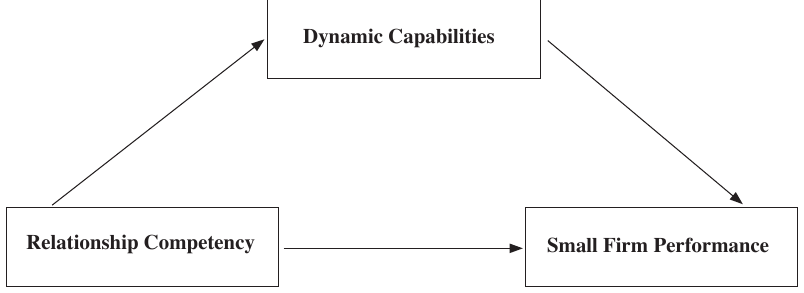
The theoretical foundation of this paper is provided by the literature review and identified the link among relationship competency and small firm performance and also highlighted the mediating role of dynamic capabilities among the above mentioned relationship. The research propositions (RPs) are provided on the basis of the above conceptual framework.
RP1: Is there a significant relationship between relationship competency and small firm performance?
RP2: Do dynamic capabilities mediate the relationship between relationship competency and small firm performance?
4.0Conclusion
By positioning the dynamic capabilities as an intervening factor between the independent and dependent variables the importance of relationship competency towards the small firm’s performance is clearly elucidated in this study. Furthermore, this study, in context of the current literature, has also shed light that through the intervention of dynamic capabilities, the influence of relationship competency on small firm’s performance can be enhanced. To conceptualize the effect of dynamic capabilities as a linking factor between the relationship competency and small firm’s performance, an empirical study to be organized in future is proposed by taking help from this conceptual framework. Thus, the empirical testing of the proposed model will provide useful insights and guide to the researchers towards a new track for observing this vital linkage.
References
- Abdullahi, I. I., & Sulaiman, C. (2015). The Determinants of Small and Medium-sized Enterprises Performance in Nigeria.
- Ahmad, N. H. (2007). A cross cultural study of entrepreneurial competencies and entrepreneurial success in SMEs in Australia and Malaysia (Doctoral dissertation).
- Ahmad, N. H., Halim, H. A., & Zainal, S. R. M. (2010). Is entrepreneurial competency the silver bullet for SME success in a developing nation? International Business Management, 4(2), 67-75.
- Aminu, M. I., & Mahmood, R. (2015). Mediating role of dynamic capabilities on the relationship between intellectual capital and performance: A hierarchical component model perspective in PLS–SEM path modeling. Research Journal of Business Management, 9(3), 443-456.
- Amit R, S. P. (1993). Strategic assets and organizational rent. Strategic Management Journal, 14(1), 33-46.
- Ayyagari, M., Demirgu¨ç-Kunt, A., & Maksimovic, V. (2011). Small vs. young firms across the world: Contribution to employment, job creation, and growth. World Bank Policy Research Working Paper, (5631).
- Barney, J. (1991). Firm resources and sustained competitive advantage. Journal of Management, 17(1), 99-120.
- Beck, T., Demirguc-Kunt, A., & Levine, R. (2005). SMEs, growth, and poverty: Cross-country evidence. Journal of Economic Growth, 10(3), 199-229.
- Bickerdyke, I., Lattimore, R. & Madge, A. (2000). Business failure and change: an Australian perspective, productivity commission staff research paper. AusInfo, Canberra. The Conceptual Framework in Examining the Influence of Relationship Competency on Small Firm Performance with the 91 Mediating Role of Dynamic Capabilities 85-
- Che Senik, Z., Md Sham, R., Scott-Ladd, B., & Entrekin, L. (2007). SMEs Internalisation: Discussing on how networking helps Malaysian SMEs to go International. In Proceeding of 4 th SMEs in Global Economy International Conference.
- Cooper, S. (2006). Technical Entrepreneurship, Pearson Education, Harlow.
- Das, T.K., & He, I.Y. (2006). Entrepreneurial firms in search of established partners: Review and recommendations. International Journal of Entrepreneurial Behaviour & Research, 12(3), 114-43.
- Eisenhardt, K. M., & Martin, J. A. (2000). Dynamic capabilities: What are they? Strategic Management Journal, 21(10-11), 1105-1121.
- Eriksson, T. (2014). Processes, antecedents and outcomes of dynamic capabilities. Scandinavian Journal of Management, 30(1), 65-82.
- Gogan, L. M., & Draghici, A. (2013). A model to evaluate the intellectual capital. Procedia Technology, 9, 867-875.
- Jenssen, J. I., & Greve, A. (2002). Does the degree of redundancy in social networks influence the success of business start-ups? International Journal of Entrepreneurial Behaviour & Research, 8(5), 254-267.
- Kregar, T. B., & Antoncic, B. (2014). Entrepreneurial networks: The multiplexity of exchange content. Economic and Social Development: Book of Proceedings, 389.
- Law, K. K. (2012). Firm Performance and Entrepreneurial Network: The Moderating Effect of Resources Factor in a Multiracial Country (Unpublished Doctoral dissertation, Universiti Utara Malaysia).
- Liao, J., Kickul, J. R., & Ma, H. (2009). Organizational dynamic capability and innovation: An empirical examination of Internet firms. Journal of Small Business Management, 47(3), 263—286.
- Lin, Y., & Wu, L. Y. (2014). Exploring the role of dynamic capabilities in firm performance under the resource-based view framework. Journal of Business Research, 67(3), 407-413.
- Minai, M. S., Ibrahim, Y., & Law, k. K. (2012). Entrepreneurial network in Malaysia: Are there any differences across ethnic groups? Journal of Business and Policy Research, 7(1), 178-192.
- Parida, V., Oghazi, P., & Cedergren, S. (2016). A study of how ICT capabilities can influence dynamic capabilities. Journal of Enterprise Information Management, 29(2), 179-201.
- Raziq, A., & Khair, S. M. (2015). Exploring training and development practices in Pakistani SMEs. Buitems Journal of Social Sciences and Humanities, 46.
- Rehman, K. U., & Saeed, Z. (2015). Impact of dynamic capabilities on firm performance: Moderating role of organizational competencies. Sukkur IBA Journal of Management and Business, 2(2), 18-40.
- Ritter, T., & Gemunden, H. G. (2004). The impact of a company’s business strategy on its technological competence, network competence, and innovation success. Journal of Business Research, 57(6), 548-556.
- Sarwoko, E., Surachman, Armanu, & Hadiwidjojo, D. (2013). Entrepreneurial characteristics and competency as determinants of business performance in SMEs. International Organization of Scientific Research Journal of Business and Management, 7(3), 31-38.
- Teece, D. J., Pisano, G., & Shuen, A. (1997). Dynamic capabilities and strategic management. Strategic Management Journal, 18(7), 509-533.
- Tseng, S. M., & Lee, P. S. (2014). The effect of knowledge management capability and dynamic capability on organizational performance. Journal of Enterprise Information Management, 27(2), 158-179.
- Ul Haq, M., Usman, M., Hussain, N., & Anjum, Z. (2014). Entrepreneurial activity in China and Pakistan: A GEM data evidence. Journal of Entrepreneurship in Emerging Economies, 6 (2), 179 193.
- Wang, C. L., Senaratne, C., & Rafiq, M. (2015). Success traps, dynamic capabilities and firm performance. British Journal of Management, 26(1), 26-44.
- Wang, Y. (2016). What are the biggest obstacles to growth of SMEs in developing countries? An empirical evidence from an enterprise survey. Borsa Istanbul Review, 16(3), 167-176.
- Wernerfelt, B. (1984). A resource-based view of the firm. Strategic Management Journal, 5, 171–180.
- Yıldız, S., Meydan, C., & Güner, M. (2014). Measurement of intellectual capital components through activity reports of companies. Procedia-Social and Behavioral Sciences, 109, 614-621.