A Proposed TEV Framework for Pulau Payar Marine Park
- School of Technology Management and Logistics, College of Business, Universiti Utara Malaysia, Sintok
- Department of Marine Park Malaysia
Journal of Business Management and Accounting 7(2) (2017) · https://doi.org/10.32890/jbma2017.7.2.8820
Abstract
This paper aims to propose Total Economic Value (TEV) framework for Pulau Payar Marine Park (PPMP). Currently, TEV framework for PPMP revealed a few components despite infeasibility of certain main scientific data to be acquired and also under assumption of non-climate change phenomenon. With the MPA exposures towards recent climate change phenomenon, this paper explored the extended areas in Pulau Payar that might contribute either positively or negatively to the value of the PPMP which will assist in marine park management in their policy making. This study conducted along the qualitative paths in which information are gathered through focus group discussions and empirical study relevant to the calamity of coral bleaching. The findings illustrate that there are eight (8) items would contribute to the use and non-use value of the TEV framework.
Keywords: Total economic value, marine park, use value, non-use value
1.0Introduction
Marine protected areas or MPAs in Malaysia is a gazette area by the government to be conserved and protected or even preserved certain resources. These MPAs are managed by Department of Marine Park (DMPM) in Peninsular Malaysia and at the federal territory, Sabah Parks in state of Sabah, and Sarawak Forestry in state of Sarawak. Generally, there are many forms of MPA either in term of management style or even the reason of the establishment, namely a few such as marine sanctuaries, ocean parks, national parks and marine wildlife refuges.
IUCN (2017) stated that Marine Protected Areas (MPAs) involve the protective management of natural areas so as to keep them in their natural state. MPAs can be conserved for a number of reasons including economic resources, biodiversity conservation, and species protection. They are created by delineating zones with permitted and non-permitted uses within that zone.
In a broader sense, MPAs is established to limit human activities that might affect the natural resources of ecosystem and biodiversity in certain parameters of zoning areas. The arising issue is whether MPA worth it to be protected and if so, what are the values and which components should to be included in the valuation.
In the past, management decisions on natural resources were usually based on traditional economic theory, in which only market costs and benefits were considered. Under this system, natural resources were deemed as free and not accounted for in decision- making processes. Valuation of non-marketed goods, in this case, protected areas, could help provide a step towards better-informed decision-making. This requires evaluating natural resources in monetary terms.
Abide the issue of the uncertainty in estimating the value of MPAs, many valuation approaches are appropriate and could be used simultaneously in measuring each of the identified components. In this study, Pulau Payar Marine Park (PPMP), which is under DMPM management, is selected to be examined. PPMP is an island situated off the coast of Kedah with an area of 31.2 hectares and an approximate length of 1.75 km and about 500 meter wide (DMPM, 2017). This island has been gazette as MPA since 1994 where two (2) nautical miles from coast line is under no-take zone area.
In year 2011, an exploratory research on economic valuation on the ecosystem and biodiversity for PPMP had been done under DMPM grant (Hasnan et al., 2012). This study revealed a few components had contributed approximately around RM174 million values to PPMP despite infeasibility of certain main scientific data to be acquired and under “freeze” or ceteris paribus assumption of climate change phenomenon.
With the MPA exposures towards recent climate change phenomenon such as coral bleaching, tsunami and ocean acidifications, there is a necessity to revisit the framework of PPMP valuation. Thus, this paper aims to explore the extended areas in Pulau Payar that might contribute either positively or negatively to the value of the PPMP which will assist in marine park management in their policy making.
2.0Literature Review
Estimating the value of ecosystems and biodiversity could be done through a variety of valuation approaches. GIZ (2012) listed five approaches with ten different methods in assessing each of identified components that are feasible to be measured. The five approaches are market price (Bockarjova & Botzen, 2017), revealed preference (Lee, Kim & Hong, 2016), cost based (Baig, Rizvi, Pangilinan & Palanca-Tan, 2016), stated preference (Lee, Kim & Hong, 2016) and transfer of value (Boyle & Parmeter, 2017). Whereas, the methods to apply each approaches including contingent valuation (Del Giudice & Del Paola, 2016), travel cost (Jala & Nandagiri, 2015), hedonic price (Liu & Ichinose, 2017), benefit transfer (Boyle & Parmeter, 2017) and many others.
Due to the complexity in getting the data, many studies doing the economic valuation based on only one variable which commonly is bequest value and being measured through willingness to pay (WTP). Among WTP studies are Hjerpe &Hussain (2016), Gatto et al. (2014), Bakaki & Bernauer (2016), and Ibrahim et al. (2017). Meanwhile for WTP studies related to marine parks in Malaysia, it can be seen from Faizana, Sasekumar, & Chenayah (2016), Akhter & Yew (2015), and Yacob, Radam & Shuib (2009).
Albeit there are many methods and approaches to do economic valuation of ecosystem and biodiversity, the total value cannot be measured just using a single method due to their different characteristics and procedures. As a consequence, a hybrid technique is required in assessing a total economic valuation as being done by O’ Gara (2007), Hasnan et al. (2012), and Ayenew & Tesfay (2015).
The economic valuation of ecosystem and biodiversity comprises a few measurable components even though the marine parks goods and services are invaluable. For Pulau Payar, Hasnan et al. (2012) used two main components, which are use value and non- use value as study done by O’ Gara (2007) at Vitu Levu Island in Fiji and Edwards (2014) in the South Coast Marine Conservation area, St Vincent and the Grenadines. Besides that Hasnan et al (2012) had broken down the use value into extractive and non-extractive, and further identified seven variables.
3.0Methodology
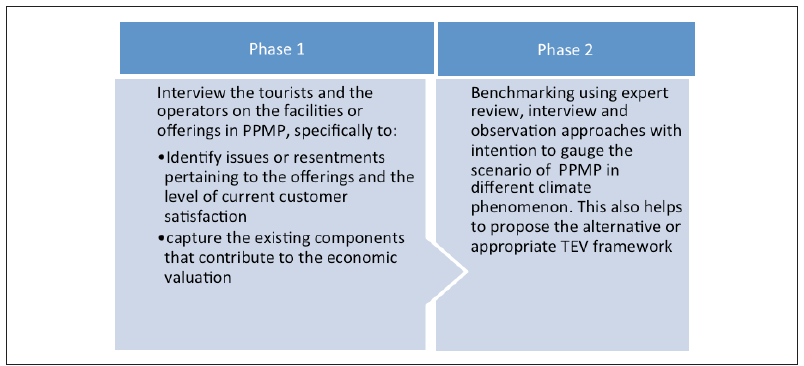
This study conducted along the qualitative paths in which information are gathered through focus group discussions (comprised of experts from DMPM). This focus group session was organized through a briefing and brainstorming in generating ideas and captures the main issue surrounding marine parks globally and in Malaysia particularly for PPMP. Further, the relevant scientific documents (reports from observations and experiments) published in relevant to the calamity of coral bleaching in the surrounding area in 2010.
4.0Findings
Based on the preliminary investigation, the following elements are classified as the variable modules for the simulation: capture fisheries, tourism, research and education, aesthetics, coastal protection, carbon sequestration and bequest value. Meanwhile, biological support from fisheries, turtles and seabird are the new elements built-in the TEV Framework. These elements are classified respectively as either benefits or costs to the PPMP’s stakeholders as illustrated by figure 2.
TEV FRAMEWORK FOR PULAU PAYAR MARINE PARK VALUATION VARIABLES SUB-VARIABLES BENEFITS COSTS TECHNIQUE Spillover of the Capture EXTRACTIVE N/A Fisheries Tourism Tourism DIRECT Maintenance NON Aesthetics Research & Production EXTRACTIVE (Aq Fish) Education Approach (Primary & Aesthetics (Coral) N/A Secondary Data) Decreasing Tangibility Turtles Fisheries Programs BIOLOGICAL SUPPORT Turtles (Eggs) N/A USE VALUE Seabirds (Walit) N/A
Coastal Coastal Protection Protection PHYSICAL (Coral Reef) Programs INDIRECT PROTECTION Coastal Protection Benefit Transfer N/A (Mangrove) Method Carbon (Secondary Carbon Sequestration Sequestration Data) (Coral Reef) GLOBAL LIFE Programs SUPPORT Carbon Sequestration N/A (Mangrove) Conservation Value Contingent NON-USE by Willingness to Pay Valuation
BEQUEST VALUE (WTP) N/A
VALUE Method (Primary Data)
The figure itself is in the PDF version.
5.0Discussion and Conclusions
MPA exposures reflect the potential calamities that affect the economic values of the MPA such as follows:
| Item | MPA Exposures |
|---|---|
| 1 | Climate Change Phenomena |
| 2 | Fishing |
| 3 | Tourism |
| 4 | Pollutions |
It is indisputable that each individual variable module reflected in this study has grown significances in gaining greater sustainability in the PPMP’s Total Economic Value (TEV). As a result, efforts to ensure the world worth inherited by the next generation are bequeathed. The risks of climate change such as more intense weather, higher ocean water temperature, changing rainfalls and rising oceans are imminent. Globally, these changes will result in intense competitions for new resources, territorial change and as well as disruption to trade patterns, all of which have the potential to cause global conflicts.
As of now, climate vulnerability like global warming is already a major threat for the earth inhabitants. Heat has changed the way of life in certain parts of the world in a rather dramatic fashion. Starvation in some parts and forest burning in the other, have created enough trouble to the world society. High water temperature has led to the extinction of marine biodiversity in many of the world’s marine parks. Consequently, this phenomenon could result in making the world a riskier place than ever.
Locally, Malaysia has also experienced many tragedies associated with the climate change phenomena over the last decades. Coral bleaching, tsunami and ocean acidifications have, among others, contributed to the ill-fated calamity surrounding people and environments, terrestrially or aquatically.
Consequently, in managing the marine parks toward greater sustainability, it is of grave needs for the managers of relevant authorities (DMPM, for instance) to occupy an effective management tool that can help simulate more precisely the immediate and long term TEV effects in view of changes imparted by the relevant phenomena on relevant variable modules. This could lead to a better capability to derive good strategies for immediate actions that can reduce the MPA exposures’ risks when such calamities take place. For that, the use of mathematical based simulation model is deemed to be highly efficient.
Acknowledgement
This research was financially supported by the Ministry of Higher Education under the ERGS grant with the collaboration from Department of Marine Park and RIMC, UUM. The authors would also like to extend their appreciation to all related parties involved in the research study.
References
- Akhter, S., & Yew, T. S. (2015). Tourists’ willingness to pay for marine resource conservation at Pulau Perhentian Marine Park, Malaysia. Greener Journal of Economics and Accountancy, 4(2), 29–41.
- Ayenew, B., & Tesfay, Y. (2015). Economic valuation of forest ecosystems service’s role in maintaining and improving water quality. Economics, 4(5), 71-80. doi: 10.11648/j.eco.20150405.11
- Baig, S. P., Rizvi, A. R., Pangilinan, M. J., & Palanca-Tan, R. (2016). Cost and benefits of ecosystem based adaptation: The case of the Philippines. Retrieved from https://portals.iucn.org/library/sites/library/files/documents/2016-009.pdf
- Bakaki, Z., & Bernauer, T. (2016). Measuring and explaining the willingness to pay for forest conservation: Evidence from a survey experiment in Brazil. Environ. Res. Lett., 11, 1-9.
- Bockarjova, M., & Botzen, W. J. W. (2017). Review of Economic Valuation of Nature Based Solutions in Urban Areas. Retrieved from https://naturvation.eu/sites/ default/files/result/files/naturvation_review_of_economic_valuation_of_ nature_based_solutions_in_urban_areas.pdf
- Boyle, K. J., & Parmeter, C. F. (2017). Benefit transfer for ecosystem services. Retrieved from https://www.bus.miami.edu/_assets/files/repec/WP2017-07.pdf
- Del Giudice, V., & Del Paola, P. (2016). The contingent valuation method for evaluating historical and culture ruined properties. Procedia - Social and Behavioral Sciences, 223, 595–600.
- DMPM (2017). The official portal of Department of Marine Park Malaysia. Retrieved from http://www.dmpm.nre.gov.my/ptl_kedah.html?uweb=jtl&lang=en
- Edwards, L. (2014). Cost benefit analysis and marine park planning in the South Coast Marine Conservation area, St Vincent and the Grenadines. United Nations University Fisheries Training Programme, Iceland [final project]. http://www. unuftp.is/static/fellows/document/luc13prf.pdf
- Faizana, M., Sasekumar, A., & Chenayah, S. (2016). Estimation of local tourists willingness to pay. Regional Studies in Marine Science, 7, 142–149.
- Gatto, P., Vidale, E., Secco, L., & Davide Pettenella, D. (2014). Exploring the willingness to pay for forest ecosystem services by residents of the Veneto Region. Bio-based and Applied Economics 3(1): 21-43.
- GIZ. (2012). Economic valuation of ecosystem services. Retrieved from https://www. giz.de/expertise/downloads/giz2013-en-biodiv-economic-valuation-ecosystem-services.pdf
- Hasnan, N., Ibrahim, K., & et al. (2012). Investigating total economic value of eco-tourism in Pulau Payar Marine Park. Department of Marine Park Malaysia, Ministry of Natural Resources and Environment: Putrajaya, Malaysia, pp 148.
- Hjerpe, E. E., & Hussain, A. (2016). Willingness to pay for ecosystem conservation in Alaska’s Tongass National Forest: a choice modeling study. Ecology and Society, 21(2), 8-22.
- Ibrahim, M. S., Yacob, M. R., Samdin, Z., Ishak, M. Y., & Abdullahi, S. I. (2017). Economic valuation for improve conservation of Yankari game reserve, Bauchi, Nigeria. International Journal of Scientific and Research Publications, 7 (3), 198–205.
- IUCN (2017). IUCN website. Retrieved from https://www.iucn.org/theme/marine-and-polar/our-work/marine-protected-areas
- Jala, & Nandagiri, L. (2015). Evaluation of Economic Value of Pilikula Lake Using Travel Cost and Contingent Valuation Methods. Aquatic Procedia, 4, 1315–1321.
- Lee, Y., Kim, H., & Hong, Y. (2016). Revealed Preference and Effectiveness of Public Investment in Ecological River Restoration Projects: An Application of the Count Data Model. Sustainability, 8, 353–366.
- Liu, K., & Ichinose, T. (2017). Hedonic Price Modeling of New Residential Property Values in Xi’an City, China. International Journal of Social Science Studies, 5(9), 42–56.
- O’ Garra, T. (2007). Estimating the total economic value (TEV) of the Navakavu LMMA (Locally managed marine area) in Vitu Levu island (Fiji). Final report. The University of the South Pacific, pp 140.
- Yacob, M. R., Radam, A., & Shuib, A. (2009). A contingent valuation study of marine parks ecotourism: The case of Pulau Payar and Pulau Redang in Malaysia. Journal of Sustainable Development, 2(2), 95-105.