Blessings as a Validity Indicator of Attaining Truth in Research
- School of Language, Civilization and Philosophy, College of Arts and Sciences, Universiti Utara Malaysia, Sintok, Kedah
Journal of Business Management and Accounting 7(2) (2017) · https://doi.org/10.32890/jbma2017.7.2.8817
Abstract
Blessings refer to the cause of a good outcome, and is said to be associated with the truth. In research, validity refers to the truth. Indicator is a tool that can be used to measure the achievement of a goal. This paper has two main objectives. First, to analyze the concept of blessings in Islam. Second, to formulate blessings as a validity indicator in research. This paper aims to address both of these issues through textual analysis of some literatures. For the first issue, this paper discusses the views of Islamic scholars concerning the concept of blessings in Islam. For the second issue, the findings sum up that blessings can be used as the indicator of validity in research.
Keywords: Indicators, blessing, validity, research
1.0Introduction
Basically, indicators refer to variables, size or features as a guide to measure change (Green & Gabor, 2012). There are many discussions related to indicators which immensely impact the world today. Indicators are among the things that play a significant role in the development of a country. Indicators that dominate the world today are viewed from an economic perspective with the use of numbers and statistics. Progress and setbacks of a country depend on measurements based on numbers and statistics in economic discussions. The world accepts this principle as a ‘law of nature’ (Karabell, 2014).
In the context of research, the need to arrive at a correct and truthful findings or conclusions is indispensable. This makes the research to be valid. Thus, what are the indicators that can be used to measure research findings or conclusions which are correct? One element that is said to be associated with the truth is blessings. Is it possible to discuss blessings in the context of validity of research? To answer these questions, this paper divides the discussion into two parts. The first part of the discussion is on the concept of blessings based on proof from the verses of al-Qur’an. The second part, relates the relevance of validity, truth and blessings as an element.
This paper was present to The 11th ISDEV International Islamic Development Management Conference (11th IDMAC 2016)
2.0First Part
In the first part, this paper identifies two substantiations from al-Qur’an relating to blessings and thereafter analyzes the views of mufassirin (scholarly experts in interpreting al-Qur’an) on the two verses. The terms that are found in these two verses are tabarak and barakat. No doubt there is more than one verse that uses these words in al-Qur’an. However, this paper will examine two of these verses to analyze the views of scholars. The following is a discussion of the two substantiations.
2.1First Substantiation
The first substantiation refers to the first verse of Surah al-Furqan with the following interpretation:
“Blessed is He (tabarak) Who sent down the Criterion (of right and wrong, i.e. this Qur’ân) to His slave (Muhammad SAW) that he may be a warner to the ‘Alamîn (mankind and jinn).” (al-Furqan, 25: 1)
The word blessings (tabarak) refers to the abundance of goodness. Goodness accrues from its previous state. That abundant goodness is continuous and uninterrupted. It is Allah SWT who gives the goodness in abundance. This illustrates the absolute glory, the greatness and sanctity of Allah SWT who has bestowed much good. Besides this, goodness here also refers to sustenance and its blissful enjoyment. It is also said that the descent of revelation (al-Qur’an) is the greatest of blessings and kindness given to mankind and jinn (Muhammad al-Amin al-Syanqitiy, 1995).
According to Muhammad al-Tahir ‘Ashur (2000), blessings refers to goodness. On the attributes of Allah SWT who has all the goodness and glory in abundance. Allah SWT revealed al-Qur’an and al-Qur’an has a lot of goodness because it is from Allah SWT. Among the goodness of al-Qur’an is the differentiation of right/truth from falsehood. In the meantime, Ahmad Muhammad al-Tha’labiy (2002), stated that the example of continuation of abundant goodness is akin to the blessings of water to a bird or even a camel. Blessings is the abundance of goodness in water and that goodness continues to favour the animals. The term blessing also refers to three aspects – first is elevation; second is increase, and third is dignity (Ali Muhammad al-Mawardi, t.t).
There are also discussions linking blessings with divine guidance. Goodness that brings the notion of divine guidance and instructions. This is based on the abundant goodness that exists in al-Qur’an, in which al-Qur’an functions as the gauge to differentiate between truth and falsehood, as well as a source of divine guidance (Sirajuddin Umar al-Dimasyqi, 1998).
There are also scholars who describe the first verse of Surah al-Furqan by proffering two meanings to the term barakat. First, the abundant increase in goodness. This abundant goodness refers to the blissful enjoyment bestowed by Allah SWT which cannot be computed. Second, the increase and the most elevated glorified status on the sanctity, nature and act of Allah SWT. Glory is to Allah SWT from any resemblance to everything else. It is also mentioned that the knowledge contained in al-Qur’an is the source of goodness and blessings (Fakhruddin al-Razi, 1981).
Al-Quran contains the sciences, knowledge and wisdom. The best of knowledge pertaining to Allah SWT creations is knowledge related to goodness and blessings. In addition, every goodness is linked to a cause (reason) whose outcome can be goodness, and it is Allah SWT who gives abundance of goodness including the benefits for religion and its worldly affairs (Fakhruddin al-Razi, 1981).
There are also scholars who associate blessings with knowledge which has the ability to distinguish between truth and falsehood. Inevitably such knowledge derives from al-Qur’an. Al-Qur’an is from Allah SWT, and it is knowledge derived from here that produces the abundant goodness and that such goodness is not uninterrupted (Muhammad Jarir al-Tabari, 2000).
2.2Second Substantiation
The next substantiation is from Surah al-A’raf verse 96, which has the following interpretation:
“And if the people of the towns had believed and had the Taqwâ (piety), certainly, We should have opened for them blessings from the heaven and the earth, but they belied (the Messengers). So We took them (with punishment) for what they used to earn (polytheism and crimes)” (Surah al-Araf, 7: 96).
According to Ahmad Muhammad al-Tha’labiy (2002), barakat (blessings) from the heavens refers to rain, whilst blessings from the earth refers to vegetation. It is due to the existence of blessings in the rain that plants grow with goodness in it. In addition, there are scholars who describe blessings from the earth as vegetations that have a lot of fruits as well as plants in the form of grains. The fruits also have a variety of shapes and flavours. Each fruit and each plant also has a variety of different goodness dependent on the consumers’ usage. As a whole, all kinds of plants and fruits as well as whole grains provide a lot of goodness and benefits (Syihabuddin Muhammad al-Alusi, t.t).
Most scholars accept that the barakat from the heavens refers to rain and barakat from the earth refers to vegetation that provides goodness. Nonetheless goodness and sustenance (rezk) stems from rain (Muhammad al-Hussain al-Baghawiy, 1997). Fakhruddin al-Razi (1981) explains the relationship between this verse and other verses that carry the same depiction that rain is a source of food, and it is from the rain that plants grow to provide sustenance to humans. He also linked that vegetation is the plentiful food sources which represents presence of continuous abundant goodness.
It is not only plants that are imbued with blessings but animals and all other creatures that bring goodness is also linked to the concept of blessings. All goodness that exists is through the benevolence of Allah SWT (Muhammad Ahmad al-Syarbiniy, t.t). In the meantime, there are also scholars who stated that barakat from the heavens refers to light which is divine guidance that is given to the heart to know Allah SWT. That light of divine guidance comes from Allah SWT. On the other hand, barakat from the earth refers to the parts of the body used to serve Allah SWT (Muhammad al- Hussain al-Salmiy, 2001). There are also views that state barakat from the heavens is the acceptance of Islam and the granting of all supplications whilst barakat from the earth is the facilitation of all needs (Mansur Muhammad al-Sam’aniy, 1997 & Ali Muhammad al-Mawardi, t.t). A thing that is imbued with blessings has the ability to enlighten and provide explanation as well as give guidance and guidelines (Nuruddin Marbu al-Banjari, 2013)*.
From the discussions of the scholars on these two propositions, 11 features of blessings can be surmised. First, there is goodness compared to the situation beforehand. Second, abundance of goodness and uninterrupted. Third, goodness is based on the perception of religion. Fourth, knowledge is contained in al-Qur’an and al-Sunnah (sunnah is interpreter of al-Qur’an). Fifth, divine guidance and instructions. Sixth, the relationship with Allah SWT. Seventh, sustenance from the sky. Eighth, al-Qur’an itself. Ninth, sustenance from the earth. Tenth, to do righteous deeds and serve in the cause of Allah SWT. Eleventh, the facilitation of all affairs. From these 11 features of blessings, they can be further divided into two types. For the first type, they can be classified as the cause for the existence of blessings. The cause for the existence of blessings are more tangible and specific in nature. In the second type, the effects of blessings are more intangible. These differences are best depicted summarily in Table 1.
| Cause for the Existence of Blessings | Effect from Blessings |
|---|---|
| 1. al-Quran dan al-Sunnah | 1. Goodness |
| 2. Knowledge that is contained in | 2. Sustenance (rezk) |
| al-Qur’an dan al-Sunnah | |
| 3. Has a relationship with Allah SWT | 3. Sustenance in the form of food (continued) |
3.0Part Two
The second part, discusses the elements of blessing in the context of validity indicator and then, surmise the element of blessings as a validity indicator in research especially in Islamic-based research. Validity refers to the knowledge gained from a study coincided with reality (Eisner & Peshkin, 1990; Klenke, 2008; Yin, 2011). Validity is also the truth based on the accurate conclusion whose results can be attained from the research conducted. The truth here still refers to the actual nature of reality (McBurney & White, 2009).
In the meantime, there are also researchers discussing that validity refers to the degree or level of a test or measuring instrument that has the ability to measure what should be measured (Thomas Nelson, & Silverman, 2010; Yahaya, 2007). Sabitha Marican (2006), added that things that ought to be measured are characteristics or ideas. In addition, validity is also defined as accuracy, truth, meaningful, instrument’s usability that allow data to be deduced (Fraenkel, Wallen & Hyun, 2011; Ghazali Darusalam, 2008).
According to Noorzan Mohd Noor (2010), validity refers to the accuracy and truth of a measurement. Validity is also not measured by the test of statistical significance. Measuring validity is subjective and depends on the opinions and assessments of researchers alone. Therefore, the meaning of validity can be divided into two. First, the validity which refers to the validity of the data. Secondly, the validity which refers to the validity of the measuring instrument or instruments. However, both are intertwined. Validity of data collected is based on the instrument formulated (Cohen, Manion, & Morrison, 2007; Ghazali Darussalam, 2008). The higher the validity of the instrument, the higher the validity of the data obtained (Ghazali Darussalam, 2008).
Validity in Islam refers to the actual reality (Fazlur Rehman Faridi, 1995; Sayyid Zainul Abedin, 1995). For Irfan Ahmad Khan (1995b) validity refers to the truth. Truth is further detailed with the concept of verification, workability and utility. One notion of validity is the truth.
Blessings and truth have relevance. Truth is mentioned in al-Qur’an referring to Allah SWT and the contents of al-Qur’an cover the aspects of theology that Allah SWT gave to the Prophets (Wan Mohd Nor Wan Daud, 1994). Truth and blessings are based from the Qur’an. Zulkifli Mohamad Al-Bakri (2014) states that something which has blessings is something that has plentiful of divine guidance. When there is divine guidance, then truth exists*. If something has the element of blessings, then that matter is the truth.
In the meantime, humans need revelation for guidance in all matters, including in determining the truth and validity of research. These are discussed by Muslim scholars such as Sayyid Abul Ala Mawdudi (1995), Muhammad Nejatullah Siddiqi (1995), Mohammed Mumtaz Ali (2008) and Irfan Ahmad Khan (1995a).
Western thinkers also recognize that people need other knowledge other than the knowledge that is to be proven scientifically. This is discussed by Mumtaz Muhammed Ali (2008). He quotes Russell:
“... A scientific civilization is to be a good civilization it is necessary that increase in knowledge should be accompanied by increase in wisdom. I mean by wisdom a right conception of the ends of life. This is something which science in itself does not provide. Increase of science by itself, therefore is not enough to guarantee any genuine progress though it provides one of the ingredients which requires progress”.
These words show that Western thinkers also recognize that making the correct decision requires a knowledge that is known as “wisdom”. Wisdom can give the accurate meaning about this life. Wisdom refers to revelation that provide instructions to guide people, even al-Qur’an speaks about wisdom and truth even before Russell.
Al-Qur’an declares that the methods to get to the truth is with tafakkur** (thinking), ta’aqul***(in-depththinking),tadabbur****(contemplation)andtadhakkur*****(remembering) (Mohd Kamal Hassan, 2011). In fact with tafakkur it can lead to the solution of problems in the future****** (Jamal Mustapha Badi & Tajdin, 2005). Yusuf al-Qardawiy says that
*      Personal communication on 25 August, 2014 with the Mufti of Federal Territories,
       Kuala Lumpur, Sahibus Samahah, Dr Zulkifli Mohamad Al-Bakri.
**     Tafakkur is the process of thinking to develop new knowledge.
***    Ta‘aqul is the process of thinking and understanding a knowledge rationally.
****   Tadabbur is the process of deep understanding of something holistically and perfectly.
***** Tadhakkur is the process of bringing existing knowledge to the heart (to revise and
       remember).
****** As in the story of Prophet Yusuf who could interpret the Kings’s dream at that time.
al-Qur’an mentions the place to carry out all these processes (faculty of intellection) is at the heart other than sight and hearing. Al-Qur’an does not mention the word ‘mind’ or even the brain although it is the function of the mind and the brain to think and understand (Mohd Kamal Hassan, 2011).
Abu Hamid al-Ghazaliy (t.t) explains that tafakkur is the act of the spiritual heart (qalb) while worship is the act of the physical organs. It is because the heart (qalb) is the most powerful organ, the acts of the spiritual heart are much more powerful than the acts of the physical organs. He also mentioned that the advantage of tadhakkur is to return knowledge to the heart.
Ibn Qayyim also accepts that the place for thinking is in the hearts and that knowledge that is generated through such thinking will produce deeds. Useful thoughts are born from a good heart which will produce good deeds and that bad thoughts as a result of the heart being possessed or influenced by the devil will produce bad deeds (Yusuf al- Qardawiy, 1996).
In fact, thinking through the spiritual heart or the physical heart has been scientifically proven to give an impact to human actions. The physical heart stores memory cells which are connected to the memory cells of the brain. One type of cell found in the human heart, known as the ganglia cell, has a much stronger memory than those of brain cells. The network of these cells emits electrical waves that are transmitted through blood circulation. Therefore, ganglia cells that are produced out of a good and cleansed heart will produce good acts and good morals. If the ganglia cells are generated from a bad heart, it will produce bad acts (Mat Rofa Ismail, 2014). One way to get a cleansed heart is through tazkiyat al-nafs. There are evidences from al-Qur’an entreating for tazkiyat al-nafs. In fact, these evidences on tazkiyat al-nafs are associated with wisdom and prudence. Allah SWT also provides methods for tazkiyat al-nafs that is by remembering Allah SWT, hearts will be calmed (Mohd Kamal Hassan: 2013)*.
Beside that, Allah SWT also mentioned through al-Qu’ran whose interpretation is as follows-:
“So fear Me (Allah), O men of understanding (who can think and understand).” (Surah al-Baqarah, 2: 197).
Isma’il al-Dimasyqiy Kathir (2000) stated that Allah SWT asked those who are imbued with the intellect and those who understand to obey Allah SWT commandments. They
* Mohd Kamal Hassan discussed this matter at his Public Lecture which he gave on 21 October 2013 at the University Conference Hall (DPU), Universiti Sains Malaysia. The titke of Public Lecture was The Heart of The Problems Vis-à-vis the Problems of the Heart. He is a Distinguished Professor at the International Institute of Islamic Thought and Civilization, International Islamic University Malaysia.
must fear the punishment and the consequences that may befall them if they violate the order of Allah SWT and forsake Allah SWT commandments. They are known as the Ulu al-Albab. The Ulu al-Albab are those who have a mind capable of thinking correctly and have a perfect understanding. It is Allah SWT who gives knowledge to this group of people. That knowledge is known as al-Hikmah (Muhammad al-Tahir ‘Asyur, 2000; Muhammad al-Syanqitiy, 1995).
As a result of the foregoing discussion, a model depicting the relationship between validity with truth and blessings is formed. From such correlations, blessings as a validity indicator in the context of Islamic-based research can be formulated. Figure 1 shows the relationship.
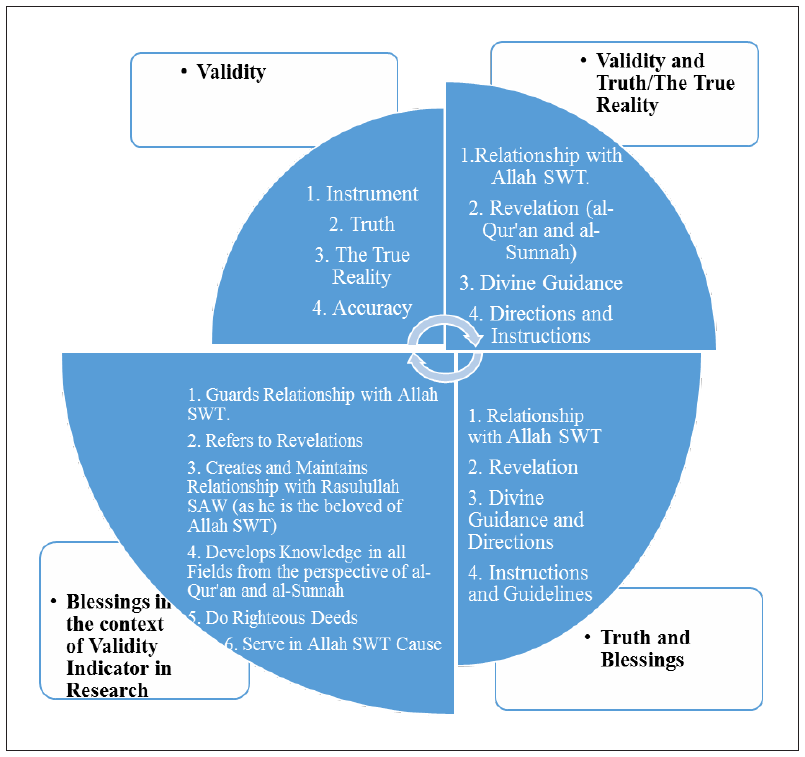
the elements of blessings. The elements of blessings can be divided into two types, as discussed in the first part, one is tangible and the other is intangible in characteristics. Since blessings is associated with truth, the element of blessings that are tangible in character can be used as an indicator (guideline) whose outcome is blessings (which are intangible in nature) simultaneously attaining the truth and validity.
In the meantime, an indicator in this context gives a different depiction. Basically indicator refer to direction, change or even outcome. In the context of the blessings, indicator is also discussed as a direction of changes and outcomes, but it is more intangible in nature, such as goodness, happiness, success, sustenance, facilitation, comfort, guidance and guidelines. All these things represent outcome from something that has blessings. Although these changes or outcome are more intangible in nature, however these things can lead to changes or outcome that are tangible. Therefore indicator here refers to the direction to obtain change or outcome which is imminent. This is based on Allah SWT promise as mentioned in al-Qur’an. As an example of Allah SWT as mentioned in Surah Ibrahim verse 7 which brings the following interpretation:
“If you give thanks (by accepting Faith and worshipping none but Allâh), I will give you more (of My Blessings),” (Surah Ibrahim, 14: 7)
4.0Conclusion
Based on this discussions, there are two things that can be inferred. First, the element of blessings has features containing both the tangibles and the intangibles. This provides the meaning that the concept of blessings can be associated with the human senses, and not purely spiritual or intangible in nature. From here, an indicator can be constructed. Second, the construction of the indicator refers to the effort or cause that can be done (tangible) to get a change or an outcome that is inevitably imminent. In this context, the cause for the existence of blessings is something that is achievable and it can thus be used as an indicator to attain outcome or changes that have blessings.
References
- Abu Hamid al-Ghazaliy (t.t). Ihya’ ‘Ulum al-Din. Indonesia: Maktabah Karyatoh Putra.
- Ahmad Muhammad al-Tha’labiy (2002). Al-Kashf wa al-Bayan. Beirut: Dar Ihya’ al-Turath. Ali Muhammad al-Mawardi (t.t). al-Nuktu wa al-‘Uyun tafsir al-Mawardiy. Beirut: Dar al-Kutub al-‘Ilmiyyah.
- Cohen, L., Manion, L., & Morrison, K. (2007). Research Methods in Education. New York: Routledge.
- Dr. Zulkiffi Mohamad Al-Bakri (2014). (Mufti of Federal Territories), personal communication, August 25, 2014
- Eisner, E. W., & Peshkin, A. (1990). Qualitative Inquiry in Education: The Continuing Debate. New York: Teachers College Press.
- Fakhruddin al-Razi (1981). Al-Tafsir al-Kabir wa Mafatih al-Ghaib. Beirut: Dar al-Fikr.
- Fazlur Rehman Faridi (1995). “Islamic Research Methodology: Some Reflections”, in. Muhammad Mumtaz Ali, Conceptual and Methodological Issues: A Few Milestones. Kuala Lumpur: Dewan Bahasa dan Pustaka.
- Fraenkel, J., Wallen, N., & Hyun, H. (2011). How to Design and Evaluate Research in Education. New York: McGraw-Hill Education.
- Ghazali bin Darusalam (2008). Kesahan dan Kebolehpercayaan Dalam Kajian Kualitatif dan Kuantitatif. 61-82. Retrieved on 21 March, 2013 from http://www. ipislam.edu.my/index.php/research/read/20/Kesahan-dan Kebolehpercayaan-dalam-Kajian-Kualitatif-Dan-Kuantitatif
- Green, P., Gabon, G. (2012). Misleading Indicators: How to Realibly Measure your Business. United States of America.
- Irfan Ahmad Khan (1995a). “The Meaning of Islamic Research”, in. Muhammad Mumtaz Ali, Conceptual and Methodologies Issues in Islamic Research: A Few Milestones. Kuala Lumpur: Dewan Bahasa dan Pustaka.
- Irfan Ahmad Khan (1995b). “Problems of Islamic Research in Philosophy”, in. Muhammad Mumtaz Ali, Conceptual and Methodological Issues in Islamic Research. Kuala Lumpur: Dewan Bahasa dan Pustaka. Isma‘il Kathir al-Dimasyqiy (2000). Tafsir al-Qur’an al-‘Azim. Kaherah: Muassasat Qurtabat.
- Jamal Badi, & Mustapha Tajdin (2005). Creative Thinking: An Islamic Perspective. Selangor: International Islamic University Malaysia
- Karabell, Z. (2014). The Leading Indicators: A Short of the Numbers that Rule our World. Simon & Schuster: United States of America: Greenbridge Management.
- Klenke, K. (2008). Qualitative Research In The Study Of Leadership. United Kingdom: Emerald Group Pub.
- Mansur Muhammad al-Sam’aniy (1997). Tafsir al-Quran. Riyad: Dar al-Watan.
- Mat Rofa Ismail (2014). Ulul Albab Ajaibnya Alam Semesta. Kuala Lumpur: Must Read.
- McBurney, D. H., & White, T. L. (2009). Research Methods. United State of America: Wadsworth Cengage Learning.
- Mohd Kamal Hassan (2011). The Human Intellect, Divine Revelation and Knowledge Based on Al-Qaradowi’s Work: al- ‘Aql wa al-’Ilm fi al-Qur’an al-Karim. Revelation and Science, 01(03). Muhammad Ahmad al-Syarbiniy (t.t). al-Siraj al-Munir fi al-Ia’nah ‘ala Ma’rifah Ba’dha Maa’niy Kalam Rabbana al-Hakim al-Khabir. t.t
- Muhammad al-Amin al-Syanqitiy (1995). Adhwa’ al-Bayan fi Idhah al-Quran bi al-Quran. Beirut: Dar al-Fikr.
- Muhammad al-Hussain al-Baghawiy (1997). Ma’alim al-Tanzil. t.t: Dar al-Tayyibah
- Muhammad al-Hussain al-Salmiy (2001). Haqaiq al-Tafsir. Beirut:Dar al-Kutub al-‘Ilmiyyah. Muhammad al-Tahir ‘Asyur (2000). al-Tahrir wa al-Tanwir. Beirut: Muassasat al-Tarikh al-‘Arabiy.
- Muhammad Jarir al-Tabari (2000). Jami’ al-Bayan fi Takwil al-Quran. Beirut: Muassasah al-Risalah
- Muhammed Mumtaz Ali (2008) Siri Kertas ISDEV. Islamic Critique of Conventional Research Methodologies. Pulau Pinang: Pusat Kajian Pengurusan Pembangunan Islam, Universiti Sains Malaysia.
- Muhammad Nejatullah Siddiqi (1995). “The Philosophy And The Nature of Islamic Research”, in Muhammad Mumtaz Ali, Conceptual and Methodologies Issues in Islamic Research: A Few Milestones. Kuala Lumpur: Dewan Bahasa dan Pustaka.
- Noorzan Mohd Noor (2010). Writing Research & Thesis Proposal Guidelines & Examples. Selangor: UTM Press.
- Sabitha Marican (2006). Penyelidikan Sains Sosial Pendekatan Pragmatik. Batu Caves, Selangor: Edusystem Sdn. Bhd.
- Sayyid Abul Ala Mawdudi (1995). “The Imperative And Objective of Islamic Research”, in Muhammad Mumtaz Ali. Conceptual and Methodological Issues in Islamic Research: A Few Milestones. Kuala Lumpur: Dewan Bahasa dan Pustaka.
- Sayyid Zainul Abedin (1995). “Problems of Islamic Research in Muslim Philosophy”, in. Muhammad Mumtaz Ali. Conceptual and Methodological Issues in Islamic Research: A Few Milestones. Kuala Lumpur: Dewan Bahasa dan Pustaka.
- Sirajuddin Umar al-Dimasyqi (1998). Al-Lubab Fi ‘Ulum al-Kitab. Beirut:Dar al-Kutub al-‘Ilmiyyah.
- Syeikh Nuruddin Marbu al-Banjari. Ahmad Safuan Abd Rashid. (2012). Adab-Adab Menuntut Ilmu. Syirfan Indra Mitra Surya Hussin. Program Cinta Ilmu. TV Al-Hijrah. Syihabuddin Muhammad al-Alusi (t.t). Ruh al-Ma’ani fi Tafsir al-Qur’an al-‘Azim wa al-Sab’ al-Samaniy. Beirut: Dar Ihya’ al-Turath al-A’rabi.
- Thomas, J. R., Nelson, J. K., & Silverman, S. J. (2010). Research Methods in Physical Activity: Human Kinetics.
- Wan Mohd Nor Wan Daud (1994). Konsep Ilmu dalam Islam (The Concept of Knowledge in Islam), transl. Rosnani Hashim. Kuala Lumpur: Dewan Bahasa dan Pustaka.
- Yahaya, A. (2007). Menguasai penyelidikan dalam pendidikan: Teori, analisis & interpretasi data: PTS Professional.
- Yin, R. K. (2011). Qualitative Research from Start to Finish. New York: The Guilford Press.
- Yusuf al-Qardawiy (1996). al-‘Aql wa al-’Ilm Fi al-Qur’an. Kaherah: Maktabat Wahbat.