Personal and Environment Factors Associated with Attraction to Tropical Urban Parks in Peninsular Malaysia
- Social Forestry Programme, Research Planning Division
- Ecotourism and Urban Forestry Programme, Forest and Environment Division, Forest Research Institute Malaysia (FRIM), 52109, Kepong, Selangor Darul Ehsan
Journal of Business Management and Accounting 8(2) (2018) · https://doi.org/10.32890/jbma2018.8.2.8805
Abstract
There is increasing demand for urban parks as recreational areas amidst urbanization in Malaysia. Urban parks are the most readily accessible resource for interactions with nature across multi groups in many urban cities, including tropical cities. This paper reports a research conducted in 2013/2014 to determine the overall quality of visits and park users’ level of motivations in selected six public parks in Peninsular Malaysia. The result of this study which examined 2,139 park users’ in 2013/2014 level of motivation and overall quality of visit in selected six public parks in Peninsular Malaysia and the result shows that about three quarter of the users are youths between 17 and 36 years old. For the quality of visit attributes, park users rated “nature and environment†as the highest dimensions with mean score (M = 4.11). The statistical analysis showed that element of shadiness as an important factor for nature motivation. The common shadiness element experienced by urban park users were considered to be unique landscape and significantly different from Western and developed countries
Keywords: Public parks, satisfaction, nature, attractions, users, leisure
1.0Introduction
Sustainable landscape management is indeed essential for the well-being of mankind as it protects and enhances the ecosystem system (flora and fauna), besides providing the future generations an opportunity to fulfil their tourism needs (Ayeni, 2012). Green space is an important feature in the development of a city, and the provision of adequate open space shows atmosphere with a favourable living environment. The urban green spaces (UGS) developed in cities, along with their necessary ecosystem services, range from maintenance of biodiversity to regulation of urban climate. Therefore, through biodiversity conservation, a viable solution is available to maintain a balance between the conservation of threatened species and further urbanization phases. For example, parks and other green spaces offer numerous ecosystem benefits, such as regulating ambient temperatures, filtering air, reducing noise pollution, sequestering carbon, and attenuating storm water.
E-mail: hudafarhana@frim.gov.my
With hectic lifestyles nowadays, some individuals prefer to escape and reduce their stress in natural environment and under shady trees. Additionally, Kaplan (2004) theory stressed that people’s engagement with the natural environment is considered as an “active engagement”. They engage with their nearby natural surrounding as a way to get closer with trees and the presence of natural elements makes the mind peaceful.
People place more value on the environments’ physical design and appearance rather than its functions (Fatin et.al, 2013). This shows that the aesthetic sensibility or quality influences people’s perceptions towards the green infrastructure. Public concerned on the quality of parks including the physical conditions, facilities and public amenities (Zengel & Turkseven Dogrusoy, 2014) while visiting parks. Parks are peaceful, tranquil, beautiful spaces to which people are intrinsically attracted (Cornelis & Hermy, 2004). Real, Arce and Sabucedo (2000) stated that natural environments in urban parks include vegetation and water elements can induce relaxation and reduce stress. Although there is an increasing interest in urban recreation area, it was also evident that some people feel insecure and report negatives feedback such as; the place is untidy, lack of facilities and negligence in maintaining plants, unsafe for women and sometimes too crowded at certain time (Ozguner & Kendle, 2006; Cohen et. al., 2014), similarly, Noralizawati (2010) stated that sound disturbance from urbanization activities usually affects the mind-set of recreational park visitors.
2.0Literature Review
A core set of motives for visiting UGS, which includes contact with nature, attractive landscapes or environment, social contact, recreation and play, privacy, active participation in community design, and a sense of community (Matsuoka & Kaplan, 2008) and other attributes were deduced as the motives for visiting UGS, however, these vary across countries. In Switzerland, visitors insist on connecting themselves to nature for rejuvenation, while social bonding is determined as the weakest motive (Home et. al, 2012). The most important motive is to relax, to listen and to observe nature, and to escape from the city (Chiesura, 2004). An Australian study found that, common motives include; enjoying nature, escaping various pressures, and enjoying the outdoor climate (Weber & Anderson, 2010). In Turkey, to feel relaxed, to meet and chat with friends, and to release stress of urban life, constitute the main motives for visiting parks (Oguz, 2000). In Asia, most of the studies come from the recognized highly urbanized and industrialized countries such as Singapore, Hong Kong, and Taiwan. Lo and Jim (2012) revealed that Hong Kong people are usually motivated to visiting UGS principally because of their need for physical exercise, relaxation, peace and being in natural surroundings. Singaporeans typically for social interaction, enjoyment of nature, relaxation, and exercise (Yuen, 1996).
Similarly, Malaysia is among the tropical countries that has increasing population categorized as urbanities. Properly designed park, is an asset to the entire city. Thus it is a contributor towards green neighborhood ideal. In addition, since the 1990s, the need and demand for urban parks has grown in Malaysia, Thailand, Indonesia, and Philippines, as these countries have become more urbanized and industrialized, and have undergone massive demographic changes (Salina & Abdul Hadi, 2006). Urban parks can be regarded as public space that has become the need of an urban citizen and the community as a whole (Abdul Malek & Mariapan, 2009). These parks often with a limited space, contribute to the social, environmental, ecological, aesthetic, and health benefits; as well as provides recreational opportunities to urban residents or visitors (Cohen et al., 2014; Dwivedi et. al, 2009) and thus serve as an effective medium for contributing positively to urban quality of life (Shan, 2014).
With continued urban growth and urbanization in Malaysia, the potential benefits of natural environment and attractions to the urban populace are too numerous to continue to be ignored. However, previous assessment of public user’s on their motives related to the nature attractions were limited only to a small size of respondents sample while there are various types of social groups gathered at urban parks and connect with the mix environment. Larger sample size of respondents should be encouraged to allow researchers in determining the average values of their data better and avoiding errors from testing a small number of sample sizes. Understanding park users’ motives and the factors influencing their motives are important, because such nature attributes are globally declining due to urbanization (Grimm et al., 2008; Yaakob et al., 2010), landscape changes (Abdullah & Hezri, 2008) and the trend of sedentary lifestyle (Ballouard et al., 2011). The issues and challenges in urban parks and open spaces were deemed to be vital and there is a need to further investigate the limited spaces available for urban communities to have their leisure activities and to be close to the natural surroundings’.
3.0Research Objectives
This article’s focus is to determine park users’ value added and trip rewards perceived while visiting selected urban parks in Peninsular Malaysia. It also explored the perceptions on quality of visits and determined the effects of nature motivations among park users. Park users’ motivations with nature attractions in urban parks were evaluated through the association between park users’ characteristics (gender, age, marital status, ethnicity, and household income) and motives to nature in urban parks.
4.0Methodology
4.1Study Areas
Six urban parks within the four main regions (central, south, north and east region) in Peninsular Malaysia were selected for evaluation in this study. The selected urban parks are; Shah Alam Lake Garden (Selangor), Kuala Lumpur Botanical Garden, Taiping Lake Garden (Perak), Penang Municipal Park (Penang), Gelora Park (Pahang) and Mutiara Rini Urban Forestry Municipal Council Park (Johor). These selected urban parks received many visitors each year, are publicly accessible, and are important sources of recreational activities for their communities. The six urban parks were selected to represent the range of public parks available to city dwellers, and managed by municipal councils. It is also acknowledged that the parks habitually have different attractions features, as urban populace are easily attracted to both natural and semi natural (i.e. built environment) features such as; green space, lakes, artificial ponds, playgrounds, sitting areas, football fields, and amphitheatres.
4.2Questionnaire Design
This study used primary data collected through an eight-page standard questionnaire which was designed in English and Malay language. The questionnaire asked for park users’ perceptions on quality of visit and their degree of motivation for various natural elements. The natural elements included recreation activities, attractiveness of the landscape, peacefulness, and amount of shade (Gobster, 2002; Chiesura, 2004; O¨zgüner, 2011). Then, activity preferences were quantified based on closed-ended questions (yes or no) related to the preferred activities that drew the individual to that particular park, including stationary and recreational activities. The activity criteria were based on Gobster (2002) group variations in passive (stationary) and active (recreational) categories.
4.3Sampling Frame
Sampling frame for this study was based on total number of monthly visitors in the six selected parks. Based on Yamane (1967), the number of sample should be 2,374 respondents, and following stratified random sampling, expected sample size by park as shown in Table 1. The sample size for visitors was calculated based on;
Where, n = the sample size N = the size of population e = the error of 5 percentage points
In total, the subjects for this study included 2,139 respondents as shown in Table 1. They were selected based on non-probability convenience sampling in order to get a broad perspective of the population. A questionnaire-interview session for each respondent takes between 20-30 minutes. Personal and Environment Factors Associated with Attraction to Tropical Urban Parks in Peninsular Malaysia: 49-64 53
| Region (s) | Local | Park(s) | Total | Expected | Respondents |
|---|---|---|---|---|---|
| authorities | visitor | number | examined (n) | ||
| (monthly) | of sample | ||||
| Penang | |||||
| Penang Municipal | |||||
| Municipal | 22,000 | 392 | 391 | ||
| Park | |||||
| Council | |||||
| North | |||||
| Taiping | |||||
| Taiping Lake Garden | |||||
| Municipal | 19,691 | 398 | 400 | ||
| Park, Perak | |||||
| Council | |||||
| Kuala | |||||
| Perdana Botanical | |||||
| Lumpur | 91,286 | 395 | 326 | ||
| Kuala Lumpur Park | |||||
| City Hall | |||||
| Central | |||||
| Shah | |||||
| Shah Alam Lake | |||||
| Alam City | 29,816 | 399 | 327 | ||
| Garden, Selangor | |||||
| Council | |||||
| Kuantan | |||||
| Kuantan Gelora Park, | |||||
| East City | 52,156 | 393 | 400 | ||
| Pahang | |||||
| Council | |||||
| Johor | |||||
| Bahru Mutiara Rini Urban | |||||
| South | 136,000 | 397 | 295 | ||
| City Forestry Park | |||||
| Council | |||||
| Total | 350,949 | 2,374 | 2,139 | ||
| *Source: Actual Survey 2013/2014 and Municipal Council | |||||
| Note: Figures in parentheses refer to percentage value | |||||
4.4Survey Participants and Procedure
The face-to face questionnaire-interview, using a dual language questionnaire surveys, were conducted over a four-month period (February to June). The surveys were done by using a structured questionnaire and the questionnaire forms consisted scaled, pre- coded (closed-ended) and open-ended questions. Questionnaire also included questions about the respondents’ socio-demographic characteristics such as gender, age, monthly gross income (Malaysian Ringgit), marital status and their visit characteristics. Degree of motivation was measured using Level of satisfaction-5 point, where “1= not at all important, to 5= very important, following the thumb rule by Vagias (2006). The mean score (hereafter M) for each trip rewards among park users, quality of visits and dimensions of nature motivations were calculated. Park users were asked their agreement on how important in terms of motivation value (i.e., nature attractions, in this study) between the six urban parks. Based on information gathered from 2,139 respondents, quantitative data analysis using the R tool statistic was carried out.
5.0Results and Discussion
5.1Profile of Respondents
| Variable | n (2,139) | Percentage (%) |
|---|---|---|
| Gender | ||
| Male | 1,111 | 52 |
| Female | 1,028 | 48 |
| Nationality | ||
| Malaysian | 2,114 | 98 |
| Non-Malaysian | 25 | 2 |
| Ethnic Group | ||
| Malay | 1,715 | 80 |
| Chinese | 297 | 14 |
| Indian | 91 | 4 |
| Others | 36 | 2 |
| Marital status | ||
| Married | 1,038 | 49 |
| Single | 1,101 | 51 |
| Age group (years) | ||
| 17-25 | 765 | 47 |
| 26-36 | 585 | 26 |
| 37-47 | 54 | 17 |
| 48-58 | 27 | 8 |
| >59 | 9 | 3 (continued) |
| Variable | n (2,139) | Percentage (%) |
| Monthly Household Income (RM) | ||
| < 1000 | 921 | 43 |
| 1001- 3000 | 949 | 44 |
| 3001- 5000 | 186 | 9 |
| 5001- 7000 | 41 | 2 |
| >7001 | 42 | 2 |
| Primary activities | ||
| Recreational/Green activities (Jogging, | 1,219 | 57 |
| walking ,sports) | ||
| Stationary activities (Picnic, watching others, | 920 | 43 |
| hanging around) | ||
| Time spent per visit (hour) | ||
| 1 hours | 614 | 29 |
| 2 hours | 1,054 | 50 |
| >3hours | 455 | 21 |
Table 2 showed a profile of the park users in six urban parks. Most respondents (n= 2,139) were male (53%). The largest group of respondents’ were those aged 17 to 25 years (47%); with second in line were those between 26 and 36 years old (26%). This means three quarters of park users were youth between 17 and 36 years old. The mean and median age were respectively 33 (S.D. = 13) years. As far as the gross monthly household income is concerned, 87% of the respondents (n= 1,970) earned below RM 3.000 per month. Majority of the respondents (53%) actively participated in recreation activities such as jogging, walking and did other sports activities during their visitation to the urban parks. The respondents spent an average of two hours in their visitation to the urban parks.
5.2Value Added and Trip Rewards Among the Park User
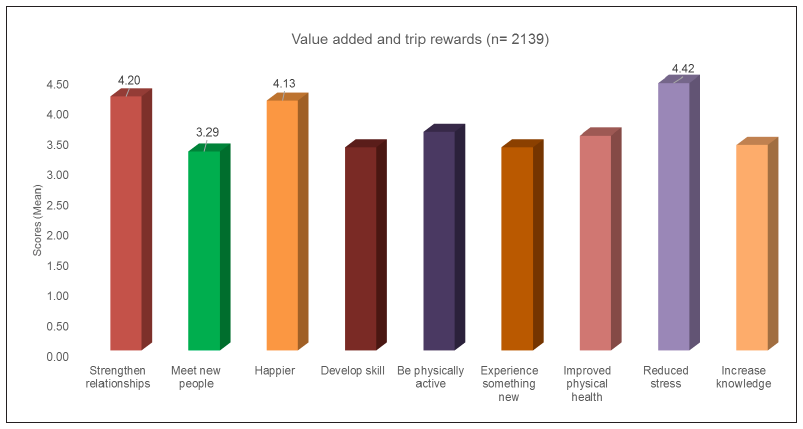
This result revealed that the daily trips to the parks had reduced their stress with a mean score, (M = 4.42); strengthened relationships with families and friends (M = 4.20) and happier (M = 4.13) (Figure 1). The mean score (M) gathered from the scale of 1 represented their degree of motivation using level of perception-5 point, where “1 = not at all important, to 5 = very important”. The park users felt meeting new people was the lowest value added during their daily trip. Even though majority of the park users were single, they were comfortable to have their own activities rather than socializing with others. The scenario might be linked to the general feeling of safety in urban parks and this attribute (i.e., being alone, previous crime experience) evoked the “fear of crime” actively participated in recreation activities such as jogging, walking and did other sports activities during their visitation to the urban parks. The respondents spent an average of two hours in their visitation to the urban parks.
that determined the defensive behaviour among the park users (Sreetheran & Van den Bosh, 2015).
5.2Value Added and Trip Rewards Among the Park User
5.3Perceptions on Quality of Visit 10
The park users rated their perceptions on the quality attributes of visits to public parks. The principal purpose of the question “how do you perceive the quality attributes about this park?” was to evaluate the strongest factor that influenced the park users’ choice in visiting the parks. This was particularly significant for those who had visited the park before. From the responses, nature and environment was highly (91%) rated satisfied and very satisfied with mean score, M = 4.11 on the 5-point scale (Table 3). The satisfaction score was highest for nature and environment, and this translated into a clear interpretation that people engaged with their nearby natural surrounding as a way to get closer with trees or presence of natural elements. Though the overall park design (M = 3.96), the conditions of the recreational facilities provided (M = 3.89), and information services (M = 3.26) were also cited. Users reported they were moderately satisfied with the service quality such as the signboard, interpretative signs and assistance services for people while visiting the park.
The other purpose was to evaluate the perceived attitudes of the park users (i.e. whether they considered it personal or environmental value). It was a crucial step that supported the quality of the space and aesthetic study or personal element from the users’ perspectives. Urban green space with higher preference for nature and environment Personal and Environment Factors Associated with Attraction to Tropical Urban Parks in Peninsular Malaysia: 49-64 57 generally contribute to a healthy conservation especially for protecting urban wildlife including the quality and variety of habitats, ornamental and native vegetation and better ecological design (Karuppannan et al., 2014). Comparable patterns have shown in Western country, such as England (Dallimer et al., 2014) that frequent users generally are more active and attracted to the physical activities offered. it has been showed that wide range of plant and animal species seems to be most valued in large parks with less frequent user’s (Berggren-Bärring and Grahn, 1995).
| Quality Dimensions of Visit | |||||||
|---|---|---|---|---|---|---|---|
| Very satisfied | |||||||
| Not satisfied | |||||||
| Not satisfied | |||||||
| Moderately | |||||||
| Satisfied | |||||||
| at all | |||||||
| Statement (s) | Mean | ||||||
| S.D | |||||||
| Percentage (%) | |||||||
| N = 2,139 | |||||||
| Nature and environment | 4.11 | 0.55 | 20 | 71 | 8 | 0 | 0 |
| Information services | 3.26 | 0.87 | 5 | 36 | 38 | 19 | 2 |
| Park design | 3.96 | 0.64 | 17 | 65 | 17 | 2 | 0 |
| Conditions of the recreational | 3.89 | 0.71 | 17 | 58 | 22 | 3 | 0 |
| facilities | |||||||
| Average mean (M) | 3.80 | ||||||
5.4Effects of Nature Motivations among Users at Different Parks
This section revealed the result of the level of motivations on nature dimensions. Four main dimensions of operational variables were applied to determine the effects of motivations between the six urban parks. These were recreation facilities (experience on safety, activities chosen and pursued by park user), peaceful surrounding (free from disturbance, tranquil), natural beauty of landscape (natural scenery, all living and non- living elements free to move and change) and the shadiness (include in term of full of shade) aspects that perceived among the park user. Two-way analysis of variance (ANOVA) was carried out to measure the difference between different parks and their motivation on nature attractiveness (Table 4).
Results on the comparison of the means of shadiness showed that it was an important factor for nature motivation. In the shadiness model, it explains 21% of the variance in total motivations, and this is statistically significant at α = 0.05. Kuantan Gelora Park and Penang Park users felt the most significant effect in the shadiness aspects (Table 4).
| Comparison of Means at 0.05 Probability Level | |||||||
|---|---|---|---|---|---|---|---|
| Dimension(s) | Penang | Mutiara | Taiping | Perdana | Kuantan | Shah Alam | CV b |
| Municipal | Rini | Lake | Botanical | Gelora | Lake Park | ||
| Park | Urban | Garden | Kuala | Park | |||
| Forestry | Park | Lumpur | |||||
| Park | Park | ||||||
| Recreation | 4.238 bc | 4.428 a | 4.279 b | 4.035 d | 3.930 e | 4.166 c | 13.75 |
| facilities and | |||||||
| activities 1 | |||||||
| Natural1 | 4.051 c | 4.271 a | 4.275 a | 4.161 b | 3.993 c | 4.009 c | 13.65 |
| Peacefulness 1 | 4.348 a | 4.264 ab | 4.332 a | 4.180 b | 4.018 c | 4.070 c | 13.24 |
| Shadiness 1 | 4.092 a Coefficient of Variation (%) | 3.599 c | 3.771 b Means followed by the same letter are not significantly different at the 5% level according to Duncan’s Multiple Range Test, post hoc test for specific differences between pairs of mean | 3.801 b | 3.370 d | 3.575 c | 21.29 |
| Confidence level : 0.95 | |||||||
Penang Park has a number of large trees and encouraged the passive engagement such as relaxing on the benches, picnic, chatting and reading books (M = 4.10). Despite of the attractiveness of natural landscapes and vegetation density, the Westerners were more concerned for the safety aspects rather than the density of vegetation (Bjerke et al., 2006), the density of trees and high level of vegetation cover could deter park visitors (Shanahan et al., 2015). Despite the potential for improved nature-based experiences and greater wellbeing benefits, other than non-tropical country; such as China (Zhang et al., 2014), United Kingdom (Laing et al., 2009; Jorgensen et al., 2002) and Norway (Bjerke et al., 2006), prefer moderately dense vegetation and considered densely spaced woody plants are less attractive.
However, Kuantan Gelora Park (M = 3.37) showed the lowest means among the parks users. They felt that the trees were not too shady, yet they preferred to have their meals in the park’s food court. Therefore, the common “shadiness” experienced by urban park users in Malaysia could be regarded as significantly different from Western and developed countries. This important element considered to be unique landscape among park user in tropical countries such as Malaysia, where preference is for shadiness by the natural elements (trees and vegetation cover) and built surroundings (small buildings and bench with cover roofs).
5.5Socio-demographic Characteristics and Motivations of Nature Attractions
The statistical analysis confirmed socio-demographic characteristics significantly influenced the motivation on nature attractions. Table 5 shows the results of multiple linear regressions for the relationship between the sociodemographic characteristics and the importance of nature attractions in urban parks. Ethnicity is positively associated with the overall dimensions of nature motivation and this association is statistically significant (p = 0.001) for all urban parks except Mutiara Rini Park (p = 0.01). Malays prefer visiting urban parks for seeking of nature attractions compared to non-Malays.
However, this finding might due to the small number of non-Malay respondents (N = 424) in this study, therefore there is need for further research that would examine a proportionate number of Malay and non-Malay respondents. Conversely, Mohamad Muslim et al., (2018) indicated that the physical condition of the parks might be more important determinant of visitor satisfaction than visitors’ ethnicity. Frequent park users comprised of multi-ethnic groups in the six selected urban parks. Multi-ethnic groups spend some of their leisure time in green areas (Peters et. al., 2010). Therefore, it is an important venue to offer the opportunity for high level of interaction between individual from different social and ethnic backgrounds (Lofland, 1998; Fainstein, 2005). A different pattern about the reasons of visiting parks from Abdul Aziz, Van den Bosch and Nilsson (2018) especially for Malaysians of Chinese descent in Kuala Lumpur and Kuching, Sarawak shows that they visited parks for restorative, social, educational and fitness motives which are different from these findings.
Household income has a small significant variation to predict the level of motivation for nature attractions (p = 0.05) for all urban parks users (Table 5). This shows that park users with higher income look forward to seeking nature attraction while visiting urban parks. In the urban context, households with high income also enjoy relaxing in the silent atmosphere of natural environments and step away from the hectic rhythm of the city. This contradicts the previous findings in China as they indicate that income level has no significant effect on urban green space perception (Jim and Shan, 2013).
In Mutiara and Shah Alam Park, the type of users, levels of engagement and the frequency of visits were others factors that should be put into considerations in future analysis. As a finding from the west indicated that women, elders, and lowly educated individuals made less green space use and adults living below the poverty line were three times less likely to be physically active than higher-income adults (Lindsey et al., 2001; Sherer, 2006).
| Nature Attractions in Selected Urban Park | ||||||
|---|---|---|---|---|---|---|
| Explanatory | Penang | Mutiara | Taiping | Perdana | Kuantan | Shah |
| variable | Municipal | Rini | Lake | Botanical | Gelora | Alam |
| (Coefficient | Park | Urban | Garden | Kuala | Park | Lake |
| value) | Forestry | Park | Lumpur | Park | ||
| Park | Park | |||||
| Gender | 0.003 | -0.088 | -0.057 | -0.030 | -0.045 | -0.031 |
| (Female)1 | ||||||
| Age | 0.005 | 0.004 | 0.005 | 0.008 | 0.007 | 0.007 |
| Ethnicity2 | 0.309** | 0.338** | 0.447*** | 0.439*** | 0.433*** | 0.409*** |
| Marital status3 | -0.004 | -0.174 | 0.037 | 0.009 | 0.032 | 0.036 |
| Household | 0.001* | 0.000 | 0.001* | 0.000* | 0.000* | 0.001* |
| income (RM) | coded as a dummy; 0= Male, 1= Female coded as a dummy; 0=non-Malay;1= Malay coded as a dummy; 0= Single, 1= Married | The level of significance is *p < 0.05, **p < 0.01, ***p < 0.001 | ||||
6.0Conclusion
The results of this study showed the importance of the nature attractions in urban parks. Urban residents always and positively seek for “nature” element in urban parks. Each urban park has small differences for its nature attractions. Peaceful surroundings and outdoor recreation activities in urban parks enrich urbanites psychological and social benefit (stress reduction, become happy and strengthen relationships), which positively reflect people’s well-being and quality of life. Notably, it fulfils the needs of open spaces increment in sustainable cities for transformation in social and public well-being.
Overall, park users were motivated with the shadiness element offered by the urban parks. Therefore, the common shadiness experienced by urban park users in Malaysia can be regarded as significantly different from Western and developed countries. This important element is considered to be unique landscape among park users in tropical countries such as Malaysia. The differences in socioeconomic backgrounds affected the level of motivations for nature in an urban park.
In the future, management plans by city planners and urban foresters should focus more on the application based on ecological perspective. Indeed, through preserving biodiversity, social as well as ecological advantages will be gained through the improvement of tree health as well as promoting aesthetic interest. It is recommended that well-managed urban environments help foster strong motivations for recreation and boost frequency of visits among users. Thus, park characteristics such as the physical conditions and park appearance are important elements in determining the motivation and in future park users’ satisfaction level. Policy makers and park managers should focus on the nature attributes in urban parks to meet the increasing demand and expectations of urbanites in the country, particularly among youths who comprise three quarters of urban park users.
Acknowledgements
We would like to thank the municipal parks; Kuala Lumpur City Hall, Shah Alam City Council, Municipal Council of Penang Island, Kuantan City Council, Taiping City Council, and Johor Bahru City Council for their kind collaboration and assistance. Appreciation goes to the trained enumerators for their teamwork and assistance during fieldwork and numerous anonymous individuals who participated in the survey from 2013 to 2014 period. Financial support was received from the Malaysian Government under Tenth Malaysian Plan (RMK10) budget (2010 – 2015 cycle).
References
- Abdullah, S. A. & Hezri, A. A. (2008): From forest landscape to agricultural landscape in the developing tropical country of Malaysia: Pattern, process, and their significance on policy. Environmental Management, 42(5), 907–917.
- Abdul Aziz, N. A., Van den Bosch, K. & Nillson, K. (2018). Recreational use of urban green space in Malaysian cities. International Journal of Business and Society, 19(S1). 1-16.
- Abdul Malek, N. and Mariapan, M. (2009). Visitors perception on vandalism and safety issues in a Malaysian urban park. Theoretical and Empirical Researchers in Urban Management, 4(13).
- Ayeni, D. A. (2012). Enhancing and developing sustainable tourism through landscaping in Nigeria. (Unpublished doctoral dissertation). De Montfort University, Leicester, United Kingdom.
- Ballouard, J. M., Brischoux, F., & Bonnet, X. (2011). Children prioritize virtual exotic biodiversity over local biodiversity. PLoS ONE, 6(8). http://doi.org/10.1371/ journal.pone.0023152.
- Berggren-Bärring, A.-M., Grahn, P. (1995). Grönstrukturens betydelse för användningen. Rapport 95:3. Sveriges Lant-bruksuniversitet, Alnarp (in Swedish).
- Bjerke T., Østdahl T., Thrane C., Strumse E. (2006). Vegetation density of urban parks and perceived appropriateness for recreation. Urban Forestry and Urban Greening, 5, 35–44.
- Chiesura, A. (2004). The role of urban parks for the sustainable city. Landscape and Urban Planning, 68,129-138.
- Cohen, P., Potchter, O., & Schnell, I. (2014). A methodological approach to the environmental quantitative assessment of urban parks. Applied Geography, 48, 87-101.
- Cornelis, J., & Hermy, M. (2004). Biodiversity relationships in urban and suburban parks in Flanders. Landscape and Urban Planning, 69(4), 385–401. doi:10.1016/j. landurbplan.2003.10.038.
- Dallimer M., Davies, Z. G., Irvine, K. N., Maltby, L. L., Warren, P. H., Gaston, K. J., & Armsworth P. R. (2014). What personal and environmental factors determine frequency of urban greenspace use? International Journal Environmental Research Public Health, 11, 7977–7992.
- Dwivedi, P., Rathore, C. S., & Dubey, Y. (2009). Ecological benefits of urban forestry: The case of Kerwa Forest Area (KFA), Bhopal, India. Applied Geography, 29(2), 194-200.
- Fainstein, S. S., (2005). Cities and diversity. Urban Affairs Review 41, 3-19.
- Fatin, M. R., Siti Sarah, A., L. Aniza, A. A., and Philips, L. E. (2013). A study on potential application and people awareness on green infrastructure for Boulevard: A case study of Putrajaya Boulevard. Seminar Proceeding, UMRAN 2013, International Islamic University Malaysia, Selangor.
- Flocks J, Escobedo F, Wade J, Varela S, Wald C (2011). Environmental justice implications of urban tree cover in Miami-dade County, Florida. Environ Justice 4, 125–134.
- Gobster P (2002). Managing urban parks for a racially and ethnically diverse clientele. Leis Sci 24, 143–159.
- Grimm, N. B., Foster, D., Groffman, P., Grove, J. M., Hopkinson, C, S., Nadelhoffer, K, J., Pataki, D, E., & Peters, PC, D. (2008). The changing landscape: Ecosystem responses to urbanization and pollution across climatic and societal gradients. Frontiers in Ecology and the Environment, 6(5), 264-272.
- Home R, Hunziker M, Bauer N. (2012). Psychosocial outcomes as motivations for visiting nearby urban green spaces. Leis Sci, 34(4), 350–365.
- Jim, C. Y., & Shan, X. (2013). Socioeconomic effect on perception of urban green spaces in Guangzhou, China. Cities, 31, 123–131. https://doi.org/10.1016/j. cities.2012.06.017.
- Jorgensen, A., Hitchmough, J., Calvert, T. (2002). Woodland spaces and edges: Their impact on perception of safety and preference. Landscape and Urban Planning, 60, 135–150.
- Kaplan, R. (2004). The social values of forests and trees in urbanized societies. In C. C. Konijnendijk, J. Schipperijn and K. H. Hoyer (Eds.). Forestry serving urbanised societies. Vienna, Austria: IUFRO World Series 14. 167-178.
- Karuppannan S, Baharuddin Z. M, Sivam A., Daniels C. B. (2014). Urban green space and urban biodiversity: Kuala Lumpur, Malaysia. Journal of Sustainable Development, 7(1), 1–16.
- Laing, R., Davies, A. M., Miller, D., Conniff, A., Scott, S., Morrice, J. (2009). The application of visual environmental economics in the study of public preference and urban green space. Environment and Planning, 36(2), 355–375.
- Lindsey, G., Maraj, M., & Kuan, S. (2001). Access, equity, and urban greenways: An exploratory investigation. Professional Geographer, 53(3), 332–346.
- Lofland, L. H., (1998). The Public Realm: Exploring the City’s Quintessential Social Territory. Aldine de Gruyter, New York.
- Lo, A. Y. H., & Jim, C. Y. (2012). Citizen attitude and expectation towards greenspace provision in compact urban milieu. Land Use Policy, 29(3), 577–586. doi:10.1016/j.landusepol.2011.09.011.
- Matsuoka, R. H., & Kaplan, R. (2008). People needs in the urban landscape: Analysis of landscape and urban planning contributions. Landscape and Urban Planning, 84(1), 7-19.
- Mohamad Muslim H. F., Yahya N. A., Numata S., Hosaka T. (2018). Ethnic Differences in Satisfaction with the Attractiveness of Tropical Urban Parks. McLellan B. (eds) Sustainable Future for Human Security. Springer, Singapore. Pp 147-159. ISBN 978-981-10-5432-7. DOI 10.1007/978-981-10-5433-4_10.
- Noralizawati, M., and Noriah, O. (2010). Push and pull factor: Determining the visitors’ satisfactions at urban recreational area. Journal of Environment-Behaviour Studies, 78-84.
- Oguz, D., 2000. User surveys of Ankara’s urban parks. Landscape Urban Plan, 152, 165–171. O¨zgüner H. (2011). Cultural Differences in Attitudes towards Urban Parks and Green Spaces. Landsc Res, 36(5):599–620. O¨zgüner, H., Kendle, A. D. (2006). Public attitudes towards naturalistic versus designed landscapes in the city of Sheffield (UK), Landscape and Urban Planning 7, 139–157.
- Peters K., Elands B., Buijs A. (2010). Social interactions in urban parks: Stimulating social cohesion? Urban Forestry & Urban Greening, 9, 93–100.
- Real, E., Arce, C., Sabucedo, J. M. (2000). Classification of landscapes using quantitative and categorical data, and prediction of their scenic beauty in north-western Spain. Journal of Environmental Psychology 20, 355–373.
- Salina, M. A and Abdul Hadi, N. (2006). Factors that influence users’ satisfaction on urban parks. Built Environment Journal, 3(2). ISSN 1675-5022.
- Shan, X.-Z. (2014). The socio-demographic and spatial dynamics of green space use in Guangzhou, China. Applied Geography, 51, 26–34. doi:10.1016/j. apgeog.2014.03.006.
- Shanahan, D. F., Lin, B. B., Gaston, K. J., Bush, R., Fuller, R. A. (2015). What is the role of trees and remnant vegetation in attracting people to urban parks? Landscape Ecology, 30, 153–165.
- Sherer, P. M. (2006). The benefits of parks: Why America needs more city parks and open space. San Francisco, CA: The Trust for Public Land.
- Sreetheran, M. and Van den Bosh, C. K. (2015): Fear of crime in urban parks: What the residents of Kuala Lumpur have to say?: Urban Forestry and Urban Greening, 14, 702–713.
- Vagias, Wade M. (2006). Likert-type scale response anchors. Clemson International Institute for Tourism & Research Development, Department of Parks, Recreation and Tourism Management. Clemson University.
- Weber, D & Anderson, D. H. (2010). Contact with nature: Recreation experience preferences in Australian parks. Annals of Leisure Research, 13(1), 46-69.
- Yaakob, U. Masron, T. and Masami, F. (2010): Ninety years of urbanization in Malaysia : A geographical investigation of its trends and characteristics. Journal of Ritsumeikan Social Sciences and Humanities 4(3), 79–101.
- Yamane, T. (1967). Elementary sampling theory. p 886. Prentice-Hall.
- Yuen, B. (1996). Use and experience of neighborhood parks in Singapore. Journal of Leisure Research, 28(4). 293-311.
- Zengel, R. & Turkseven Dogrusoy, I. (2014). The importance of sociocultural habits in park design, leisure behaviour and user satisfaction. A Comparative Study on Two Parks in İzmir, Turkey. Journal of Settlements and Spatial Planning, 5(2). 107-117.
- Zhang, H., Chen, B., Sun Z., Bao, Z. (2014). Landscape perception and recreation needs in urban green space in Fuyang, Hangzhou, China. Urban Forestry & Urban Greening, 12, 44–52.